By Louis ‘Barok‘ C. Biraogo — August 1, 2025
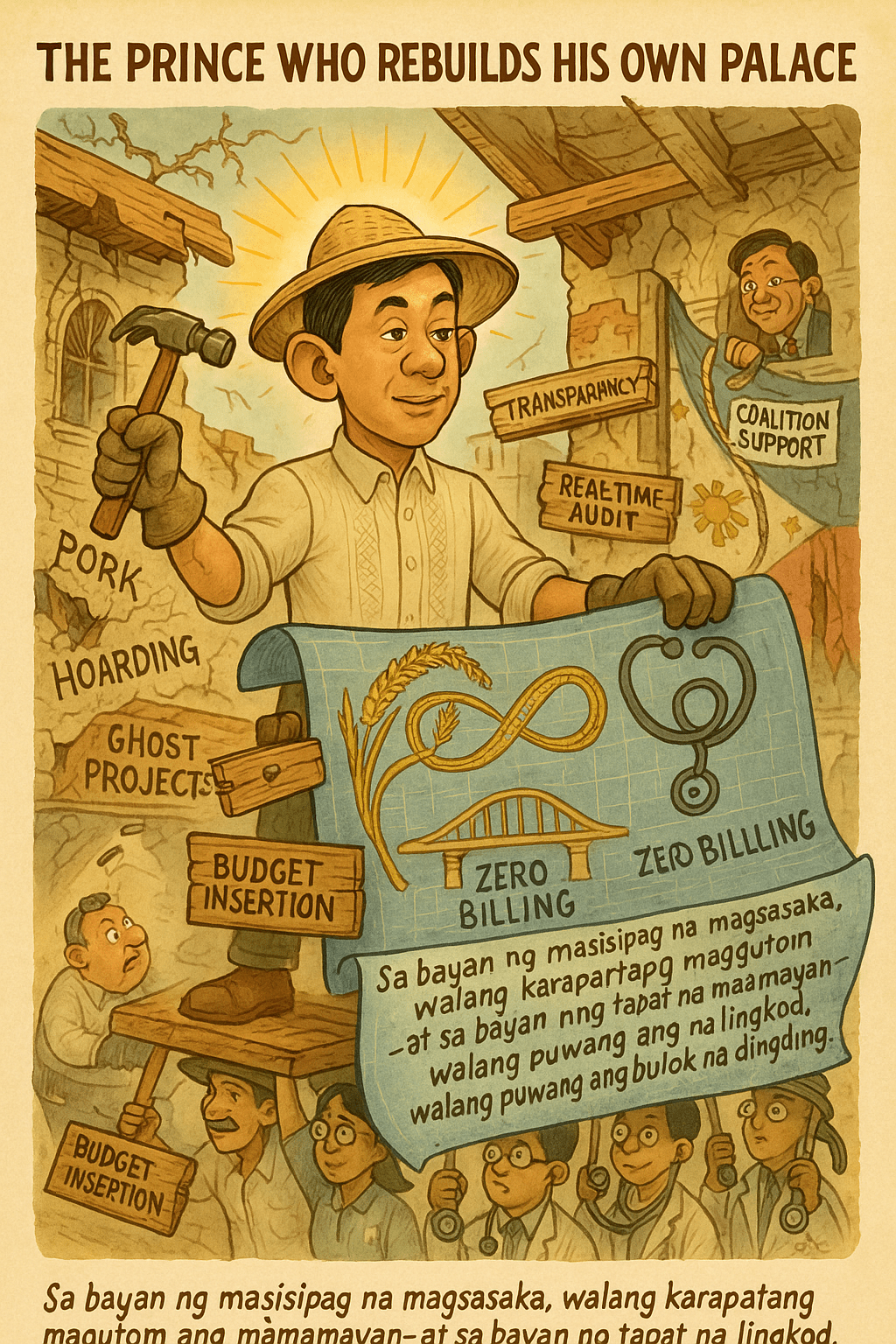
IN THE blistering humidity of a July afternoon in Quezon City, the Speaker of the Philippine House of Representatives stood not in the shadow of dynasty but in the light of duty. With no pomp and little preamble, Ferdinand Martin Romualdez began what may come to be remembered as a turning point in his nation’s legislative history. “This House must not be a refuge of privilege,” he declared. “It must be the pillar of the everyday Filipino.” In a country long bruised by promises unmet and institutions undermined, this was not rhetoric—it was rebellion.
Romualdez is no outsider. He is, after all, a cousin to the President and scion of one of the Philippines’ most enduring political families. But in this speech, he did not sound like a traditional power broker. He sounded like a man trying to redeem a broken system from within. And in doing so, he may have placed himself—quietly but firmly—on the frontline of democratic renewal.
Rice, Hunger, and the Politics of the Plate
Romualdez’s proposal for the Rice Industry and Consumer Empowerment (RICE) Act is more than a policy—it’s a gamble against the deep-seated dysfunctions of Philippine agriculture. It promises not just affordable rice, but also dignity for farmers long trapped between typhoons and middlemen. By targeting smuggling, hoarding, and price manipulation, the RICE Act seeks to dislodge the informal monopolies that have long distorted the food market.
The ambition is considerable. Critics will point, fairly, to past reforms like the 2019 Rice Tariffication Law, which faltered amid poor enforcement and failed safety nets. But Romualdez adds a new layer: infrastructure. He envisions a modernization campaign—from irrigation to logistics—that moves beyond subsidies and tackles the structural gaps that keep farming unprofitable and food insecure.
Most notably, his institutionalization of the Walang Gutom Program through monthly electronic food credits marks a sharp break from traditional welfare models. This is not just a handout—it’s a pivot to data-driven, tech-enabled social protection. The implementation, of course, will be the crucible. Ensuring that food credits reach the most vulnerable without falling prey to corruption or digital exclusion will require not just good policy but ferocious political will.
Still, the moral clarity of the message resounds: “Sa bayan ng masisipag na magsasaka, walang karapatang magutom ang mamamayan.” In a land of hardworking farmers, hunger should have no dominion.
The Price of Health, and the Promise of Dignity
Perhaps the boldest promise Romualdez made was on healthcare: zero billing in government hospitals. This is the kind of pledge that invites derision from technocrats and inspires hope in the slums. And Romualdez knows the stakes. “No family should be torn apart by the cost of saving a life,” he said—and in that line lies a truth most Filipinos know too well.
Can the government afford it? Not easily. PhilHealth, the country’s health insurance backbone, already teeters on a deficit. Universal zero billing would require upward of ₱250 billion annually—a fiscal Everest, especially with a national budget under strain. Yet, what sets Romualdez apart is his grasp of the political mechanics. He hints at revenue earmarks, potentially through sin taxes, and more efficient procurement. It’s not a complete fiscal roadmap, but it’s a start—and more importantly, a commitment.
What differentiates this initiative from past attempts, like the Universal Health Care Law, is the emphasis on rural deployment and facility modernization. Romualdez acknowledges the implementation bottlenecks: the shortage of health professionals, the inaccessibility of remote clinics, the political inertia. His solution? Decentralized investment, targeted incentives, and a renewed contract between state and citizen. He doesn’t pretend the obstacles don’t exist; he challenges his institution to rise above them.
Making the Budget a Moral Document
If the RICE Act and zero billing are about compassion, Romualdez’s budget transparency initiative is about credibility. And it’s here that he seems most intent on reclaiming the moral authority of Congress. “We are not here to cover up. We are here to clean up,” he said—an unusually confrontational line for a man at the apex of power.
Opening bicameral budget conferences to civil society observers may sound procedural, but in a system infamous for pork barrel scandals and insertions cloaked in discretion, it’s revolutionary. Enabling watchdog participation and promising real-time televised budget deliberations are moves that could, if fulfilled, redraw the boundaries of accountability.
Skeptics will scoff. They will say that the very Speaker promising to root out “ghost projects” presides over the same chamber accused of inserting them. But perhaps this is the paradox of real reform: it sometimes requires those within the castle to dismantle its drawbridges.
Romualdez’s pledge to legislate real-time project reporting and national infrastructure audits goes beyond symbolism. It forces transparency into the bloodstream of governance. And if successful, it may offer an answer to that gnawing question in Philippine democracy: Can public institutions ever earn back the people’s trust?
A Reformist’s SWOT: What Romualdez Faces
Romualdez is not naïve. He operates in a system beset by contradictions—where idealism often meets inertia, and where reformers are eaten alive by the machinery they try to fix. But he is a master tactician. His strength lies in institutional savvy, coalition-building, and a surprising receptivity to civil society pressure. Unlike previous House leaders who barricaded themselves with allies, Romualdez is betting on transparency as a source of political capital.
He has a rare opportunity: public exhaustion with corruption is at a fever pitch, and faith in traditional politics is so low that even incremental honesty can feel like revolution. Add to that the structural reforms proposed by President Marcos, and Romualdez finds himself uniquely positioned to ride a wave of coordinated legislative-executive momentum.
The challenges, however, are formidable. Funding constraints could sink flagship proposals. Resistance from entrenched interest groups—rice cartels, pork beneficiaries, inefficient LGUs—will be fierce. And Romualdez himself faces lingering suspicion over his family ties and political motives.
But the biggest risk? That the boldness of his agenda collapses under the weight of an indifferent bureaucracy or a fatigued electorate. Reform is not won by speeches; it is earned in implementation.
Learning from the World: Global Playbooks, Local Action
Romualdez’s vision doesn’t exist in a vacuum. His zero-billing healthcare plan echoes Thailand’s Universal Coverage Scheme, which began modestly and expanded through sin taxes and strong political will. Thailand taught the world that universal health access need not wait for prosperity; it can create it.
Likewise, his transparency proposals channel South Korea’s open budget initiatives, which democratized fiscal oversight through public portals and legislative transparency. Korea succeeded because it institutionalized citizen participation and enforced real-time scrutiny—not just in law, but in practice.
Romualdez has borrowed these lessons wisely. What’s more, he brings a unique advantage: a political coalition large enough to push through reform, yet broad enough to demand accountability. That’s a balance few leaders achieve.
The Verdict: A Reformer Worth Betting On
It’s easy to be cynical. The Philippines has seen its share of reformist speeches drowned in the swamp of self-interest. But Ferdinand Martin Romualdez is not merely gesturing toward reform—he is putting political capital on the line for it. His legislative agenda is ambitious but not fantastical, empathetic yet grounded in institutional realism.
What makes him the right leader for this moment is not that he’s perfect, but that he’s purposeful. In a time of political entropy, he is choosing engagement over avoidance, reform over ritual.
If he fails, it will not be because he lacked vision. It will be because the system chose comfort over change. But if he succeeds—even partially—he may well redefine what it means to be Speaker in a country hungry not just for rice, but for dignity, truth, and justice.
And perhaps that, more than any law he will pass, will be his lasting legacy.

- ₱75 Million Heist: Cops Gone Full Bandit

- ₱6.7-Trillion Temptation: The Great Pork Zombie Revival and the “Collegial” Vote-Buying Circus

- ₱1.9 Billion for 382 Units and a Rooftop Pool: Poverty Solved, Next Problem Please

- ₱1.35 Trillion for Education: Bigger Budget, Same Old Thieves’ Banquet

- ₱1 Billion Congressional Seat? Sorry, Sold Out Na Raw — Si Bello Raw Ang Hindi Bumili

- “We Will Take Care of It”: Bersamin’s P52-Billion Love Letter to Corruption

- “Skewed Narrative”? More Like Skewered Taxpayers!

- “Scared to Sign Vouchers” Is Now Official GDP Policy – Welcome to the Philippines’ Permanent Paralysis Economy
- “Robbed by Restitution?” Curlee Discaya’s Tears Over Returning What He Never Earned

- “No Pressure” Luistro? The House Pork Bazaar Exposed
- “My Brother the President Is a Junkie”: A Marcos Family Reunion Special

- “Mapipilitan Akong Gawing Zero”: The Day Senator Rodante Marcoleta Confessed to Perjury on National Television and Thought We’d Clap for the Creativity


 KWEBA ni BAROK
Leave a comment