By Louis ‘Barok‘ C. Biraogo — July 30, 2025
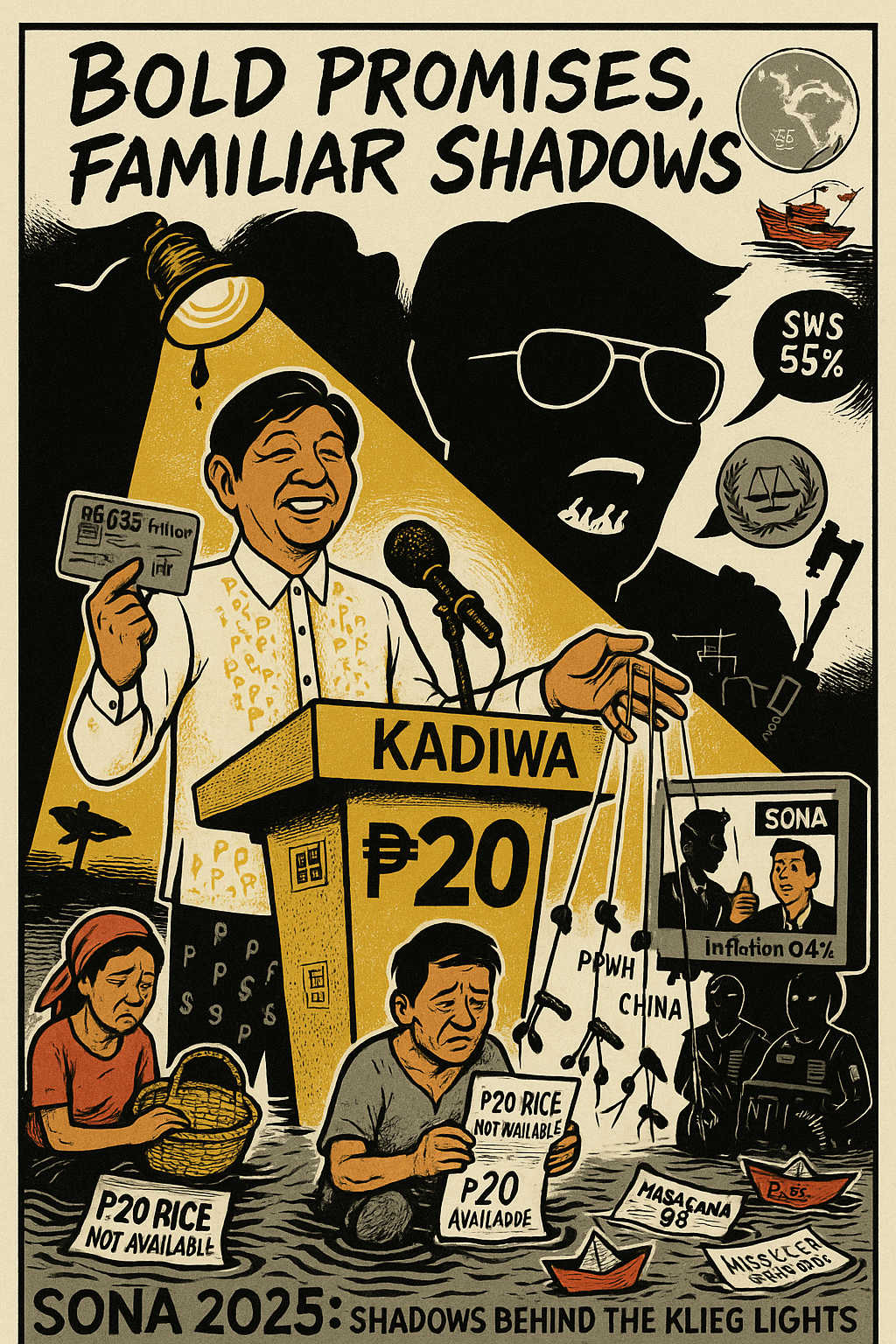
IN THE grand halls of the Batasang Pambansa, President Ferdinand Marcos Jr. delivered his fourth State of the Nation Address (SONA) on July 28, 2025, with the polish of a leader eager to redefine his family’s legacy. He spoke of accountability, affordable rice, and a nation rising above its challenges. Yet, for Maria, a coconut farmer in Quezon province scraping by on less than PHP 300 a day, his words ring hollow against the weight of history. Her family, like millions, lives under the shadow of the Marcos name—a name tied to ambition but tainted by corruption and human rights abuses.
As Marcos Jr. touted economic gains and infrastructure triumphs, the specter of his father’s regime loomed large. This critique dissects the SONA’s rhetoric, weighing its populist appeal against the stark realities of poverty, corruption, and unaddressed controversies.
The Illusion of Progress
Marcos Jr.’s speech painted an optimistic economic picture. He championed the P20-per-kilo rice program through KADIWA stores as a fulfilled campaign promise, claiming it supports 8.5 million farmers and fishermen (Rappler, 2025). He highlighted “negative inflation” of -0.4% for the poorest households in June 2025 and a PHP 6.33 trillion budget to drive growth.
Yet, these claims clash with the reality faced by Filipinos like Maria. A Social Weather Stations (SWS) survey shows 55% of Filipinos—15.5 million families—still consider themselves poor, the highest rate in 2025. In Mindanao, where poverty reaches 70% (Philippine Statistics Authority, 2025), the disconnect is glaring.
The P20 rice program, while populist, raises concerns. Supporters argue it alleviates food insecurity, improving nutrition and stabilizing markets for low-income families. But peasant groups like Kilusang Magbubukid ng Pilipinas call it an electoral ploy, timed suspiciously before the 2025 midterms (Rappler, 2025). Its reliance on imports and subsidies risks unsustainability, reminiscent of Marcos Sr.’s Masagana 99, which collapsed by 1980, leaving farmers in debt (Philstar, 2020).
Current palay prices (P16-P19/kg for wet, P19-P23/kg for dry) are deemed fair (GMA News, 2025), but Maria reports middlemen forcing sales below production costs. Globally, India’s rice subsidies distort markets without agrarian reform—a gap Marcos Jr. barely addressed.
The broader economic narrative falters under scrutiny. Marcos claimed stability, but SWS data suggests gains are Manila-centric, bypassing Mindanao. The “negative inflation” masks stagnant wages and underemployment. For the 60% of Filipinos reliant on agriculture, the lack of land reform undermines the SONA’s promises. Marcos’ vision risks being a mirage for the millions trapped in poverty.
Corruption as a Recurring Villain
Marcos Jr.’s pledge to combat corruption was central, particularly his call to audit flood control projects after typhoons exposed “failed and imaginary” infrastructure (Rappler, 2025). He ordered the Department of Public Works and Highways (DPWH) to publish a three-year project list, vowing to prosecute corrupt officials. This resonates with Juan, a Bulacan fisherman whose home was flooded due to shoddy floodwalls. His family now languishes in a cramped evacuation center, their livelihood eroded by floods and graft.
The anti-corruption rhetoric responds to public frustration, but irony abounds. The Marcos family’s legacy—billions in ill-gotten wealth (Presidential Commission on Good Government, 2025)—casts doubt on Marcos Jr.’s resolve to dismantle a system his family shaped. His transparency call is promising, but without naming culprits or clear mechanisms, it feels performative. The 2013 pork barrel scandal showed how pledges fade without oversight.
The PHP 6.33 trillion budget, with allocations for projects like the 32-km Bataan-Cavite Interlink Bridge, invites scrutiny. Without checks, these could become new patronage avenues. Globally, Indonesia’s anti-graft body (KPK) reduced infrastructure corruption through independent audits (World Bank, 2022). Marcos’ failure to propose similar reforms questions his commitment.
For the poor, corruption is a betrayal, diverting funds from floodwalls and schools. Juan’s plight shows: every stolen peso leaves families vulnerable to the next storm.
The Silence That Speaks Volumes
Marcos’ SONA was as notable for its omissions as its content. His boast of drug-related arrests rivaling Duterte’s era sidestepped the International Criminal Court’s (ICC) probe into over 20,000 deaths in Duterte’s drug war, many from poor communities (Human Rights Watch, 2023). His silence on the ICC and continuation of punitive drug policies signal a refusal to confront this dark legacy. For urban slum families, targeted by police, this perpetuates fear and violence.
Equally striking was the absence of any mention of China’s aggression in the West Philippine Sea. Despite escalating incursions threatening fishermen’s livelihoods, Marcos chose diplomatic ambiguity, emphasizing a “friend to all, enemy to none” stance (Rappler, 2025). For Zambales fishermen, facing harassment from Chinese vessels, this silence is abandonment. Their dwindling catch, vital for survival, gets no relief.
Marcos also sidestepped the growing debate over online gambling and U.S. tariffs, despite their economic and social toll (BusinessWorld, 2025). Just days before the SONA, he warned that e-gaming destroys families through addiction, yet he offered no stance on proposed bans or regulations, leaving operators like DigiPlus in limbo and families vulnerable to unregulated platforms. Similarly, the 19% U.S. tariff on Philippine exports, threatening PHP 6 billion in lost revenue, was ignored despite its impact on jobs in export industries, where the poor rely heavily. Critics argue this omission reflects a lack of urgency on issues hitting marginalized workers hardest (BusinessWorld, 2025).
The speech ignored Vice President Sara Duterte’s absence and impeachment threats, highlighting political fractures. By avoiding these tensions and Supreme Court rulings, Marcos undermines constitutional checks, leaving the poor exposed to elite power struggles and eroding trust in institutions.
Building a Philippines for All
Marcos’ SONA offered hope—KADIWA stores, free college for 2 million students, and expanded PhilHealth coverage—but systemic flaws demand bolder action. Recommendations include:
- Independent Infrastructure Oversight: Create an autonomous anti-corruption body, like Indonesia’s KPK, to audit projects. Public dashboards would empower Juan to hold officials accountable.
- Agrarian Reform for Rice Subsidies: Pair P20 rice with land redistribution and cooperatives. Maria’s struggle underscores the need for fair pricing to counter middlemen. Vietnam’s rice model shows sustainability through local production (FAO, 2020).
- Human Rights Accountability: Engage the ICC to probe drug war abuses, breaking from Duterte’s legacy. Community rehabilitation would better serve the poor.
- Protect West Philippine Sea Fishermen: Deploy naval patrols and subsidies for coastal communities. A firm China stance would boost livelihoods.
- Address Regional Disparities: Prioritize Mindanao’s 70% poverty rate with targeted education and health programs. Decentralized BUCAS centers and classrooms must reach remote areas.
Marcos’ SONA 2025 was a populist masterclass, but its promises falter without tackling deep-seated issues. For Maria and Juan, the gap between rhetoric and reality is a daily struggle. Corruption, dynastic politics, and silence on human rights and foreign policy betray the poor. Marcos Jr. can break from his family’s past, but only with bold action. The poor deserve more than promises—they deserve a future free from history’s shadows.
Key Citations
- Presidential Communications Office (PCO). (2025). Transcript of President Ferdinand Marcos Jr.’s 2025 SONA.
- Rappler. (2025). Full Text of Marcos’ SONA 2025.
- Rappler. (2025). Is Marcos Jr. Close to Fulfilling Rice Promise?
- GMA News, 2025: Marcos: Palay prices won’t go down further
- Philippine News Agency. (2023). PBBM Bullish on P20/kg Rice.
- Philstar. (2020). Masagana 99 ‘Success’ All in Imee’s Head.
- Wikipedia. (2025). Masagana 99.
- Social Weather Stations (SWS). (2025). Self-Rated Poverty Survey.
- Philippine Statistics Authority (PSA). (2025). Poverty Statistics.
- Presidential Commission on Good Government (PCGG). (2025). Marcos Ill-Gotten Wealth.
- Rappler. (2013). Pork Barrel Scandal.
- World Bank. (2022). Indonesia’s Anti-Corruption Efforts (PDF).
- International Criminal Court (ICC). (2025). Philippines Drug War Investigation.
- Human Rights Watch. (2024). Philippines: New ‘Drug War’ Declared in Davao City .
- BusinessWorld, 2025: Marcos skips e-gaming, tariffs in SONA
- FAO. (2020). Vietnam’s Rice Cooperative Model.

- “Forthwith” to Farce: How the Senate is Killing Impeachment—And Why Enrile’s Right (Even If You Can’t Trust Him)
- “HINDI AKO NAG-RESIGN!”

- “I’m calling you from my new Globe SIM. Send load!”

- “Mahiya Naman Kayo!” Marcos’ Anti-Corruption Vow Faces a Flood of Doubt

- “Meow, I’m calling you from my new Globe SIM!”

- “No Special Jail for Crooks!” Boying Remulla Slams VIP Perks for Flood Scammers
- “PLUNDER IS OVERRATED”? TRY AGAIN — IT’S A CALCULATED KILL SHOT

- “Several Lifetimes,” Said Fajardo — Translation: “I’m Not Spending Even One More Day on This Circus”
- “Shimenet”: The Term That Broke the Internet and the Budget
- “We Did Not Yield”: Marcos’s Stand and the Soul of Filipino Sovereignty

- “We Gather Light to Scatter”: A Tribute to Edgardo Bautista Espiritu

- $150M for Kaufman to Spin a Sinking Narrative



 KWEBA ni BAROK
Leave a comment