By Louis ‘Barok‘ C. Biraogo — August 4, 2025
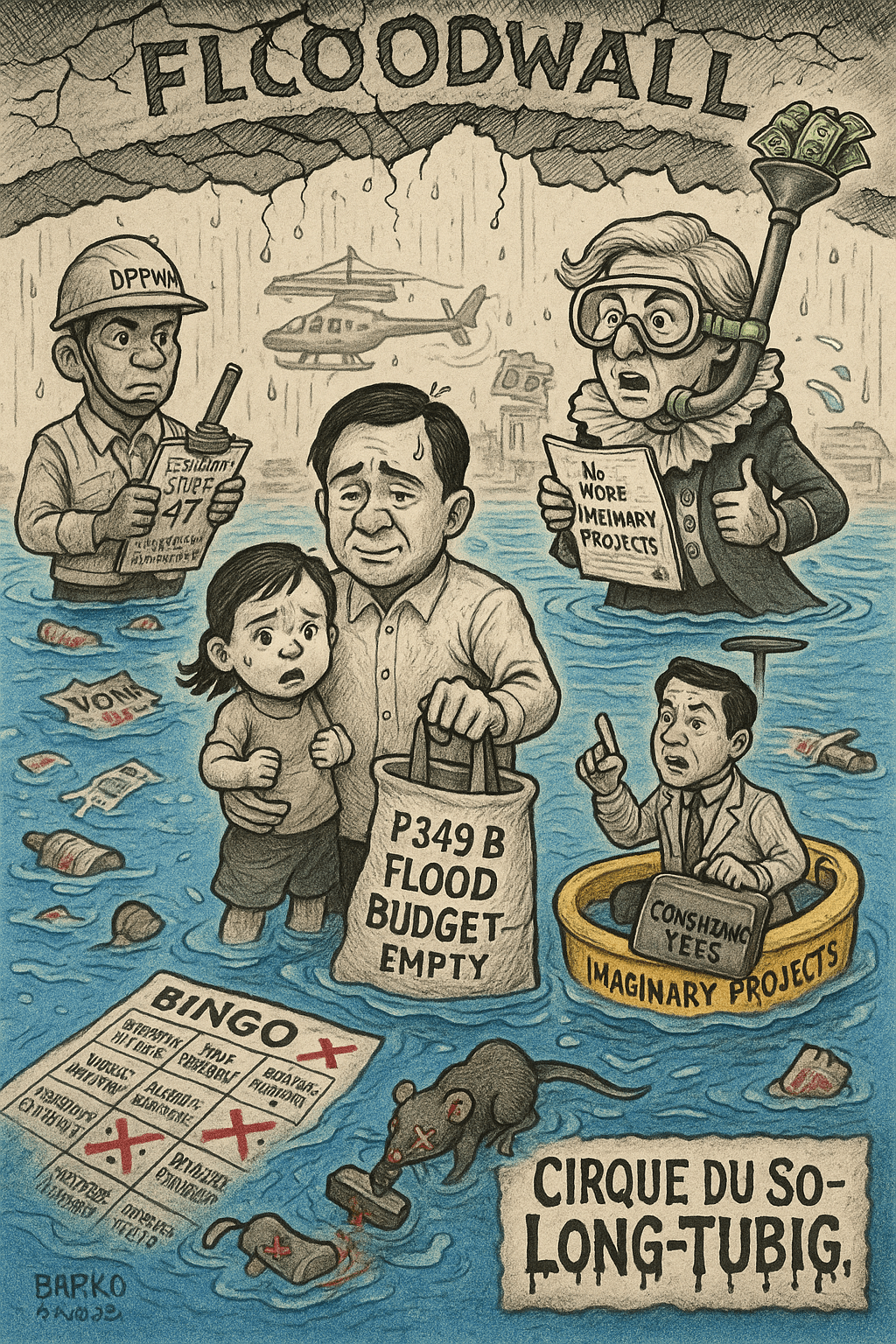
FILIPINOS are paddling through waist-deep floodwaters in inflatable kiddie pools, while their leaders ride out monsoons in Land Cruisers with engine snorkels—government-issued, of course. In Manila, flood season now doubles as boat season. I met a mother near Araneta Avenue last week who held her toddler in one arm and an empty rice sack in the other.
“Para saan pa ‘yung proyekto nila?” she asked me, while plastic bottles bobbed beside her feet.
I didn’t have the heart to tell her that ₱349 billion had already been spent this year on flood control.
This is the theater of the absurd. It’s Cirque du Sobrang Tubig, headlined this monsoon by Budget Secretary Amenah Pangandaman and her dramatic cry:
“No more imaginary projects!”
Cue the applause. But let’s hold the curtain—because what she’s condemning isn’t fiction. It’s far worse: the real and ruinous kind of incompetence that’s been funded, audited, and immortalized in cement.
Act I: Pangandaman vs. the Phantom Menace (of Her Own Making)
Let’s dissect this. Secretary Pangandaman’s July 2025 speech—her Hamlet moment—where she denounced “ghost projects” as villains draining the nation’s coffers.
Noble? Sure. But who exactly wrote the budget script?
Oh, right. She did.
The Commission on Audit (COA) has already released the spoiler: ₱131 billion in unfinished infrastructure projects. And yet Pangandaman’s Department of Budget and Management (DBM) was the one greenlighting them.
This is the bureaucratic equivalent of a firefighter setting the blaze, then holding a press conference on fire prevention.
According to COA’s 2023 reports, only 450 out of 905 flood mitigation structures were completed. That’s not imaginary—that’s criminal negligence with a cement mixer.
Her rhetoric rests on a false binary: projects are either visible or ghosts. But the real scandal lies in the swampy middle—the zombie projects: half-built, poorly engineered, permanently delayed. They exist just long enough to justify budget insertions and campaign posters, then quietly erode in the next typhoon.
Her agency’s performance metric? Something about “felt impact.”
If that’s the standard, then every drenched commuter in Quezon City should count as a success story.
Act II: Concrete Promises and Collapsed Trust
President Ferdinand Marcos Jr., never one to miss a pageant of performative indignation, offered his own soundbite:
“Mahiya naman kayo!”
He wagged his fingers at unnamed officials—as if he hadn’t just vetoed ₱16.7 billion in flood control items his own office approved just months earlier.
Meanwhile, the 2012 World Bank-funded master plan—a $1.2 billion roadmap to flood resilience—sits untouched. Instead, we fund new “feasibility studies.” Why fix floods when you can study them for a fee?
To quote a DPWH insider (anonymity preserved to avoid drowning in paperwork):
“Each ‘study’ is a career’s worth of free meals and per diems.”
COA’s audits read like gothic horror:
- The Pasig-Marikina River Channel Improvement Project shows “negative slippage”—a term that translates roughly to “we dug a hole and forgot why.”
- Drainage projects from the Aquino era remain “ongoing.”
- In Pampanga, ₱170 million was spent on flood walls that collapsed within weeks.
Someone should tell DPWH that “permanent flood control” doesn’t mean permanently constructing it.
Act III: The Cost of Incompetence (and Climate)
Then came Super Typhoon Carina:
- ₱4.7 billion in damages,
- 7 million Filipinos affected,
- Entire economies drowned in weeks.
For perspective, that’s nearly the entire budget of the Department of Social Welfare and Development (DSWD)—a department that had its emergency funds slashed.
Because when you’re underwater, naturally the first thing to cut is life vests.
It’s the poor who pay most dearly: relocated from waterways to nowhere, promised “resilient housing” that now doubles as aquariums. While Pangandaman talks about fiscal discipline, programs like AKAP and MAIP—lifelines for displaced families—are labeled “pork.”
Irony alert:
Flood budgets become pork. Anti-pork rhetoric becomes political pork. It’s the ouroboros of hypocrisy, now with more algae.
One slum-dweller told me during the habagat surge:
“When they say flood control, they mean controlling the funds, not the water.”
He gestured to a concrete wall stamped with a congressman’s face. Behind it, the river had simply rerouted.
Barok’s Corruption Bingo
Let’s play along with the bureaucracy. Here’s your corruption decoder:
| Bureaucratic Euphemism | Translation |
|---|---|
| Idle projects | Embezzlement sabbatical |
| Negative slippage | We lost the blueprints |
| Felt impact | Nobody died this week |
| Budget realignment | The money’s somewhere in Cavite |
| Consultancy phase | Champagne with a PowerPoint |
| Unified masterplan | A sequel to the unfinished draft |
| Audit pending | Pray COA gets distracted |
What to Do After the Water Rises and the Lies Settle
Let’s drop the pageantry and do something that actually works:
1. Geotag or GTFO
Build a public, GPS-tagged dashboard of all flood projects with real-time updates, drone photos, and budget tracking. If Waze can track potholes, the government can track flood walls.
2. Prosecute, Don’t Posture
COA already named officials involved in anomalous spending. Freeze their assets. File disallowance cases. Handcuff the contractors who took the cash and poured sand.
3. Nature, Not Just Concrete
The Asian Development Bank offered $500 million in support for nature-based flood protection. Reforest uplands. Reclaim wetlands. And ban concrete on riverbanks unless it’s to jail corrupt engineers.
Curtain Call: Pangandaman’s Snorkel
Next monsoon, instead of another workshop at a Tagaytay hotel, let’s gift Secretary Pangandaman a snorkel.
It’s cheaper, more useful, and—unlike her department’s performance—actually waterproof.
Because in the Philippines, the only thing more predictable than the rain… is the flood of excuses.
Key Citations
- Inquirer, 2025: Budget chief: No more ‘imaginary,’ ‘idle’ flood control projects
- Pangandaman on “Imaginary Projects” (DBM Press Release, July 2025)
- COA 2023 Audit Reports – DPWH Flood Projects
- PhilStar, 2024: DPWH flagged for delayed projects worth P215.9 billion
- PhilStar, 2025: COA, not DPWH, should audit flood control projects
- Marcos Jr.’s Veto of ₱16.7B in Flood Projects (Official Gazette, July 2025)
- GMA News, 2024: Marcos removes P16.7B worth of flood control projects in 2025 budget
- Inquirer, 2024: Pampanga River slope protection segment collapses; 10 families evacuated
- Asian Development Bank. (2025, January 29). $500 million ADB loan to bolster Philippines’ disaster resilience. [News Release]
- House Opposition to Cuts in DSWD Funds (PhilStar, July 2025)
- MSN, 2024: DSWD responds to potential cuts in 2025 budget

- ₱75 Million Heist: Cops Gone Full Bandit

- ₱6.7-Trillion Temptation: The Great Pork Zombie Revival and the “Collegial” Vote-Buying Circus

- ₱1.9 Billion for 382 Units and a Rooftop Pool: Poverty Solved, Next Problem Please

- ₱1.35 Trillion for Education: Bigger Budget, Same Old Thieves’ Banquet

- ₱1 Billion Congressional Seat? Sorry, Sold Out Na Raw — Si Bello Raw Ang Hindi Bumili

- “We Will Take Care of It”: Bersamin’s P52-Billion Love Letter to Corruption

- “Skewed Narrative”? More Like Skewered Taxpayers!

- “Scared to Sign Vouchers” Is Now Official GDP Policy – Welcome to the Philippines’ Permanent Paralysis Economy

- “Robbed by Restitution?” Curlee Discaya’s Tears Over Returning What He Never Earned

- “My Brother the President Is a Junkie”: A Marcos Family Reunion Special

- “Mapipilitan Akong Gawing Zero”: The Day Senator Rodante Marcoleta Confessed to Perjury on National Television and Thought We’d Clap for the Creativity

- “Just Following Orders” Is Dead: How the Hague Just Turned Tokhang’s Finest Into International Fugitives





 KWEBA ni BAROK
Leave a comment