By Louis ‘Barok’ C Biraogo — August 4, 2025
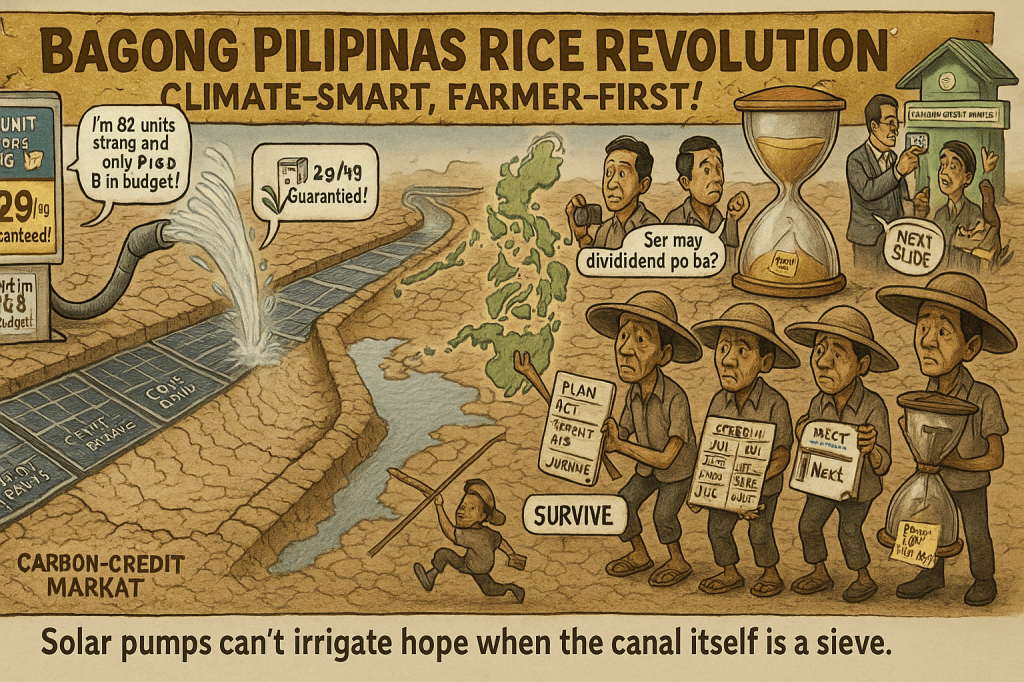
THE National Irrigation Administration (NIA) in the Philippines has rolled out a glittering pageant of promises—contract farming, climate-smart irrigation, and AI-driven dreams to “future-proof” rice farming. Administrator Eduardo Guillen’s vision is a bureaucratic fairy tale: farmers empowered, rice at P29/kg for the poor, and solar pumps humming with eco-friendly glory. But beneath the Bagong Pilipinas fanfare lies a grim reality of crumbling canals, exploited small farmers, and a revolution that’s more mirage than miracle. With sardonic glee, let’s dissect this high-tech charade where the only thing “climate-smart” is the NIA’s ability to dodge accountability.
The Shiny Brochure: Promises That Sparkle Like Fool’s Gold
The NIA’s pitch is a masterwork of optimism. The Alternate Wetting and Drying (AWD) technique, pioneered by the International Rice Research Institute, slashes water use by 30%, strengthens rice roots, and dangles carbon credits for lower methane emissions. Solar-powered irrigation systems, with 333 units built at P1.517 billion, replace diesel pumps that once cost farmers P40,000–P80,000 per hectare. The “double dry cropping” schedule—planting in October, harvesting in February, then again in March for July—dodges typhoons and boosts yields with sunlight. Over 300 cooperatives and 200 rice processing centers promise farmers a slice of milling and distribution profits. It’s a vision of empowerment, sustainability, and food security. Too bad the fine print reads like a tragicomedy.
The Cracked Foundation: Where Promises Meet Potholes
Guillen’s mantra, “Hindi dapat magtapos sa pagbenta ng palay,” envisions farmers as agri-entrepreneurs, reaping dividends from cooperatives. But the reality is less Forbes and more Kafka. Contract farming’s “guaranteed prices” (P21–P25/kg, with 20% at P29/kg for buffer stocks) come with chains: forced fertilizer purchases, stricter quality standards, and transport costs that gut profits. A 2014 study by Roehl Briones found contract farming boosted tobacco farmer profitability but favored medium to large farmers, with small farmers crippled by transport costs and poor infrastructure. “Pole vaulting”—farmers selling to higher bidders—thrives because the system punishes the vulnerable, risking penalties or contract termination.
Carbon credits? A cruel jest. The complexity of carbon markets is a maze for small farmers, many of whom lack the literacy or resources to navigate it. The NIA’s “empowerment” feels like a PowerPoint slide pitched to donors, not farmers. Meanwhile, the FAO warns that contract farming risks exploitation—delayed payments, loan default penalties, and companies ditching unprofitable deals. It’s neoliberalism dressed in farmer’s overalls: privatize the labor, socialize the risk.
The Farcical Flood: High-Tech Hopes Sinking in Mud
Picture this: a solar-powered pump, gleaming with AI-driven weather forecasts, feeding a canal that leaks 60% of its water. The NIA’s infrastructure is a monument to absurdity—61% of canals are unlined, and many of the 39% lined are crumbling, per a 2015 NIA report. Downstream farmers beg for water while upstream overuse fuels disputes (F-value 6.473, critical value 4.067 at 0.05 level). The NIA’s repair response? A lackluster 3.29 satisfaction score, with delays blamed on “appropriations procedures” (NIA overview).
The double dry cropping schedule is another bureaucratic fantasy. Older farmers (ages 81–90, 51–60) barely comply, with younger ones slightly better (F-value 3.687, 2.502, critical value 2.456 at 0.05 level), per a study on cropping compliance. Why? Survival trumps schedules—farmers plant when they can afford to, not when Excel says so. And then there’s Bukidnon’s PHP15 million irrigation rebid debacle, part of 161 stalled projects flagged by the Commission on Audit in February 2025, with 75 others worth P5.06 billion languishing. The COA’s verdict? Rescind contracts, seize bonds, sue the negligent. Farmers, meanwhile, watch their fields dry and their hopes wither.
The Great PR Mirage: P29/kg Rice vs. a Bureaucratic Black Hole
The NIA’s Bagong Bayaning Magsasaka rice at P29/kg for seniors, PWDs, and 4Ps beneficiaries is sold as a lifeline for the poor. But in Mountain Province, a pilot program delivered just 500 bags—a teaspoon of relief in a sea of poverty where 20% of Filipinos scrape by below the line. The NIA boasts 1.14 million kilos sold, but who ensures it reaches the needy? Not the LGUs, stretched thin and tasked with sustaining reforms while the NIA’s canals collapse. It’s like asking a tightrope walker to juggle while the rope frays.
Guillen’s cooperative dream—farmers profiting from milling and distribution—is undercut by their lack of control over processing facilities. Dividends? More myth than money. The NIA’s call for LGUs to fund warehouses with National Tax Allotments is a cruel dodge, shifting blame to underfunded local governments while the NIA’s own P77 million contract farming fund remains opaque.
The Casualties: Farmers, Poor, and Planet Left High and Dry
- Farmers: Small farmers are squeezed by contract farming’s hidden burdens—forced inputs, delayed payments, and transport costs—while larger farmers thrive. Cooperatives sound empowering, but without transparency or milling control, they’re a hollow promise.
- The Poor: P29/kg rice is a PR stunt when distribution is a trickle. Inefficiencies could drive market prices higher, hitting the poor hardest.
- The Environment: AWD and solar pumps are green on paper, but dilapidated canals waste water, sabotaging sustainability. Carbon credits remain a pipe dream for farmers without the means to claim them.
The Puppet Masters: Power Plays in a Crumbling System
The NIA’s reliance on LGUs to sustain reforms while its own infrastructure rots is peak absurdity. Guillen’s vision of farmers capturing the value chain ignores their powerlessness against contractors and middlemen. The push for Public-Private Partnerships (PPPs)—50 projects with seven revenue streams like hydropower and carbon credits—reeks of privatization by stealth. Who audits the P77 million contract farming fund? Not the farmers, who are too busy dodging water disputes and praying for a harvest.
Draining the Swamp: A Plan to Save NIA’s Drowning Dreams
- Patch the Leaky Bucket: Line the 61% unlined canals and repair the 39% crumbling ones before flaunting AI-powered pumps (NIA infrastructure report).
- Farmer-Led Oversight: Let farmers audit the P77 million contract farming fund. If cooperatives are the future, give farmers the keys, not just the rhetoric.
- Demystify Carbon Credits: Simplify carbon markets for small farmers with clear, accessible guides—Tagalog, not technobabble.
- Fair Contracts, Not Shackles: Cap input costs, guarantee timely payments, and ban punitive penalties in contract farming agreements.
- Fund LGUs, Don’t Flinch: Directly support LGUs for warehouses and cooperatives, rather than dumping the burden on their overstretched budgets.
The Final Harvest: Fix the Canals, Not Just the Headlines
The NIA’s rice revolution is a tale of two harvests: one for the press releases, another for the farmers and poor left grasping at straws. Dear NIA: Your solar pumps and AI apps are cute, but they’re useless if 60% of the water never reaches the fields. Empower farmers with real control, not just cooperative letterheads. Ensure the P29/kg rice reaches the hungry, not just the headlines. Until then, your climate-smart vision is a high-tech mirage, evaporating in the heat of your own neglect.
Key Citations
- GMA News: NIA Pushes Contract Farming, Climate-Smart Irrigation – Overview of NIA’s programs and Guillen’s claims.
- PIDS: Contract Farming: Boon or Bane? – Briones’ study on contract farming’s inequities.
- FAO: Contract Farming Risks – Warnings on exploitative terms in contract farming.
- NIA: Infrastructure Overview – Data on canal conditions and service delays.
- PNA: NIA’s P29/kg Rice Program – Details on limited distribution.
- PNA, 2024: NIA launches sale of P29/kg. rice through contract growing program
- PNA, 2024: NIA: Farmers must capture value added in palay via contract farming
- COA: 2025 Audit Report – Bukidnon rebid and stalled projects.
- IRRI: Alternate Wetting and Drying – Technical details on AWD.
- Journal of Agricultural Science and Technology: Cropping Compliance – Farmer adherence to cropping schedules.
- NIA: Solar Irrigation Projects – Costs and scale of solar pumps.

- “Forthwith” to Farce: How the Senate is Killing Impeachment—And Why Enrile’s Right (Even If You Can’t Trust Him)
- “HINDI AKO NAG-RESIGN!”

- “I’m calling you from my new Globe SIM. Send load!”

- “Mahiya Naman Kayo!” Marcos’ Anti-Corruption Vow Faces a Flood of Doubt

- “Meow, I’m calling you from my new Globe SIM!”

- “No Special Jail for Crooks!” Boying Remulla Slams VIP Perks for Flood Scammers

- “PLUNDER IS OVERRATED”? TRY AGAIN — IT’S A CALCULATED KILL SHOT

- “Several Lifetimes,” Said Fajardo — Translation: “I’m Not Spending Even One More Day on This Circus”

- “Shimenet”: The Term That Broke the Internet and the Budget

- “We Did Not Yield”: Marcos’s Stand and the Soul of Filipino Sovereignty

- “We Gather Light to Scatter”: A Tribute to Edgardo Bautista Espiritu

- $150M for Kaufman to Spin a Sinking Narrative






 KWEBA ni BAROK
Leave a comment