By Louis ‘Barok‘ C Biraogo — August 5, 2025
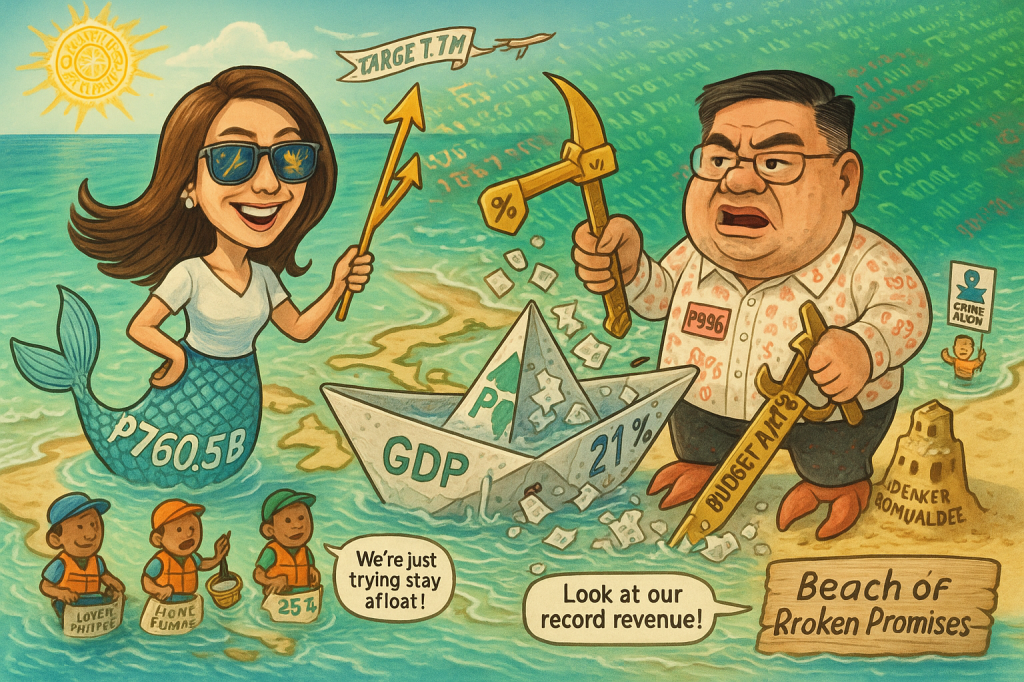
IN THE Philippines, where turquoise waters and vibrant festivals draw millions, a storm brews not on the beaches but in the halls of power. The clash between Tingog Party-list Rep. Jude Acidre and Tourism Secretary Christina Garcia-Frasco threatens to unravel a tourism success story—₱760.5 billion in revenue and 6.75 million jobs in 2024—shadowed by missed targets, audit red flags, and whispers of political vendettas.
For ordinary Filipinos—Boracay vendors, Manila jeepney drivers, Palawan fishers—this isn’t just bureaucratic sparring. It’s about livelihoods tied to an industry powering 8.9% of GDP, with projections soaring to 21% in 2025. But what if the Department of Tourism’s (DOT) glittering numbers are a house of cards, as Acidre suggests? Or is Frasco right that Congress’s budget axe is crippling a vital economic engine?
The Core Controversy: Accountability vs. Achievement
The stakes are immense for the 6.75 million Filipinos whose families rely on tourism. Acidre points to a deafening silence in President Ferdinand Marcos Jr.’s 2024 State of the Nation Address (Sona), which omitted tourism entirely—a snub he interprets as a verdict on DOT’s underperformance [Inquirer, 2024].
He cites Commission on Audit (COA) findings: in 2022, DOT obligated only 65.32% of its budget, leaving ₱396.346 million in unpaid obligations and ₱483.812 million in unliquidated funds, flagged for “lack of documentation” [Inquirer, 2023]. These figures suggest systemic inefficiencies that could erode public trust and justify budget cuts, like the slashing of DOT’s promotional funds from ₱1.2 billion in 2023 to ₱100 million in 2025.
Frasco counters with dazzling achievements: tourism generated ₱760.5 billion in 2024, a 126.75% recovery from pre-pandemic levels, employing 6.75 million and contributing 8.9% to GDP [PIA, 2025]. She blames Congress’s 83% budget cut in 2024 for hampering DOT’s ability to compete with Thailand (35.5 million visitors) and Malaysia (25 million), while the Philippines managed 5.95 million arrivals [Inquirer, 2024].
Yet, political subtext looms large. Frasco alleges Acidre’s attacks stem from her husband, Cebu Rep. Duke Frasco, declaring independence after abstaining from a House Speakership vote for Ferdinand Martin Romualdez. Acidre, a Romualdez ally, dismisses this as deflection, insisting his critique is about governance.
Is this accountability or political theater? The truth lies in a murky middle. Acidre’s COA-backed critique is fact-based, but its timing—post-Duke’s defection—raises eyebrows. Frasco’s economic claims are robust, yet her sidestepping of audit issues fuels skepticism. For Filipinos, the question is whether this feud will choke an industry that’s a lifeline for millions.
Data-Driven Duel: Triumphs and Troubles
The numbers paint a tale of two realities:
Economic Wins:
- Revenue: ₱760.5 billion in 2024, a 126.75% recovery from 2019; January 2025 exceeded USD 1 billion (₱65 billion) [DOT, 2024].
- Jobs: 6.75 million employed in 2024, contributing 8.9% to GDP, with a projected 21% in 2025 [WTTC, 2025].
- Domestic Surge: 103% of 2019 domestic tourism levels in Q1 2025 [Tribune, 2025].
Cracks in the Facade:
- Visitor Shortfalls: 5.95 million arrivals in 2024 vs. a 7.7 million target; a 0.82% decline in January-April 2025 [Tribune, 2025].
- Korean Tourist Drop: 18% decline in early 2025 due to safety concerns like crime [Esquire, 2025].
- COA Red Flags: ₱483.812 million unliquidated funds, ₱396.346 million unpaid obligations in 2022 [Inquirer, 2023].
Killer Question: How can DOT tout economic wins while missing targets and facing COA scrutiny? Tourism’s macroeconomic impact, driven by global demand and private sector dynamism, masks agency-specific lapses. Frasco’s narrative leans on industry-wide gains, but COA’s findings expose bureaucratic stumbles that invite Acidre’s skepticism.
Accountability and Transparency Audit
Frasco’s Blind Spots
Why hasn’t DOT publicly addressed COA’s ₱483.812 million in unliquidated funds or ₱396.346 million in unpaid obligations? These aren’t clerical errors—they signal mismanagement that could undermine future budgets [Inquirer, 2023]. Frasco’s focus on “record revenue” feels like deflection, sidestepping questions about bureaucratic inefficiencies.
The 2023 “Love the Philippines” campaign, marred by stock footage from other countries, further dents her execution credibility [PIA 2025]. While she highlights a proposed ₱3.5 billion 2026 budget, including ₱500 million for promotions, her silence on COA reforms risks perceptions of evasion.
Acidre’s Credibility
Acidre’s push for transparency is grounded, citing COA’s findings and missed targets like the 7.7 million visitor goal [Inquirer, 2024]. His critique of “poorly planned” Tourism Rest Areas in low-traffic zones is incisive. Yet, he risks cherry-picking data, downplaying tourism’s 8.9% GDP contribution and 6.75 million jobs. His ties to Romualdez and the timing of his attacks—post-Duke’s defection—suggest political motives may taint his oversight. Acidre’s credibility hinges on separating legitimate critique from partisan games.
Implications for the Philippines
Economic Dominoes
Tourism’s projected 21% GDP contribution in 2025 could falter if budget cuts and infighting persist [WTTC, 2025]. The promotional budget’s drop to ₱100 million in 2025—compared to Thailand’s multimillion-dollar campaigns—limits global competitiveness, risking stagnation in hospitality, transport, and small businesses [Inquirer, 2024].
Social Fallout
The 6.75 million tourism workers face vulnerability if arrivals stagnate. The 18% drop in Korean tourists due to crime fears threatens communities reliant on foreign visitors, from tricycle drivers to souvenir shops [Esquire, 2025]. A Palawan vendor’s words haunt: “Tourists mean food on my table. If they stop coming, we’re back to scraping by.”
Global Reputation
The Philippines’ “recovery story” shines with ₱760.5 billion in revenue, but governance controversies and COA red flags could deter investors and tourists, tarnishing its image as a stable destination [PIA 2025]. Political mudslinging risks eroding public trust, leaving citizens caught between progress and exposed cracks.
Reclaiming Tourism’s Promise
This is no time for false binaries—tourism is neither a miracle nor a mess, but a sector demanding accountability and ambition. For lasting progress:
For DOT (Frasco):
- Address COA Head-On: Publish a detailed response to 2022 audit findings, outlining reforms to liquidate funds and improve documentation [Inquirer, 2023].
- Transparent KPIs: Report visitor arrivals, revenue per tourist, and budget utilization monthly on DOT’s website.
- Depoliticize Budget Talks: Focus on data-driven justifications for 2026, avoiding personal defenses.
For Congress (Acidre):
- Prioritize Oversight: Use COA findings to drive reform, not fuel partisan feuds [Inquirer, 2024].
- Balance Critique: Acknowledge tourism’s economic role while pressing for efficiency.
For Filipinos:
Demand accountability and recognize tourism’s power. Write to representatives, attend budget hearings, and amplify tourism-dependent voices. Reject narratives pitting jobs against governance—both matter.
This dispute isn’t just about Frasco or Acidre; it’s about whether the Philippines can harness its tourism potential without stumbling over politics. The world watches, as do 6.75 million families.
Key Citations
- Inquirer (2024): “Acidre to Frasco: Justify DOT Performance During Budget Deliberations.”
- Inquirer (2023): “COA Disallows P6.1M in DOT Expenses.”
- Inquirer (2025): “Acidre: Absence of Tourism in Sona Means DOT Is Underperforming.”
- PIA (2025): “PHL Hits Record-High Tourism Revenue in 2024.”
- Tribune (2025): “Tourism Recovery Stalls as Philippines Draws 1.65M Tourists in Q1.”
- WTTC (2025): “Philippines Travel & Tourism Sector Set to Inject a Record PHP 5.9tn to the Economy 2025.”
- Esquire (2025): “Tourist Arrivals in the Philippines Slow Down This 2025.”
- PNA (2023): “DOT Addresses ‘Love the Philippines’ Campaign Controversy.”
- PNA (2025): “DOT Eyes Tourism Investments for 2026.”
- PSA (2025): “Philippine Tourism Statistics 2024.”

- ₱75 Million Heist: Cops Gone Full Bandit

- ₱6.7-Trillion Temptation: The Great Pork Zombie Revival and the “Collegial” Vote-Buying Circus

- ₱1.9 Billion for 382 Units and a Rooftop Pool: Poverty Solved, Next Problem Please

- ₱1.35 Trillion for Education: Bigger Budget, Same Old Thieves’ Banquet
- ₱1 Billion Congressional Seat? Sorry, Sold Out Na Raw — Si Bello Raw Ang Hindi Bumili

- “We Will Take Care of It”: Bersamin’s P52-Billion Love Letter to Corruption

- “Skewed Narrative”? More Like Skewered Taxpayers!

- “Scared to Sign Vouchers” Is Now Official GDP Policy – Welcome to the Philippines’ Permanent Paralysis Economy
- “Robbed by Restitution?” Curlee Discaya’s Tears Over Returning What He Never Earned
- “My Brother the President Is a Junkie”: A Marcos Family Reunion Special

- “Mapipilitan Akong Gawing Zero”: The Day Senator Rodante Marcoleta Confessed to Perjury on National Television and Thought We’d Clap for the Creativity

- “Just Following Orders” Is Dead: How the Hague Just Turned Tokhang’s Finest Into International Fugitives




 KWEBA ni BAROK
Leave a comment