By Louis ‘Barok‘ C. Biraogo — August 9, 2025
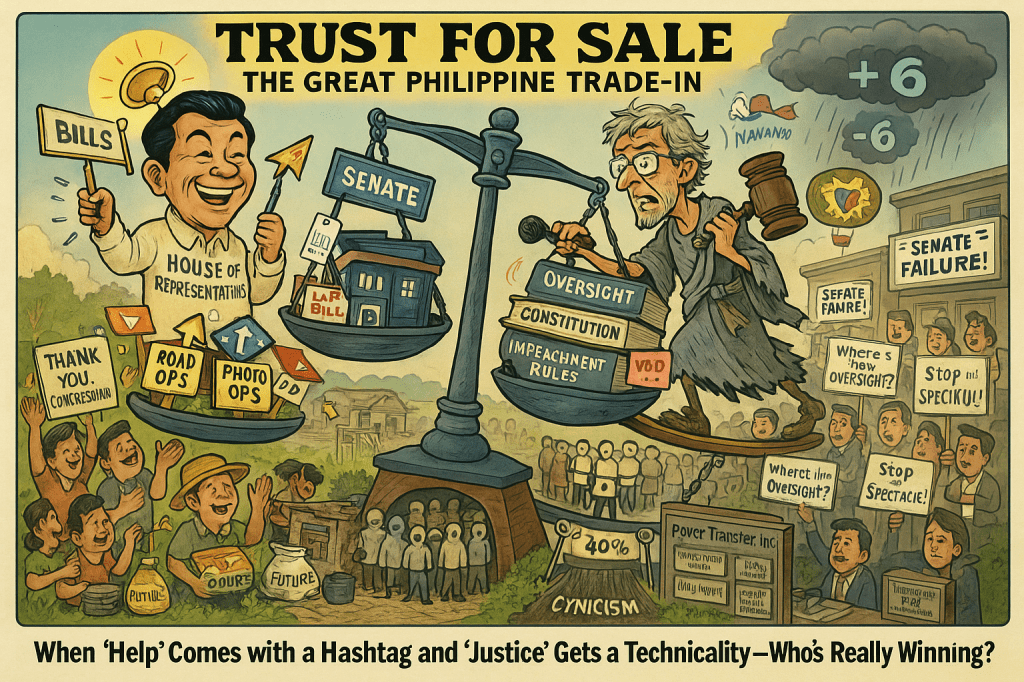
THERE is a photograph I keep seeing in my mind: a sari-sari store in Davao where an exhausted farmer counts the last of his cash to buy fertilizer; a college dorm in Manila where a student activist scrolls the news feed and stops, not with hope, but with the slow, dull ache of betrayal. These are not dramatic scenes of riots or slogans. They are the small, private reckonings that follow when institutions meant to protect the public good start acting like rival PR machines. And the latest poll — the House of Representatives now trusted by 57% of Filipinos while the Senate falls to 49% — is the clearest sign yet that something in the heart of Philippine representative democracy is fraying.
What’s really happening is not merely a popularity contest. It is a re-arrangement of power, conducted with smiling press releases and package deals that look, from the outside, like helpful governance and, from the inside, like a carefully engineered transfer of influence. The House has not been loved by accident; its recent climb is the product of an aggressive, locally targeted mix of lawmaking that reads well on billboards, cash-payout optics on the ground, and a disciplined message machine that converts speed into legitimacy. The Senate’s backslide was not only political ineptitude — it was a collapse of the halo that once insulated an institution whose brand was deliberation and oversight.
The hidden forces at work
If you ask why trust in the House rose eight points while the Senate dropped six, the answer lies in strategy more than substance. The House has become a daily deliverer of visible wins — wage-increase headlines, high-reach pressers, and community distributions — a politics of immediacy that reads as help to those who need it. The Senate, by contrast, has let its worst moments drown out its work: procedural delays, walkouts, and high-profile missteps around the handling of Vice President Sara Duterte’s impeachment dented its image of competence and conscience. The Supreme Court’s July ruling that voided that impeachment complaint — a legal rebuke that effectively barred proceedings until next year — crystallized public confusion about whether the Senate was dithering or playing politics.
Which brings us to motive. Is this institutional collapse — or a calculated power grab? There is room for both answers. The House’s surge smells of a deliberate, well-oiled campaign: pass the bills people can show the camera, push help to provincial strongholds, and flood local social feeds with grateful beneficiaries. When politics becomes distribution plus narrative, trust becomes a commodity that can be manufactured. Meanwhile, the Senate’s traditional role as a check on power has been hollowed by its own spectacle: impeachment drama that played badly on social media, leadership that failed to control the optics, and a public left wondering whether the chamber’s deliberations were about justice or careers.
The human cost — not abstract, but immediate
The numbers are cold; the consequences are not. For a Mindanao cacao farmer whose harvest was hit by storms, a House that promises an “ayuda” and a barangay road repair feels like life support. For a small-business owner in Quezon City, a Senate probe that stalls reform feels like the final straw as prices rise. For the student activist who once believed the Senate was the place for principled resistance, the impeachment saga has been disillusionment made public.
These are not isolated anecdotes. The sharp 13-point drop in Senate trust in Mindanao is not merely statistical noise — it is the echo of regional loyalty, the Duterte dynastic pull, and the perception that the Senate bungled the one prosecution that mattered to the South. When institutions fail to adjudicate disputes fairly and visibly, people turn to what delivers: local bosses, populist leaders, or pragmatic bargains. Trust is transferred, and with it the levers of accountability.
Forensic dissection of the big controversies
The Duterte impeachment debacle. Was the Senate cowardly, incompetent, or tactical? The procedural record reads like all three. Four months to form an impeachment court, then delays, then a Supreme Court order that nullified the proceedings on constitutional grounds — this is not the film of a chamber brimming with confidence. Some senators defended their caution after the Court’s decision; others were plainly outmaneuvered by the speed and framing of House action and the legal technicality that blew the case apart. The public judged the outcome less on legal nuance than on spectacle: justice deferred looked like justice denied.
Class warfare or patronage? The paradox in the poll — the poorest Filipinos still trust both chambers more (63–66%) while middle- and upper-class trust the Senate far less (33%) — is instructive. The poor live by transactions: a cash aid, a road, a local program. The House gives transactional politics with immediate currency. The middle and upper classes, who pay closer attention to institutional norms and long-term rulemaking, see the Senate’s drift and recoil. Is it populism when the poor favor visible benefits? Yes. Is it patronage? Also yes. The political system now rewards short-term, visible interventions while the messy, long-term labor of rulemaking — the Senate’s historic specialty — grows less valued in the public square.
Regional fractures. Mindanao’s 13-point drop in Senate trust is a map of political identity. The Duterte name still commands loyalty there; the Senate’s limp handling of her impeachment felt like a betrayal to many voters in the region. Luzon’s lower confidence reflects its different media diet: cable talk, elite commentary, and a class that expects procedural rigor. The net effect: a Congress that no longer feels like a single national institution but two chambers speaking to carved-out electorates.
Is the data trustworthy — or hiding the quiet majority?
We must interrogate the numbers. OCTA’s July survey (1,200 respondents, ±3%) is methodologically credible, but polling can misread ambivalence. Forty percent “undecided” for Senate trust is not calm — it’s a latent cohort. These undecideds are a reservoir of silent dissent, of citizens who will not endorse spectacle but also will not actively resist a House that brings bread today. Sampling frames, question phrasing, and nonresponse biases could skew class and regional splits; social desirability bias may overstate “trust” when respondents conflate personal benefit with institutional approval. In short: the undecideds are a powder keg. Handle with care.
What comes next — bleak forecasts that demand clear eyes
Power shifts. If the House translates trust into control of the legislative calendar, expect Congress to tilt toward speed over scrutiny. Legislation with big-photo wins but little oversight will proliferate. Budget insertions and local pork will follow the political currents, and a Senate weakened in the court of public opinion will struggle to act as a meaningful brake.
Democracy at risk. A diminished Senate removes an institutional counterweight to both the executive and the House majority. When checks are weakened by public disaffection or by their own missteps, the temptation to centralize power grows — not always by overt coup, but by the accumulation of “legal” advantages and the erosion of norms. The Supreme Court’s technical nullification of the Duterte impeachment, while legally defensible, also risks becoming a precedent for legalism that protects powerful actors from political accountability.
2028 elections. These numbers can birth two trends: a populist wave that rewards quick relief and dynastic brands, or a technocratic backlash from elites and reformers alarmed by institutional erosion. Both are dangerous in different ways — one promises more immediate clientelism, the other risks political alienation that drives protest and instability.
When outrage must become action
There is one way out: a civic shock therapy composed of transparency, relentless local reporting, and public pressure for procedural reform. Civil society must stop treating polls as ephemeral and start treating them as early-warning systems. Media should stop glazing over “deliverables” visuals and instead follow the money: who benefits from “ayuda” distributions and whose names are on the contracts? Voters must demand that the Senate reclaim its identity not by theatrical investigations but by visible, accountable oversight — public calendars, live, searchable disclosure of senators’ attendance, gifts, and financial interests, and a commitment to fast-tracked but fair procedures when the Republic’s highest offices are on trial.
If you want an image to hold in your mind as you decide what to demand, picture this composite: a mother in Tarlac who received a small cash transfer months ago — she’s grateful, yes — but her child’s school roof is still leaking because the provincial project was “inserted” and never built. That gap, between immediate relief and structural public goods, is where corruption and cynicism germinate. It is where power consolidates quietly, through gratitude for small favors and inattention to systemic decay.
We are at a moral crossroads. If the Senate collapses into spectacle and the House into patronage, the consequence will not be only political math; it will be a continued hollowing out of the public realm where ordinary Filipinos look for recourse. The remedy is not poetic: it is civic vigilance, investigative journalism that follows both the cash and the contract, and voters who treat elections as the start of accountability, not its end.
Let the undecideds be heard. Let civil society stop asking whether the House or the Senate is more trusted and start demanding whether either is truly worthy of that trust. If Filipinos do not insist on institutions that can withstand the temptations of speed and spectacle, then the next poll will be a eulogy rather than a warning.
Key Sources:
- PhilStar, 2025: Senate trust falters as House bounces back with majority — survey
- Duterte v. House (G.R. 278353, 2025)

- ₱75 Million Heist: Cops Gone Full Bandit

- ₱6.7-Trillion Temptation: The Great Pork Zombie Revival and the “Collegial” Vote-Buying Circus

- ₱1.9 Billion for 382 Units and a Rooftop Pool: Poverty Solved, Next Problem Please

- ₱1.35 Trillion for Education: Bigger Budget, Same Old Thieves’ Banquet

- ₱1 Billion Congressional Seat? Sorry, Sold Out Na Raw — Si Bello Raw Ang Hindi Bumili

- “We Will Take Care of It”: Bersamin’s P52-Billion Love Letter to Corruption

- “Skewed Narrative”? More Like Skewered Taxpayers!

- “Scared to Sign Vouchers” Is Now Official GDP Policy – Welcome to the Philippines’ Permanent Paralysis Economy

- “Robbed by Restitution?” Curlee Discaya’s Tears Over Returning What He Never Earned

- “No Pressure” Luistro? The House Pork Bazaar Exposed
- “My Brother the President Is a Junkie”: A Marcos Family Reunion Special

- “Mapipilitan Akong Gawing Zero”: The Day Senator Rodante Marcoleta Confessed to Perjury on National Television and Thought We’d Clap for the Creativity



 KWEBA ni BAROK
Leave a comment