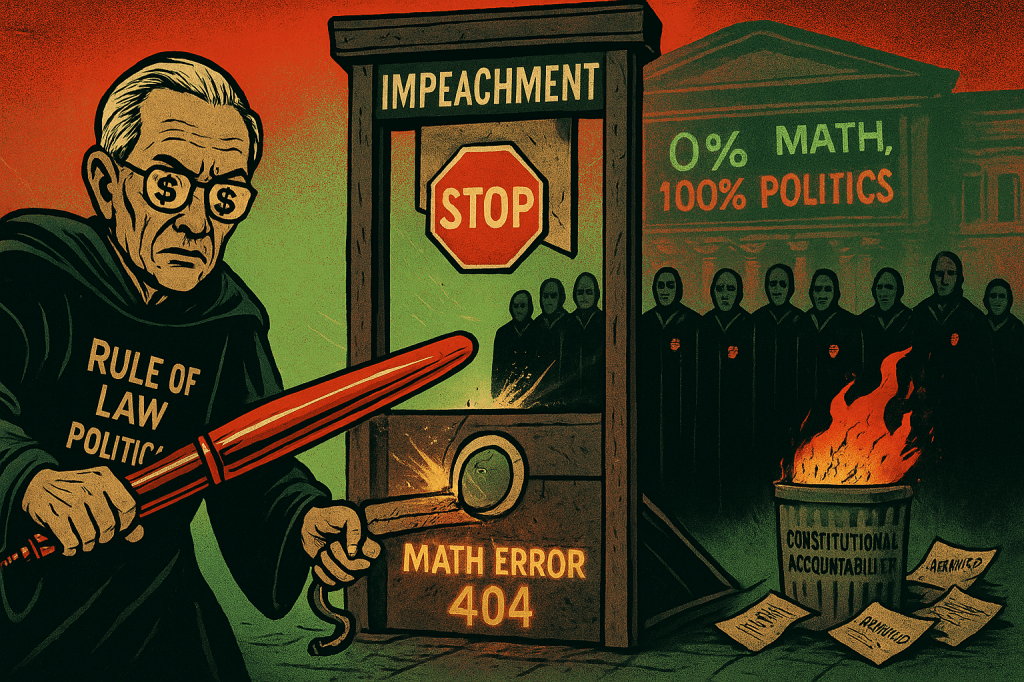
Unveiling the Court’s Math Mishap That Shielded Duterte’s 2028 Ambitions
By Louis ‘Barok‘ C. Biraogo — August 15, 2025
THE Supreme Court’s 13-0 ruling in Duterte v. House of Representatives (G.R. Nos. 278353 and 278359, July 25, 2025) isn’t just a legal misstep—it’s a constitutional trainwreck, cloaking political protectionism in a veneer of procedural piety. By nullifying Vice President Sara Z. Duterte’s impeachment complaint for allegedly violating the one-year bar under Article XI, Section 3(5), the Court didn’t just derail a Senate trial; it handed a 2028 presidential contender a bulletproof shield while gutting the Constitution’s accountability core. Retired Justice Adolfo S. Azcuna’s August 14, 2025, Facebook post exposes this as a mathematical sham and a betrayal of public trust.
Let’s eviscerate the Court’s logic, champion Azcuna’s razor-sharp critique, and map a path to salvage impeachment from this judicial dumpster fire.
I. The Court’s Calculus Catastrophe: When 1 Year Equals 1 Day
The Court’s ruling hinges on a tortured reading of Article XI, Section 3(5):
“No impeachment proceedings shall be initiated against the same official more than once within a period of one year.”
Three complaints against Duterte, filed between December 2024 and February 5, 2025, were archived without action. On February 5, a fourth complaint—endorsed by one-third of House members—met the initiation threshold under Francisco v. House of Representatives (G.R. No. 160261, 2003). Yet, the Court declared it barred, claiming the archived complaints triggered the ban on the same day.
Absurdity alert: February 5, 2025, is both the trigger and the first day of the ban, making same-day filings “more than once” in a period that hasn’t started.
Azcuna dismantles this with Article 13 of the Civil Code:
“In computing a period, the first day shall be excluded, and the last day included.”
This isn’t arcane—it’s standard, applied in cases like Commissioner of Internal Revenue v. Primetown (G.R. No. 162155, 2007) for tax deadlines. If February 5 is excluded, the ban begins February 6, and same-day initiations evade the bar. The Court’s math makes “more than once” mean “even once”—a logical faceplant.
In Francisco, the Court flexibly defined “initiation” to balance accountability and process. In Gutierrez v. House of Representatives (G.R. No. 193459, 2011), it allowed a second complaint after a first lapsed. Here? Rigid textualism that smells of selective amnesia.
II. Constitutional Slaughter: Prioritizing Red Tape Over Justice
The Court’s obsession with technicalities betrays Article XI, Section 1:
“Public office is a public trust. Public officers and employees must at all times be accountable to the people…”
Why does a hyperliteral “initiation” protect Duterte when the fourth complaint—properly initiated per Francisco—was the only one with legs? The Court equates archived, unacted-upon complaints to full initiations, creating a procedural moat around accountability. This isn’t law; it’s legerdemain.
In Gutierrez, the Court permitted a 2011 trial despite earlier complaints, recognizing that lapsed filings don’t eternally block justice. Yet in Duterte, archived complaints—never referred, never debated—trigger a year-long immunity. It’s a constitutional Catch-22: file a complaint, it’s archived; file another, it’s barred.
Azcuna’s “three strikes” model—first initiation triggers, second is allowed, third is barred—offers a logical fix, ensuring accountability isn’t throttled by bad-faith filings. The Court’s ruling, by contrast, invites abuse: one flimsy complaint can lock out legitimate ones for 365 days. Accountability? More like a constitutional coma.
III. Ethical Evisceration: A Court Guarding Its Patron?
The 13-0 vote isn’t consensus—it’s a red flag. Nine justices, appointed by Sara’s father, Rodrigo Duterte, delivered a ruling that shields a 2028 frontrunner amid Marcos-Duterte feuds. Coincidence? Hardly.
The Court’s claim of neutrality is laughable when its logic insulates a political titan. Azcuna, a retired justice breaking ranks, calls this out: his Facebook post is a clarion call against judicial cronyism.
By contrast, the Court’s silence on the House’s due process failures—rushing complaints without hearings—reveals its selective outrage.
The Court’s newfound due process fetish is equally suspect. In Francisco, impeachment was a political question with minimal judicial meddling. In Gutierrez, procedural quirks didn’t halt proceedings. Now, the Court demands notice, hearings, and evidence at the House stage, effectively rewriting impeachment rules.
Azcuna nails it: “The Supreme Court is not supposed to write the rules for Congress.” This isn’t adjudication—it’s legislation from the bench.
IV. Rule of Law Apocalypse: Immunity by Placeholder
This ruling doesn’t just pause Duterte’s trial; it cripples impeachment’s teeth. One bad-faith complaint—filed and archived—grants a 12-month immunity shield. X users are already sounding alarms:
“The SC made impeachment impossible,” one fumes. Another predicts “dummy complaints to protect allies.”
Azcuna warns this “dilutes the deterrent role” of impeachment, turning it into a procedural piñata. The Senate’s archiving of the case on August 7, 2025, proves the point: no trial, no justice.
The Court’s due process posturing—demanding rigorous House procedures—sets an unattainable bar, inviting abuse. Allies of the powerful can flood the House with sham complaints, each triggering a year-long blackout. The result? A surge in placeholder filings, ensuring officials skate free while the public’s trust in accountability erodes.
This isn’t rule of law—it’s rule by loophole.
V. Resurrecting Accountability: Five Fixes for a Broken System
To claw back impeachment’s purpose, Congress and the judiciary must act decisively:
- Rewrite House Rules with Surgical Precision: Define “initiation” as filing plus referral or one-third endorsement, per Francisco. Clarify that archived complaints don’t trigger the one-year bar unless substantively acted upon, aligning with Azcuna’s logic.
- Lock in a Filing Window: Mandate a two-week annual period (e.g., February 1–14) for impeachment complaints, with a vetting panel to consolidate filings into one robust case, thwarting multiple initiations.
- Demystify Archiving: Amend House Rules to state archiving isn’t initiation or dismissal for constitutional purposes, freeing the process from premature bars.
- Sync House-Senate Timelines: Require House transmission to the Senate within 30 days of approval, preventing judicial delays from killing trials.
- Amend the Constitution for Clarity: Propose revising Article XI, Section 3(5) to adopt Article 13’s computation or specify that only substantive complaints count, codifying Azcuna’s reasoning.
VI. Final Salvo: Judicial Malpractice Masquerading as Law
The Supreme Court’s Duterte ruling isn’t jurisprudence—it’s a judicial heist. By twisting “initiation” to include archived complaints, ignoring Article 13’s clear math, and dressing political favoritism in due process robes, the Court has handed public officials a cheat code to evade scrutiny.
Azcuna’s Facebook critique—grounded in legal precision and constitutional fidelity—stands as a defiant rebuke to this travesty.
The rule of law doesn’t thrive on unanimous votes or procedural platitudes; it demands courage to expose hypocrisy, as Azcuna has done. Until Congress rewrites the rules or the Court finds its backbone, impeachment is a dead letter, and public trust is collateral damage.
Game over, accountability—unless we rewrite the rules.
Key Citations
- Constitutional Provisions:
- Article XI, Section 1: Public office is a public trust; officials accountable at all times.
- Article XI, Section 3(5): No impeachment proceedings initiated more than once within a year.
- Civil Code:
- Article 13: Excludes first day, includes last in computing periods.
- Supreme Court Cases:
- Francisco v. House of Representatives (G.R. No. 160261, 2003): Defines “initiation” as filing plus referral or one-third endorsement.
- Gutierrez v. House of Representatives (G.R. No. 193459, 2011): Allowed second complaint after first lapsed.
- Commissioner of Internal Revenue v. Primetown (G.R. No. 162155, 2007): Applied Article 13 to tax deadlines.
- Duterte v. House of Representatives (G.R. Nos. 278353 and 278359, July 25, 2025): Supreme Court’s 13-0 ruling.
- External Commentary:
- Adolfo S. Azcuna, Facebook Post, August 14, 2025: Critiques SC ruling on one-year bar.
Footnotes
- On the 13-0 vote: Nine Duterte-appointed justices? Smells like a loyalty oath, not law.
- On due process: The Court’s sudden fairness fetish ignores the House’s own sloppy hearings. Hypocrisy, anyone?
- On placeholders: Expect a tsunami of sham complaints by 2026. The Court just greenlit constitutional sabotage.

- “Forthwith” to Farce: How the Senate is Killing Impeachment—And Why Enrile’s Right (Even If You Can’t Trust Him)

- “HINDI AKO NAG-RESIGN!”

- “I’m calling you from my new Globe SIM. Send load!”

- “Mahiya Naman Kayo!” Marcos’ Anti-Corruption Vow Faces a Flood of Doubt

- “Meow, I’m calling you from my new Globe SIM!”

- “No Special Jail for Crooks!” Boying Remulla Slams VIP Perks for Flood Scammers

- “PLUNDER IS OVERRATED”? TRY AGAIN — IT’S A CALCULATED KILL SHOT

- “Several Lifetimes,” Said Fajardo — Translation: “I’m Not Spending Even One More Day on This Circus”

- “Shimenet”: The Term That Broke the Internet and the Budget

- “We Did Not Yield”: Marcos’s Stand and the Soul of Filipino Sovereignty

- “We Gather Light to Scatter”: A Tribute to Edgardo Bautista Espiritu

- $150M for Kaufman to Spin a Sinking Narrative






 KWEBA ni BAROK
Leave a comment