By Louis ‘Barok‘ C. Biraogo — August 20, 2025
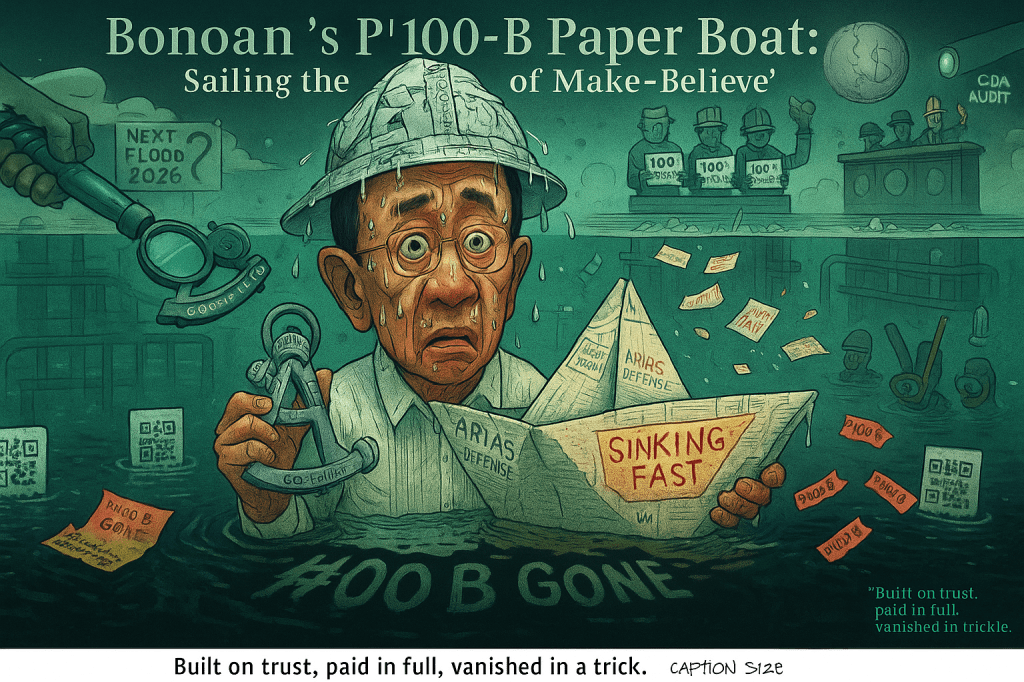
WELCOME to another sordid chapter of Kweba ng Katarungan’s favorite telenovela: As the Graft Turns. Today, we dive into the Department of Public Works and Highways (DPWH), where flood control projects—those supposed saviors of soggy communities—have morphed into a ₱100 billion cesspool of ghost projects. Starring Secretary Manuel Bonoan as the hapless captain of this sinking ship, this scandal is a masterclass in how to build nothing but excuses. Grab your waders, folks; we’re knee-deep in a flood of corruption.
The “Padrino System” as a Machine of Graft
Let’s dissect the machinery of this scandal, a predictable contraption of corruption so cliched it belongs in a museum of malfeasance. Here’s how it works:
- Rigged Procurement: Bids are tailored to favor cronies like Wawao Builders, who miraculously snagged ₱9 billion nationwide, including ₱5.971 billion in Bulacan alone. Competitive bidding? More like a VIP list for the connected.
- Falsified Progress Reports: Geotagged photos of phantom dikes and imaginary canals convince the gullible to release funds. It’s paperwork so creative it deserves a Palanca Award for fiction.
- Illicit Payments: Billions flow to contractors for “work” that exists only in their dreams, with funds vanishing faster than floodwater down a storm drain.
- Political Kickbacks: Up to 60% of the loot, per Senate whispers, flows back to the masterminds, ensuring everyone’s palms stay greased.
The scale is staggering: ₱100 billion of the DPWH’s ₱545 billion flood control budget since 2022, cornered by just 15 contractors, as reported in the Philippine Star’s August 19, 2025, exposé. These aren’t just numbers—they’re a neon billboard screaming “CAPTURED SYSTEM.” Meanwhile, flood-prone Bulacan drowns, with ghost projects leaving citizens wading through betrayal. The irony? These “flood control” initiatives hold water about as well as a paper bag.
Bonoan’s “Honesty”: A Confession of Catastrophe
Enter Secretary Manuel Bonoan, whose August 19, 2025, Senate Blue Ribbon Committee performance was a tragicomic self-own. When Senator Jinggoy Estrada asked if ghost projects exist, Bonoan’s “In all honesty, Your Honor, I think so” wasn’t transparency—it was a flare gun signaling his leadership’s collapse. Honesty? Sure, if admitting a ₱100 billion failure after the fact counts as a personality trait. For the head of a department tasked with public infrastructure, ignorance isn’t a defense; it’s the crime.
Bonoan, a DPWH veteran since 2022, claims he only learned of these ghosts “lately.” A single contractor—Wawao Builders—amassing ₱9 billion? That’s not a red flag; it’s a crimson siren. Yet, his response—promising audits, validations, and charges “when necessary”—is like mopping the floor during a typhoon. The funds are gone, contractors are dodging subpoenas, and the public is left with flooded homes and shattered trust.
Demolishing the “Arias Defense”
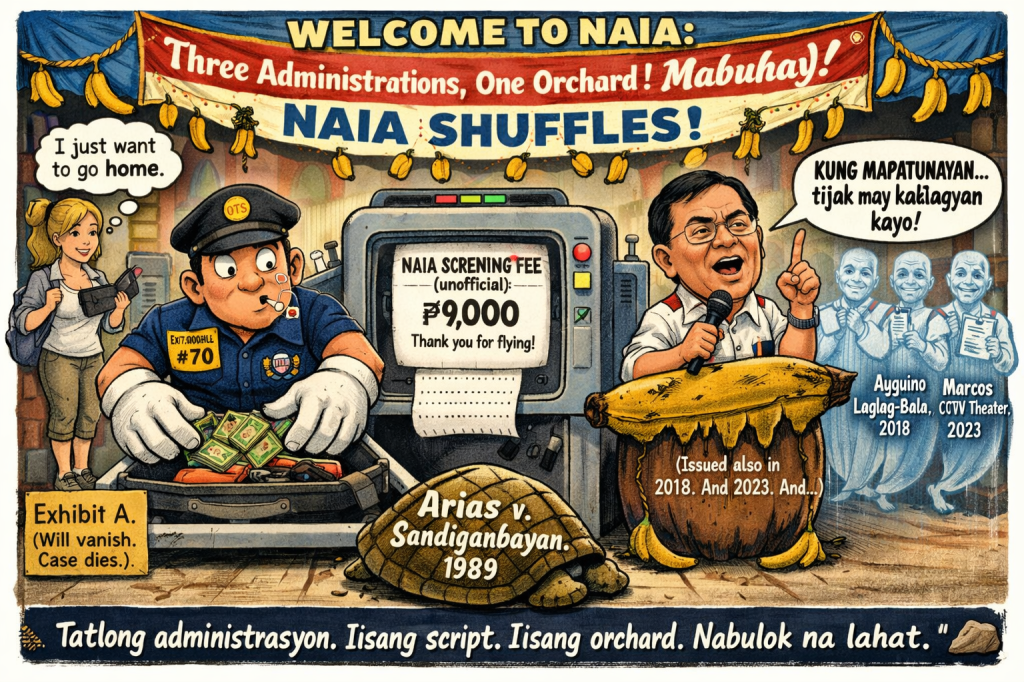
Bonoan might clutch the Arias v. Sandiganbayan (G.R. No. 81563, 1989) defense, arguing he relied on subordinates in good faith. Cute, but that shield collapses like a shoddy bridge. The Supreme Court allows reliance only absent “glaring red flags.” A ₱9 billion contract concentration to one contractor, plus ₱100 billion split among 15 firms, isn’t a flag—it’s a five-alarm fire. Add the physical absence of projects in Bulacan, and Bonoan’s Arias defense is as sturdy as a house of cards in a monsoon. The Court has long held that heads can’t play ostrich when anomalies scream (Alvizo v. Sandiganbayan, G.R. No. 101689, 1993).
Bonoan’s Liability: Negligence or Complicity?
Let’s talk legal exposure. Under Republic Act 3019, Sec. 3(e), causing “undue injury” to the government through “gross inexcusable negligence” is a one-way ticket to the Sandiganbayan. Did Bonoan’s failure to install robust systems—despite decades of DPWH scandals—fit the bill? When ₱100 billion flows to a handful of contractors and projects vanish like rainwater, the answer tilts toward “yes.” The injury isn’t just financial; it’s the betrayal of communities left vulnerable to floods real projects could have stopped.
Administratively, Republic Act 6713 demands “responsibility” and “integrity.” Bonoan’s belated relief of the Bulacan office, only after presidential and senatorial prodding, is as responsible as a lifeguard napping during a storm. His post-discovery actions (audits, subpoenas) might mitigate, but they don’t erase the porous controls that let this happen. If the Ombudsman finds ignored red flags, Presidential Decree 1606 ensures Sandiganbayan jurisdiction. PDAF scam precedents, such as Belgica v. Ochoa (G.R. Nos. 208566, 208493, 209251, 2013), remind us: ignorance isn’t innocence when the playbook of systemic graft is this worn.
The Graft Opera’s Program of Events
This scandal is a full-blown production, with a cast of enablers, beneficiaries, and a rotten system. Here’s the lineup:
- The Enablers (DPWH Engineers & Inspectors): These stagehands forge the props—fake progress reports, geotagged fantasies, and completion certificates for ghost dikes. They face:
- RPC Art. 171 (Falsification): For cooking the books.
- RPC Art. 217 (Malversation): For letting funds vanish.
- RA 3019, Sec. 3(e): For enabling undue injury. Their signatures are as binding as a noose.
- The Beneficiaries (Contractors like Wawao): Not bit players, but co-conspirators pocketing billions for fiction. They’re liable for:
- RPC Art. 172 (Falsification by Private Individuals): For fake documents.
- RPC Art. 315 (Estafa): For fraud.
- RA 3019: As principals in graft. If the loot exceeds ₱50 million, RA 7080 (Plunder) looms, with non-bailable reclusion perpetua. Wawao’s Senate no-show? Not stage fright—guilt dodging the spotlight.
- The System (DPWH & COA): The theater is rotten, with controls as effective as a screen door on a submarine. The 1987 Constitution, Art. IX-D mandates COA to catch fraud, yet it missed ₱100 billion. Madera v. COA (G.R. No. 244128, 2020) holds approving officers solidarily liable for disallowed funds unless they prove good faith—a high bar when red flags scream. The DPWH’s procurement, supposedly under RA 9184, is a farce, letting bid-rigging flourish.
The “Solutions”: A Mirage in the Flood
The response is as predictable as a monsoon. Bonoan’s “relief” of the Bulacan office and promises of charges are less reform and more sacrificial lambs for the Senate gods. An “independent commission” or “digital monitoring”? Spare me. RA 9184 already mandates transparent procurement, and RA 6770 gives the Ombudsman teeth. The issue isn’t laws; it’s the spine to enforce them against powerful players. Another commission is just another layer of bureaucracy to capture, like adding a penthouse to a condemned building. And with the Ombudsman’s backlog, defendants might bank on delays, cynically invoking their 1987 Constitution, Art. III, Sec. 16 right to a speedy disposition.
Recommendations: Bulldoze and Rebuild
To drain this swamp, we need:
- Preventive Suspension (RA 6770, Sec. 24): The Ombudsman must suspend implicated officials—starting with Bulacan’s engineers—to stop evidence tampering. Bonoan’s inclusion depends on audits, but keeping him is toxic optics.
- Forensic Audit: Skip technical reviews for a financial colonoscopy, tracing every peso to contractors’ and officials’ banks. Subpoena Wawao’s accounts.
- Criminal Indictments: Charge the conspiracy—officials and contractors—under PD 1606 for Sandiganbayan jurisdiction. Pair RA 3019 with RPC falsification and malversation.
- Blacklist Wawao and Co.: Under RA 9184, Sec. 69 and GPPB Resolution No. 09-2004, Uniform Guidelines for Blacklisting, bar these firms from all government contracts. Make it sting like a collapsed bridge on their bottom line.
The Verdict: A System Built to Fail
This isn’t an anomaly; it’s the DPWH’s default setting, a flood of corruption washing away public trust. Bonoan’s leadership—whether actively corrupt or passively negligent—is the keystone in this arch of failure. His “honesty” in admitting ghost projects isn’t absolution; it’s a confession of a department so broken that ₱100 billion could vanish without a trace. The PDAF scam showed us this playbook before, and yet here we are, wading through the same muck. Until the system is bulldozed—replacing complicity with accountability—expect more ghost projects, more floods, and more excuses. Bonoan’s legacy? A foundation of lies, crumbling under the weight of his department’s rot.
Key Citations
1. News Report
- Philippine Star, August 19, 2025: Are there ghost projects? DPWH comes clean on flood control
- Details Bonoan’s admission, Wawao’s ₱9 billion contracts, and Senate probe.
2. Supreme Court Cases
- Arias v. Sandiganbayan (G.R. No. 81563, 1989): LawPhil
- Limits reliance on subordinates when red flags are obvious.
- Alvizo v. Sandiganbayan (G.R. No. 101689, 1993)
- Convicted officials for ghost disbursements via fake documents.
- Madera v. COA (G.R. No. 244128, 2020)
- Approving officers solidarily liable unless proving good faith.
- Belgica v. Ochoa (G.R. Nos. 208566, 208493, 209251, 2013)
- Declared PDAF unconstitutional, exposing the systemic flaws that enabled fund diversion to ghost projects, a pattern mirrored in the DPWH scandal.
3. Statutes
- Republic Act No. 3019 (Anti-Graft and Corrupt Practices Act): Official Gazette
- Sec. 3(e): Undue injury via gross negligence; Sec. 3(g): Disadvantageous contracts.
- Republic Act No. 6713 (Code of Conduct and Ethical Standards): Official Gazette
- Mandates responsibility and integrity.
- Republic Act No. 7080 (Plunder Law): Official Gazette
- Non-bailable offense for ₱50 million+ ill-gotten wealth.
- Republic Act No. 9184 (Government Procurement Reform Act): Official Gazette
- Sec. 65: Penalizes bid-rigging; Sec. 69: Blacklisting guidelines.
- Republic Act No. 6770 (Ombudsman Act): Official Gazette
- Sec. 24: Preventive suspension powers.
- Presidential Decree No. 1606 (Sandiganbayan Jurisdiction): Official Gazette
- Defines Sandiganbayan’s role in graft cases.
- Revised Penal Code: LawPhil
- Art. 171: Falsification by public officers.
- Art. 172: Falsification by private individuals.
- Art. 217: Malversation of public funds.
- Art. 315: Estafa (fraud).
4. Constitutional Provisions
- 1987 Constitution, Art. IX-D (Commission on Audit): Official Gazette
- Mandates COA to audit public funds.
- 1987 Constitution, Art. III, Sec. 16 (Speedy Disposition): Official Gazette
- Right to speedy case resolution.
5. Guidelines
- GPPB Resolution No. 09-2004, Uniform Guidelines for Blacklisting of Manufacturers, Suppliers, Distributors, Contractors and Consultants:
- Rules for blacklisting errant contractors for violations like falsification or non-performance.

- “Forthwith” to Farce: How the Senate is Killing Impeachment—And Why Enrile’s Right (Even If You Can’t Trust Him)
- “HINDI AKO NAG-RESIGN!”

- “I’m calling you from my new Globe SIM. Send load!”

- “Mahiya Naman Kayo!” Marcos’ Anti-Corruption Vow Faces a Flood of Doubt

- “Meow, I’m calling you from my new Globe SIM!”

- “No Special Jail for Crooks!” Boying Remulla Slams VIP Perks for Flood Scammers

- “PLUNDER IS OVERRATED”? TRY AGAIN — IT’S A CALCULATED KILL SHOT

- “Several Lifetimes,” Said Fajardo — Translation: “I’m Not Spending Even One More Day on This Circus”

- “Shimenet”: The Term That Broke the Internet and the Budget
- “We Did Not Yield”: Marcos’s Stand and the Soul of Filipino Sovereignty

- “We Gather Light to Scatter”: A Tribute to Edgardo Bautista Espiritu

- $150M for Kaufman to Spin a Sinking Narrative

 KWEBA ni BAROK
Leave a comment