By Louis ‘Barok‘ C. Biraogo — August 21, 2025
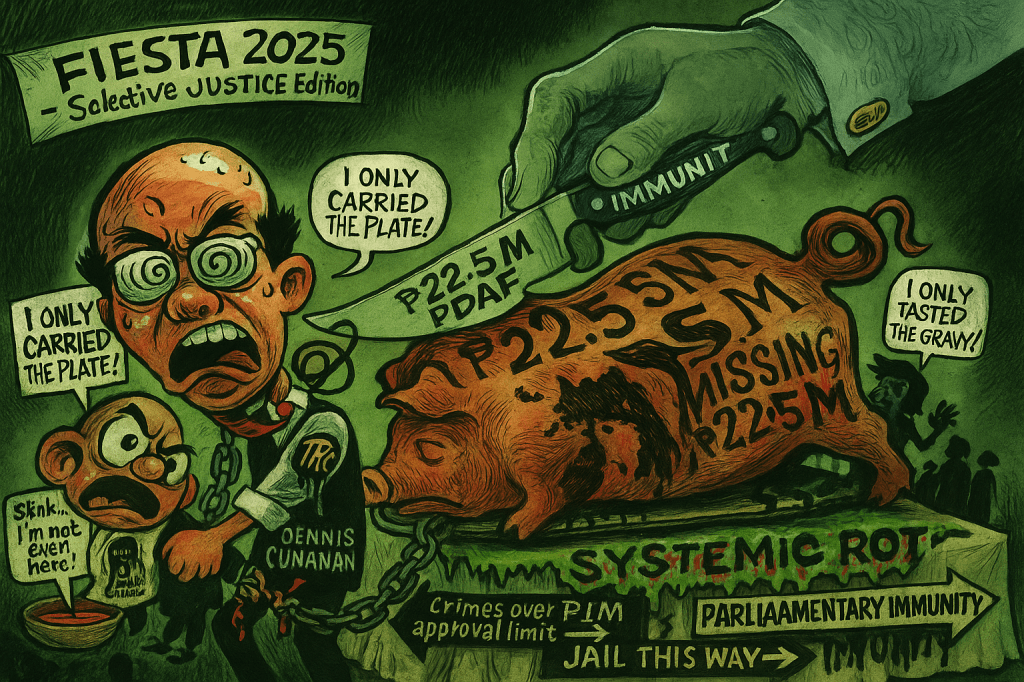
IN THE Philippines, where corruption scandals erupt like monsoon storms, the Sandiganbayan’s August 15, 2025, conviction of former Technology Resource Center (TRC) Deputy Director Dennis Cunanan and Group Manager Maria Rosalinda Lacsamana for graft and malversation over P22.5 million in Senator Gregorio “Gringo” Honasan’s Priority Development Assistance Fund (PDAF) is a lightning strike of justice—and a thunderous reminder of its limits. GMA News Report.
Why does the scribe who signs the check face prison, while the senator who pulls the strings walks free? This case, a grim echo of the P10 billion pork barrel scam, demands a scalpel-sharp dissection of legal and ethical failures, a fierce reckoning with Cunanan’s culpability, a map of his dwindling legal options, and a searing expose of the devastation left for the poor. Let’s dive into this cesspool of systemic rot with the urgency it commands.
I. Betraying the Public Trust: A System Built for Plunder
The Sandiganbayan’s ruling nails Cunanan and Lacsamana for violating three pillars of Philippine law: Republic Act (RA) 3019 (Anti-Graft and Corrupt Practices Act), Article 217 of the Revised Penal Code (RPC) (Malversation), and RA 6713 (Code of Conduct and Ethical Standards). These breaches expose not just personal failings but a PDAF system rigged for plunder.
A. RA 3019: Handing Millions to a Ghost NGO
Section 3(e) of RA 3019 punishes public officers who, through gross negligence or bad faith, cause undue injury to the government or grant unwarranted benefits to private parties. Cunanan’s signature on Disbursement Voucher (DV) No. 012007122117 greenlit P22.5 million to Pangkabuhayan Foundation Inc. (PFI), a sham NGO with fake addresses and no projects. The Sandiganbayan ruled this caused undue injury and gave PFI unwarranted benefits, echoing Albert v. Sandiganbayan (G.R. No. 164015, 2008). Cunanan’s failure to verify PFI’s legitimacy, despite his senior role, was no mere oversight—it was gross negligence that fueled fraud.
B. Article 217, RPC: Losing Millions Through Negligence
Article 217 of the RPC holds accountable officers who permit misappropriation of public funds through negligence. As TRC deputy director, Cunanan was a gatekeeper of public money. His approval of the DV enabled PFI to siphon P22.5 million, with zero evidence of delivered projects. The Commission on Audit’s (COA) 2013 report—detailing fake suppliers and falsified liquidation reports—created a presumption of malversation that Cunanan couldn’t rebut. U.S. v. Catolico (18 Phil. 504, 1911) confirms negligence alone is enough for conviction, no personal gain required.
C. RA 6713: Shredding Ethical Duty
RA 6713 demands public officials act with integrity and professionalism. Cunanan’s failure to scrutinize PFI’s credentials violated Section 4(a) and (c), betraying the public trust. The Supreme Court’s Belgica v. Ochoa (G.R. No. 208566, 2013) declared PDAF unconstitutional for enabling such abuses, spotlighting how Cunanan’s negligence propped up a corrupt system.
D. The Untouchable Elite: Selective Justice in Action
The glaring injustice? Senator Honasan, whose PDAF allocation fueled this scam, faces no charges. This mirrors cases like People v. Revilla (SB-14-CRM-0240, 2018), where Senator Bong Revilla dodged plunder charges, and People v. Enrile (SB-14-CRM -0238, 2024), where Juan Ponce Enrile was acquitted. Why do lawmakers skate while bureaucrats burn? Political favoritism and elite capture shield the powerful, leaving mid-level officials like Cunanan as sacrificial lambs. This selective prosecution mocks equal justice, fueling public cynicism.
II. Cunanan on Trial: Guilty Enabler or Systemic Scapegoat?
A. Prosecution’s Slam Dunk: Negligence Fuels Fraud
The prosecution’s case is brutal in its clarity: Cunanan’s signature unleashed P22.5 million to a fake NGO, causing direct government loss. The COA’s 2013 audit exposed PFI’s fraud—fake addresses, non-existent suppliers, forged liquidation reports. As deputy director, Cunanan had the duty and authority to verify the transaction. His failure constitutes gross negligence under RA 3019, Section 3(e) and malversation under Article 217, RPC. The Sandiganbayan highlighted his admitted signing authority up to P1 million, dismantling claims of being a mere cog. People v. Napoles (G.R. No. 247611, 2021) holds that enabling ghost projects makes officials complicit, profit or not. Ethically, Cunanan’s breach of RA 6713—ignoring red flags like PFI’s sham credentials—seals his guilt.
B. Defense’s Desperate Plea: Good Faith or Grasping at Straws?
Cunanan’s defense rests on three shaky pillars: good faith, ministerial duty, and no direct benefit. He claims he relied on subordinates’ certifications and standard protocols, citing Arias v. Sandiganbayan (G.R. No. 81563, 1989), which allows heads to trust subordinates absent clear irregularities. He argues the DV was pre-approved by TRC higher-ups and Honasan’s endorsement, making his role routine. No evidence shows he pocketed funds, a point that softened liability in People v. Sanchez (G.R. No. 121039, 2001).
But these arguments implode. Arias requires no obvious red flags, yet PFI’s fake addresses and forged documents screamed fraud—a senior official like Cunanan should have noticed. His ministerial duty claim fails; his authority included discretionary oversight, not blind rubber-stamping. Lack of direct benefit is irrelevant—both RA 3019 and Article 217 punish negligence. His role as a state witness in other PDAF cases, testifying against Enrile and Estrada, adds a twist of irony but not innocence. If anything, his insider knowledge undermines claims of ignorance. Procedurally, his selective prosecution argument, while sympathetic, doesn’t negate his guilt.
III. Cunanan’s Last Stand: Legal Lifelines in a Losing Battle
Cunanan faces 6 to 12 years for graft and malversation, plus a crushing P20 million restitution order. His legal options are narrow but not nonexistent:
A. Motion for Reconsideration: A Shot in the Dark
Under Rule 121 of the Revised Rules of Criminal Procedure, Cunanan can file a motion for reconsideration within 15 days, challenging factual or legal errors, like insufficient evidence or misapplication of Arias. New evidence—say, proof of PFI’s partial legitimacy—could warrant a new trial, but COA’s airtight audit makes this unlikely.
B. Supreme Court Appeal: Uphill Climb
If denied, Cunanan can appeal via a Petition for Review on Certiorari under Rule 45, raising legal questions like whether reliance on subordinates negates intent. The Supreme Court, as in Estrada v. Sandiganbayan (G.R. No. 148560, 2001), may review evidence standards, but its scope is limited, and Cunanan’s odds are slim.
C. Probation: A Partial Escape
The graft conviction (6 years minimum) may qualify for probation under Presidential Decree 968, as amended by RA 10707, for first-time offenders. But malversation’s reclusion temporal penalty (up to 17 years) likely bars relief, as probation is limited to sentences under 6 years post-Indeterminate Sentence Law.
D. Executive Clemency: Political Pipe Dream
Cunanan could seek a presidential pardon under Article VII, Section 19 of the 1987 Constitution, but clemency for corruption is rare without full contrition, and public outrage would likely block it.
E. Settling the Debt: A Financial Longshot
The P20 million restitution, with 6% interest, is daunting. Partial settlement, as in Corona v. Senate (G.R. No. 200242, 2012), could mitigate penalties or optics, but People v. Revilla shows enforcement lags—P124 million remains uncollected years later.
IV. The Real Victims: The Poor Robbed, Governance Gutted
A. Widows and Orphans Cheated
The P22.5 million was meant for livelihood aid to widows and orphans of fallen soldiers in Isabela and Cagayan. With 21% of Filipinos below the poverty line (Philippine Statistics Authority, 2023), this loss directly starved vulnerable communities, deepening poverty’s grip. Corruption’s toll is brutal: misallocated funds mean fewer schools, clinics, and jobs, with studies showing it inflates project costs by 20% (Transparency International, 2024).
B. Governance in Chains: Accountability or Paralysis?
The conviction bolsters the Sandiganbayan’s anti-graft role, signaling that negligence has consequences. Yet, acquittals of Enrile (2024) and Revilla (2018) scream impunity for the elite. Bureaucrats like Cunanan face the gavel, while lawmakers hide behind influence. This risks bureaucratic paralysis—officials may stall legitimate disbursements, fearing liability, as seen post-PDAF when approvals slowed (COA, 2015). But it also deters future negligence, if paired with reforms.
C. Elite Capture: Corruption’s Economic Stranglehold
The PDAF scam, tied to Janet Lim-Napoles’ P10 billion plunder, exposes elite capture. Belgica v. Ochoa (G.R. No. 208566, 2013) killed PDAF, but discretionary funds linger under new names, risking repeat scandals. The Philippines’ 115th ranking on the Corruption Perceptions Index (Transparency International, 2024) and 2% GDP loss to corruption (World Bank, 2023) show the economic devastation. Without crushing political dynasties and discretionary budgets, the poor will keep paying.
V. Justice Half-Served: A Call to Break the Cycle
Cunanan’s conviction is a hollow victory. Legally, his gross negligence under RA 3019 and Article 217, RPC, plus ethical breaches under RA 6713, justify the verdict. His good faith and ministerial duty defenses collapse against PFI’s blatant fraud and his senior role. Appeals or probation offer slim hope, and the P20 million restitution looms large.
But the real scandal is systemic. Why does Honasan, the PDAF’s source, escape? Why do lawmakers dodge accountability while bureaucrats fall? The poor—widows and orphans here—suffer most, robbed of aid while corruption cripples development. To end this, the Philippines needs ruthless reforms: ironclad COA oversight, abolition of discretionary funds, anti-dynasty laws, and whistleblower protections. Until the power-brokers, not just the scribes, face justice, the pork barrel saga will fester, a grim testament to a system where corruption thrives.
When will the real culprits pay?
Key Citations
- RA 3019, Anti-Graft and Corrupt Practices Act: Section 3(e) on causing undue injury or unwarranted benefits.
- Article 217, Revised Penal Code: Malversation of public funds.
- RA 6713, Code of Conduct and Ethical Standards: Ethical duties of public officials.
- U.S. v. Catolico (18 Phil. 504, 1911): Negligence alone can constitute criminal liability for public officers entrusted with public funds.
- Belgica v. Ochoa (G.R. No. 208566, 2013): PDAF declared unconstitutional.
- Albert v. Sandiganbayan (G.R. No. 164015, 2008): Negligence in fund disbursement.
- People v. Napoles (G.R. No. 247611, 2021): Liability for enabling ghost projects.
- Arias v. Sandiganbayan (G.R. No. 81563, 1989): Reliance on subordinates.
- People v. Sanchez (G.R. No. 121039, 2001): Absence of personal gain in malversation.
- Estrada v. Sandiganbayan (G.R. No. 148560, 2001): Evidence standards in PDAF cases.
- Corona v. Senate (G.R. No. 200242, 2012) – Partial settlement mitigation.
- People v. Revilla (SB-14-CRM-0240, 2018)
- People v. Enrile (SB-14-CRM -0238, 2024)
- Rule 121, Revised Rules of Criminal Procedure: Motion for reconsideration.
- Rule 45, Revised Rules of Civil Procedure: Petition for Review on Certiorari.
- Presidential Decree 968, Probation Law: Probation eligibility.
- Article VII, Section 19, 1987 Constitution: Executive clemency.
- Philippine Statistics Authority, 2023: Poverty incidence data.
- Transparency International, 2024: Corruption Perceptions Index.
- World Bank, 2023: Economic impact of corruption.
- COA, 2015: Post-PDAF audit delays.

- “Forthwith” to Farce: How the Senate is Killing Impeachment—And Why Enrile’s Right (Even If You Can’t Trust Him)
- “HINDI AKO NAG-RESIGN!”

- “I’m calling you from my new Globe SIM. Send load!”

- “Mahiya Naman Kayo!” Marcos’ Anti-Corruption Vow Faces a Flood of Doubt

- “Meow, I’m calling you from my new Globe SIM!”

- “No Special Jail for Crooks!” Boying Remulla Slams VIP Perks for Flood Scammers
- “PLUNDER IS OVERRATED”? TRY AGAIN — IT’S A CALCULATED KILL SHOT

- “Several Lifetimes,” Said Fajardo — Translation: “I’m Not Spending Even One More Day on This Circus”

- “Shimenet”: The Term That Broke the Internet and the Budget

- “We Did Not Yield”: Marcos’s Stand and the Soul of Filipino Sovereignty

- “We Gather Light to Scatter”: A Tribute to Edgardo Bautista Espiritu

- $150M for Kaufman to Spin a Sinking Narrative


 KWEBA ni BAROK
Leave a comment