By Louis ‘Barok‘ C. Biraogo — August 23, 2025
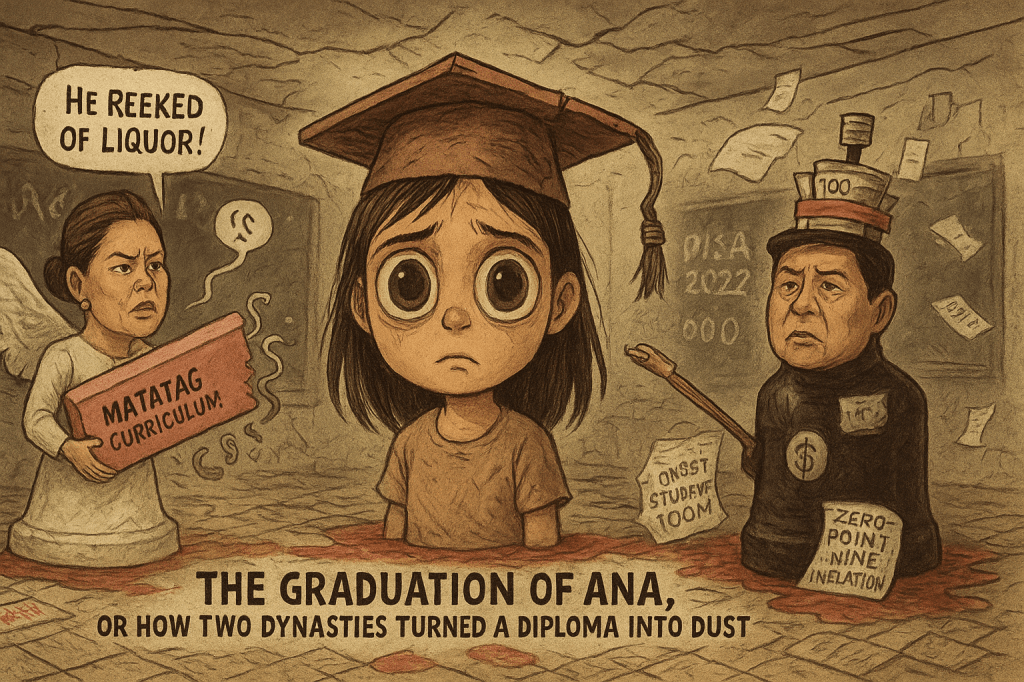
IN A crumbling classroom in Tondo, Manila, 12-year-old Ana huddles over a shared, dog-eared textbook, her dream of becoming a nurse fading amid broken promises. Outside, the air is thick with political venom as Vice President Sara Duterte and President Ferdinand Marcos Jr. trade barbs, their feud exposing a governance system where power trumps progress. Duterte’s claim that Marcos “reeked of liquor” during her resignation as Education Secretary in June 2024, met with the Palace’s retort of her “complete failure” at DepEd, is more than a scandal—it’s a betrayal of 28 million public school students, especially the poorest. This critique, rooted in the Manila Times report and extensive research, dissects their accusations, evaluates their records, and lays bare the human toll on Filipinos like Ana.
Explosive Allegations: A Dynasty Duel Undermines a Nation
The controversy ignited when Sara Duterte, speaking from The Hague, alleged that President Marcos was intoxicated during their June 19, 2024, meeting, where he begged her to stay in the Cabinet or take another post to bolster his 2025 midterm prospects (Manila Times, 2025). Duterte framed this as a courageous truth-telling, exposing a floundering government. The Palace, via Press Officer Claire Castro, branded her claims “self-serving” lies, accusing her of plotting to oust Marcos and slamming her DepEd tenure as a disaster—citing 1.5 million undistributed gadgets, P100 million in “ghost student” voucher fraud, and her admitted lack of curriculum expertise.
Truth or Tactic?
The alcohol allegation is uncorroborated, a personal jab countered by Marcos’ fitness-conscious image. The Palace’s data-driven attacks, backed by COA reports, hold weight but risk overreach by framing Duterte’s motives as purely ambitious, ignoring her 57% approval rating in 2023 (Pulse Asia, 2023). Both sides’ mudslinging diverts focus from policy, eroding trust among Filipinos who rely on stable governance.
Power Struggle Roots
This feud marks the collapse of the 2022 “UniTeam” alliance, a fragile pact between dynasties now fraying with Rodrigo Duterte’s ICC detention and looming 2028 elections. The poor, dependent on public services, suffer when leaders prioritize score-settling over delivery.
Sara Duterte’s DepEd Debacle: Promises Unkept, Children Left Behind
By the Numbers: A Record of Ruin
- Classroom Crisis: Duterte inherited a 91,000-classroom shortage, which ballooned to 165,000 by 2024. In 2023, only 192 of 6,379 targeted classrooms were built (3% success rate) (PhilStar, 2024).
- Resource Fiasco: 1.5 million gadgets and learning materials, procured pre-COVID, remained undistributed by 2024, with zero progress in the 2023 computerization program (PhilStar, 2024).
- Budget Blunders: DepEd’s 2023 budget utilization was abysmal—17% for textbooks, 23–50% for computerization, 65–81% for feeding programs. Over P100 million was lost to “ghost student” voucher fraud (Inquirer.net, 2023).
- Learning Losses: The 2022 PISA ranked the Philippines near the bottom in reading, math, and science, with no improvement in 2024’s creative thinking test (bottom four of 64 countries) (OECD, 2024).
The Human Story: Intent Without Impact
Duterte’s defenders praise her MATATAG curriculum, piloted in 35 schools to streamline K–10 and boost literacy, and her efforts to reduce teachers’ administrative loads (Manila Bulletin, 2023). Her school visits projected empathy, resonating with educators. Yet, her lack of expertise—she admitted curriculum was “not her field”—led to chaotic MATATAG rollouts with untrained teachers (Rappler, 2024). Arbitrary orders, like banning classroom decorations, lacked evidence, while her P150 million confidential funds request for DepEd sparked corruption fears (ABS-CBN, 2023). Frequent foreign trips, including 11 in 2025, fueled perceptions of neglect amid a learning crisis.
Verdict: A Legacy of Lost Opportunity
Duterte inherited systemic woes but failed to resolve them. Her reforms showed ambition but crumbled under poor execution, leaving students like Ana in dilapidated schools without modern tools, deepening educational inequity for the poor.
Marcos’ Presidency: Economic Wins, Educational Woes
By the Numbers: A Fragile Recovery
- Economic Metrics: GDP growth averaged 6% (7.6% in 2022, 5.4% in Q1 2025). Inflation fell to 0.9% by July 2025, but 2024’s 5.6–5.7% growth missed targets (PSA, 2025). Unemployment was 3.9% in May 2025, with poverty at 15.5% (down from 2022), yet 63% self-rated poor in Q4 2024 (SWS, 2024).
- Education Investment: DepEd’s budget rose from P5.268T (2023) to P6.352T (2025), but utilization remained low, with classroom and gadget backlogs persisting (DBM, 2025).
- Public Trust: Trust dropped to 60% by April 2025 (from 65% in 2024), with approval at 25–29% and net satisfaction at -13 to -28 (Pulse Asia, 2025).
The Human Story: Progress Marred by Politics
Marcos’ appointment of Sonny Angara as DepEd Secretary signaled reform continuity, with Angara reversing Duterte’s decoration ban and prioritizing teacher training (DepEd, 2024). The Education and Workforce Development Group (EWDG) aims to unify policies, but critics see bureaucratic bloat (Inquirer.net, 2025). Marcos’ broader governance earned praise for economic recovery (e.g., $14.36B in foreign investments) and social programs like 4Ps, lifting 2.5 million from poverty (PCO, 2024). Yet, corruption scandals (e.g., sugar importation), South China Sea tensions, and the Duterte feud fuel perceptions of elitism. Appointing Duterte to DepEd, despite her inexperience, ties Marcos to its failures.
Verdict: Gains at Risk
Marcos stabilized the economy, but education delivery lags, with unresolved backlogs harming the poor. The feud consumes political capital, threatening focus on critical services as 2028 elections loom.
The Human Toll: Poor Filipinos Pay the Price
Education’s Collapse
The feud distracts from DepEd’s crisis—165,000 classroom shortages and 1.5 million undistributed gadgets hit poorest students hardest, who lack private options (UNICEF, 2024). PISA’s dire 2022–2024 results signal a generation at risk, trapping families like Ana’s in poverty. Voucher fraud and budget inefficiencies starve public schools, especially in Bangsamoro, where students lag two years behind (UNICEF, 2024).
Economic Strain
Low inflation (0.9%) and 3.9% unemployment ease burdens, but 63% self-rated poverty reflects weak gains for the poor (SWS, 2024). The feud risks investor hesitancy and diverted funds, threatening jobs and subsidies for 17.5 million poor Filipinos (PSA, 2023). Rising hunger, tied to food inflation, hits hardest those reliant on rice and vegetables.
Political Instability
The rift, amplified by Rodrigo Duterte’s ICC case, risks protests and polarization, diverting resources from classrooms and health to political battles. Trust erosion (Marcos at 60%, Duterte at 57%) fuels cynicism, potentially empowering populist rivals by 2028 (Pulse Asia, 2025).
Human Faces
Ana’s dream of nursing fades without digital tools or safe classrooms. Teachers face burnout from policy chaos, while parents grapple with rising costs. The feud’s noise buries these struggles, leaving the poor most vulnerable.
A Roadmap to Redemption: Policy Reforms to Save a Generation
- Clear the Backlog Blitz: Launch a 90-day campaign to distribute 1.5 million gadgets, with public dashboards, COA audits, and regional directors’ pay tied to results. Target: 80% distribution by Q1 2026.
- Voucher Fraud Crackdown: Cross-match SHS voucher rolls with PhilSys IDs, enforce clawbacks, and publish quarterly anomaly reports. Target: <0.5% invalid beneficiaries by 2026.
- Transparent Classroom Pipeline: Create an open-data portal tracking builds/repairs, empowering LGUs and CSOs. Target: 10,000 new classrooms by 2027.
- Depoliticize DepEd: Appoint education experts, not politicians, with merit-based, five-year terms for continuity (UNICEF, 2024).
- Boost and Track Funding: Raise DepEd’s budget to 6% of GDP, prioritizing teacher training and rural schools, with strict COA oversight.
- Marcos’ Ceasefire Call: Halt public attacks, focus on KPIs (classrooms, rice prices, jobs), and engage CSOs to rebuild trust. Target: 70% trust by 2026 (Pulse Asia, 2025).
A Cry for Ana’s Future: Leadership Over Egos
The Marcos-Duterte feud is a tragedy for Ana, whose dreams hinge on a working education system. Duterte’s DepEd tenure, riddled with backlogs and mismanagement, squandered chances to lift millions from learning poverty. Marcos’ economic gains are fragile, undermined by education failures and political rifts he helped ignite. Both share blame—Duterte for operational collapse, Marcos for appointing her and fanning flames. The poor, like Ana’s family, bear the cost: no gadgets, no classrooms, no hope. Leaders must clear backlogs, appoint experts, and prioritize delivery over drama. If Ana’s generation is to rise, the Philippines needs governance that serves, not squabbles. The clock is ticking.
Key Citations
- Manila Times, 2025: Core news report detailing Duterte’s allegations and Palace response.
- COA, 2023: Audit reports confirming P100 million voucher fraud and budget inefficiencies.
- PhilStar, 2024: Sara-led DepEd built just 3% of classroom target – Data on classroom shortages and DepEd performance metrics.
- PhilStar, 2024: 1.5 million DepEd laptops, items stuck in warehouses since 2020 – Angara
- Inquirer.net, 2023: DepEd used only 11% of 2023 textbook funds – House research arm
- Pulse Asia, 2023–2025: Surveys on Duterte’s approval (57% in 2023) and Marcos’ trust ratings (60% in 2025).
- OECD, 2024: PISA results showing Philippines’ low education rankings.
- Rappler, 2024: Teachers dismayed by ‘chaotic’ rollout of Matatag curriculum – Reports on MATATAG rollout issues and Duterte’s policies.
- ABS-CBN, 2024: Duterte defends P150M confidential funds under DepEd’s proposed 2024 budget – Coverage of confidential funds controversy and political instability risks.
- PSA, 2023–2025: Economic and poverty data (e.g., 15.5% poverty, 3.9% unemployment).
- SWS, 2024: Self-rated poverty (63% in Q4 2024) and public sentiment.
- PCO, 2024: Almost 2.5 million Filipinos lifted from poverty — PBBM
- Manila Bulletin, 2023: Pilot run of MATATAG K to 10 Curriculum begins in 35 schools
- DepEd, 2023: Official statements on MATATAG and reform continuity.
- UNICEF REPORT, 2024 (PDF): Reports on education disparities, especially in Bangsamoro.
- DBM, 2025: Budget allocations for DepEd (P5.268T to P6.352T).
- DSWD, 2024: 4Ps program impact, lifting 1.3 million from poverty.
- Philippine Daily Inquirer, 2025: Critique of EWDG as bureaucratic bloat.

- “Forthwith” to Farce: How the Senate is Killing Impeachment—And Why Enrile’s Right (Even If You Can’t Trust Him)

- “HINDI AKO NAG-RESIGN!”

- “I’m calling you from my new Globe SIM. Send load!”

- “Mahiya Naman Kayo!” Marcos’ Anti-Corruption Vow Faces a Flood of Doubt

- “Meow, I’m calling you from my new Globe SIM!”

- “No Special Jail for Crooks!” Boying Remulla Slams VIP Perks for Flood Scammers

- “PLUNDER IS OVERRATED”? TRY AGAIN — IT’S A CALCULATED KILL SHOT

- “Several Lifetimes,” Said Fajardo — Translation: “I’m Not Spending Even One More Day on This Circus”

- “Shimenet”: The Term That Broke the Internet and the Budget
- “We Did Not Yield”: Marcos’s Stand and the Soul of Filipino Sovereignty

- “We Gather Light to Scatter”: A Tribute to Edgardo Bautista Espiritu

- $150M for Kaufman to Spin a Sinking Narrative





 KWEBA ni BAROK
Leave a comment