By Louis ‘Barok‘ C. Biraogo – August 27, 2025
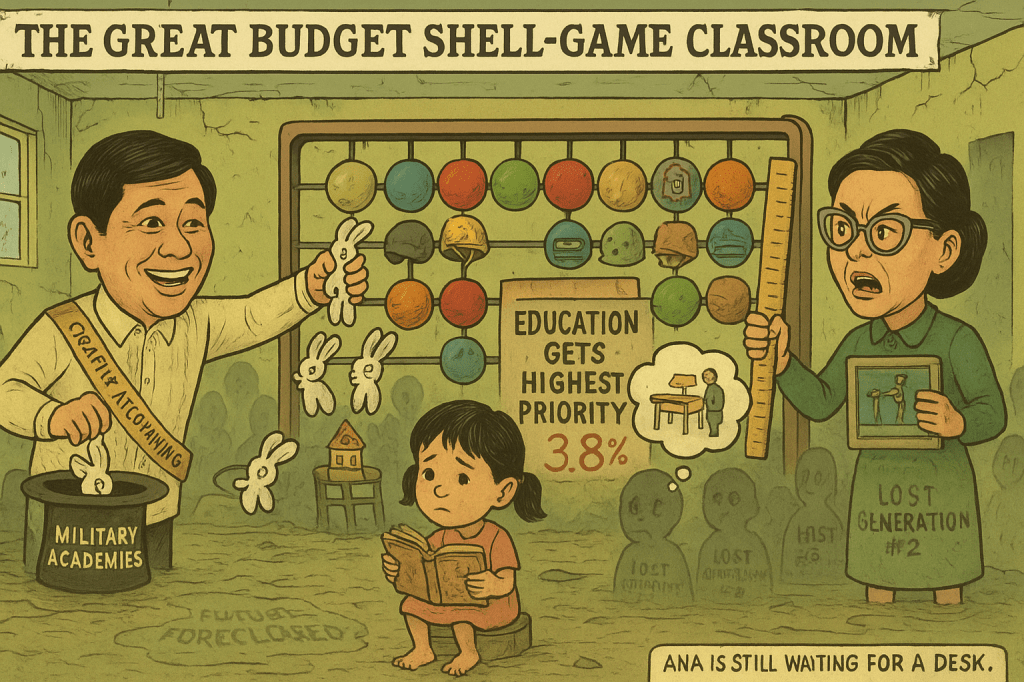
IN A stunning display of bureaucratic innovation, the Philippine government and its critics have managed to transform a national learning crisis into a tedious math quarrel. The Philippine Business for Education (PBEd) says the 2026 education budget is only 3.8% of GDP. The government insists it’s closer to 4%, if you squint hard enough and count military academies as classrooms. Both are right. And both are missing the point: a generation of Filipino children is being failed while adults bicker over decimal points.
The Marcos administration, like its predecessors, treats the budget process as a shell game. Take the ₱1.178 trillion allocation and pad it with whatever is handy—uniformed-service academies, police training schools, even line items more useful to generals than to grade-schoolers. Voilà: we’ve “met” UNESCO’s 4% benchmark. It’s like claiming you’ve solved a food shortage because your farm bought more tractors, never mind that the children are still hungry. If numbers could read, they’d be laughing.
PBEd, for its part, uses a stricter definition of “education” that excludes the military window dressing. That gives us the damning 3.8% figure—too low by UNESCO’s own floor, let alone its 4–6% recommended range. The truth is that both sides are technically correct. The tragedy is that this definitional joust obscures what matters: classrooms without desks, teachers without aides, and children without a fighting chance. It’s not whether we fund education at 3.8% or 4.0% of GDP; it’s that either figure is nowhere near enough, and even those pesos are spent poorly.
Let’s be clear: even if we accept the government’s creative accounting, the Philippines barely scrapes the bottom of global benchmarks. That’s a cause for alarm, not self-congratulation. UNESCO didn’t pull its 4–6% target out of thin air; it’s the minimum needed to avoid collapse. Yet the Philippines—whose Constitution solemnly promises that education gets the “highest priority”—averaged only 3.2% over the last decade. Compare that with Malaysia at 4.26%, India at 4.64%, or OECD countries averaging nearly 5%. Finland, which the world envies for its schools, spends over 6%. Only in Manila could barely reaching the floor be trumpeted as a triumph.
But numbers are abstractions. Let’s imagine nine-year-old “Ana” in a rural school in Bohol. She sits in a class of 55 students sharing textbooks that still reference presidents long out of office. Her teacher, juggling administrative paperwork and two extra classes, can’t give her the attention she needs to master basic reading. Ana isn’t a data point in UNESCO’s chart. She is a child whose future is being bargained away for the sake of accounting tricks and political spin. When PBEd warns of a “lost generation,” Ana is Exhibit A.
Every decimal point we debate has a human cost. A 3.8% budget means thousands more classrooms left unbuilt, teachers left unsupported, and children like Ana left behind. It means learning poverty persists, productivity stagnates, and inequality deepens. This is not a rounding error—it is a betrayal measured in futures foreclosed.
So what to do? First, stop lying. Call things by their proper names: publish two numbers, one for “Core Education” and another for the broader “Sector.” If the government insists on counting police schools as education, fine—just don’t bury the distinction in the footnotes. Livestream the budget hearings, publish the line items, and let the sunlight disinfect the creative accounting.
Second, fund like we mean it. Pass a law mandating a multi-year climb to 5% of GDP for core education, not through grand promises but through measurable milestones: classrooms actually built, teachers actually hired, textbooks actually delivered.
Third, prioritize what matters. Ring-fence money for the foundation years—K to 3—where the battle for literacy and numeracy is won or lost. Fund teacher aides and remedial programs, not cadet barracks.
Finally, fix execution. Don’t earmark billions for school buildings if the lots aren’t titled and contractors aren’t vetted. Spend that money instead on programs that can actually reach Ana this year—remedial reading, feeding programs, teacher support.
The tragedy of Philippine education isn’t that the budget is 3.8% or 4.0% of GDP. It’s that the nation congratulates itself for hitting the bare minimum while the classrooms themselves collapse. The children know the truth. They know that the adults are busy counting while they are still waiting for books, desks, and hope. And unless the government stops playing this shell game, Ana’s lost generation won’t be a warning. It will be a fact.

- ₱75 Million Heist: Cops Gone Full Bandit

- ₱6.7-Trillion Temptation: The Great Pork Zombie Revival and the “Collegial” Vote-Buying Circus

- ₱1.9 Billion for 382 Units and a Rooftop Pool: Poverty Solved, Next Problem Please

- ₱1.35 Trillion for Education: Bigger Budget, Same Old Thieves’ Banquet
- ₱1 Billion Congressional Seat? Sorry, Sold Out Na Raw — Si Bello Raw Ang Hindi Bumili

- “We Will Take Care of It”: Bersamin’s P52-Billion Love Letter to Corruption

- “Skewed Narrative”? More Like Skewered Taxpayers!

- “Scared to Sign Vouchers” Is Now Official GDP Policy – Welcome to the Philippines’ Permanent Paralysis Economy
- “Robbed by Restitution?” Curlee Discaya’s Tears Over Returning What He Never Earned
- “No Pressure” Luistro? The House Pork Bazaar Exposed
- “My Brother the President Is a Junkie”: A Marcos Family Reunion Special

- “Mapipilitan Akong Gawing Zero”: The Day Senator Rodante Marcoleta Confessed to Perjury on National Television and Thought We’d Clap for the Creativity

 KWEBA ni BAROK
Leave a comment