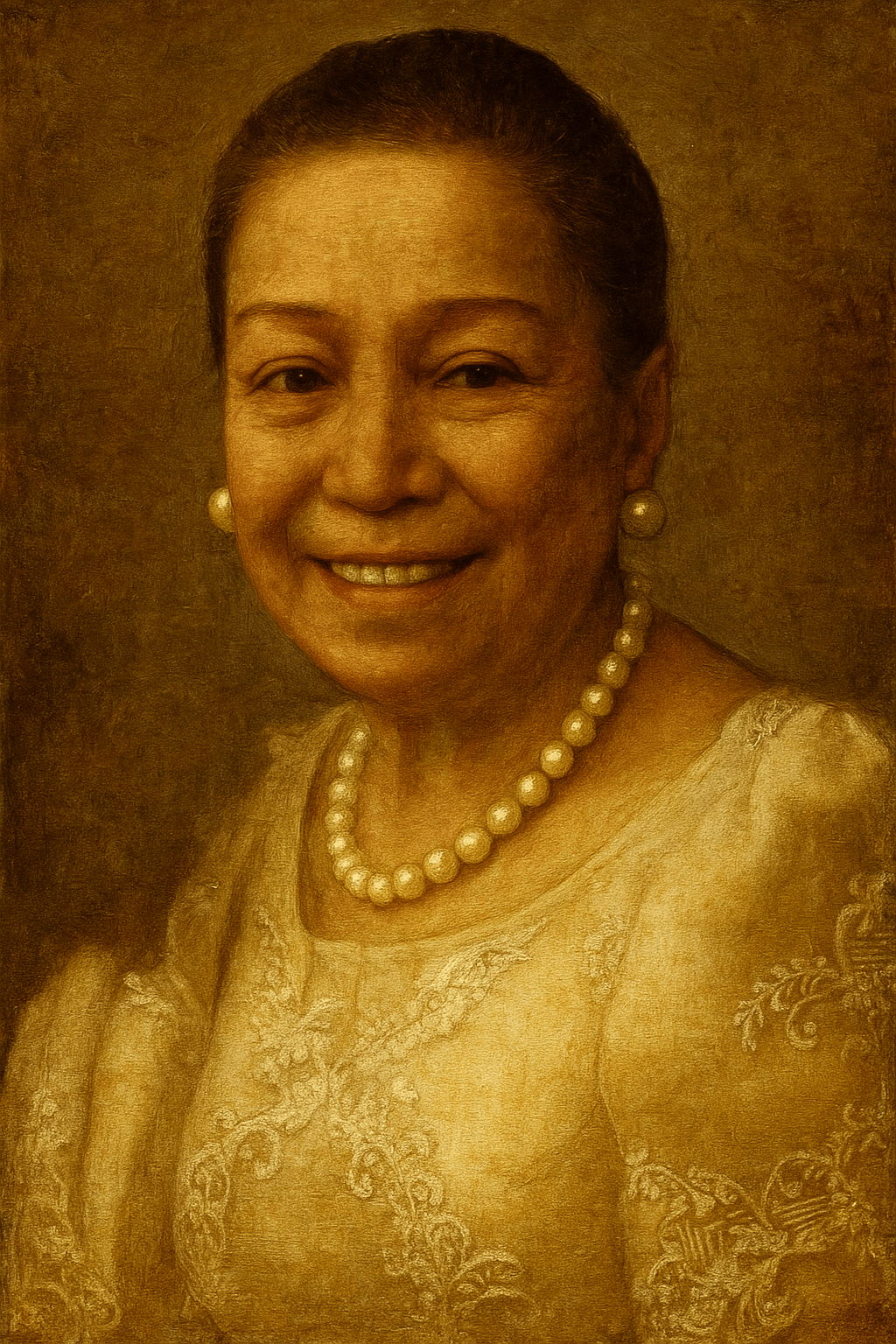
A Portrait of the Woman Who Turned Loss into Light, and Silence into Lasting Power
By Louis ‘Barok‘ C. Biraogo — August 27, 2025
IN Cubao, where the bright arteries of commerce and culture converge, stands Araneta City—a monument to vision and enterprise, a humming testament to urban possibility. It is easy, passing through its theaters, arenas, and high towers, to believe that it was built only by men of bold blueprints and capital. But listen closely, past the clamor of traffic and the exuberance of crowds, and you may discern the subtler architecture of another presence: the steady, quiet force of Judy Araneta Roxas, who shaped this place and so many others not with noise or spectacle but with grace, resolve, and a faith that permanence is found not in monuments of steel but in acts of devotion.
Judy’s life was lived in the interstice between two great legacies—the commercial and pioneering spirit of the Aranetas, and the public service and democratic conscience of the Roxases. To be eldest daughter of J. Amado Araneta and wife of Senator Gerry Roxas was to be at the very crossroads of wealth and politics, power and responsibility. Yet she wore these inheritances not as crowns to dazzle the public, but as mantles to be quietly stewarded. Hers was the strength of the matriarch who makes the house a sanctuary, the mentor who makes the stranger feel seen, the survivor who, after Plaza Miranda’s bombs shattered a night of democracy, stood up, scarred but unbroken, to light again the lamp of hope.
Those who knew her best recall less her titles than her gestures. A junior staffer at the Gerry Roxas Foundation remembers her listening intently, as if their words carried equal weight with senators and CEOs. Liberal Party stalwarts remember the Bahay na Puti not simply as a residence but as a refuge: a place where strategy was whispered, laughter softened the despair of Martial Law, and a woman’s steady presence conferred reassurance that even in the nation’s bleakest hours, someone was keeping faith with the flame. This was Judy’s genius—that the small mercies she offered became the scaffolding for larger movements.
Her work with the foundations was not duty but devotion. To chair the Gerry Roxas Foundation, to lead the J. Amado Araneta Foundation, was for her a form of remembrance made flesh, the act of transforming grief into stewardship. Widowhood and the later death of her son Dinggoy could have withdrawn her into bitterness. Instead, she converted loss into resolve. She kept faith with Gerry by educating scholars who would never meet him but carry forward his ideals. She honored her father by ensuring that Araneta City was not simply a marketplace, but a living community of culture and livelihood. Every scholarship awarded, every youth leadership program nurtured, was her whispered defiance of the cynicism that corrodes public life.
And then there was Upsilon Sigma Phi—the fraternity into which Gerry, her brother Jorge, and her son Dinggoy were initiated, a brotherhood whose call to gather light and scatter it into the world mirrored her own quiet ethic of service. The Bahay na Puti, during Dinggoy’s exuberant early years as an Upsilonian, became a de facto fraternity house, filled with young men brimming with ideals and restless energy. Judy, without fanfare, allowed her home to become their sanctuary, as if to say that the next generation’s hopes were as welcome at her table as her own children. When, in her later years, she and her son Mar pledged anew to Upsilon, it was not a simple donation but a final act of guardianship, ensuring that the torch of civic idealism would not gutter out but be passed, still burning, to younger hands.
It is tempting, in measuring legacies, to enumerate. Araneta City’s skyscrapers, the thousands of Gerry Roxas Foundation scholars, the millions she gave to political campaigns, the countless beneficiaries of her philanthropy—all these are visible monuments. But the truer testament lies in the unseen: the aide who, because she was kind to him, believed in the dignity of his work; the young Liberal who, because she listened, stayed the course during years of exile and oppression; the son who, because she was steadfast, believed that politics, at its best, is still service.
To call Judy Araneta Roxas a “quiet force” is to understand that silence can be more enduring than sound. Thunder fades, but the earth, shaped imperceptibly by the steady pressure of roots and rivers, changes forever. She moved not as a storm but as a current—carving valleys of opportunity, irrigating fields of hope. In the public tumult of our history, her power was not always noticed. But in the private reckonings of those she uplifted, it resounds still.
And so her legacy endures. Not in statues or speeches, though she merits both, but in the way her life teaches us that true impact is not the loud declaration but the steadfast act; not the monument of stone but the hand extended in grace. In a world enamored with noise, Judy Araneta Roxas reminds us that it is often the quiet force—the one who builds, who tends, who perseveres—that reshapes the world most lastingly.

- ₱75 Million Heist: Cops Gone Full Bandit

- ₱6.7-Trillion Temptation: The Great Pork Zombie Revival and the “Collegial” Vote-Buying Circus

- ₱1.9 Billion for 382 Units and a Rooftop Pool: Poverty Solved, Next Problem Please

- ₱1.35 Trillion for Education: Bigger Budget, Same Old Thieves’ Banquet

- ₱1 Billion Congressional Seat? Sorry, Sold Out Na Raw — Si Bello Raw Ang Hindi Bumili

- “We Will Take Care of It”: Bersamin’s P52-Billion Love Letter to Corruption

- “Skewed Narrative”? More Like Skewered Taxpayers!

- “Scared to Sign Vouchers” Is Now Official GDP Policy – Welcome to the Philippines’ Permanent Paralysis Economy

- “Robbed by Restitution?” Curlee Discaya’s Tears Over Returning What He Never Earned

- “No Pressure” Luistro? The House Pork Bazaar Exposed

- “My Brother the President Is a Junkie”: A Marcos Family Reunion Special

- “Mapipilitan Akong Gawing Zero”: The Day Senator Rodante Marcoleta Confessed to Perjury on National Television and Thought We’d Clap for the Creativity










 KWEBA ni BAROK
Leave a comment