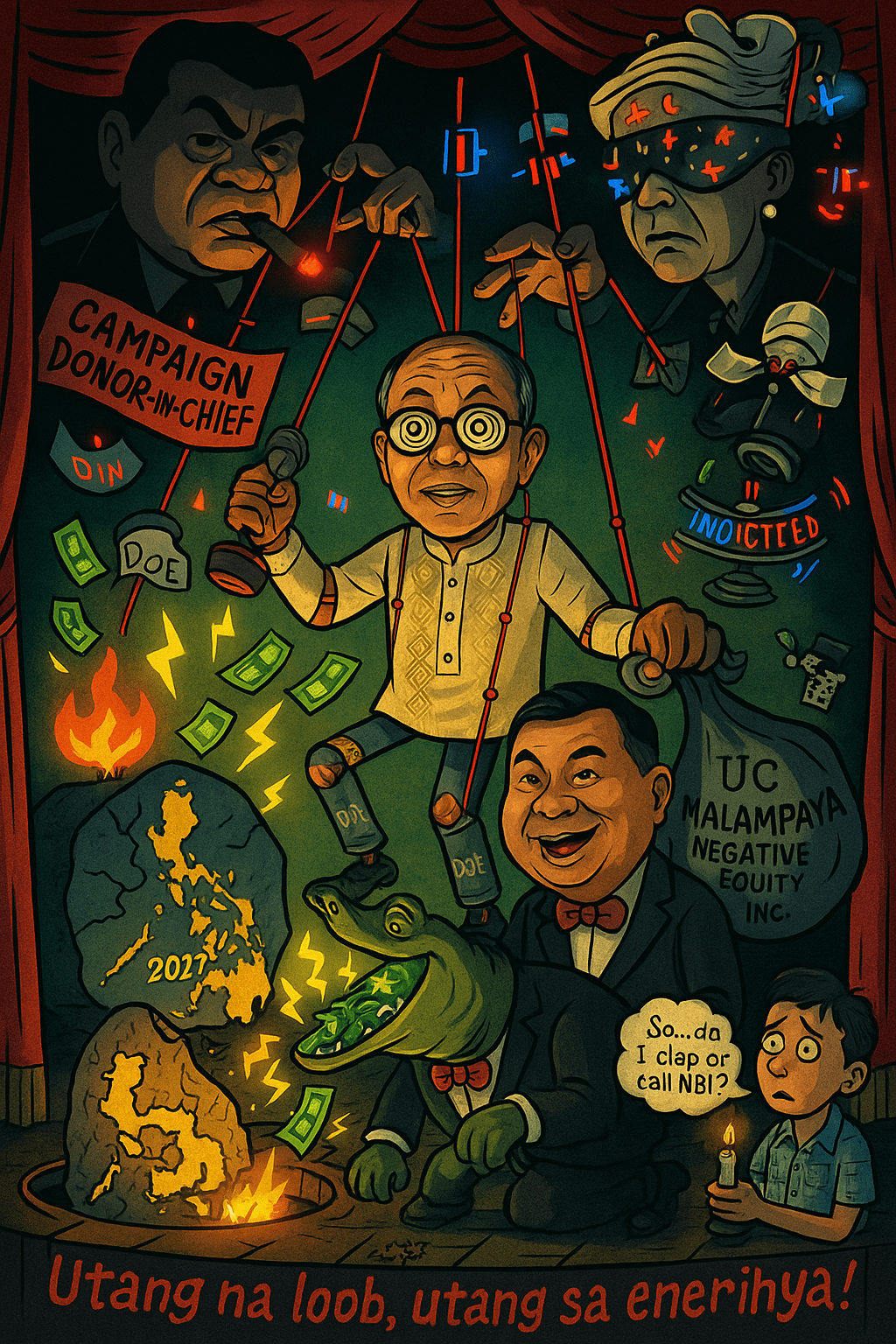
Unraveling the shady deal that traded energy security for political loyalty, with the Ombudsman’s late plot twist stealing the show.
By Louis ‘Barok‘ C. Biraogo — September 1, 2025
BUCKLE-UP, legal thrill-seekers, because the Malampaya gas field saga is a masterclass in Philippine political theater, where energy security, crony capitalism, and anti-corruption posturing collide in a spectacular mess. The Office of the Ombudsman’s November 2024 indictment of former Energy Secretary Alfonso Cusi and 11 other officials for graft over the 2019 UC Malampaya-Chevron deal has all the makings of a blockbuster scandal: a critical national asset, a Duterte-linked tycoon, and a flip-flopping Ombudsman that smells either of justice delayed or political vendetta. But is this a righteous takedown of corrupt dealmakers, or just another act in Manila’s endless game of gotcha? Let’s dissect this beast with a scalpel dipped in sarcasm, exposing the legal, ethical, and political rot at its core.
The Deal That Keeps on Giving (Headaches)
The Malampaya gas field, pumping out 20% of the Philippines’ electricity and nearly PHP 291 billion in government revenue since 2002, is no small fry. So when Cusi and his DOE cronies greenlit Udenna Corporation’s subsidiary, UC Malampaya, to snag Chevron’s 45% stake in 2019, eyebrows shot up faster than a Luzon blackout. UC Malampaya, a shell company with negative working capital, unaudited financials, and zero experience in upstream oil and gas, was somehow deemed fit to manage a national treasure. Because nothing screams “qualified” like a balance sheet in the red and a resume thinner than a campaign promise.
The Ombudsman, after dismissing the case in January 2024, did a dramatic 180 in November, charging Cusi and crew with violating Section 3(e) of RA 3019 for granting “unwarranted benefits” through “manifest partiality, evident bad faith, or gross inexcusable negligence.” The case, now filed in court as of August 2025, hinges on accusations of rushed approvals and ignored red flags, all tied to Dennis Uy’s cozy ties with former President Duterte. But wait—did the Ombudsman finally grow a spine, or is this just a new administration settling old scores?
Legal Shenanigans: A House of Cards Built on RA 3019
The Ombudsman’s Case: Negligence or Nefariousness?
The Ombudsman’s indictment rests on Section 3(e) of RA 3019, which slaps public officials with 6-15 years in jail for giving “unwarranted benefits” or causing “undue injury” through partiality, bad faith, or gross negligence. Here’s the rub: UC Malampaya was a financial dumpster fire with no technical chops, yet Cusi’s DOE waved it through like a VIP at a Duterte rally. The Ombudsman cites “undue haste” and a failure to enforce DOE Circular DC 2007-04-0003, which demands transferees have legal, financial, and technical qualifications. This smells like gross negligence, if not bad faith, especially since Malampaya’s depletion looms by 2027, making competent management non-negotiable.
Supreme Court precedent backs this up. In Uriarte v. People (G.R. No. 169251, December 20, 2006), the Court held that Section 3(e) violations can stem from deliberate disregard of rules, like ignoring a transferee’s disqualifying factors. Javier v. Sandiganbayan (G.R. No. 147026-27, September 11, 2009) nailed officials for entering disadvantageous deals, emphasizing bad faith as intentional rule-breaking. The Ombudsman’s reversal, triggered by Senator Gatchalian’s reconsideration request, is legally sound under RA 6770, Section 13(1), and Rule 112, Section 4 of the Revised Rules of Criminal Procedure, allowing new evidence to reopen cases. The “new evidence” card is a classic, but what took 10 months to uncover? A dusty ledger in a DOE basement?
Cusi’s Defense: Just Following Orders, Your Honor!
Cusi and his posse are likely to lean on the Arias v. Sandiganbayan (G.R. No. 81563, December 19, 1989) doctrine, which shields department heads from liability if they relied on subordinates’ recommendations without personal knowledge of wrongdoing. They’ll argue the DOE’s technical team vetted UC Malampaya, and they just signed the dotted line—because who has time to read financials when you’re busy running a country? Udenna’s claim that the deal was a “private share sale” not requiring strict DOE scrutiny under Presidential Decree No. 87, Section 11, is a stretch but not baseless, as parent-level transactions can skirt certain regulations. Plus, they’ll point out that Malampaya’s still pumping gas, so where’s the “undue injury” required for RA 3019?
Recent rulings, like People of the Philippines v. Juliana Acuin Villasin (G.R. No. 255567, January 29, 2024), suggest mere procedural lapses don’t always equate to gross negligence unless intent is clear. A November 2024 Supreme Court decision further clarified that Section 3(e) needs bad faith or gross negligence, not just sloppy paperwork. Cusi’s political persecution claim gains traction given the indictment’s timing under a new administration, with Uy’s Duterte donor status as the only “evidence” of partiality—hardly a smoking gun under People of the Philippines vs. Benjamin Olidan y Erlandez et al. (2024), which demands clear intent for conspiracy charges.
Ethical Dumpster Fire: Public Trust or Private Pals?
RA 6713, the Code of Conduct and Ethical Standards, is supposed to keep officials honest, but this case reads like a violation highlight reel. Section 4(a) demands prioritizing public interest, yet Cusi’s crew approved a deal that could’ve tanked a fifth of the nation’s power supply. Section 4(c) calls for justness and sincerity, but the “midnight deal” stench suggests backroom handshakes with Uy, Duterte’s campaign sugar daddy. Section 4(b)‘s professionalism mandate? Laughable when you approve a company with less oil and gas know-how than a Manila traffic enforcer. Penalties under Section 11 include fines or dismissal, but will the Sandiganbayan have the guts to enforce them?
The Ombudsman’s “turned a blind eye” finding screams ethical failure, but Cusi might argue he relied on subordinates’ expertise, per RA 6713‘s allowance for delegation. Yet, when the asset is as critical as Malampaya, isn’t “I trusted my team” a cop-out? The public deserves better than officials who play hot potato with accountability.
Political Soap Opera: Justice or Vendetta?
The political undertones are thicker than Manila smog. Cusi, a PDP-Laban bigwig, cries foul, claiming the indictment is a witch hunt by the Marcos Jr. administration to kneecap Duterte’s allies. The timing—post-2022 elections and after a 2024 dismissal—raises suspicions of selective justice. Ombudsman Samuel Martires, known for independence, isn’t exactly a Marcos puppet, but the 10-month reversal delay fuels doubts. Was new evidence really uncovered, or did political winds shift?
On the flip side, the Senate’s 2022 resolution and Gatchalian’s dogged pursuit suggest genuine concern, not just politicking. Uy’s Duterte donations and Cusi’s party role don’t prove conspiracy, but they cast a long shadow. The Ombudsman’s independence under RA 6770 is a double-edged sword: it can probe fearlessly or be weaponized for score-settling. Either way, the public’s left wondering if justice is blind or just winking at the right people.
Procedural Plot Twists: Due Process or Dawdling?
The Ombudsman’s reversal is legal under RA 6770 and Administrative Order No. 7, Rule II, Section 7, allowing reconsideration for new evidence or errors. But the 10-month gap from dismissal to indictment teeters on violating speedy disposition rights under Article III, Section 16 of the Constitution and Ombudsman rules mandating 90-180 day resolutions. Cagang v. Sandiganbayan (G.R. No. 206438, July 31, 2018) warns that undue delays can prejudice the accused, potentially grounds for dismissal if Cusi’s lawyers play hardball.
The Ombudsman’s probable cause finding only needs substantial evidence, not proof beyond reasonable doubt, which the Sandiganbayan will demand. But the lack of transparency on the “new evidence” smells fishy. Did Gatchalian dig up a golden ledger, or is this just a rehash dressed up as diligence?
Arguments For and Against the Indictment
ArgumentFor Ombudsman (Against Cusi)For Cusi (Against Indictment)Legal Basis UC Malampaya’s negative capital, unaudited financials, and no expertise violated DOE Circular DC 2007-04-0003. Uriarte and Javier support conviction for ignoring red flags. Arias doctrine protects reliance on subordinates; no clear proof of bad faith per Bacani and 2024 SC ruling. Ethical Violations RA 6713, Sections 4(a), 4(c) breached by favoring Uy over public interest, risking energy security. Delegation allowed under Section 4(b); no direct evidence of personal gain. Political Motive Senate’s 2022 resolution and Gatchalian’s probe show bipartisan concern, not just politics. Timing and Cusi’s PDP-Laban role suggest selective prosecution; Uy’s donor status isn’t proof. Procedural Fairness Reversal valid under RA 6770 and Rule 112; new evidence justified. 10-month delay risks violating speedy disposition; vague “new evidence” undermines credibility.
Broader Implications: Energy, Governance, and the Anti-Corruption Mirage
Energy Security: Teetering on the Brink
Malampaya’s looming depletion by 2027 makes this case a ticking time bomb. Approving an unqualified operator risks operational hiccups, delayed investments, and potential blackouts for millions. Enrique Razon’s 2022 stake acquisition from Uy shows the field’s still a hot potato, but legal uncertainty could scare off investors needed for extensions. The DOE’s cavalier attitude threatens a sector already plagued by mismanagement—because who needs stable power when you’ve got candles?
Governance: Accountability or Circus?
A conviction could deter future graft, signaling that even cabinet bigwigs aren’t untouchable. But an acquittal might embolden cronies, reinforcing the Philippines’ reputation as a corruption playground. The Ombudsman’s flip-flop, while legal, fuels distrust in institutions already battered by political meddling. RA 6770‘s independence is only as strong as public perception allows.
Investment Climate: Confidence or Chaos?
The indictment could boost investor trust by showing anti-corruption teeth, but it also risks chilling legitimate deals if approvals face retroactive witch hunts. The Philippines’ energy sector needs billions to transition from fossil fuels, yet bureaucratic overreach could send capital fleeing faster than a politician from a press conference.
Recommendations: Fixing a Broken System
- Judicial Clarity: The Sandiganbayan must apply People v. Bacani (G.R. No. 239878. February 28, 2022) to distinguish negligence from gross negligence, ensuring convictions rest on intent or reckless disregard, not just errors. Transparency on evidence is non-negotiable to avoid due process challenges.
- Policy Reforms:
- Independent Vetting Panels: Mandate third-party experts to evaluate energy deals, reducing DOE discretion and cronyism risks.
- Stricter RA 6713 Enforcement: Impose mandatory ethics training and harsher penalties (e.g., asset forfeiture) for violations.
- Whistleblower Protections: Strengthen RA 6713‘s framework to shield energy sector whistleblowers, encouraging early reporting of irregularities.
- Institutional Accountability: The Ombudsman must adhere to strict timelines (90-180 days per Administrative Order No. 8) to avoid delays that erode trust or violate rights. Public disclosure of reconsideration grounds would silence critics crying “politics.”
- Energy Sector Safeguards: Revise DOE Circular DC 2007-04-0003 to require audited financials and proven technical expertise, with mandatory public hearings for major concessions.
Conclusion: A Nation Held Hostage by Its Own System
The Malampaya indictment is a high-stakes gamble: a chance to nail corrupt officials or a political circus that distracts from real reform. The Ombudsman’s case has legal legs—UC Malampaya’s deficiencies and Cusi’s haste scream negligence, if not worse—but the defense’s Arias shield and political persecution claims muddy the waters. Malampaya’s fate, tied to 20% of the nation’s power, hangs in the balance as the Sandiganbayan decides whether this was gross incompetence or a deliberate sellout.
This case lays bare a system where connections trump competence, and energy security is a bargaining chip for political loyalty. The Philippines can’t afford another scandal that ends in acquittals or empty reforms. Demand transparency, enforce RA 3019 and RA 6713 with teeth, and hold the DOE accountable—or watch Malampaya’s gas run dry while cronies cash out. The clock’s ticking, and so is the nation’s patience.
Final Zinger:
If Cusi walks, it’s proof the system’s rigged. If he’s convicted, it’s a rare win against corruption. Either way, Malampaya’s future is a gamble, and the house always wins—unless the house is the Filipino people.
Key Citations
- News Report on Indictment: About-face: Ombudsman indicts Cusi, others for graft over UC Malampaya-Chevron deal (Rappler, December 11, 2024).
- RA 3019 Full Text: Republic Act No. 3019 (Anti-Graft and Corrupt Practices Act) (Official Gazette).
- Uriarte v. People (G.R. No. 169251, December 20, 2006)
- Arias v. Sandiganbayan (G.R. No. 81563, December 19, 1989)
- Javier v. Sandiganbayan (G.R. Nos. 162748-50, March 28, 2006)
- People of the Philippines v. Juliana Acuin Villasin (G.R. No. 255567, January 29, 2024)
- William Velasco Guillen v. People of the Philippines (G.R. No. 220108, August 07, 2024)
- People of the Philippines vs. Benjamin Olidan y Erlandez et al. (G.R. No. 263920, 2024)
- Cagang v. Sandiganbayan (G.R. No. 206438, July 31, 2018)
- People v. Bacani (G.R. No. 239878. February 28, 2022)
- RA 6713 Full Text: Republic Act No. 6713 (Code of Conduct and Ethical Standards) (Official Gazette).
- RA 6770 Full Text: Republic Act No. 6770 (Ombudsman Act of 1989) (Official Gazette).
- DOE Circular DC 2007-04-0003: Guidelines for Transferees in Petroleum Service Contracts (DOE, 2007).
- Presidential Decree No. 87, Section 11: Oil Exploration and Development Act of 1972 (Official Gazette).
- Cagang v. Sandiganbayan (G.R. No. 206438): Full Text (Supreme Court E-Library, July 31, 2018).

- ₱75 Million Heist: Cops Gone Full Bandit

- ₱6.7-Trillion Temptation: The Great Pork Zombie Revival and the “Collegial” Vote-Buying Circus

- ₱1.9 Billion for 382 Units and a Rooftop Pool: Poverty Solved, Next Problem Please

- ₱1.35 Trillion for Education: Bigger Budget, Same Old Thieves’ Banquet
- ₱1 Billion Congressional Seat? Sorry, Sold Out Na Raw — Si Bello Raw Ang Hindi Bumili

- “We Will Take Care of It”: Bersamin’s P52-Billion Love Letter to Corruption

- “Skewed Narrative”? More Like Skewered Taxpayers!

- “Scared to Sign Vouchers” Is Now Official GDP Policy – Welcome to the Philippines’ Permanent Paralysis Economy
- “Robbed by Restitution?” Curlee Discaya’s Tears Over Returning What He Never Earned

- “No Pressure” Luistro? The House Pork Bazaar Exposed
- “My Brother the President Is a Junkie”: A Marcos Family Reunion Special

- “Mapipilitan Akong Gawing Zero”: The Day Senator Rodante Marcoleta Confessed to Perjury on National Television and Thought We’d Clap for the Creativity



 KWEBA ni BAROK
Leave a comment