By Louis ‘Barok‘ C. Biraogo — September 6, 2025
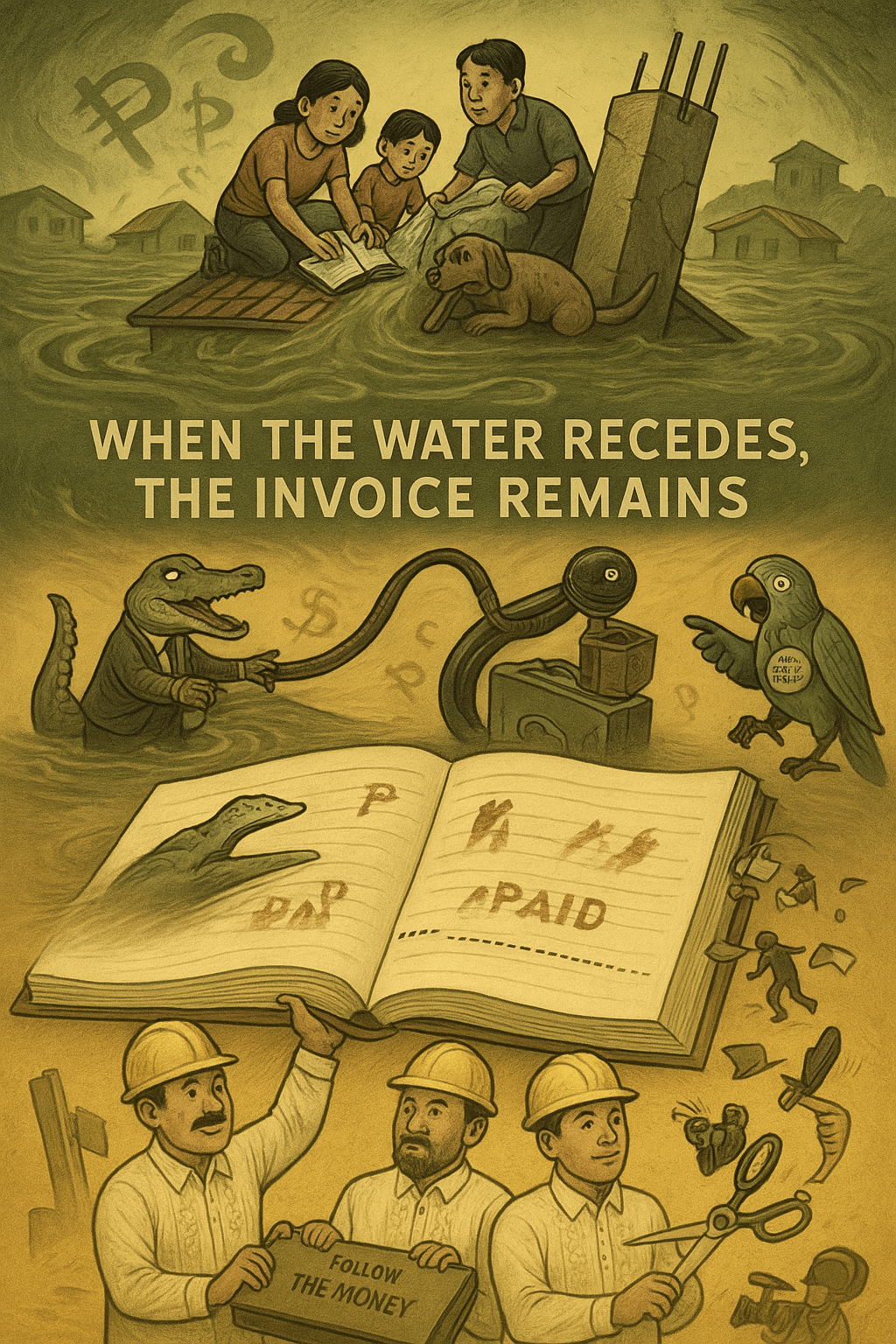
THEY climbed out of the water and found the family dog clinging to a floating bookshelf. The bookshelf was holding the photo albums; the albums had the children’s kindergarten pictures, the bus receipts for a year of missed work, and a note from a father who had promised a new roof last Christmas.
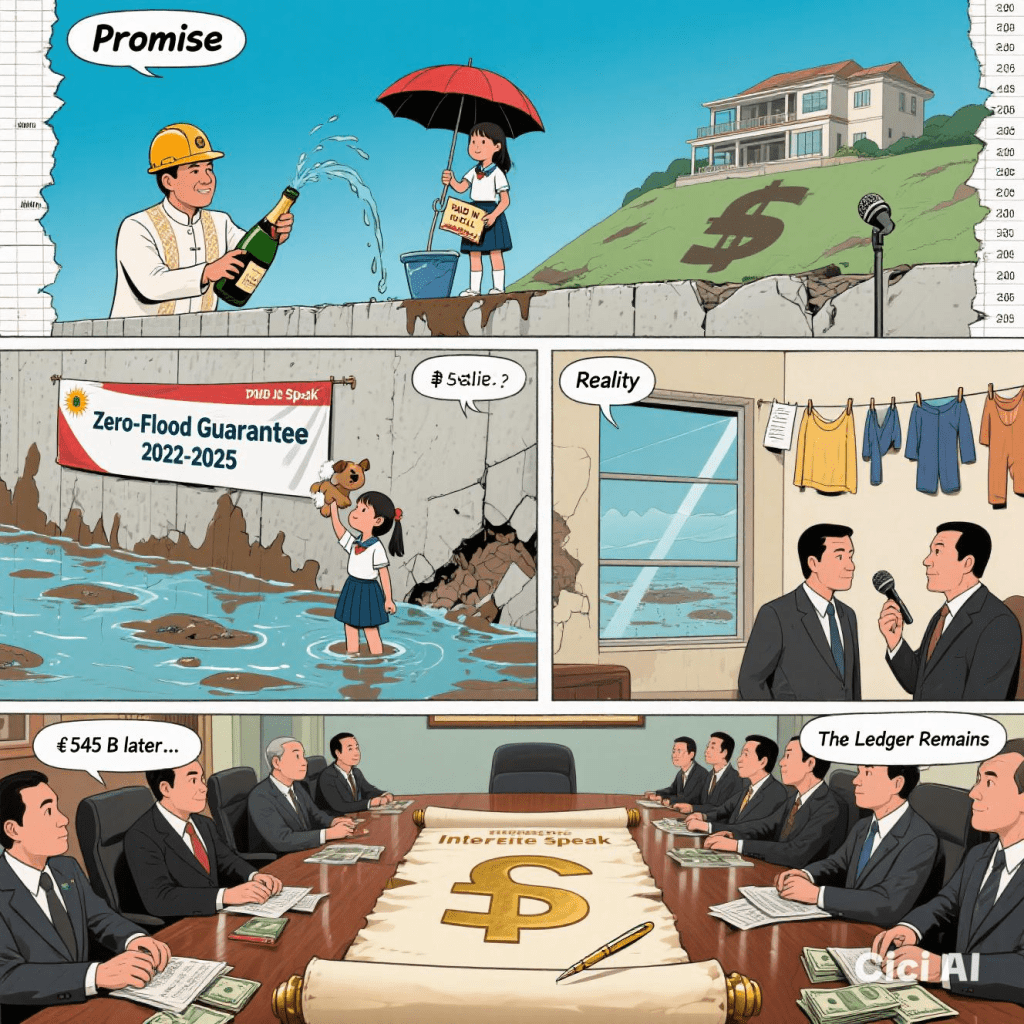
The plywood shack where the family had slept for six years was half-submerged, mangled by the same flood that the government had promised would never reach them again. On the far side of town, a concrete structure that was supposed to divert the river and protect neighborhoods had buckled and collapsed like a wet cookie—an expensive folly whose contractor had already built a villa on the hill.
That concrete wall, according to auditors and whistleblowers, existed more as an invoice than as engineering. It was the kind of “project” that sits neatly on a procurement list, disappears into some district ledger, and becomes a wealth-making machine for the politically connected. It is not an accident that families are losing everything; it is the intended outcome when infrastructure becomes a gravy train.
The theft is not abstract. It is wet, and stinks like mold and rot, and carries children’s shoes downstream.
When the Elite Finally Speak
Recently, thirty of the Philippines’ most influential business and civic organizations broke the long, embarrassed silence of the elites and issued a joint condemnation of what they called “shameful, unabated, continuing and excessive” graft in government projects. That statement is newsworthy—not because it reveals something new, but because the insiders are finally whispering what everyone else already knew.
When the beneficiaries of the status quo begin to plead for reform, you should sit up and take notice. It isn’t moral heroism. It is desperation.
The Arithmetic of Theft
The scale is daunting. The Palace audit and subsequent reporting put the value of questioned flood-control projects at roughly ₱545 billion spent between 2022 and May 2025—money meant to protect communities, much of it apparently paid for projects that were shoddy, incomplete, or never built. That is not just a fiscal scandal; it is a moral one.
Put that number another way: ₱545 billion could have funded about 27,250 basic public schools (at a conservative ₱20 million each), or 1,090 district hospitals (at ₱500 million apiece), or 10,900 kilometers of resilient flood channels at roughly ₱50 million per kilometer. Instead, it helped lubricate a system in which a small number of contractors captured an outsized share of projects, stamped invoices, and left concrete promises to rot.
These numbers are the arithmetic of suffering. They ought to be shouted from rooftops and carved on the stone memorials for the lives lost in flood events like the July 2024 monsoon—Carina disaster, which drenched Manila and surrounding provinces and displaced hundreds of thousands. The rains came not only with weather but also with the human consequences of stolen mitigation funds.
The Insiders Speak—Out of Panic, Not Virtue
So what did the thirty business groups propose? Their six-point plan reads like the menu of a reform conference: help identify the guilty, support voter education, gather evidence for criminal cases, blacklist corrupt contractors, endorse an Integrity Pledge for industry leaders, and urge banks and the Anti-Money Laundering Council to “follow the money.”
On first reading it sounds promising—civic virtue meets private capacity. But the devil is in the details, and the devil has a construction license.
Blacklists: A Blunt Instrument Prone to Abuse
Consider the private-sector blacklist. On paper it will punish repeat offenders and protect honest bidders. In practice, a private-sector blacklist without judicial safeguards is vigilante justice with letterhead.
Who draws up the list? Who ensures due process? How will appeals work? Too easily this tool becomes a cudgel wielded by rival cartels and politically favored firms to knock out competitors. A market-enforced blacklist could simply reconfigure, rather than remove, the capture.
Pledges: Performative and Powerless Without Teeth
The Integrity Pledge is worse if we are honest about human incentives. Signing a pledge against bribery is like promising to stop taking oxygen when you are the one fueling the combustion. Without independent monitoring, real sanctions, and legal consequences, a pledge is ceremonial moralizing—a press release for shareholders and donors.
It is meaningful only if tied to compliance systems: audits, whistleblower protections, and public reporting that is auditable by independent watchdogs. Otherwise it’s virtue signaling with a glossy certificate.
Following the Money: Necessary, but Banks Have Incentives
And what of urging the banks and the AMLC to expose laundering? This is vital: following the money is often the only route to accountability. Yet banks profit from powerful clients; their incentives run the other way unless compelled by law or the fear of penalties. The AMLC has the legal tools but not necessarily the public will.
Calling on these institutions to act is necessary, but insufficient—and it risks giving the impression that private groups can outsource law enforcement to financial institutions while avoiding the risks of legal accountability themselves.
Complicity and the Inconvenient Truth
There is also an unspoken hypocrisy in the business groups’ public posture that must be named plainly. The private sector is not a neutral, principled force divorced from patronage. Some businesses have been part of the bargain that made this corruption possible: paying to win, renting out credentials, or turning a blind eye to bid-padded contracts.
When such groups now denounce corruption, one must ask: did their silence stem from impotence, complicity, or calculation? The answer matters. Moral leadership is not a press release; it is courage to endure loss of profits and influence for the sake of public goods. If the new zeal is a tactic to reconfigure which firms control public works rather than to end the practice, then the outing of corruption could simply rearrange who profits.
This isn’t some intellectual exercise in cynical sociology. It is practical and murderous. Corruption in flood projects literally kills people. It consigns whole neighborhoods to repeated displacement and deepening poverty. It siphons off funds that could have paid teachers, stocked clinics, and built drainage that lasts more than a season. It distorts investment priorities, inflates costs, and corrodes trust in institutions supposed to safeguard the commonwealth.
What Genuine Courage Looks Like
So what would real, meaningful action look like? Here are practical yardsticks:
- Independent statutory commission. Not an ad-hoc panel with gentle recommendations, but a commission with subpoena power, forensic accounting muscle, and a time-bound mandate to investigate specific years and projects. This should be legislated so it is insulated from political winds.
- Channel evidence properly. If private groups have documentation, they must deliver it through secure, legal channels (the Ombudsman, DOJ, COA) with strict chain-of-custody procedures—not via press leaks that create spectacle but destroy legal cases.
- Transparent blacklisting protocol. If blacklists must exist, they should be harmonized with government debarment lists and governed by clear, objective criteria, with notice, right to respond, and independent review. Due process matters, because a misused blacklist harms the innocent and empowers the corrupt to cry “persecution.”
- Genuine compliance, not pledges. Require signatories to publish anti-bribery policies, third-party audit results, and conflict-of-interest registers. Make integrity a procurement criterion, not a press event.
- Protect whistleblowers and journalists. Too many brave people who expose graft face intimidation and legal harassment. Change the incentives: make whistleblower protections real, and stop the strategic lawsuits against public participation (SLAPPs) that silence reporters.
- Follow the money—legally and openly. Strengthen AML reporting rules, fund the AMLC and forensic accountants, and do not let bank confidentiality become a shield for the corrupt. But this must be done inside the law; selective outing on social media or by non-competent actors risks undermining prosecutions.
There is also a political reality. Business groups can accelerate reform if they do three things: disclose conflicts of interest within their own ranks; commit publicly to providing defensible forensic support to prosecutors rather than just headlines; and pledge to back structural reforms that cut opportunities for rent-seeking, including procurement transparency and competitive public tendering.
The Real Test
I am not saying that private pressure is useless. On the contrary: when business leaders break ranks it can create momentum for reform, reduce political cover for the corrupt, and make prosecutions feasible. But to achieve that, private actors must accept scrutiny themselves. They must be willing to be investigated, to publish their conflict registers, and to risk losing profits by insisting on clean bidding.
Courage looks different when it costs you money.
Finally, for the families who are now rebuilding by salvaging soggy schoolbooks and drying out uniforms, justice will not come from platitudes. They need durable infrastructure, functioning schools, health clinics, and restitution. They need prosecutions that end impunity and restitution that rebuilds what was stolen. Until those things happen, the business groups’ declarations are a welcome but incomplete moral gesture.
When a coalition of the powerful finally speaks up about a theft they tolerated for so long, pay attention—but do not be fooled into thinking that a pledge and a press conference will build what decades of pilfering destroyed. The test will be whether those groups fund the independent investigations, surrender evidence to legitimate prosecutors, and accept reforms that shrink the space for rent-seeking—even at cost to their own bottom lines.
If they do that, the tears of the flood victims might one day dry on firm, honest ground. If they do not, then all the apologies in the world will merely be a new, polished invoice in a ledger that still belongs to the thieves.
The waters recede, but the choices remain.
Key Citations
- BusinessWorld — Bonoan resigns; Dizon named as DPWH chief (coverage of DPWH leadership changes).
- Reuters — Philippine groups demand independent investigation of ‘excessive corruption’ in government projects (overview of the 30-group statement and Palace audit).
- Philippine Daily Inquirer — 30 business groups condemn corruption in Philippine bureaucracy (text of statement; six-point plan).
- Philippine Daily Inquirer — Flood of plunder: Billions paid for projects existing only on paper (detailed reporting on ₱545.64B and problematic projects).
- PAGASA — Preliminary report on Tropical Cyclone Carina (2024) (rainfall and flood impacts).
- Philippine Daily Inquirer — Senate subpoenas 5 contractors, 3 DPWH execs in flood probe (legislative action to compel witnesses).
- The Diplomat — Philippine Business Groups Call For Action on ‘Excessive’ Corruption (analysis).

- ₱75 Million Heist: Cops Gone Full Bandit

- ₱6.7-Trillion Temptation: The Great Pork Zombie Revival and the “Collegial” Vote-Buying Circus

- ₱1.9 Billion for 382 Units and a Rooftop Pool: Poverty Solved, Next Problem Please

- ₱1.35 Trillion for Education: Bigger Budget, Same Old Thieves’ Banquet

- ₱1 Billion Congressional Seat? Sorry, Sold Out Na Raw — Si Bello Raw Ang Hindi Bumili

- “We Will Take Care of It”: Bersamin’s P52-Billion Love Letter to Corruption
- “Skewed Narrative”? More Like Skewered Taxpayers!

- “Scared to Sign Vouchers” Is Now Official GDP Policy – Welcome to the Philippines’ Permanent Paralysis Economy
- “Robbed by Restitution?” Curlee Discaya’s Tears Over Returning What He Never Earned

- “No Pressure” Luistro? The House Pork Bazaar Exposed
- “My Brother the President Is a Junkie”: A Marcos Family Reunion Special

- “Mapipilitan Akong Gawing Zero”: The Day Senator Rodante Marcoleta Confessed to Perjury on National Television and Thought We’d Clap for the Creativity


 KWEBA ni BAROK
Leave a comment