By Louis ‘Barok‘ C Biraogo — September 7, 2025
THE water came fast, as it always does in the low-lying barangay of Navotas. One moment, children were playing by the seawall. The next, a torrent burst through, the floodgate buckling like paper. Families scrambled to the rooftops, clutching pots and plastic bags of rice, watching as their homes sank beneath the brown tide. It was supposed to have been prevented by a ₱300-million flood-control project. But the concrete was thin, the rebar missing. A mother told me: “They built this to fail. And we pay with our lives.”
That failed floodgate is not a tragedy of nature. It is a crime scene. It is part of a sprawling scandal in which billions of pesos earmarked for flood protection have instead gone into “ghost” projects, overpriced contracts, and the bank accounts of favored contractors. Nearly 10,000 flood-control projects were budgeted in recent years, costing over half a trillion pesos. At least 6,000 turned out to be defective, unfinished, or simply non-existent. One firm alone, owned by the Discaya family, took in ₱25 billion worth of contracts and paraded around in a fleet of luxury cars.
And now, amid the wreckage of drowned neighborhoods and ruined livelihoods, the scandal has set off a civil war within the Philippine elite itself: between President Ferdinand “Bongbong” Marcos Jr. and his cousin, House Speaker Martin Romualdez.
The Facts of the Scandal
Let’s begin with the basics. The Department of Public Works and Highways allocated ₱545 billion for flood-control between 2022 and 2025. Audits found that hundreds of billions vanished into anomalies: river walls built in places that never flood, slope protection for already-completed projects, “multi-year programs” suddenly stripped of funding midstream. Typhoons this July displaced 300,000 people and killed 26—not just because of bad weather, but because protection systems were never built.
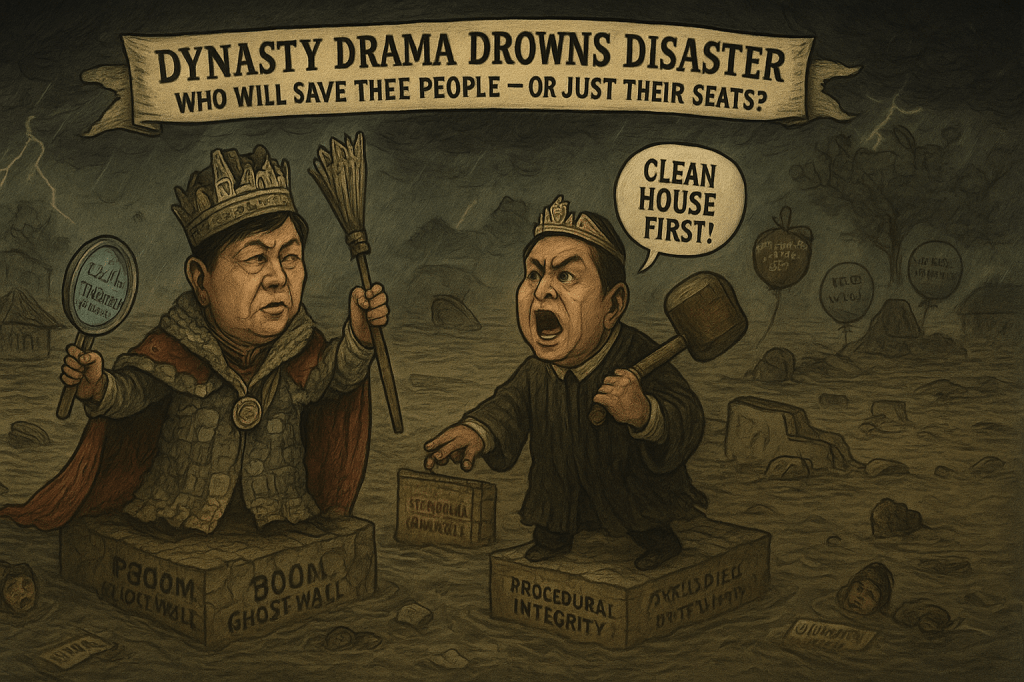
President Marcos, facing outrage, accepted the resignation of his public works secretary, vowed to prosecute, and promised an independent commission. His Executive Secretary, Lucas Bersamin, went further, publicly rebuking the House of Representatives for “political theatrics” and demanding it “clean your house first.”
The House, led by Romualdez and his lieutenants, countered by moving to return the ₱6.7-trillion 2026 budget to the Department of Budget and Management, citing errors and duplications. They framed it as procedural integrity. The Palace calls it obstruction. Both claim to fight corruption. Both have reason to hide.
The Palace’s Argument—and Its Flaws
The Marcos administration insists it is acting decisively: replacing officials, blacklisting contractors, and ordering probes. It has audit data and shocking site inspections on its side. In Bulacan, the President himself visited a “ghost” project: a ₱96-million river wall that exists only on paper.
But there is a risk this crusade is more theatre than reckoning. The danger is selective justice: targeting contractors tied to Romualdez or Duterte allies, while sparing those linked to the Palace. That would turn reform into weaponized politics. And let’s not forget—the executive spent ₱545 billion in three years without catching the rot until the media and floods made it unavoidable.
The House’s Argument—and Its Hypocrisy
The House claims to defend procedure, to ensure budgets are clean before deliberation. On paper, that is true: it has every right to return a flawed spending plan. But these same lawmakers are also the ones who benefit from pork-barrel insertions, who control committee hearings, and who pressure agencies to funnel contracts to their favored firms. Conflict of interest doesn’t begin to describe it.
Bersamin’s retort—“clean your house first”—may be crude, but it lands. The House’s sudden zeal for budgetary hygiene reeks of self-preservation.
This Isn’t New—It’s Déjà Vu
We’ve been here before. In 2013, the pork-barrel (PDAF) scandal revealed ₱10 billion siphoned off through fake NGOs. Filipinos flooded the streets in the Million People March, and the Supreme Court abolished PDAF. For a moment, reform felt possible. And yet, the system adapted. Pork was reborn as “insertions” and “slush funds,” hidden in the fine print of the budget.
The flood-control scandal is PDAF reborn on steroids: bigger sums, more brazen ghost projects, and more lives lost.
We’ve also been here in a darker sense. During the Marcos dictatorship, billions were stolen through crony contracts, from the Bataan Nuclear Plant to sugar monopolies. Historical denialism has tried to launder that kleptocracy into nostalgia. But when water rushes through a collapsed seawall, history intrudes. Corruption kills.
Dynasties at War, People Forgotten
Some analysts see this as a family quarrel. After all, Marcos and Romualdez are cousins. But it is less Shakespeare than Sopranos: rival clans bickering over spoils, while the public suffers. The BTI Governance Index notes that Philippine politics remains dominated by dynasties—Marcoses, Romualdezes, Dutertes, Arroyos—who rotate offices like a family heirloom.
When Bersamin accuses the House of corruption, and when the House accuses the Palace of budget tampering, both may be right. What we are witnessing is not reform, but elite fracture: the moment when rival factions stop protecting each other and start weaponizing scandal for political advantage.
The Implications
Where does this end? Several scenarios loom:
- A credible, independent commission with subpoena powers could prosecute contractors and politicians alike. That’s the best outcome—but history suggests it is also the least likely.
- More probable is an elite bargain: some firings, some scapegoats, a cosmetic budget redo, and business as usual.
- Or the feud could spiral into a leadership challenge in the House, destabilizing governance further.
- The most dangerous possibility is paralysis: a reenacted budget, stalled infrastructure, and growing public fury.
Already, civil society is stirring. Youth groups march under banners reading “No More Ghosts.” Business leaders warn that investor confidence is collapsing. Ordinary families, their homes underwater, whisper of a government that protects dynasties but cannot build a proper floodwall.
Lessons From the Past
The PDAF scandal showed that outrage can spark reform if it is sustained. The Estrada impeachment in 2000 proved corruption can topple a president. But the Marcos dictatorship itself showed that entrenched dynasties will sacrifice democracy before surrendering their spoils.
The question now is whether the flood-control scandal becomes another moment of containment or a turning point. Will Filipinos once again accept elite horse-trading—or will they demand something bolder?
What Must Be Done
President Marcos has a choice. He can treat this as another PR problem, contain it, and protect his kin. Or he can make history.
A credible path forward requires not just scapegoats but a roadmap of reform:
Short-Term Fixes (Next 12 Months)
- Independent Commission: Establish a body with subpoena powers, chosen not by Malacañang or Congress but via a transparent process involving civil society, academia, and the judiciary.
- Full Disclosure: Publish all audit findings, contractor lists, and project documents online. Filipinos deserve to see where every peso goes.
- Immediate Prosecutions: File charges against both contractors and government officials implicated in ghost projects, with no exemptions for political allies.
Medium-Term Reforms (1–3 Years)
- Procurement Overhaul: Replace the current bidding system, riddled with “friendly” contractors, with an electronic, fully transparent platform where bids are public in real time.
- Lifetime Blacklists: Enforce permanent bans on firms proven to defraud the government, and criminally charge executives, not just their shell companies.
- Budget Transparency Law: Mandate the publication of all “insertions” and amendments in the national budget, with a public ledger of who proposed each one.
Long-Term Structural Change (3–10 Years)
- Anti-Dynasty Legislation: Finally enact the constitutional mandate banning political dynasties, so that governance is not captured by a handful of families.
- Campaign Finance Reform: Curb the dependency on contractor donations that fuel the pork-barrel cycle. Require real-time disclosure of political contributions.
- Disaster-Resilient Infrastructure Policy: Shift from pork-driven flood projects to a national, science-based master plan guided by independent engineers, not politicians.
A Final Question
The waters of Manila Bay will rise again with the next storm. The only question is: will the seawalls hold, or will they collapse once more under the weight of corruption?
And perhaps an even deeper question: will President Marcos allow investigators to follow the money all the way to his allies—and, if necessary, to his own family’s door?
The view from a rooftop in Navotas is a brutal indictment of failed leadership. Below, the floodwaters. Above, empty promises. For the families waiting there, and for a nation all too familiar with this cycle, the question is no longer about the weather, but about power: how long will the people allow their futures to be drowned by the weight of a single family’s ambition?

- ₱75 Million Heist: Cops Gone Full Bandit

- ₱6.7-Trillion Temptation: The Great Pork Zombie Revival and the “Collegial” Vote-Buying Circus

- ₱1.9 Billion for 382 Units and a Rooftop Pool: Poverty Solved, Next Problem Please

- ₱1.35 Trillion for Education: Bigger Budget, Same Old Thieves’ Banquet

- ₱1 Billion Congressional Seat? Sorry, Sold Out Na Raw — Si Bello Raw Ang Hindi Bumili

- “We Will Take Care of It”: Bersamin’s P52-Billion Love Letter to Corruption

- “Skewed Narrative”? More Like Skewered Taxpayers!

- “Scared to Sign Vouchers” Is Now Official GDP Policy – Welcome to the Philippines’ Permanent Paralysis Economy

- “Robbed by Restitution?” Curlee Discaya’s Tears Over Returning What He Never Earned

- “No Pressure” Luistro? The House Pork Bazaar Exposed
- “My Brother the President Is a Junkie”: A Marcos Family Reunion Special

- “Mapipilitan Akong Gawing Zero”: The Day Senator Rodante Marcoleta Confessed to Perjury on National Television and Thought We’d Clap for the Creativity




 KWEBA ni BAROK
Leave a comment