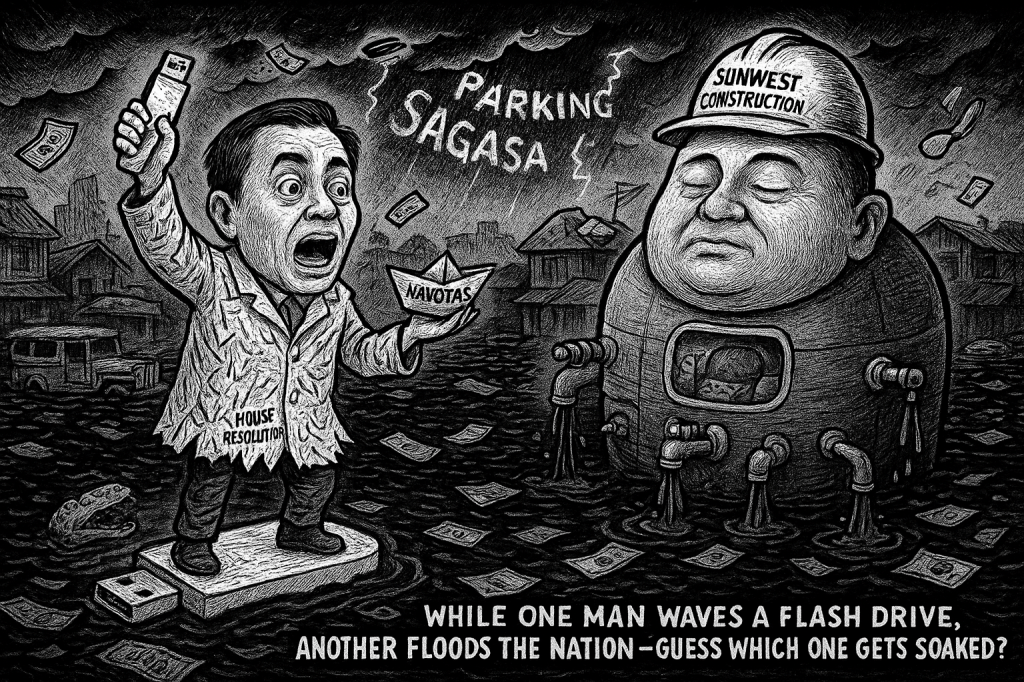
When a whistleblower with baggage meets a power broker with billions, the Philippines drowns in more than just rainwater
By Louis ‘Barok‘ C. Biraogo — September 10, 2025
I. The Floods that Never End
Every rainy season, Filipinos brace for the familiar nightmare: streets morph into rivers, classrooms into evacuation centers, and homes into swimming pools. In Navotas, a mother lifts her child onto a floating refrigerator while her husband clings to the rafters of their flooded house. In Marikina, families wade through thigh-deep water, clutching sacks of rice in one hand and toddlers in the other. In Pampanga, farmers mourn fields once green with rice now buried under muddy torrents.
Year after year, billions are poured into “flood control” projects. Yet year after year, the floods get worse. Where does all that money go?
This week, Navotas Rep. Toby Tiangco claimed he had the answer—or at least part of it. Armed with a flash drive and a flair for drama, he told the Senate Blue Ribbon Committee that ₱13.8 billion worth of flood-control “insertions” in the 2025 budget could be traced back to a single man: Zaldy Co, the former chair of the House appropriations committee.
II. The Allegations
Tiangco’s claim was simple but explosive: massive sums for flood-control projects appeared in congressional districts where the elected representatives swore they never asked for them. In political slang, this was either “parking” (funds temporarily housed in a district for later diversion) or “sagasa” (funds rammed into a district without its representative’s consent).
In theory, budget allocations should match the requests of lawmakers who know their districts’ needs. If a project is in Marikina, its congressman should have requested it. If it’s in Pampanga, the local representative should be accountable for it. But Tiangco said the paper trail led instead to Co.
The hearing might have been routine legislative theater—except that Tiangco produced files the House itself had barred him from presenting in a previous inquiry.
And then came the silence. Co, conveniently, was absent—said to be “under medical care” in the United States. No testimony, no confrontation, only shadows and allegations.
III. Who Is Zaldy Co?
For many Filipinos, the name Zaldy Co barely registers. Yet in political circles, it has long been synonymous with clout. As appropriations chair, Co controlled the House’s most powerful lever: the national budget. In a system where money translates to patronage, loyalty, and survival, the appropriations chair is less a legislator than a kingmaker.
His family’s construction firm, Sunwest Construction, has long been linked to Department of Public Works and Highways (DPWH) projects, raising perennial whispers of conflict of interest. Reports dating back more than a decade flagged Sunwest as a frequent winner of government contracts. Co has always denied wrongdoing, but the perception lingers: that he straddles the line between public office and private profit.
Now, Tiangco’s revelation threatens to put those suspicions under a harsher light.
IV. Who Is Toby Tiangco?
But what of the accuser? Toby Tiangco is no innocent. A former mayor and a seasoned lawmaker, he has weathered his share of controversies. He was once a close ally of ex-Vice President Jejomar Binay, defending him even as corruption scandals swirled. His own political dynasty in Navotas has been accused of wielding local patronage with a heavy hand.
So why the sudden crusader act?
One theory is idealism: Tiangco genuinely wants to expose a rot that has long plagued Congress. Another is politics: having lost clout in the House, he may see Co’s downfall as his redemption. A third is survival: by painting himself as reformist, he shields himself from accusations about his own turf.
The truth may be all three. In Philippine politics, motives are rarely pure.
V. A History of Budget Scandals
To understand the weight of these allegations, recall history. The Philippines has been here before—again and again.
- The Pork Barrel Scam (2013): Janet Lim-Napoles infamously engineered the Priority Development Assistance Fund (PDAF) racket, where lawmakers’ funds for community projects were funneled into ghost NGOs. Billions vanished, and several senators landed in jail.
- “Parking” Allegations (2018–2019): Lawmakers accused each other of “parking” billions in favored agencies or districts to channel funds discreetly. Then-Budget Secretary Benjamin Diokno himself was accused of facilitating questionable allocations.
- The Flood Control Bonanza: For years, the DPWH has been notorious for bloated flood-control budgets. Billions are allocated annually, yet year after year, Metro Manila drowns. Engineers joke grimly that “flood control” has become the new pork barrel.
Against this backdrop, Tiangco’s claims don’t sound far-fetched—they sound depressingly familiar.
VI. The Legal Terrain
If Tiangco is right, several laws may be implicated:
- Article 170, Revised Penal Code (Falsification): If documents misrepresent proponents or beneficiaries, this could amount to falsification of public documents.
- RA 3019, Anti-Graft and Corrupt Practices Act: Allocating funds for personal benefit, or conspiring with contractors, could fall under corrupt practices.
- RA 6713, Code of Conduct for Public Officials: Conflict of interest rules may apply if Co’s ties to Sunwest overlap with his appropriations role.
But proving intent and conspiracy is another matter. Philippine corruption cases often wither in court, buried under motions, delays, and “medical leaves.”
VII. Tiangco: Whistleblower or Political Opportunist?
Whistleblower:
- His evidence allegedly shows mismatches between proponents and project locations.
- Multiple lawmakers deny authorship of the insertions.
- Co’s absence raises suspicion of evasion.
Opportunist:
- Tiangco’s political motives are suspect.
- “Parking” and “sagasa” can be hard to prove—projects could still be defensible as “national priorities.”
- Co has not yet had the chance to publicly rebut the allegations.
The truth may lie in the messy middle: systemic abuse that is normalized until someone, for reasons noble or self-serving, decides to cry foul.
VIII. The Consequences
For Tiangco, the risks are real. If his evidence falters, he could be accused of defamation, political grandstanding, or even violating House rules. His enemies in the House may close ranks to isolate him further.
For Co, the stakes are higher. If the allegations stick, he could face graft charges, suspension, or worse. His political career—and perhaps his business empire—hangs in the balance.
But for the Filipino people, the consequences are worst of all. Every peso misallocated is a canal left clogged, a pump left broken, a dike left unbuilt. Corruption here does not merely steal—it drowns.
IX. What Must Be Done
Enough. Filipinos deserve more than crocodile tears and recycled scandals.
- Audit the flash drive. A full forensic probe, preferably by an independent body, must verify every byte.
- Suspend the releases. The Department of Budget and Management (DBM) should withhold the Special Allotment Release Orders (SARO) and Notices of Cash Allocation (NOCA) tied to disputed projects until their legitimacy is established.
- Prioritize a real-time audit. The Commission on Audit (COA) should conduct a special audit and issue Audit Observation Memoranda (AOM) or Notices of Suspension (NOS) to flag questionable disbursements before they vanish into private pockets.
- File cases. The Ombudsman must investigate Zaldy Co, his allies, and the contractors, and if warranted, seek court orders to stop further releases. No more hearings without handcuffs.
- Reform the rules. Abolish the opaque “small committee” process that breeds ghost insertions. Every peso must have a named proponent accountable in public.
- Follow the money. Journalists and civil society must hound the trail, expose the beneficiaries, and shame the enablers.
X. A Nation at the Crossroads
The Philippines faces a stark choice. It can treat Tiangco’s revelations as just another episode in the long-running telenovela of corruption—a spectacle to be consumed, debated, and forgotten. Or it can seize this moment to confront the systemic rot that keeps the nation submerged.
The floodwaters are rising. The question is whether Filipinos will let corruption drown them yet again—or whether this time, finally, the tide will turn.
Key Citations:
- Inquirer.net, September 8, 2025: Zaldy Co is proponent of P13.8B insertions in 2025 budget – Tiangco
- Wikipedia: Pork barrel scam
- Manila Standard, December 14, 2018: ‘Parking’ budget scheme bared
- GMA News, September 8, 2025: Makati Business Club flags DPWH budget increases
- Article 170, Revised Penal Code (Falsification)
- RA 3019, Anti-Graft and Corrupt Practices Act
- RA 6713, Code of Conduct for Public Officials

- “Forthwith” to Farce: How the Senate is Killing Impeachment—And Why Enrile’s Right (Even If You Can’t Trust Him)

- “HINDI AKO NAG-RESIGN!”

- “I’m calling you from my new Globe SIM. Send load!”

- “Mahiya Naman Kayo!” Marcos’ Anti-Corruption Vow Faces a Flood of Doubt

- “Meow, I’m calling you from my new Globe SIM!”

- “No Special Jail for Crooks!” Boying Remulla Slams VIP Perks for Flood Scammers

- “PLUNDER IS OVERRATED”? TRY AGAIN — IT’S A CALCULATED KILL SHOT

- “Several Lifetimes,” Said Fajardo — Translation: “I’m Not Spending Even One More Day on This Circus”

- “Shimenet”: The Term That Broke the Internet and the Budget

- “We Did Not Yield”: Marcos’s Stand and the Soul of Filipino Sovereignty

- “We Gather Light to Scatter”: A Tribute to Edgardo Bautista Espiritu

- $150M for Kaufman to Spin a Sinking Narrative

 KWEBA ni BAROK
Leave a comment