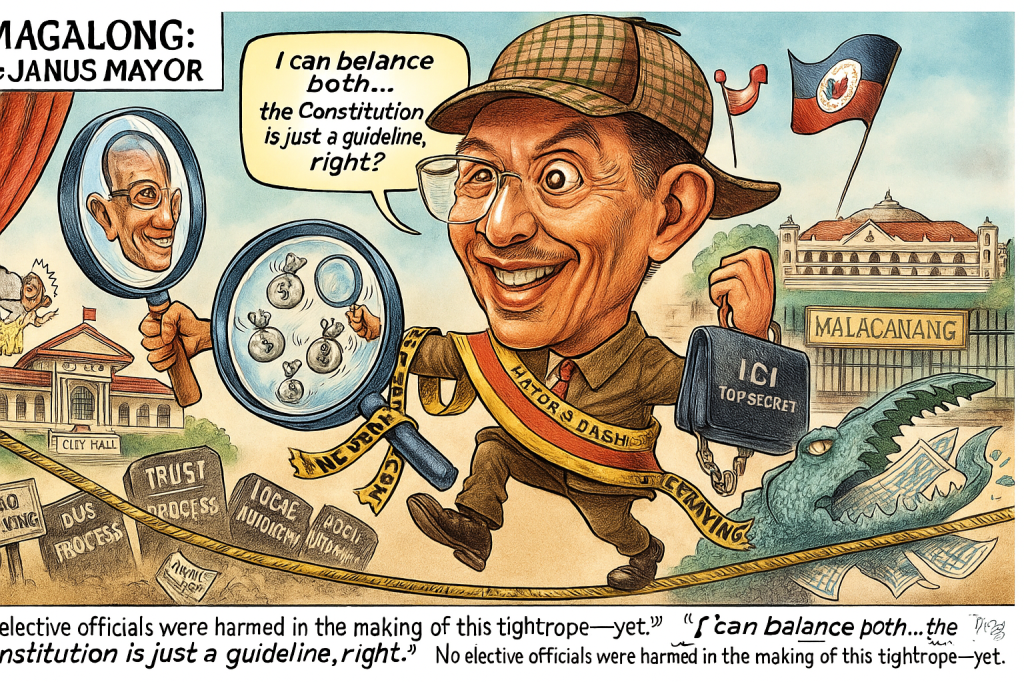
Mayor by Day, Malacañang’s Sleuth by Night: Magalong’s Constitutional Tightrope
By Louis ‘Barok‘ C. Biraogo — September 15, 2025
IN THE high-stakes drama of Philippine politics, where every move is a calculated scene in an endless teleserye, Baguio City Mayor Benjamin Magalong has found himself cast as both hero and villain. His appointment as special adviser and investigator to the Independent Commission for Infrastructure (ICI) under Executive Order (EO) No. 94 (2025) has sparked a constitutional firestorm. [77] The Federation of Free Workers (FFW), a labor union, cries foul, demanding he choose between his mayoral throne and this shiny new Malacañang badge. Is this a bold anti-corruption gambit or a constitutional overreach destined to crash like a poorly planned flyover? Let’s dissect this palabas with the precision of a University of the Philippines Diliman Ivory Tower Know-It-All and the gritty edge of a Davao street pundit.
A Constitutional Clash in the City of Pines
Picture this: Baguio’s cool mountain air, usually a balm for the soul, now crackles with tension. Mayor Benjamin Magalong, the former Philippine National Police (PNP) officer who sniffed out “ninja cops” and exposed a local parking fee scam, has been tapped by Malacañang to play Sherlock Holmes for the ICI, a body tasked with probing infrastructure anomalies nationwide. But the FFW, like a righteous tita clutching the 1987 Constitution, demands he resign as mayor, citing a clear ban on dual office-holding. This isn’t just a legal spat—it’s a high-wire act between Magalong’s anti-corruption cred, Malacañang’s political chess, and the sanctity of the Constitution. Will Magalong’s double life unravel, or is this just another episode in the Philippines’ never-ending political soap opera?
Legal Deconstruction: A Constitutional No-No or a Pragmatic Pass?
The Ironclad Rule of One Job at a Time
Let’s start with the law, because in this country, the Constitution is the ultimate script. Article IX-B, Section 7 of the 1987 Philippine Constitution states: “No elective official shall be eligible for appointment or designation in any capacity to any public office or position during his tenure, unless otherwise allowed by law or by the primary functions of his position.” Section 94(a) of Republic Act (RA) No. 7160, the Local Government Code of 1991, echoes this, barring local officials from holding additional government posts unless explicitly permitted. The FFW’s argument is textbook: Magalong, as an elected mayor, can’t moonlight as an ICI investigator without violating this sacred rule. [10] [37] [78]
The Supreme Court (SC) doesn’t play favorites here. In Civil Liberties Union v. Executive Secretary (G.R. No. 83896, 1991), the Court struck down concurrent appointments of Cabinet members to ex officio posts, emphasizing that the ban is absolute unless the law carves out a specific exception. [71] Similarly, Funa v. Agra (G.R. No. 191644, 2013) voided a dual appointment as Acting Justice Secretary and Solicitor General, citing the incompatibility of roles. [67] EO 94, which created the ICI, doesn’t explicitly allow elective officials to serve, and Magalong’s mayoral duties—overseeing local infrastructure, permits, and contracts—aren’t inherently tied to national anti-corruption probes. [10] [79] The FFW’s case is airtight: Magalong’s appointment is a constitutional middle finger unless a clear exemption exists.
Magalong’s Defense: A Functionalist Loophole?
But Magalong’s camp isn’t waving the white flag. They could argue the ICI role isn’t a “public office” under the strict definition in De Leon v. Esguerra (G.R. No. 78059, 1987), which requires fixed duties, authority, and compensation. [9] If his ICI gig is an unpaid, advisory role—more consultant than czar—it might not trigger the constitutional ban. Think of it like a guest star role in a teleserye, not a permanent cast member. National Amnesty Commission v. Commission on Audit (COA) (G.R. No. 156982, 2004) supports this, allowing temporary, uncompensated assignments as exceptions. [69] Magalong’s storied career as a corruption-busting PNP officer could also justify a functionalist reading: his expertise aligns with the ICI’s mission, arguably serving the “public interest” under RA 6713, the Code of Conduct and Ethical Standards for Public Officials and Employees. [47]
The Incompatible Offices Trap
Even if Magalong dodges the constitutional ban, the Doctrine of Incompatible Offices is a landmine. This common-law principle, adopted in Adaza v. Pacana (G.R. No. L-68160, 1985), voids dual roles if their duties clash. [18] As mayor, Magalong approves local infrastructure permits; as ICI investigator, he’d probe national projects, potentially including those tied to Baguio’s contractors or allies. Imagine him investigating a flood control project linked to a local crony—awkward, right? The conflict isn’t hypothetical; it’s a neon sign flashing “impartiality at risk.” [71]
Ethical Minefield: The Smell of Impropriety
Conflict of Interest: A Mayor’s Divided Heart
Beyond legality, RA 6713 demands public officials avoid even the appearance of conflict. Section 7 prohibits outside roles that could sway decision-making, and Section 4 prioritizes public interest over personal gain. [47] Magalong’s own track record—exposing Baguio’s parking fee corruption—shows he’s no stranger to sniffing out local scams. [0] But what happens if the ICI probes a project involving Baguio’s contractors? Can he impartially investigate allies or political donors without raising eyebrows? The public’s trust, already fragile as a jeepney’s suspension, could crumble under the weight of perceived bias.
The ICI’s Tarnished Halo
The ICI’s credibility is on the line before it even starts. Appointing a sitting mayor, however upright, risks painting the commission as a Malacañang puppet show. Magalong’s independence—his biggest asset—could be seen as co-opted by the Palace, especially given his vocal support for the Senate’s probe over the House of Representatives’ “less credible” investigation into infrastructure anomalies. [10] If the public smells political maneuvering, the ICI’s findings will be dismissed as scripted drama, not truth.
FFW’s Hidden Script?
The FFW’s crusade isn’t pure altruism. As a labor union, they might be protecting sectoral interests—perhaps wary of the ICI probing projects tied to their allies or industries. Their legalism smells of principle, but could it mask a political agenda? Why single out Magalong when the ICI’s chair remains unnamed? [13] This selective outrage deserves scrutiny, lest we mistake their constitutional piety for something less noble.
Political Calculus: Who’s Playing Whom?
Malacañang’s Masterstroke or Misstep?
Why Magalong? His reputation as a no-nonsense whistleblower makes him a public relations coup for a commission that needs instant legitimacy. [0] But there’s a darker read: by pulling him into the Palace’s orbit, Malacañang might neutralize a potential critic or tie him to a commission doomed to fail under political pressure. The Senate-House tug-of-war over infrastructure probes adds spice—Magalong’s Senate bias makes his Palace appointment look like a strategic leash, ensuring he toes the executive line. [10]
Magalong’s Gambit: Patriot or Pawn?
Magalong’s acceptance screams ambition. A national role elevates his profile, positioning him as a corruption-fighting rockstar beyond Baguio’s borders. But it’s a risky bet. If the ICI flops or gets mired in scandal, his sterling reputation could take a hit. His history as a PNP whistleblower suggests sincerity, but diving into Malacañang’s pool risks drowning his local mandate. [0] Is he a patriot answering the call or a politician eyeing the next rung?
Senate vs. House: The Bigger Stage
Magalong’s Senate preference exposes the real undercurrent: a power struggle between Congress’ chambers. The Senate’s probe, which he called “more credible,” threatens the House’s turf, and his ICI role could tilt the scales toward Malacañang’s narrative. [10] This appointment isn’t just about Magalong—it’s a proxy war in the eternal Manila power game.
Resolution Scenarios: How This Teleserye Ends
The Legal Showdown
If Magalong digs in, expect a courtroom drama. The FFW or any taxpayer could file a quo warranto petition (Rule 66, Revised Rules of Court) to challenge his eligibility or a certiorari case (Rule 65) to nullify EO 94’s application to him. [38] The Supreme Court, ever the referee in constitutional cage matches, could set a landmark precedent on executive appointments of elective officials. Think Kare v. Comelec (G.R. No. 157526, 2004), where a mayor’s dual role led to disqualification. [72]
Political Exits
- Magalong Resigns as Mayor: Clean, but brutal. Baguio’s voters lose their chosen leader, and his political capital takes a hit. RA 7160’s succession rules kick in, with the vice-mayor stepping up. [38]
- Magalong Declines the ICI Role: A win for the FFW and constitutional purists, but it kneecaps the ICI’s credibility before it starts.
- Malacañang Reframes the Role: Rebrand Magalong as an unpaid “special consultant” to sidestep the “public office” label, as in Liban v. Gordon (G.R. No. 175352, 2009). [76] Risky, but it buys time.
- Constitutional Throwdown: If the Supreme Court rules, it could either uphold Magalong’s dual role (citing public interest) or slap it down, reinforcing the ban’s rigidity. Either way, it’s a precedent-setting spectacle.
Final Judgment & Recommendations: Barok’s Verdict
Magalong’s appointment is a legal landmine wrapped in ethical quicksand. The Constitution’s ban is unambiguous, and the Doctrine of Incompatible Offices seals the deal—his mayoral duties and ICI probes are a recipe for conflict. [71] Ethically, the optics are toxic; even a saint like Magalong can’t escape the stench of divided loyalty. Politically, Malacañang’s move is a gamble that risks tainting the ICI as a Palace prop, while Magalong’s acceptance smells of ambition over principle.
- To Magalong: Decline the ICI role or demand it be recast as an uncompensated consultancy. Your integrity is your currency—don’t spend it on a legally dubious gig that could drag you into Malacañang’s mud.
- To Malacañang: If you want the ICI to shine, appoint truly independent figures, not elected officials with baggage. Transparency, not political pageantry, will make this commission credible.
- To the Public: Don’t let this drama distract you. Demand accountability from all sides—Magalong, Malacañang, and the FFW. The fight against corruption deserves better than a constitutional circus.
In this teleserye, the real casualty might be public trust. Let’s not let the plot twist into another Philippine tragedy.
Key Citations
- News Report: Manila Times, “Magalong asked to resign as Baguio mayor after appointment as adviser in infra body,” September 13, 2025 [[0, 10, 13]]
- 1987 Constitution: Article IX-B, Section 7 [[10]]
- Local Government Code of 1991 (RA 7160): Section 94(a) [[37, 38]]
- Code of Conduct and Ethical Standards (RA 6713): Sections 4, 7 [[47]]
- Supreme Court Cases:
- Civil Liberties Union v. Executive Secretary (G.R. No. 83896, 1991) [71]
- Funa v. Agra (G.R. No. 191644, 2013) [67]
- De Leon v. Esguerra (G.R. No. 78059, 1987) [9]
- National Amnesty Commission v. COA (G.R. No. 156982, 2004) [69]
- Adaza v. Pacana (G.R. No. L-68160, 1985) [18]
- Liban v. Gordon (G.R. No. 175352, 2009) [76]
- Kare v. Comelec (G.R. No. 157526, 2004) [72]
- Revised Rules of Court: Rules 65, 66 [[38]]
- Executive Order 94, Series of 2025 [[77, 78, 79]]

- “Forthwith” to Farce: How the Senate is Killing Impeachment—And Why Enrile’s Right (Even If You Can’t Trust Him)

- “HINDI AKO NAG-RESIGN!”

- “I’m calling you from my new Globe SIM. Send load!”

- “Mahiya Naman Kayo!” Marcos’ Anti-Corruption Vow Faces a Flood of Doubt

- “Meow, I’m calling you from my new Globe SIM!”

- “No Special Jail for Crooks!” Boying Remulla Slams VIP Perks for Flood Scammers

- “PLUNDER IS OVERRATED”? TRY AGAIN — IT’S A CALCULATED KILL SHOT

- “Several Lifetimes,” Said Fajardo — Translation: “I’m Not Spending Even One More Day on This Circus”

- “Shimenet”: The Term That Broke the Internet and the Budget

- “We Did Not Yield”: Marcos’s Stand and the Soul of Filipino Sovereignty

- “We Gather Light to Scatter”: A Tribute to Edgardo Bautista Espiritu

- $150M for Kaufman to Spin a Sinking Narrative







 KWEBA ni BAROK
Leave a comment