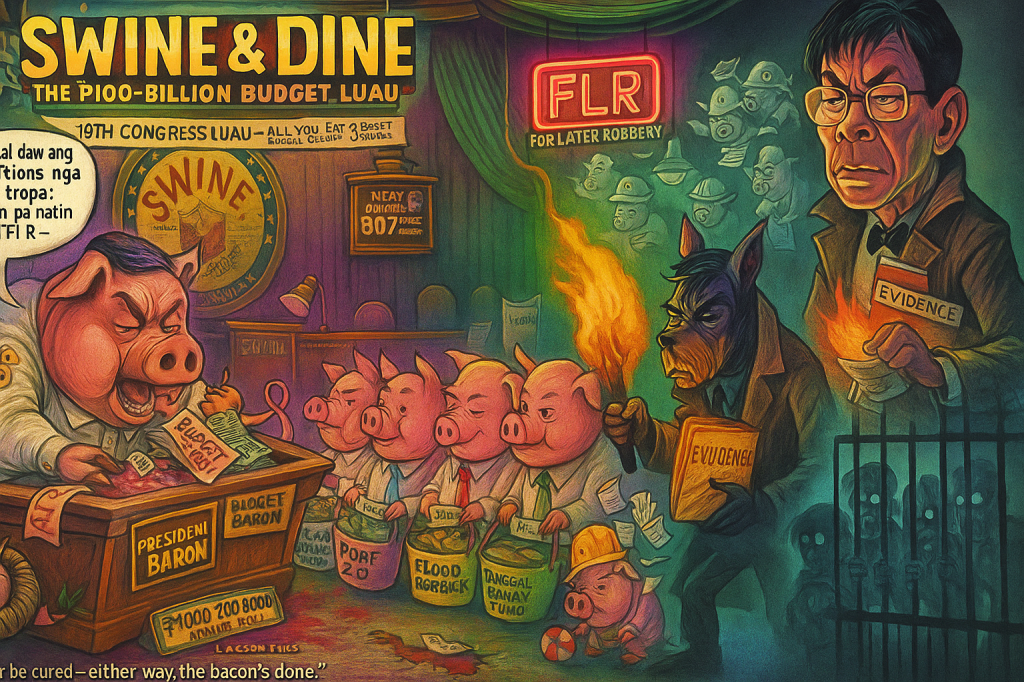
Lacson’s Exposé Lifts the Lid on a ₱100B+ Budget Swindle
By Louis “Barok” C. Biraogo — September 30, 2025
WALANG-HIYA! What a glorious mess we have in the hallowed halls of the Philippine Senate! Senator Panfilo “Ping” Lacson, that grizzled watchdog with a nose for fiscal filth, has flung open the sty door to reveal a trough overflowing with hundreds of billions in budget insertions for 2025. Yes, mga ka-kweba, almost all senators of the 19th Congress—those self-styled guardians of public welfare—have been caught with their snouts deep in the slop, shoveling in projects tagged “For Later Release” (FLR) like kids sneaking cookies before dinner. Lacson calls it a “crisis in the Senate.” I call it a masterclass in legalized larceny. Buckle up, because we’re diving into the muck.
The Great Pork Heist: A Scandal of Biblical Proportions
Let’s start with the numbers, shall we? Lacson’s documents—oh, how I’d love to frame those pages—reveal Senate-side insertions alone hitting at least ₱100 billion, with the grand total ballooning to “hundreds of billions” when you toss in the broader budgetary sleight-of-hand. That’s not pocket change; that’s enough to build schools, hospitals, or flood controls that actually work. Instead, it’s a mountain of cash tucked into the General Appropriations Act (GAA) like Easter eggs for the politically connected. And the kicker? Many of these are FLR items—funds held back for “later release,” a mechanism so ripe for abuse it might as well come with a neon sign screaming, “Kickbacks Welcome!”
The scale is, as Lacson puts it, “unprecedented.” Unprecedented? Try obscene. This isn’t your tita’s pork barrel; this is industrial-grade patronage, a systemic plundering so brazen it makes the PDAF scam look like a bake sale. The Senate, that supposed bastion of oversight, has turned into a bazaar where projects are bartered, and public funds are divvied up like loot from a pirate raid. Who’s implicated? Nearly everyone, from holdovers like Alan Peter Cayetano and Jinggoy Estrada to the dearly departed like Sonny Angara and Grace Poe. The Blue Ribbon hearings on flood control have already fingered names—Villanueva, Estrada, Escudero, Revilla, Binay—for alleged kickbacks. Their denials? As predictable as a teleserye plot twist.
The Legalistic Charade: “It’s Just How We Do Things”
Now, let’s dissect the defenses, because oh, how the powerful love their alibis. The senators’ chorus goes something like this: “Insertions are legal! It’s our legislative prerogative! FLR is just a technicality!” Spare me. Yes, Congress can amend the National Expenditure Program (NEP) during budget deliberations. Yes, FLR is a legitimate tool to hold funds pending compliance, as outlined in DBM budget circulars. But when hundreds of billions in pet projects materialize out of thin air, untethered to the executive’s planning or procurement rules, you’re not amending—you’re hijacking. When those funds are tagged FLR, giving legislators and their cronies discretion over who gets paid and when, you’re not budgeting—you’re racketeering.
The “it’s legal” excuse is a hollow shell. Republic Act 3019, the Anti-Graft and Corrupt Practices Act, doesn’t care about your parliamentary privilege if you’re soliciting kickbacks or funneling funds to ghost projects. RA 6713, the Code of Conduct, demands ethical behavior, not just legal compliance. The senators’ cries of “presumption of innocence” are rich—yes, due process applies, but when witnesses at Blue Ribbon hearings (ex-DPWH engineers, no less) point fingers and procurement papers start smelling fishy, that presumption starts to wobble. And don’t get me started on the “political vendetta” defense. If Lacson’s playing politics, good for him—someone’s got to blow the whistle on this circus.
The Evidence: Paper Trails and Guilty Consciences
Lacson’s got documents. That’s step one. He’s shared them with Senate President Vicente Sotto III, and the numbers are staggering. But documents alone don’t convict; they’re the map, not the treasure. The real gold lies in what comes next: procurement records, Special Allotment Release Orders (SAROs), contracts, and bank transfers. The flood-control hearings have already produced star witnesses—contractors and engineers spilling the beans on kickbacks and rigged bids, as reported by ABS-CBN. If their testimony holds up, corroborated by a paper trail, we’re looking at a prosecutorial jackpot.
Here’s what investigators need to do, and fast:
- Freeze the FLR funds. Malacañang’s already held back some of these releases—bravo. Keep it that way until the Commission on Audit (COA) and National Bureau of Investigation (NBI) finish sniffing around.
- Forensic audit, now. COA, get off your bureaucratic behind and trace every peso. Match insertions to SAROs, contracts, and physical outputs. No school built? No road paved? Red flag.
- Preserve the evidence. Subpoena bank records, freeze suspect accounts, and lock down procurement files before they mysteriously “disappear.”
- Follow the witnesses. Corroborate their stories with hard evidence. If multiple contractors sing the same tune, it’s not a coincidence—it’s a conspiracy.
If the evidence pans out, we’re not just talking administrative slaps on the wrist. RA 3019 carries prison time, fines, and perpetual disqualification from public office. Senators, start sweating.
The Real Cost: Schools Not Built, Lives Not Saved
Let’s make this tangible, because the senators’ apologists love to hide behind abstractions. Every billion in insertions siphoned off to ghost projects or padded contracts is:
- A school not built for kids in Tondo.
- A flood-control system that could’ve saved homes in Marikina but instead got washed away in kickbacks.
- A hospital bed that doesn’t exist when your lolo needs it most.
The 2025 budget was supposed to be our roadmap to progress; instead, it’s a treasure map for the corrupt. The public trust? Shattered. When “almost all” senators are implicated, the Senate stops being an institution and starts looking like a syndicate. Taxpayers, already squeezed dry, will ask why they should fund a government that treats their money like a piñata. And don’t think the world isn’t watching—global media like Associated Press (AP) is amplifying the outrage, and with billions in potential losses, international donors and rating agencies could soon tighten the screws on loans and aid unless we clean house.
Solutions: Stop the Bleeding, Then Build a Dam
This isn’t just about outrage; it’s about fixing the damn system. Here’s my prescription, ranked by urgency and feasibility:
Immediate Fixes (Do This Yesterday)
- Freeze All FLR Releases. The President should order DBM to halt every FLR-tagged peso tied to these insertions until COA and NBI give the all-clear. Political will, not excuses.
- Fast-Track Forensic Audits. COA, hire independent forensic accountants if you must. Prioritize flood-control projects and insertions named in hearings. Publish findings in 90 days, no redactions.
- Evidence Lockdown. DOJ, issue preservation orders for all relevant documents and accounts. No shredders, no “lost” files.
Medium-Term Reforms (Get It Done in 2026)
- Transparency Portal. Mandate a public, online register of every budget insertion—senator’s name, project details, FLR status, implementing agency. Let sunlight burn away the rot.
- Tighten FLR Rules. DBM and COA, cap FLR allocations at 5% of the GAA. Require time-bound conditions and mandatory reporting. No more blank checks.
- Procurement Safeguards. Every insertion must have pre-qualified implementers, independent cost estimates, and open bidding. No more sweetheart deals.
Long-Term Overhaul (The Hard Part)
- Ban Ad-Hoc Insertions. Pass a law requiring all insertions to be vetted by implementing agencies and certified by DBM. Politically toxic? Sure. Necessary? Absolutely.
- Turbocharge Prosecutions. Streamline COA-DOJ-Ombudsman coordination for faster graft cases. Offer whistleblower protections and plea deals to crack open conspiracies.
- Empower Citizens. Fund civil-society monitors to audit high-risk projects. Community audits catch what Manila bureaucrats miss.
Feasibility? The short-term fixes are doable—Malacañang’s already halfway there. Medium-term reforms need congressional buy-in, which is like asking pigs to vote for bacon. Long-term? That’s a generational fight, but if we don’t start now, we’re doomed to repeat this farce.
The Verdict: Resignations or Handcuffs
This scandal isn’t just a “crisis in the Senate”; it’s a betrayal of every Filipino who trusted these senators to serve, not steal. Lacson’s done his part, waving the red flag. Now it’s time for accountability. If the evidence holds—and the witnesses and documents suggest it will—those implicated must face RA 3019 charges, administrative sanctions, and the court of public opinion. Resignations should be the bare minimum; handcuffs should be the goal.
To the senators crying “due process”: Fine, you’ll get it. But don’t hide behind it while the evidence piles up. To the public: Don’t let this fade into the next news cycle. Demand audits, demand prosecutions, demand a budget that serves the people, not the powerful. And to Lacson: Keep those documents coming, Ping. The kweba’s deep, but we’re digging.
Key Citations
- PhilStar, “Ping: Almost all senators had insertions in 2025 budget,” Neil Jayson Servallos, Sept 28, 2025
- Department of Budget and Management (DBM), National Expenditure Program 2025
- DBM Budget Circulars on FLR and Fund-Release Protocols
- Republic Act 3019: Anti-Graft and Corrupt Practices Act
- Republic Act 6713: Code of Conduct and Ethical Standards for Public Officials
- ABS-CBN News, Blue Ribbon Hearing Reports on Flood-Control Probes
- Associated Press, Coverage of Philippine Budget Scandal and Flood-Control Hearings
- Commission on Audit (COA)
- National Bureau of Investigation (NBI)
- Department of Justice (DOJ)

- ₱75 Million Heist: Cops Gone Full Bandit

- ₱6.7-Trillion Temptation: The Great Pork Zombie Revival and the “Collegial” Vote-Buying Circus

- ₱1.9 Billion for 382 Units and a Rooftop Pool: Poverty Solved, Next Problem Please

- ₱1.35 Trillion for Education: Bigger Budget, Same Old Thieves’ Banquet

- ₱1 Billion Congressional Seat? Sorry, Sold Out Na Raw — Si Bello Raw Ang Hindi Bumili

- “We Will Take Care of It”: Bersamin’s P52-Billion Love Letter to Corruption

- “Skewed Narrative”? More Like Skewered Taxpayers!

- “Scared to Sign Vouchers” Is Now Official GDP Policy – Welcome to the Philippines’ Permanent Paralysis Economy
- “Robbed by Restitution?” Curlee Discaya’s Tears Over Returning What He Never Earned

- “No Pressure” Luistro? The House Pork Bazaar Exposed
- “My Brother the President Is a Junkie”: A Marcos Family Reunion Special

- “Mapipilitan Akong Gawing Zero”: The Day Senator Rodante Marcoleta Confessed to Perjury on National Television and Thought We’d Clap for the Creativity


 KWEBA ni BAROK
Leave a comment