
A Senate Sob-Fest for Duterte’s Get-Out-of-Jail-Free Card
By Louis ‘Barok‘ C. Biraogo — October 5, 2025
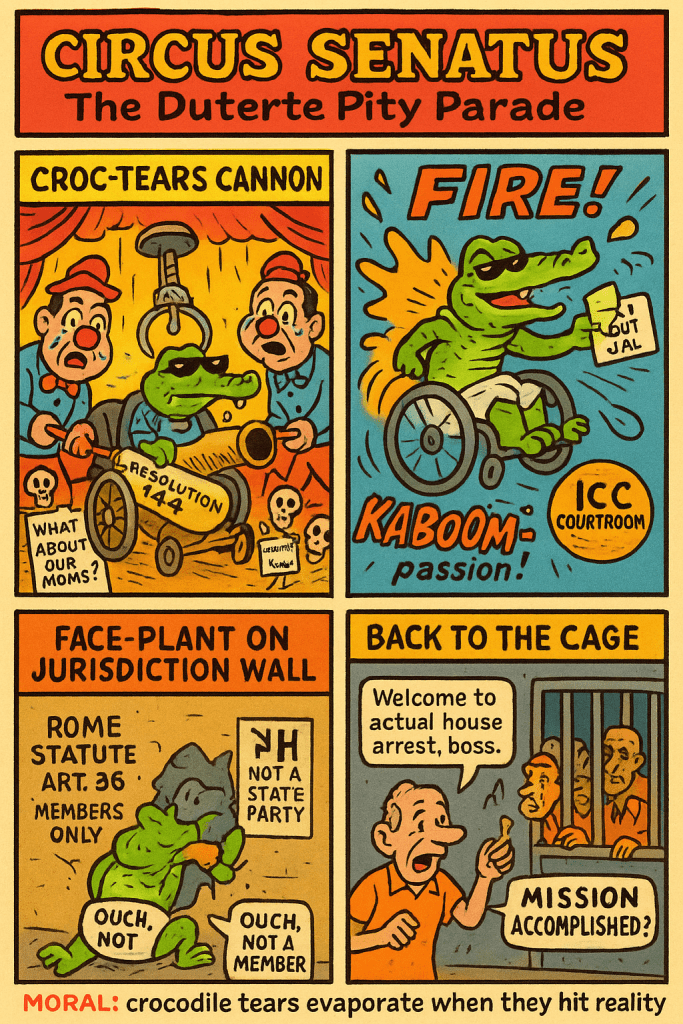
MGA ka-kweba, gather ’round the circus tent that is the Philippine Senate, where ou0r esteemed solons have just staged a performance so brazen, so dripping with irony, it could make a carabao weep from second-hand embarrassment. Senate Resolution No. 144, a pathetic plea to the International Criminal Court (ICC) to grant former President Rodrigo Duterte house arrest, isn’t just a legal nullity—it’s a soap opera of sovereign shame, a masterclass in political coddling dressed up as humanitarian concern. With all the legal force of a strongly worded Yelp review, this resolution is a grotesque display of the Philippine elite’s enduring love affair with impunity. Let’s dissect this travesty with a scalpel of precedent and a flamethrower of truth.
The Pity Ploy: Crocodile Cries for a Culprit
The Senate, led by the dynamic duo of Alan Peter Cayetano and Juan Miguel “Migz” Zubiri, wants us to believe this is about compassion. Duterte, they coo, is an 80-year-old man, frail and ailing, deserving of house arrest because, apparently, The Hague’s detention facilities are just too harsh for his delicate constitution. Oh, how touching! The same Senate that sat mute while thousands were butchered in Duterte’s drug war—mothers, fathers, children gunned down in alleys, their bodies piled into unmarked graves—now discovers its bleeding heart for one man’s alleged “cognitive impairments.” Spare me the violins.
Let’s contrast this sudden burst of empathy with the deafening silence these senators offered the estimated 20,000 victims of extrajudicial killings, as documented by human rights groups like Karapatan. Where were the resolutions for the sickly, elderly detainees rotting in Philippine jails, packed like sardines in cells designed for half their number? Where was the humanitarian outcry when poor Filipinos, accused of petty crimes, died in custody without so much as a Senate intern batting an eye? The Anti-Torture Act (Republic Act No. 9745) demands equal treatment under the law, yet here we are, with 15 senators penning a love letter to the ICC for one man while the poor get nothing but platitudes.
And the irony? If Duterte’s so cognitively impaired that he needs house arrest, how is he fit to stand trial for crimes against humanity? Either he’s sharp enough to face justice, or he’s too far gone to be prosecuted—pick a lane, senators. The medical assessments, conveniently pushed by his political allies, reek of the same playbook used by every dictator dodging The Hague: fake a cough, claim dementia, and hope the court buys it. This isn’t compassion; it’s a con.
Motive Autopsy: The Senate’s Self-Serving Puppet Show
Why this resolution, and why now? Let’s perform a motive autopsy. For the 15 “yes” voters—Zubiri, Cayetano, Rodante Marcoleta, Imee Marcos, and the rest of the Duterte fan club—this is less about humanitarianism and more about political survival. As ICC Assistant Counsel Kristina Conti pointed out in a social media post, at least one senator (cough, Marcoleta, cough) is “probably among the co-perpetrators” in Duterte’s ICC case. This resolution is a patently self-serving act of political ventriloquism, with Duterte’s allies using the Senate as their stage to shield themselves from the same machinery of impunity they helped build. Are they burnishing their legacy as loyalists? Hedging against Duterte’s still-potent influence in Davao? Or preemptively protecting themselves from the ICC’s crosshairs? All of the above, likely.
Then there’s the “no” voters—Risa Hontiveros, Bam Aquino, and Francis “Kiko” Pangilinan—who deserve a standing ovation for siding with the victims. Hontiveros’ blistering speech, reminding us of the “winasak na buhay” of thousands, was a rare moment of moral clarity in a chamber drowning in crocodile tears. Pangilinan, as chair of the Senate Committee on Justice and Human Rights, nailed it: justice for the thousands killed trumps fake compassion for one accused. These senators stood tall, refusing to play extras in this farce.
And the abstentions? Vicente “Tito” Sotto III and Raffy Tulfo, with their spineless “let’s not divide the nation” routine, embody the ultimate act of political cowardice. Sotto’s excuse—abstaining to preserve unity—is like refusing to put out a fire because it might upset the arsonist. Unity at the cost of justice is just impunity in a cheap tuxedo.
Legal Annihilation: A Resolution with No Teeth
This resolution is a legal nullity, a jurisdictional farce so absurd it could star in a Kafka novel. The Philippines, by Duterte’s own design, withdrew from the Rome Statute in 2019, leaving it a non-member state with all the standing of a nosy neighbor yelling advice through the ICC’s courtroom window. The ICC Appeals Chamber ruled in 2023 that jurisdiction over Duterte’s drug war crimes (2011–2019) remains intact, withdrawal be damned (see ICC jurisdictional rulings). But that same withdrawal means the Senate has zero leverage to influence ICC proceedings. Under Article 86 of the Rome Statute, only State Parties have cooperative obligations with the Court. The Philippines? It’s just a bystander now, thanks to Duterte’s own escape hatch.
Procedurally, the Senate’s resolution is unsolicited legal fan-fiction. Article 60(3) of the Rome Statute and Rule 119 of the ICC’s Rules of Procedure and Evidence clearly state that only the accused, his counsel, or the Prosecutor can request interim release. The Senate isn’t on that list. It’s like a random uncle crashing a wedding to demand the couple rewrite their vows. As Kristina Conti put it, this is “mere political noise,” irrelevant unless transmitted through proper channels (spoiler: it won’t be).
The ultimate irony? Duterte’s withdrawal, meant to shield him, has left him and his allies legally neutered. They can’t formally influence the ICC because they burned that bridge. Even if the ICC entertained house arrest, the Philippines, as a non-State Party, can’t be compelled to enforce it. The logistics would fall to a cooperating state like the Netherlands, rendering the Senate’s plea as useful as a paper fan in a typhoon.
Weaponizing Precedent: The ICC Won’t Fall for This
Let’s talk precedent. The Senate might point to the Bemba case, where the ICC granted conditional release due to health and prolonged detention. But Bemba was no Duterte. Jean-Pierre Bemba wasn’t a former head of state with a loyal political machine and a history of thumbing his nose at international law. Duterte, with his family’s grip on Davao and a network of diehard loyalists, is a flight risk so obvious he might as well wear a “Will Bolt to Davao” T-shirt. The ICC’s experience with Omar al-Bashir, Sudan’s fugitive ex-president (see ICC Darfur situation), proves that powerful figures don’t play nice with conditional release. House arrest for Duterte would require conditions so stringent—constant surveillance, restricted communication—that it’d be detention by another name.
Domestically, the resolution exposes the Senate’s hypocrisy. The Philippine justice system, notorious for overcrowded jails and abysmal conditions, has never seen a Senate resolution championing house arrest for the thousands of elderly, sickly detainees languishing without trial. The Bureau of Jail Management and Penology (BJMP) reported in 2024 that over 70% of inmates await trial in conditions violating the United Nations’ Standard Minimum Rules for the Treatment of Prisoners (Mandela Rules). Where’s their Senate resolution? The Prosecution Service Act (Republic Act No. 10071) demands fairness, yet this resolution screams privilege for the powerful.
Final Verdict and Recommendations
This resolution is political performance art, a stunt legally weightless but ethically grotesque. It’s a desperate attempt by Duterte’s allies to paint him as a frail old man while ignoring the blood on his hands. The ICC, if it has any spine, will toss this resolution into the shredder where it belongs.
- To the Senate: Stop embarrassing yourselves. Focus on passing laws that deliver justice to the thousands of drug war victims at home, not drafting pathetic pleas for a single accused abroad. Investigate the unmarked graves. Fund reparations for families. Do your job.
- To the ICC: Treat this resolution with the legal relevance it deserves: none. If anything, it’s evidence of Duterte’s continued political clout, proof he’s a flight risk who can still pull strings from a cell. Let it remind you why independence matters.
- To the Public: Wake up. This is the old guard protecting its own, proving that in Philippine politics, accountability is for the poor, and compassion is a currency only the powerful can spend. Demand justice for the voiceless, not clemency for the culpable.
The Senate’s resolution isn’t just a legal dud—it’s a moral disgrace. Duterte’s legacy of impunity lives on, not in his actions, but in the cowardice of those who still shield him. The Kweba ni Barok verdict? This resolution deserves to be buried in the same unmarked grave as the Senate’s dignity.
Key Citations
- “Senate Adopts Resolution Urging ICC to Grant Rodrigo Duterte House Arrest.” GMA News Online, 1 Oct. 2025.
- Rome Statute of the International Criminal Court. International Criminal Court, 17 July 1998.
- Rules of Procedure and Evidence. International Criminal Court, 2013.
- “Situation in the Philippines.” International Criminal Court. Accessed 3 Oct. 2025.
- “The Bemba Case.” International Criminal Court. Accessed 3 Oct. 2025.
- “Situation in Darfur, Sudan.” International Criminal Court. Accessed 3 Oct. 2025.
- Republic Act No. 9745: Anti-Torture Act of 2009. Official Gazette of the Republic of the Philippines, 10 Nov. 2009.
- Republic Act No. 10071: Prosecution Service Act of 2010. Official Gazette of the Republic of the Philippines, 8 Apr. 2010.
- The United Nations Standard Minimum Rules for the Treatment of Prisoners (the Nelson Mandela Rules). United Nations Office on Drugs and Crime, 2015.
- “Jail Statistics.” Bureau of Jail Management and Penology. Accessed 3 Oct. 2025.
- “Human Rights Reports on Extrajudicial Killings.” Karapatan Alliance Philippines. Accessed 3 Oct. 2025.

- ₱75 Million Heist: Cops Gone Full Bandit

- ₱6.7-Trillion Temptation: The Great Pork Zombie Revival and the “Collegial” Vote-Buying Circus

- ₱1.9 Billion for 382 Units and a Rooftop Pool: Poverty Solved, Next Problem Please

- ₱1.35 Trillion for Education: Bigger Budget, Same Old Thieves’ Banquet

- ₱1 Billion Congressional Seat? Sorry, Sold Out Na Raw — Si Bello Raw Ang Hindi Bumili

- “We Will Take Care of It”: Bersamin’s P52-Billion Love Letter to Corruption

- “Skewed Narrative”? More Like Skewered Taxpayers!

- “Scared to Sign Vouchers” Is Now Official GDP Policy – Welcome to the Philippines’ Permanent Paralysis Economy
- “Robbed by Restitution?” Curlee Discaya’s Tears Over Returning What He Never Earned

- “No Pressure” Luistro? The House Pork Bazaar Exposed
- “My Brother the President Is a Junkie”: A Marcos Family Reunion Special

- “Mapipilitan Akong Gawing Zero”: The Day Senator Rodante Marcoleta Confessed to Perjury on National Television and Thought We’d Clap for the Creativity


 KWEBA ni BAROK
Leave a comment