
Now the nation’s top graft-buster, the former Justice Secretary faces a test rarer than power itself — the courage to turn it down.
By Louis ‘Barok‘ C. Biraogo — October 8, 2025
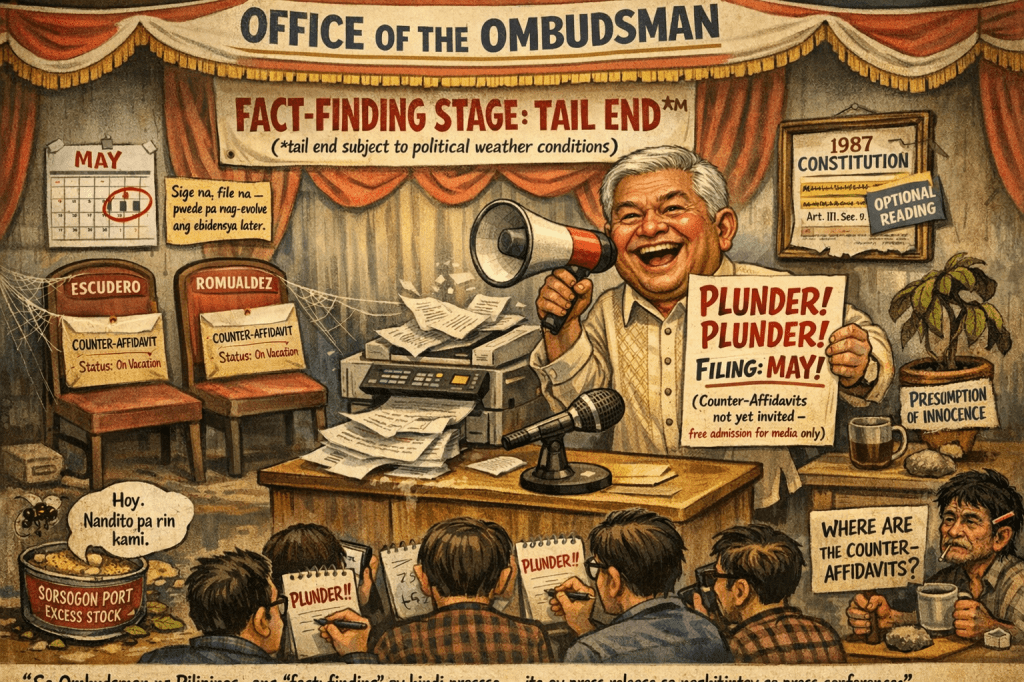
THE Office of the Ombudsman is supposed to be the nation’s moral compass—the one institution designed to call out the powerful when everyone else is too afraid to speak. In the Philippines, it was built as a sanctuary for accountability, a bulwark against the rot of political impunity. And yet, like so many democratic ideals, it has often been bent by the very forces it was meant to restrain.
Now, into this crucible steps Jesus Crispin “Boying” Remulla—veteran prosecutor, political insider, and until a week ago, President Ferdinand Marcos Jr.’s Justice Secretary. His appointment as Ombudsman may well be the most consequential test yet of whether Philippine democracy still possesses the courage to police its own power.
Remulla’s new office is no ceremonial post. It is the Republic’s watchdog—and sometimes its last defense. The only question is whether he will bare his teeth or wag his tail.
The Paradox of Boying Remulla: Reformer or Loyalist?
To judge Remulla fairly, one must start with his undeniable credentials. As Justice Secretary, he led a campaign to professionalize prosecution. He raised the bar for evidence—insisting that only cases with “prima facie certainty of conviction” should reach the courts. He broadened prosecutors’ roles in case build-up and sought to bring order to the chaos of the Bureau of Corrections, where corruption had become systemic.
Those reforms earned him quiet respect among career lawyers. And when his own son was arrested in 2022 for drug possession, Remulla resisted the instinct to interfere—a gesture that lent him moral credibility rare in Philippine politics.
But every virtue casts its own shadow. The very proximity to power that allowed him to reform the justice system now endangers his credibility as Ombudsman. His bond with the Marcos administration runs deep; he has been one of its most articulate defenders, a constant presence in the Cabinet, and the President’s reliable legal lieutenant.
So when he told the Judicial and Bar Council that he would “do away with the Ombudsman being used as a weapon,” it sounded to some like statesmanship—and to others, surrender. Was he vowing to protect innocent officials from harassment, or signaling that politically sensitive investigations would be softened, even shelved?
The ambiguity of that promise—noble in phrasing, ominous in effect—now haunts his appointment.
Inside the Fire: The Cases That Will Define His Integrity
No new Ombudsman in recent memory has inherited such a treacherous docket. Each case before him is a political minefield. Each will test whether his office still stands for the law—or merely for those who make it.
1. The Sara Duterte Confidential Funds Case
At the top of the pile lies the complaint against Vice President Sara Duterte, accused of misusing ₱612 million in confidential funds across the Office of the Vice President and the Department of Education. The case—based on a congressional committee’s recommendation—is nothing less than a test of institutional courage.
If Remulla allows this investigation to proceed with transparency and vigor, it could redefine the meaning of independence in an age of dynastic politics. If he slows or dilutes it, the Ombudsman’s credibility may not survive the year.
2. The Zaldy Co–DPWH Flood Control Scandal
Then there’s the Independent Commission for Infrastructure’s referral involving Representative Zaldy Co and Department of Public Works and Highways officials over a ₱289.5 million road dike project in Oriental Mindoro. Substandard construction, falsified records, possible malversation—the accusations read like a manual of systemic corruption.
This is a chance for Remulla to prove that justice can be both technical and fearless. A clean, evidence-driven prosecution here would do more for the Ombudsman’s reputation than a hundred press releases.
3. The COA Commissioner Lipana Probe
Perhaps the most delicate case is the investigation into Commission on Audit Commissioner Mario Lipana for alleged conflicts of interest in government contracts. That a COA official—the guardian of fiscal probity—faces such allegations is a tragic irony. For Remulla, it is also an opportunity: to show that accountability respects neither title nor tenure.
Beyond these headline files lie others that intertwine with his former office—the Percy Lapid murder probe, the Apollo Quiboloy case, the POGO scandals, the missing sabungeros. Any of these could generate administrative or criminal referrals. And because Remulla once oversaw the DOJ’s handling of many of them, each will test whether he can truly separate his past from his present.
The Power and Peril of the Office: A Strategic SWOT in Motion
The Ombudsman’s office is both sword and shield. Its success depends not only on integrity but also on strategy.
Strengths: A Prosecutor’s Mind in a Politician’s Body
Remulla knows how to build a case. His deep grasp of evidence and procedure could cut through the Ombudsman’s notorious backlog. His reformist streak—tempered by pragmatism—might bring professionalism to an office long plagued by internal politics. And his closeness to the Palace, while risky, gives him political capital that could be used, paradoxically, to protect institutional independence if he wields it wisely.
Weaknesses: The Weight of Perception
But his biggest handicap is optics. To many Filipinos, he is too close to the Marcoses to be trusted. Every decision will be read through the lens of loyalty. His warning against “weaponizing” the Ombudsman, however well-meaning, risks being interpreted as a pretext for timidity. And his own entanglement in past DOJ controversies could spawn conflict-of-interest challenges that bog down his early months.
Opportunities: To Restore the People’s Faith
Remulla has a chance few Ombudsmen ever get—to reclaim the public’s belief that corruption can still be punished. A few clean, high-profile convictions—particularly in the infrastructure and audit cases—could send a shockwave through the bureaucracy. More profoundly, he can modernize the office: strengthen forensic accounting, use independent technical panels for procurement audits, and make case milestones public.
Threats: The Politics That Poison Justice
The enemies are invisible but everywhere. Political patrons will test his loyalty; allies will expect protection. Congress may threaten oversight; the courts may question his discretion. And should he falter even once—should a major ally be spared or a critic targeted—the credibility of the office will collapse, perhaps irreparably.
The Crossroads: What Remulla Must Do Now
If the Ombudsman is to reclaim its moral gravity, Remulla must act with a clarity that silences doubt.
First, he must embrace radical transparency.
Publish a case-management plan for the top twenty investigations—timelines, processes, oversight mechanisms. Let sunlight, not rumor, define his office.
Second, he must institutionalize integrity.
Draft and publicly adopt a conflict-of-interest and recusal policy, especially for cases touching his DOJ past. Ethical walls are not signs of weakness; they are shields of legitimacy.
Third, he must build technical muscle.
Equip the Ombudsman’s investigators with the forensic, digital, and engineering tools to pursue corruption that hides in spreadsheets and supply chains, not just in envelopes.
Fourth, he must remember who his true client is.
Not the President, not the Cabinet, not Congress—the Filipino public. The Ombudsman’s loyalty is not to political convenience but to constitutional conscience.
If he succeeds, he could leave behind a legacy that redeems the very idea of public accountability. If he fails, the office will sink further into cynicism, a watchdog declawed by politics.
The Verdict Before the Verdict
Ultimately, the question is not whether Boying Remulla will fight corruption—it’s whether he will fight power. The two are rarely the same.
He carries both the tools to reform and the temptations to retreat. His legacy will not be measured by eloquent speeches or quiet reforms but by whether the guilty, regardless of name or connection, finally face the law.
In a nation exhausted by scandal fatigue, the Ombudsman’s office still holds symbolic power: the belief that justice, though slow, can still be blind. For that belief to survive, Remulla must prove that loyalty to truth can outweigh loyalty to friends.
The true measure of his tenure will not be how many enemies he makes—but how many friends he refuses to protect.
And in that lonely act of courage may rest the fate of Philippine democracy itself.

- ₱8B BBM Pork: CCTV for Every Captain’s Kumpare?
- ₱75 Million Heist: Cops Gone Full Bandit

- ₱6.7-Trillion Temptation: The Great Pork Zombie Revival and the “Collegial” Vote-Buying Circus

- ₱1.9 Billion for 382 Units and a Rooftop Pool: Poverty Solved, Next Problem Please

- ₱1.35 Trillion for Education: Bigger Budget, Same Old Thieves’ Banquet

- ₱1 Billion Congressional Seat? Sorry, Sold Out Na Raw — Si Bello Raw Ang Hindi Bumili

- “We Will Take Care of It”: Bersamin’s P52-Billion Love Letter to Corruption

- “Skewed Narrative”? More Like Skewered Taxpayers!

- “Scared to Sign Vouchers” Is Now Official GDP Policy – Welcome to the Philippines’ Permanent Paralysis Economy

- “Robbed by Restitution?” Curlee Discaya’s Tears Over Returning What He Never Earned

- “No Pressure” Luistro? The House Pork Bazaar Exposed
- “My Brother the President Is a Junkie”: A Marcos Family Reunion Special


 KWEBA ni BAROK
Leave a comment