Hocus Pocus, Constitution Vanished: UA’s Sleight-of-Hand Robs the People
By Louis “Barok” C. Biraogo — October 9, 2025
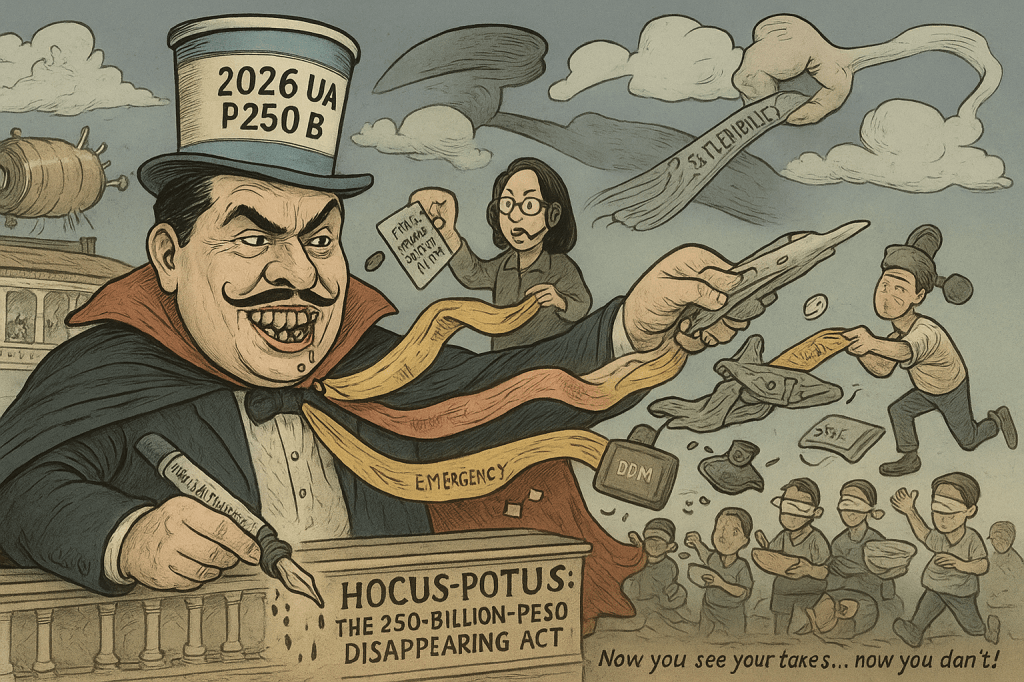
A cartoonish villain perches atop Malacañang’s marble steps, twirling a mustache and brandishing a P250-billion check emblazoned with “Unprogrammed Appropriations.” With a smirk that could sour leche flan, the Palace has swatted away Representative Chel Diokno’s valiant plea to obliterate this fiscal Frankenstein. “Emergencies!” they wail. “Documentation!” they crow. As if Filipinos, drowning in floods and haunted by the pork barrel’s specter, will swallow such hogwash. This is the blistering sequel to my last exposé, Marcos Budgetary Bonanza. The Palace’s defense of Unprogrammed Appropriations (UA) isn’t just a policy blunder—it’s a constitutional assassination, a heist of public funds cloaked in bureaucratic doublespeak. Strap in, because I’m about to torch their excuses with the Constitution’s flame and the law’s razor.
“Emergencies” and “Paperwork”: The Palace’s Laughable Lies
Let’s dissect the Palace’s pitiful defense, delivered by Press Officer Claire Castro with the conviction of a telemarketer selling expired sardines. Unprogrammed Appropriations, she claims, are for “emergencies” and “urgent situations.” Spare me the melodrama. Allocating P250 billion for pre-planned projects—like P80.86 billion for infrastructure, P97.3 billion for foreign-assisted projects, and P50 billion for Armed Forces of the Philippines (AFP) modernization—is an emergency fund? This isn’t a disaster relief kit; it’s a slush fund dressed up like one, brimming with cash for projects the administration already planned. Emergencies are typhoons, earthquakes, or pandemics—not a wish list of bridges and fighter jets. Calling this an emergency fund is like labeling a yacht a lifeboat. It’s a lie so audacious it mocks every taxpayer’s IQ.
Then there’s the “documentation” farce. Castro insists Unprogrammed Appropriations can’t be tapped “recklessly” because paperwork is required. Oh, please. A few forms from the Department of Budget and Management (DBM) are no shield against abuse—they’re a bureaucratic Band-Aid slapped over a gaping wound. This “documentation” is a hollow gesture, a veneer of legality for a predetermined cash grab. It doesn’t ensure accountability; it buries P250 billion in shadows, far from public scrutiny. The Palace thinks we’re idiots, happy to let them raid a “magic pot” (Diokno’s genius term) as long as they scribble some memos. This isn’t governance—it’s a fiscal con game designed to sidestep Congress and the people.
The Constitution’s Corpse: Article VI, Section 29(1) Bleeds
Time to wield the ultimate weapon: the 1987 Philippine Constitution, which the Palace treats like a paper towel. Article VI, Section 29(1) is unambiguous: “No money shall be paid out of the Treasury except in pursuance of an appropriation made by law.” An appropriation isn’t a vague IOU or a blank check; it’s a precise congressional mandate for specific purposes. Unprogrammed Appropriations twist this into a fiscal free-for-all, turning P250 billion into a “standby” slush fund the Executive can tap at will. This isn’t flexibility; it’s a robbery of Congress’s power of the purse.
The Supreme Court has already swung its gavel. In Belgica v. Ochoa (G.R. No. 208566, 2013), the Court obliterated the Priority Development Assistance Fund (PDAF) for violating separation of powers, condemning lump-sum funds that let legislators—or worse, the Executive—play fiscal roulette post-enactment. Unprogrammed Appropriations are PDAF 2.0: The Executive’s Revenge. Like its outlawed cousin, they’re a lump-sum monstrosity dodging legislative oversight and begging for abuse. The P80.86 billion for infrastructure and P97.3 billion for foreign projects aren’t contingencies—they’re programmed obligations hidden in Unprogrammed Appropriations to evade the General Appropriations Act’s (GAA) transparency. In Araullo v. Aquino (G.R. No. 209287, 2014), the Court skewered the Disbursement Acceleration Program (DAP) for similar executive sleight-of-hand, warning against maneuvers that undermine Congress. Unprogrammed Appropriations are just DAP with a better press kit, daring the Court to strike again.
Ethics? Don’t make me laugh. Republic Act (RA) 6713, the Code of Conduct and Ethical Standards for Public Officials and Employees, demands “justness” and “simplicity” in governance. Stashing P250 billion in a “parallel budget system,” as Diokno nails it, is neither. It’s a deliberate obfuscation that spits on the public’s right to know where their taxes go. The Palace’s defense isn’t just flimsy—it’s a moral middle finger.
Diokno, the Fiscal Firebrand
Cue Rep. Chel Diokno, the constitutional crusader this nation needs but doesn’t deserve. His call to zero out Unprogrammed Appropriations isn’t radical—it’s the bare minimum the Constitution demands. He’s not chasing windmills; he’s fighting for a budget that’s transparent, specific, and accountable. His metaphors are dynamite: Unprogrammed Appropriations as a “parallel budget system” and a “magic pot” expose its sinister core. These aren’t standby funds; they’re a fiscal abyss where projects vanish from public view, only to resurface as patronage plums or executive pet projects. Diokno asks the obvious: If these projects—P80.86 billion for infrastructure, P50 billion for AFP—are so vital, why hide them in Unprogrammed Appropriations instead of programming them in the General Appropriations Act? The answer is damning: because transparency kills control.
The Palace’s counter—”flexibility” and “efficiency”—is a shameless dodge. Flexible for whom? Efficient for what? To funnel funds to cronies? To sidestep Congress? To revive the pork barrel under a new name? Their arguments crumble like a house of cards in a typhoon. If flexibility is needed, Congress can pass supplemental budgets for true emergencies, as the Constitution permits. If efficiency is the goal, why not program these projects openly, where Commission on Audit (COA) scrutiny and public hearings can keep them honest? The Palace’s excuses are a smokescreen for centralized, unaccountable power.
The Heist of the Century: P250 Billion and Counting
The numbers are obscene. Unprogrammed Appropriations swelled from P149.8 billion in 2023 to a monstrous P731.4 billion in 2024, a fiscal Frankenstein fueled by congressional insertions. The 2026 proposal’s P250 billion is no outlier—it’s a symptom of a system addicted to opacity. Every peso in Unprogrammed Appropriations is a peso Congress can’t oversee, a peso the public can’t question, a peso ripe for plunder. The ghosts of Priority Development Assistance Fund and Disbursement Acceleration Program loom large, whispering of Napoles’s plunder and Aquino’s fiscal acrobatics. History screams: lump-sum funds breed corruption. Yet the Palace doubles down, betting we’re too numb to care.
We’re not. Filipinos deserve a budget that honors their sweat, not one that treats them like suckers in a rigged game. Unprogrammed Appropriations mock the constitutional checks our democracy hinges on. They’re a cancer in the General Appropriations Act, growing with every unscrutinized peso.
Rally the Troops: Smash the Magic Pot!
This isn’t a debate—it’s a revolution. Congress must grow a backbone and amputate Unprogrammed Appropriations from the 2026 General Appropriations Act. No half-measures, no compromises. If projects are essential, program them openly. If emergencies strike, pass supplemental budgets. The Constitution doesn’t bow to convenience, and neither should we. Citizens, unleash hell! Flood your representatives’ inboxes, storm the streets, demand they uphold their constitutional oath. And to the Supreme Court: finish what you started in Belgica and Araullo. Obliterate this fiscal abomination before it bankrupts our democracy.
The Palace’s defense of Unprogrammed Appropriations isn’t just wrong—it’s an affront to every Filipino who values the rule of law. Diokno’s right: this “magic pot” must be shattered. Arm yourselves with constitutional rage and demand a budget that serves the people, not the powerful. The fight is now. Who’s ready?
Louis “Barok” C. Biraogo is the firebrand behind this blog. Read his previous takedown, “Marcos Budgetary Bonanza”, for more.
Key Citations
- Belgica v. Ochoa. G.R. No. 208566, Supreme Court of the Philippines, 19 Nov. 2013.
- Araullo v. Aquino. G.R. No. 209287, Supreme Court of the Philippines, 1 July 2014.
- Cabato, Luisa. “Palace Rejects Diokno’s Proposal to Scrap Unprogrammed Funds.” Inquirer.net, 9 Oct. 2025.
- “Marcos Budgetary Bonanza: Unprogrammed Appropriations Spit in the Constitution’s Face.” Kweba ni Barok, 1 Oct. 2025.
- Republic Act No. 6713: Code of Conduct and Ethical Standards for Public Officials and Employees. Official Gazette of the Republic of the Philippines, 20 Feb. 1989.
- The 1987 Constitution of the Republic of the Philippines. Official Gazette of the Republic of the Philippines, 2 Feb. 1987.

- ₱75 Million Heist: Cops Gone Full Bandit

- ₱6.7-Trillion Temptation: The Great Pork Zombie Revival and the “Collegial” Vote-Buying Circus

- ₱1.9 Billion for 382 Units and a Rooftop Pool: Poverty Solved, Next Problem Please

- ₱1.35 Trillion for Education: Bigger Budget, Same Old Thieves’ Banquet

- ₱1 Billion Congressional Seat? Sorry, Sold Out Na Raw — Si Bello Raw Ang Hindi Bumili

- “We Will Take Care of It”: Bersamin’s P52-Billion Love Letter to Corruption

- “Skewed Narrative”? More Like Skewered Taxpayers!

- “Scared to Sign Vouchers” Is Now Official GDP Policy – Welcome to the Philippines’ Permanent Paralysis Economy
- “Robbed by Restitution?” Curlee Discaya’s Tears Over Returning What He Never Earned
- “My Brother the President Is a Junkie”: A Marcos Family Reunion Special

- “Mapipilitan Akong Gawing Zero”: The Day Senator Rodante Marcoleta Confessed to Perjury on National Television and Thought We’d Clap for the Creativity
- “Just Following Orders” Is Dead: How the Hague Just Turned Tokhang’s Finest Into International Fugitives

 KWEBA ni BAROK
Leave a comment