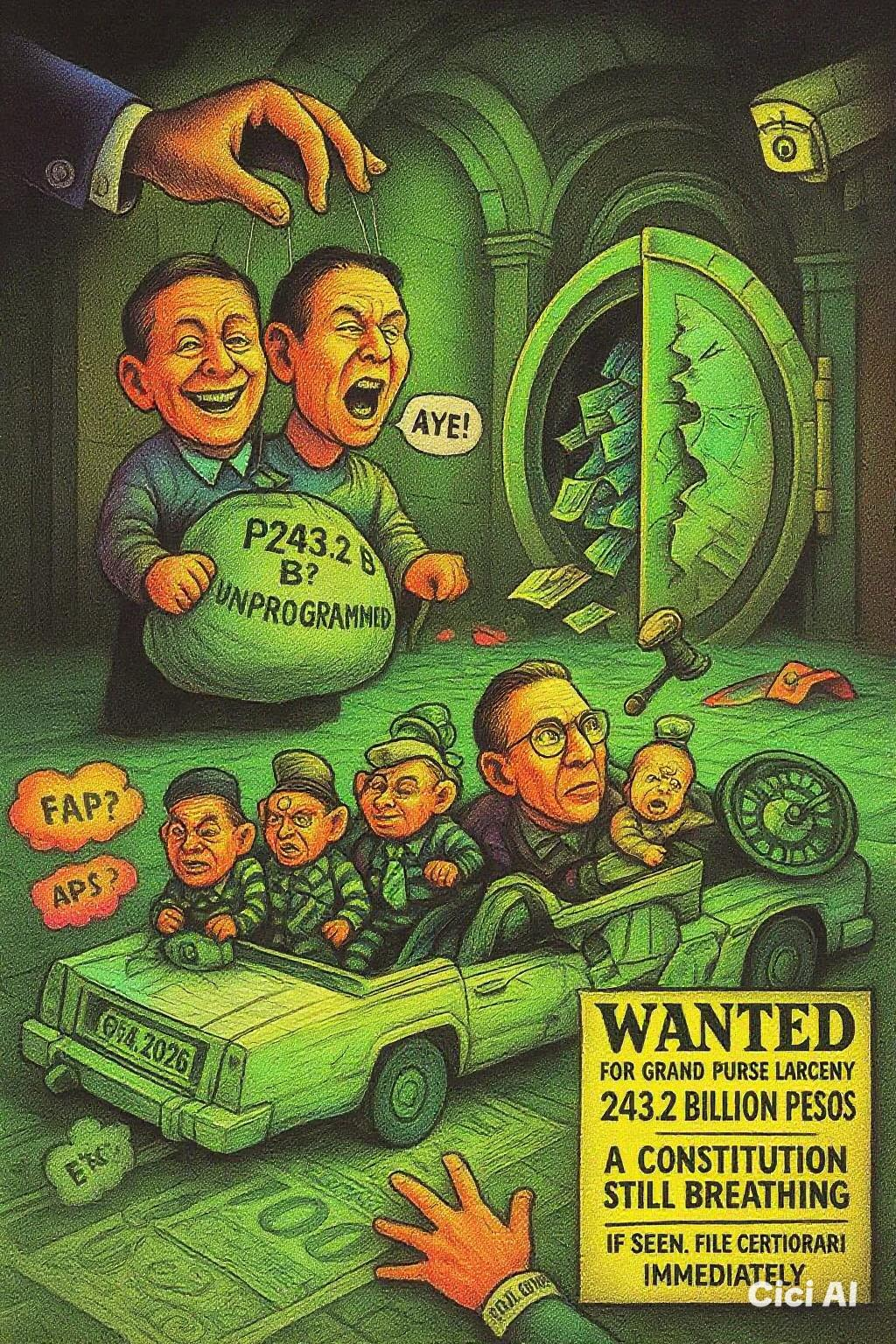
From Power of the Purse to Powerless Puppets: Congress’s Capitulation
By Louis “Barok” C. Biraogo — October 12, 2025
BEHOLD the 2026 General Appropriations Bill (GAB), where P243.2 billion in “unprogrammed funds” slinks into the shadows like a fiscal phantom, ready to bankroll Malacañang’s wildest whims. This isn’t a budget line; it’s a gilded slush fund, a constitutional loophole that laughs in the face of accountability. Rep. Chel Diokno, the budget’s last honest gladiator, tried to slay this dragon, only to be buried under the House’s smug “Ayes” in a viva voce vote that felt like a backroom deal sealed with a smirk. Rejecting his amendment wasn’t just a misstep—it’s a full-throated betrayal of the power of the purse, handing the Executive a blank check to fleece your taxes. Get ready, because this isn’t a debate—it’s a stick-up, and the House just drove the getaway car.
The Constitutional Sellout: Trading the Purse for a Piggy Bank
The 1987 Constitution, Article VI, Section 29(1), declares with righteous clarity: “No money shall be paid out of the Treasury except in pursuance of an appropriation made by law.” This is the sacred covenant of the power of the purse, the bedrock that ensures Congress, not the Executive, decides how your taxes are spent. Yet, by preserving P243.2 billion in unprogrammed funds, the House of Representatives has traded this hallowed duty for a farcical sequel: the Power of the Purse-Strings, gripped tightly by Malacañang. These lump-sum funds, free from the shackles of line-item scrutiny, are the Executive’s dream—a slush fund with a fancy name, ready to be sprinkled on pet projects or loyal allies. Rep. Diokno’s amendment demanded that these funds, if truly priorities like farmer subsidies or the Pantawid Pamilyang Pilipino Program (4Ps), be programmed, named, and debated. But the House, in its infinite cynicism, decided transparency is for suckers. Why bother with accountability when you can have a fiscal free-for-all?
Déjà Vu and Judicial Ghosts: Haven’t We Been Burned Before?
The House’s gall is almost poetic, a nostalgic nod to the fiscal scandals of yesteryear. Cast your mind back to the Priority Development Assistance Fund (PDAF) and the Disbursement Acceleration Program (DAP). In Belgica v. Ochoa (G.R. No. 208566, Nov. 19, 2013) and Araullo v. Aquino (G.R. No. 209287, July 1, 2014), the Supreme Court didn’t just tut-tut lump-sum discretionary funds—it obliterated them. These rulings declared that budgetary mechanisms allowing the Executive to bypass Congress’s appropriation power or reallocate funds without oversight violate the Constitution. Yet, here we are, with the House testing the Supreme Court’s patience like a toddler poking a sleeping lion. Unprogrammed funds, with their vague purposes and discretionary triggers, are PDAF and DAP’s lovechild, dressed up in bureaucratic legalese. Haven’t we seen this movie before? Newsflash: the Supreme Court already told us it ends in an unconstitutional dumpster fire.
Flimsy Excuses Roasted: The House’s Pathetic Defense
The House, led by Rep. Mikaela Angela Suansing, Chairperson of the Committee on Appropriations, offered a trifecta of excuses for clinging to the Magic Money Pot. Let’s carve them up with the precision they deserve.
1. “No Final Contracts” for Foreign-Assisted Projects (FAPs)
Suansing claimed FAPs can’t be programmed because they lack final contracts or National Economic and Development Authority (NEDA) Board approval. This is a chicken-and-egg fallacy so blatant it’s almost performance art. Why are we budgeting billions for projects so half-baked they don’t even have contracts? Shouldn’t Congress demand that the bureaucracy finalize deals before the GAB is passed, ensuring taxpayer money isn’t held hostage to administrative dawdling? This isn’t a defense; it’s a confession of incompetence.
2. “Commitments to Multilateral Partners”
Cue the diplomatic blackmail! We’re told cutting unprogrammed funds might offend the World Bank, Asian Development Bank (ADB), Korea International Cooperation Agency (KOICA), or Japan International Cooperation Agency (JICA). Spare me the crocodile tears. These institutions, which preach transparency, would choke on the opacity of a P243.2-billion lump sum. If these projects are so vital, program them with clear milestones. Hiding them in unprogrammed funds isn’t diplomacy—it’s fiscal laziness.
3. “Sheltering Assistance” for Social Programs
The House claims P45 billion in unprogrammed funds supports social programs like 4Ps and farmer subsidies. How touching. But why are these critical programs left in budgetary limbo, dependent on revenue windfalls or loan proceeds? This is charity by roulette, not governance by design. If they’re priorities, they belong in the main budget, not dangling like fiscal piñatas for the Executive to crack open at will.
These excuses aren’t reasons; they’re a smokescreen for a system where funds can be released with minimal oversight, timed for maximum political gain. It’s not flexibility—it’s a license to loot.
The Rot Sets In: Patronage, Showdowns, and Ethical Collapse
The House’s decision isn’t a mere oopsie; it’s a blueprint for systemic decay. Unprogrammed funds are the perfect tool for patronage politics, where releases are timed to reward allies, sway voters, or fatten campaign coffers. With elections on the horizon, the temptation to weaponize these funds is as subtle as a sledgehammer. Imagine: a sudden “release” of farmer subsidies before a key vote, or FAPs funneled to loyal districts. This isn’t speculation; it’s history repeating itself.
Worse, this invites a constitutional showdown. The Supreme Court, armed with Belgica and Araullo, won’t sit idly by if these funds become Malacañang’s personal ATM. If the Executive starts treating unprogrammed appropriations like a piggy bank, expect a petition to hit the Court faster than you can say “technical malversation.” Republic Act (RA) 6713, the Code of Conduct and Ethical Standards for Public Officials and Employees, demands transparency and accountability, yet the House’s vote screams the opposite. Every “Aye” voter should brace for a reckoning when the Commission on Audit (COA) or Ombudsman comes calling.
The Cure to Fiscal Fraud: A Bulletproof Amendment
If the House is so confident in its virtue, it should have no issue bolting ironclad safeguards onto the GAB. Enter the Model Amendment, the only antidote to this fiscal poison. It demands:
- Specificity: Unprogrammed funds must name exact purposes, agencies, and projects.
- Triggers: Releases require Bureau of the Treasury certifications of excess revenue or loan realization, plus NEDA approval for FAPs.
- Transparency: Real-time Department of Budget and Management (DBM) postings of every release, down to the last peso.
- Oversight: Congressional concurrence for releases over P1 billion, ensuring the House doesn’t just rubber-stamp Malacañang’s whims.
- Sunset Clause: Unused funds lapse, and unprogrammed appropriations are capped at 2% of the total budget.
This isn’t rocket science; it’s governance 101. If the House rejects these safeguards, it’s not defending flexibility—it’s guarding a system ripe for abuse. So, which is it, honorable solons?
The Final Act: Who Dares Challenge the Heist?
The House’s rejection of Diokno’s amendment isn’t just a vote; it’s a gauntlet thrown at every Filipino who values constitutional integrity. The P243.2-billion Magic Money Pot sits untouched, a fiscal time bomb primed for patronage and opacity. Civil society, media, and vigilant taxpayers will keep watch, but the real cliffhanger looms: who will drag this swindle before the Supreme Court? Will it be Diokno, a watchdog group, or a citizen fed up with the House’s fiscal sleight of hand? The Constitution waits, and the clock is ticking.
This is Barok, signing off, still wondering why the House thinks it can outfox the ghosts of PDAF and DAP. Spoiler: it won’t.
Key Citations
- Araullo v. Aquino, G.R. No. 209287, 1 July 2014.
- Belgica v. Ochoa, G.R. No. 208566, 19 Nov. 2013.
- “House Rejects Diokno’s Proposal to Remove P243.2-B Unprogrammed Funds in 2026 Budget.” ABS-CBN News, 10 Oct. 2025.
- Philippine Constitution, Art. VI, Sec. 29(1), 1987.
- Republic Act No. 6713: Code of Conduct and Ethical Standards for Public Officials and Employees, 20 Feb. 1989.

- ₱75 Million Heist: Cops Gone Full Bandit

- ₱6.7-Trillion Temptation: The Great Pork Zombie Revival and the “Collegial” Vote-Buying Circus

- ₱1.9 Billion for 382 Units and a Rooftop Pool: Poverty Solved, Next Problem Please

- ₱1.35 Trillion for Education: Bigger Budget, Same Old Thieves’ Banquet
- ₱1 Billion Congressional Seat? Sorry, Sold Out Na Raw — Si Bello Raw Ang Hindi Bumili

- “We Will Take Care of It”: Bersamin’s P52-Billion Love Letter to Corruption

- “Skewed Narrative”? More Like Skewered Taxpayers!

- “Scared to Sign Vouchers” Is Now Official GDP Policy – Welcome to the Philippines’ Permanent Paralysis Economy
- “Robbed by Restitution?” Curlee Discaya’s Tears Over Returning What He Never Earned
- “No Pressure” Luistro? The House Pork Bazaar Exposed
- “My Brother the President Is a Junkie”: A Marcos Family Reunion Special

- “Mapipilitan Akong Gawing Zero”: The Day Senator Rodante Marcoleta Confessed to Perjury on National Television and Thought We’d Clap for the Creativity

 KWEBA ni BAROK
Leave a comment