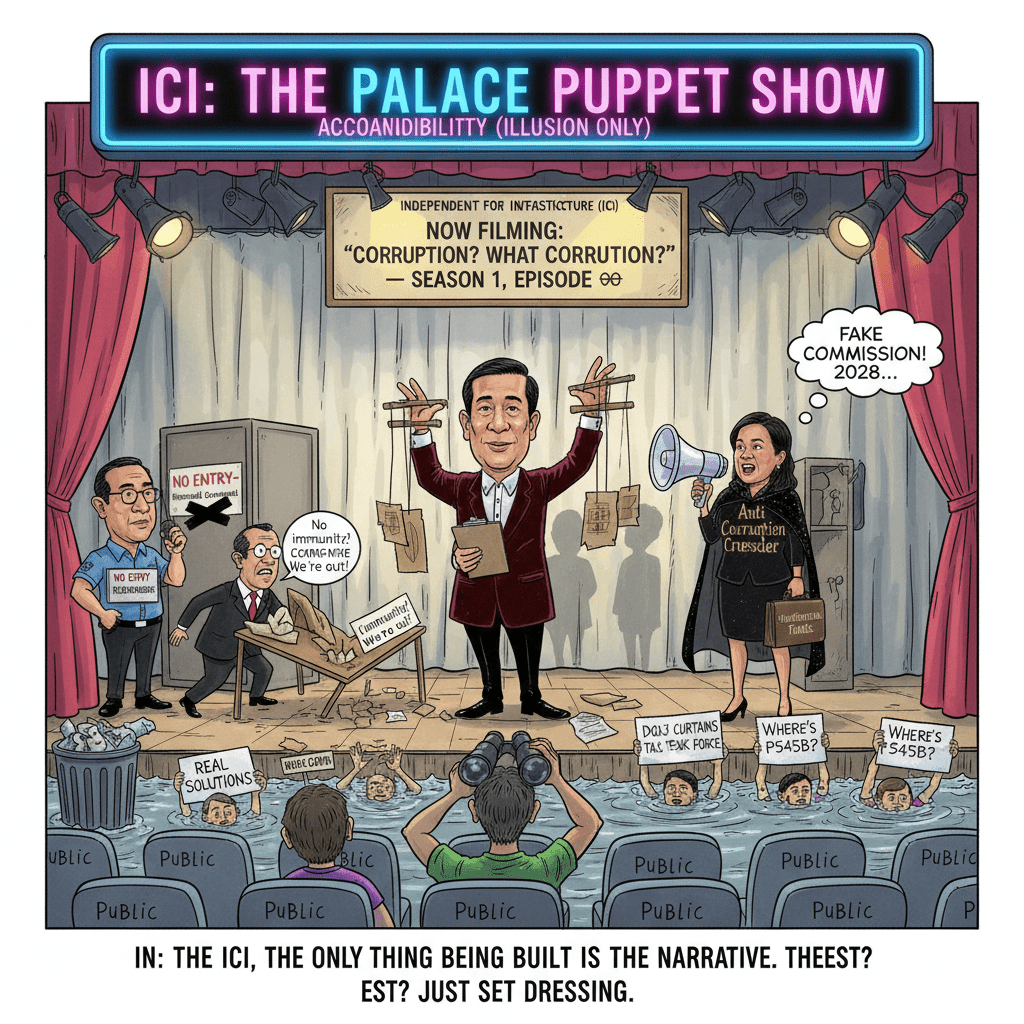
Cue the Drama: Sara’s Jabs Expose Marcos’ ICI as a Narrative Stage Prop
By Louis ‘Barok‘ C. Biraogo — October 21, 2025
The ICI: A Spoon Trying to Drain a Swamp
Behind the closed doors of the Independent Commission for Infrastructure (ICI), the Philippines’ latest anti-corruption drama unfolds with all the gravitas of a badly scripted teleserye. Witnesses ghost hearings, politicians lob accusations like confetti, and the public squints through a fog of secrecy, wondering if this is justice or just another act in the political circus. The irony is thicker than Manila’s traffic:
- A commission created by President Ferdinand Marcos Jr. to probe corruption in his own administration’s infrastructure projects now laments a lack of cooperation—from, you guessed it, his own administration.
This is the stage for the ICI, and it’s less an instrument of justice than a carefully lit platform for political shadowboxing, where the real fight isn’t against corruption but for control of the narrative ahead of the 2028 elections.
Act I: The Stage (A Farce in Three Parts)
The ICI, born via Executive Order No. 94, is a masterclass in performative governance. Its flaws aren’t just procedural—they’re practically theatrical:
The Transparency Farce
Executive Director Brian Hosaka defends closed-door hearings as a shield against “trial by publicity,” as if transparency were a virus to be contained. In a healthy democracy, sunlight disinfects; here, the priority seems to be keeping the mushrooms growing in the dark. No livestreamed hearings mean the public gets only what the commission chooses to serve, neatly packaged to shape perceptions. Why let citizens see the messy truth when a polished report can be fed later, tied with a bow?
The “Toothless Tiger” Paradox
The ICI can “investigate” but lacks subpoena power or prosecutorial teeth, making it a glorified fact-finding club. The case of contractors Pacifico and Cezarah Discaya, who withdrew cooperation after being denied state witness status, exposes this impotence. They expected a deal; instead, they got a shrug and a former DPWH secretary’s public skepticism about their value. When key players can simply walk away, the ICI isn’t a watchdog—it’s a suggestion box with no lock.
Act II: The Players and Their Scripted Lines
The cast of this political theater plays their roles with gusto, each with their own agenda:
Marcos Jr.: The Reluctant Director
Why create a new commission when the Ombudsman and Commission on Audit (COA)—constitutionally mandated, independent bodies—already exist? The answer lies in optics and control. By birthing the ICI, Marcos projects action without risking the unpredictability of a truly independent probe.
- The Ombudsman might dig too deep.
- The COA might audit too thoroughly.
- Both might uncover skeletons that rattle the Palace’s glass walls, perhaps implicating allies like Rep. Martin Romualdez, Marcos’ cousin, who breezily denied kickback allegations before the ICI.
The ICI offers a safer stage: visible enough to appease outrage over ₱545 billion in questionable flood control projects, yet pliable enough to avoid destabilizing his political base. What is Marcos so afraid the Ombudsman might find?
Sara Duterte: The Critic from the Wings
Vice President Sara Duterte’s critique of the ICI as a tool to “legitimize” Marcos’ narrative lands with the sting of truth but reeks of hypocrisy. This is the same Duterte who, as Education Secretary, oversaw billions in confidential funds with less transparency than a Manila Bay reclamation project.
- Her attack isn’t about good governance; it’s a pre-emptive strike to discredit findings that might implicate her or her family’s political machine.
- By painting herself as an anti-establishment outsider, she’s auditioning for 2028, conveniently forgetting her starring role in the system she now critiques.
- She’s not attacking secrecy; she’s mad it’s not her secrecy.
The Unspoken Alliance in Inaction
For all their public feuding, Marcos and Duterte share an unspoken interest in a probe that’s dramatic enough to appease the public but inconclusive enough to preserve the political ecosystem they both inhabit. The ICI’s drawn-out, toothless inquiry serves both:
- Marcos looks tough on corruption without rocking the boat.
- Duterte can rail against the system without offering solutions.
It’s a pas de deux of mutual convenience, choreographed to keep the status quo intact.
Act III: The Path Not Taken
What would a genuine anti-corruption drive look like? Here’s a menu of alternatives, served with a side of sarcasm to highlight the ICI’s inadequacy:
Turbo-Charge the COA
A leader serious about results might give the COA a special mandate and budget, letting forensic auditors move at the speed of scandal, not the pace of bureaucracy. But that would mean ceding control, and control is the currency of Philippine politics.
DOJ-Led Task Force
A prosecution-ready task force with real teeth could haul in contractors and officials, with evidence admissible in court. Too risky—someone might actually go to jail.
Public Geotagging Dashboards
Mandate geotagging for every infrastructure project, with public dashboards showing budgets, progress, and photos. Transparency invites scrutiny, though, and scrutiny is the enemy of narrative.
Blue Ribbon Committee Probe
A fully resourced, livestreamed Senate investigation could drag the truth into the open with subpoena power. But that would steal the Palace’s spotlight.
These alternatives weren’t chosen because they work too well, threatening the political cartels that thrive on opacity. The ICI was a choice—a politically convenient one.
The Final Curtain: A Tragedy in Floodwater
The real cost of this circus isn’t measured in headlines but in human lives. Substandard flood control projects, ghost contracts, and kickbacks have left communities drowning—literally. Typhoon after typhoon, towns are submerged, lives are lost, and the poor pay the price for elite gamesmanship. The ICI isn’t just a failure of process; it’s a symptom of a system that refuses to cure its own disease.
The Tragedy
Corruption isn’t the scandal—it’s the refusal to confront it head-on, opting instead for a commission that’s more stage prop than solution.
The Culprits
This isn’t Marcos’ fault alone, nor Duterte’s. It’s the collective failure of a political class that prefers shadowboxing to accountability.
Recommendations for the Public and Institutions
- Demand the Ombudsman and COA take center stage with real resources.
- Reject closed-door drama and insist on livestreamed hearings.
- See the political sniping for what it is: a distraction from submerged towns and empty coffers.
The ICI may be a spoon, but the people can still demand a shovel.
Source:
- Sampang, Dianne. “Sara Duterte: ICI Formed to ‘Legitimize’ Gov’t Narrative on Infra Mess.” Philippine Daily Inquirer, 19 Oct. 2025.

- ₱75 Million Heist: Cops Gone Full Bandit

- ₱6.7-Trillion Temptation: The Great Pork Zombie Revival and the “Collegial” Vote-Buying Circus

- ₱1.9 Billion for 382 Units and a Rooftop Pool: Poverty Solved, Next Problem Please

- ₱1.35 Trillion for Education: Bigger Budget, Same Old Thieves’ Banquet

- ₱1 Billion Congressional Seat? Sorry, Sold Out Na Raw — Si Bello Raw Ang Hindi Bumili

- “We Will Take Care of It”: Bersamin’s P52-Billion Love Letter to Corruption

- “Skewed Narrative”? More Like Skewered Taxpayers!

- “Scared to Sign Vouchers” Is Now Official GDP Policy – Welcome to the Philippines’ Permanent Paralysis Economy
- “Robbed by Restitution?” Curlee Discaya’s Tears Over Returning What He Never Earned

- “No Pressure” Luistro? The House Pork Bazaar Exposed
- “My Brother the President Is a Junkie”: A Marcos Family Reunion Special

- “Mapipilitan Akong Gawing Zero”: The Day Senator Rodante Marcoleta Confessed to Perjury on National Television and Thought We’d Clap for the Creativity



 KWEBA ni BAROK
Leave a comment