
Senator’s Splashy Crusade Collides with DOJ’s Steady Trawl
By Louis ‘Barok‘ C. Biraogo — October 24, 2925
DOJ’s Drama Derby: Bold Claims vs. Quiet Facts
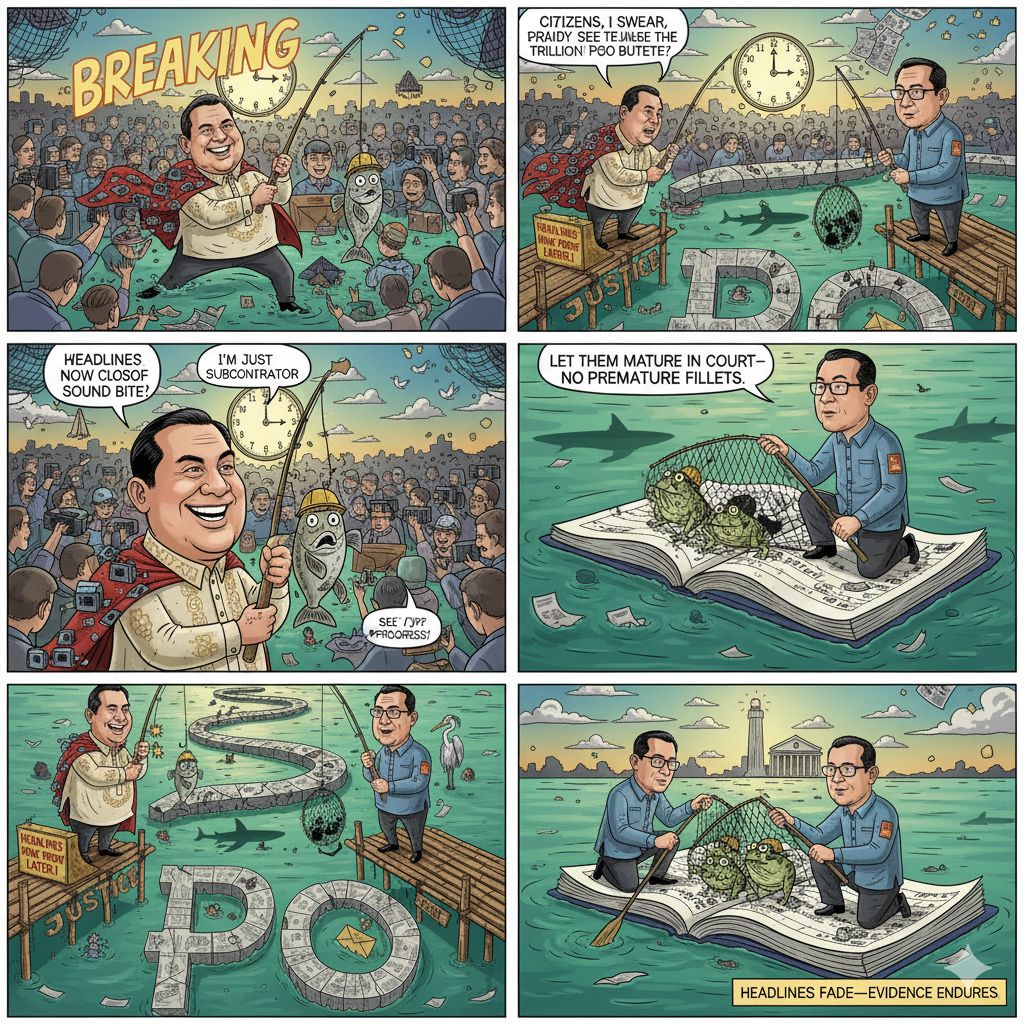
Picture Manila’s political stage aglow: former Justice Secretary Jesus Crispin Remulla steps forward, announcing with gusto that the Anti-Money Laundering Council has reeled in “big fish”—two senators and a former congressman, their assets reportedly locked in a P1 trillion flood control scandal. Social media hums; reporters scramble. Then, DOJ Undersecretary Jesse Hermogenes Andres takes the mic at a Senate hearing, calmly clarifying: no politicians’ assets are frozen, only DPWH officials’ accounts. This isn’t a misstep; it’s a dance between bold public signals and meticulous legal groundwork. While the crowd buzzes over headlines, Andres, the scandal’s steady hand, toils to secure the real catch.
Unraveling the Riddle: Why the DOJ’s Story Shifted
The apparent contradiction between Remulla’s September 2025 claim and Andres’ October correction isn’t the blunder it seems. Remulla announced that the AMLC, acting on National Bureau of Investigation (NBI) recommendations, had secured Court of Appeals freeze orders targeting Senators Joel Villanueva, Jinggoy Estrada, and former Representative Zaldy Co. Yet, Andres told Senator Rodante Marcoleta that no politicians’ assets were frozen—only those of Department of Public Works and Highways (DPWH) officials and contractors. Social media buzzed with confusion, and Marcoleta bristled, accusing the DOJ of netting only “sapsap and butete” (small fry) while masterminds swam free.
The truth likely lies in timing and scope. Remulla’s statement probably referred to AMLC applications or early actions, not finalized court orders. Since September 16, the AMLC has frozen over 2,800 bank accounts, 27 insurance policies, and P5 billion in assets, likely targeting contractors and bureaucrats while evidence against politicians builds. Andres’ clarification isn’t a retreat but a masterclass in legal rigor: freeze orders demand probable cause under the Anti-Money Laundering Act, and premature claims risk unraveling cases. His “circumspect” approach is the backbone of a prosecution built to withstand court scrutiny, not just to win headlines.
Spotlight Hog: Marcoleta’s Crusade or Charade?
Senator Rodante Marcoleta styles himself as the people’s avenger, wielding his Senate platform to demand accountability for the “big fish.” His outrage resonates: P1 trillion in public funds, meant to shield Filipinos from floods, has been siphoned off. By highlighting social media rumors, he taps into a nation’s demand for clarity. But his theatrics—dismissing frozen assets as mere “sapsap and butete”—smack of grandstanding. His public grilling of Andres risks alerting suspects, who could hide assets or destroy evidence. Critics, like Senator Ping Lacson, question his motives, suggesting his push to protect whistleblowers like contractors Curlee and Sarah Discaya might shield certain allies. Is Marcoleta chasing justice or angling for the anti-corruption crown? His rush to bypass restitution for witnesses, contra DOJ policy, prioritizes quick headlines over convictions that last. His stagecraft, while gripping, muddies the waters, potentially letting the real culprits slip away.
Enter Andres, the unsung architect of justice. His refusal to name politicians isn’t timidity but strategy. The AMLC’s freeze orders, targeting DPWH officials and contractors, are a deliberate first step, tracing money trails to build ironclad cases. His “systematic” work—evaluating five whistleblowers, including the Discayas, and preparing charges against 21 individuals—chooses evidence over fanfare. In a nation where corruption cases often crumble under political pressure, Andres’ restraint is a shield, ensuring prosecutions endure.
The Heart of the Heist: A Trillion-Peso Betrayal
Beyond the headlines lies the real crime: P1 trillion in flood control funds, looted while Filipinos face deadly floods. The Senate Blue Ribbon Committee and Independent Commission for Infrastructure have exposed 421 ghost projects—shoddy dikes, inflated contracts, and kickbacks laundered through shell companies. The toll is devastating: lives lost, communities uprooted, and 2,000 DPWH jobs slashed as the scandal ripples. The P5 billion in frozen assets is a mere fraction of the trillion-peso theft. Every public spat, every contradiction, deepens public despair, fueling fears that the powerful will escape while ordinary citizens drown in the fallout.
Charting the Course: Justice Beyond the Drama
Andres and the DOJ should stay the course but add strategic clarity. A redacted timeline of AMLC actions—filing dates, court orders, and general targets—would quell rumors without jeopardling leaks. Unified messaging with the NBI and AMLC, perhaps via a single spokesperson, would avoid future missteps. Speeding up freeze orders against politicians, where evidence supports, and finalizing witness deals would show progress. Sharing sealed court documents with the Senate in a closed briefing would satisfy oversight without jeopardling public chaos.
Marcoleta, if truly committed to justice, should swap theatrics for substance. He could subpoena AMLC records for a closed-door Senate review, ensuring accountability without tipping off suspects. Proposing laws to streamline AMLC’s freeze powers, with robust court checks, would tackle systemic flaws. His public demands, while rousing, risk undermining the prosecutions he champions.
The bottom line? The flood control scandal isn’t just a financial crime; it’s a gut-punch to a nation’s faith. The real mess isn’t the DOJ’s mixed messages but the political circus that drowns out the quiet, resolute work of people like Andres. Justice demands precision, patience, and evidence—not a race for applause. In this storm, Andres’ steady hand is the beacon for convictions that last, not headlines that vanish.
Source:

- “Forthwith” to Farce: How the Senate is Killing Impeachment—And Why Enrile’s Right (Even If You Can’t Trust Him)

- “HINDI AKO NAG-RESIGN!”

- “I’m calling you from my new Globe SIM. Send load!”

- “Mahiya Naman Kayo!” Marcos’ Anti-Corruption Vow Faces a Flood of Doubt

- “Meow, I’m calling you from my new Globe SIM!”

- “No Special Jail for Crooks!” Boying Remulla Slams VIP Perks for Flood Scammers

- “PLUNDER IS OVERRATED”? TRY AGAIN — IT’S A CALCULATED KILL SHOT

- “Several Lifetimes,” Said Fajardo — Translation: “I’m Not Spending Even One More Day on This Circus”

- “Shimenet”: The Term That Broke the Internet and the Budget

- “We Did Not Yield”: Marcos’s Stand and the Soul of Filipino Sovereignty

- “We Gather Light to Scatter”: A Tribute to Edgardo Bautista Espiritu

- $150M for Kaufman to Spin a Sinking Narrative







 KWEBA ni BAROK
Leave a comment