
A Bureaucratic Séance Summons a Six-Year Secret
By Louis ‘Barok‘ C. Biraogo — October 26, 2025
I. A Verdict That Skulked Out of the Crypt
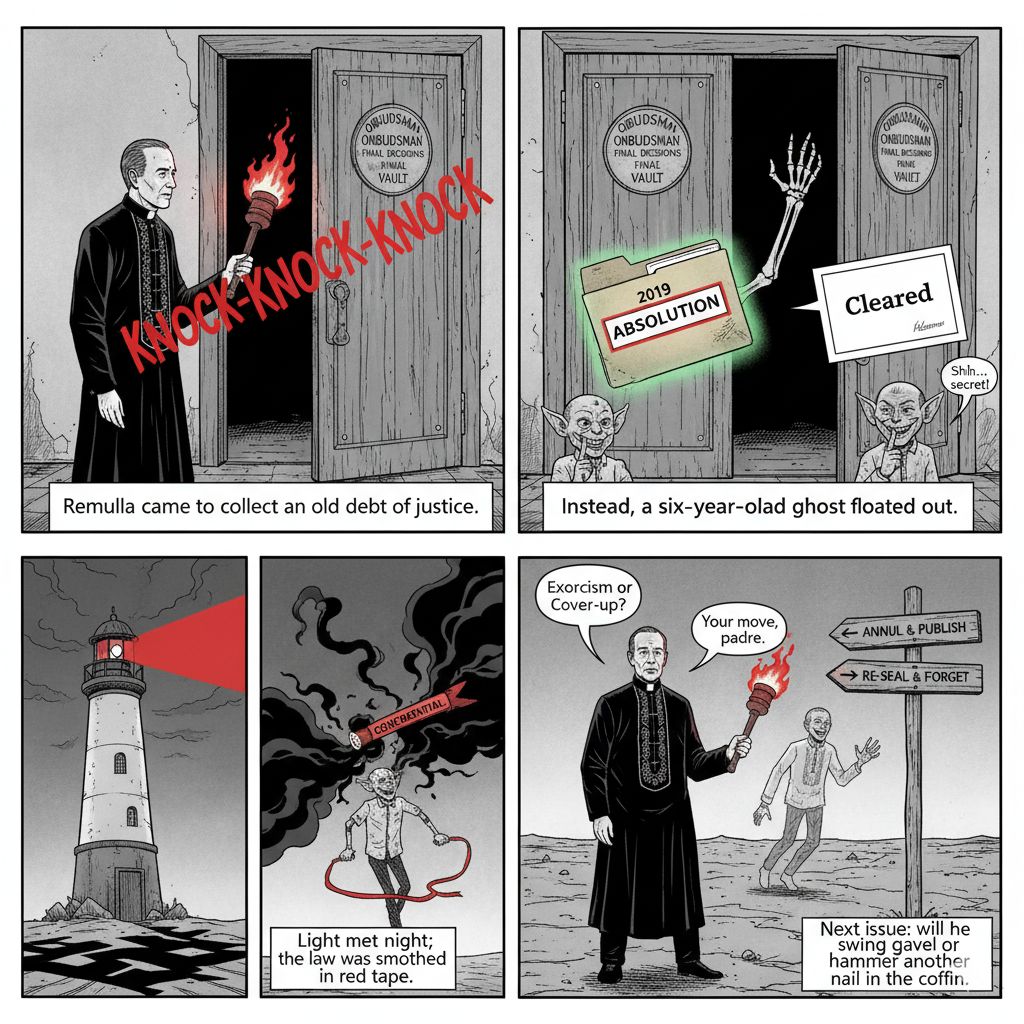
Back in 2016, Ombudsman Conchita Carpio Morales, the iron lady of accountability, swung a legal sledgehammer, smashing Senator Joel Villanueva’s career for his alleged pork barrel heist. Fast forward to 2025, and Ombudsman Boying Remulla, itching to enforce that righteous smackdown, stumbled into a bureaucratic horror show: a 2019 “secret decision” by former Ombudsman Samuel Martires, yanked from the Ombudsman’s haunted vaults, that let Villanueva slink back to respectability like a zombie dodging a headshot.
This ghost verdict, unearthed only when Remulla rattled the cage, wasn’t shared with the Senate, the public, or even the Ombudsman’s own staff. It’s not justice—it’s a bureaucratic vanishing act. What festered in the Office of the Ombudsman’s shadows for six years? Let’s crack open this scandal’s coffin and dissect the decay.
II. Morales vs. Martires: A Battle for the Ombudsman’s Bleeding Soul
Conchita Carpio Morales wielded the Ombudsman’s gavel like a lighthouse, illuminating corruption. Her 2016 dismissal of Villanueva for serious dishonesty and grave misconduct—tied to an alleged ₱10 million Priority Development Assistance Fund (PDAF) scam with Janet Lim-Napoles’ fake non-governmental organizations (NGOs)—was a testament to accountability. Under Rule III, Section 7 of the Ombudsman Rules of Procedure, Villanueva had ten days to file a motion for reconsideration. Miss that, and the decision becomes final and executory, per Fabian v. Desierto (G.R. No. 129742, 1998). Morales’ rulings were open, served, and enforced.
Then came Samuel Martires, who turned the Ombudsman’s office into a haunted house. In July 2019, he signed a reversal of Morales’ order, but instead of proclaiming it, he stashed it in the shadows. For six years. Even Senate President Tito Sotto was left in the dark. This isn’t a procedural oopsie—it’s a betrayal of the Ombudsman’s constitutional duty as “protector of the people” (Article XI, Section 12, 1987 Constitution). Morales stood for sunlight; Martires conjured a blackout.
III. The Legal Slaughter: Why This Phantom Verdict Is a Corpse
Let’s carve this scandal with a legal machete. If the 2016 dismissal was final, it was untouchable. The doctrine of immutability of judgments, cemented in De Guzman v. Sandiganbayan (G.R. No. 103276, 1994), declares final decisions sacred—unalterable even by the issuing authority. Once Villanueva’s ten-day window for reconsideration closed, Morales’ verdict was granite. Martires’ 2019 reversal, three years late, was not just irregular—it was legally dead on arrival.
Even if Villanueva filed a timely motion, the Ombudsman Rules demand “prompt disposition” (Rule II, Sec. 11). Three years isn’t prompt; it’s a bureaucratic coma. Worse, the secrecy violates due process, enshrined in Article III, Section 1 of the 1987 Constitution. Paat v. Court of Appeals (G.R. No. 111107, 1994) is clear: decisions without notice are null. The Senate, tasked with enforcing the dismissal, deserved notice. The public, clinging to fading trust, deserved transparency.
The Republic Act (R.A.) 6770, or Ombudsman Act of 1989, mandates swift action against corruption (Sec. 15). The Republic Act (R.A.) 6713, or Code of Conduct and Ethical Standards for Public Officials and Employees, demands openness (Sec. 4(c)). Martires’ phantom verdict spits on both. It’s not just a legal error; it’s an ethical gut-punch, a mockery of the public’s right to know.
IV. The Feeble Alibi: A Flicker in the Ombudsman’s Gloom
Let’s entertain Martires’ defense, if only to watch it collapse. He might claim he was correcting a miscarriage of justice, as the Ombudsman Rules allow reversals for new evidence or grave errors (Rule III, Sec. 7). Publication isn’t strictly required for administrative decisions (Tañada v. Tuvera, G.R. No. L-63915, 1986), and judicial immunity might shield discretionary acts (State Prosecutors v. Judge Manuel T. Muro. A.M. No. RTJ-92-876, Supreme Court of the Philippines, 19 Sept. 1994).
But this alibi is thinner than a politician’s promise. Immunity doesn’t cover deliberate concealment. Discretion doesn’t justify a three-year delay or a six-year silence. Where’s the evidence justifying the reversal? Without transparency, Martires’ decision isn’t justice—it’s a bureaucratic burial.
V. Martires’ Reckoning: Incompetence or Conspiracy?
Let’s not mince words: Martires’ secrecy is either gross negligence or a darker plot. R.A. 6713, Sec. 4(c) demands transparency; Martires delivered opacity. The Ombudsman Rules (Rule 13, Sec. 4) require notice; he gave none. If intentional, this could flirt with Article 208 of the Revised Penal Code (RPC), dereliction of duty, for officers who “maliciously refrain from instituting prosecution or suspend execution of law.”
Was Martires shielding Villanueva? Playing political chess? Or just bumbling through his tenure? Regardless, the damage is catastrophic. A secret absolution undermines the Ombudsman more than any corrupt senator ever could. This demands investigation—yesterday.
VI. Remulla’s Trial by Fire: Will He Slay the Phantom or Join It?
Ombudsman Boying Remulla stepped into this mess with a bold promise to enforce the 2016 dismissal, only to be blindsided by Martires’ ghost verdict. His “surprise” betrays an office in disarray. Now, he faces a choice: be a crusader or a coward.
Under R.A. 6770, Sec. 15(1), Remulla can probe Martires for misconduct, even post-tenure. He could audit the 2019 decision’s paper trail—when was it filed, who hid it, and why? If it lacked jurisdiction or notice, he can annul it motu proprio (Ombudsman Rules, Rule III, Sec. 7). He could escalate to the Supreme Court for declaratory relief, letting justices decide the verdict’s fate.
But boldness demands more. Remulla must publish the full record—every memo, every signature, every delay. Transparency is the only cure for this scandal’s stench. Anything less, and he’s complicit in the Ombudsman’s descent into darkness.
VII. The Abyss Stares Back: A Democracy on the Brink
This isn’t just about Villanueva’s fate or Martires’ misdeeds. It’s about the Office of the Ombudsman as the last bastion against corruption. When its decisions vanish into a void, the democratic edifice cracks. If justice can be undone with a secret signature, what stops the powerful from rewriting accountability altogether?
The Philippines’ anti-corruption fight hinges on institutions that deliver truth, not shadows. A phantom verdict isn’t a scandal—it’s a symptom of a system where impunity still lurks.
VIII. The Exorcism: Banishing the Ghosts of Secret Justice
Ombudsman Remulla, your time is now. Don’t just gasp at the ghost verdict—slay it. Annul the 2019 decision for its jurisdictional and ethical sins. Audit Martires’ tenure to root out any rot. Refer misconduct to the Department of Justice or Supreme Court. And mandate that all Ombudsman decisions be published within days, not decades, to prevent another phantom absolution.
The public demands truth, not shadows. If the Ombudsman’s office can’t deliver justice in the open, it’s not a protector—it’s a crypt. Bury the secrets. Resurrect accountability. The soul of the nation depends on it.
Justice delayed is justice denied. Justice concealed is justice betrayed.
Key Citations
- Constitution of the Republic of the Philippines. 1987, Art. III, Sec. 1; Art. XI, Sec. 12.
- De Guzman v. Sandiganbayan. G.R. No. 103276, 11 Apr. 1994.
- Fabian v. Desierto. G.R. No. 129742, 16 Sept. 1998.
- State Prosecutors v. Judge Manuel T. Muro. A.M. No. RTJ-92-876, Supreme Court of the Philippines, 19 Sept. 1994. LawPhil Project.
- Office of the Ombudsman. “Omnibus Rules of Procedure..
- Paat v. Court of Appeals. G.R. No. 111107, 10 Jan. 1997.
- Republic Act No. 6713: Code of Conduct and Ethical Standards for Public Officials and Employees. 20 Feb. 1989, Sec. 4(c).
- Republic Act No. 6770: The Ombudsman Act of 1989. 17 Nov. 1989, Sec. 15(1).
- Revised Penal Code of the Philippines. Act No. 3815, Art. 208, 8 Dec. 1930.
- Tañada v. Tuvera. G.R. No. L-63915, 24 Dec. 1986.
- “Ombudsman Urged to Look into ‘Secret Decision’ to Clear Villanueva.” Inquirer.net, 24 Oct. 2025.
- “Forthwith” to Farce: How the Senate is Killing Impeachment—And Why Enrile’s Right (Even If You Can’t Trust Him)

- “HINDI AKO NAG-RESIGN!”

- “I’m calling you from my new Globe SIM. Send load!”

- “Mahiya Naman Kayo!” Marcos’ Anti-Corruption Vow Faces a Flood of Doubt

- “Meow, I’m calling you from my new Globe SIM!”

- “No Special Jail for Crooks!” Boying Remulla Slams VIP Perks for Flood Scammers

- “PLUNDER IS OVERRATED”? TRY AGAIN — IT’S A CALCULATED KILL SHOT

- “Several Lifetimes,” Said Fajardo — Translation: “I’m Not Spending Even One More Day on This Circus”

- “Shimenet”: The Term That Broke the Internet and the Budget

- “We Did Not Yield”: Marcos’s Stand and the Soul of Filipino Sovereignty

- “We Gather Light to Scatter”: A Tribute to Edgardo Bautista Espiritu

- $150M for Kaufman to Spin a Sinking Narrative




 KWEBA ni BAROK
Leave a comment