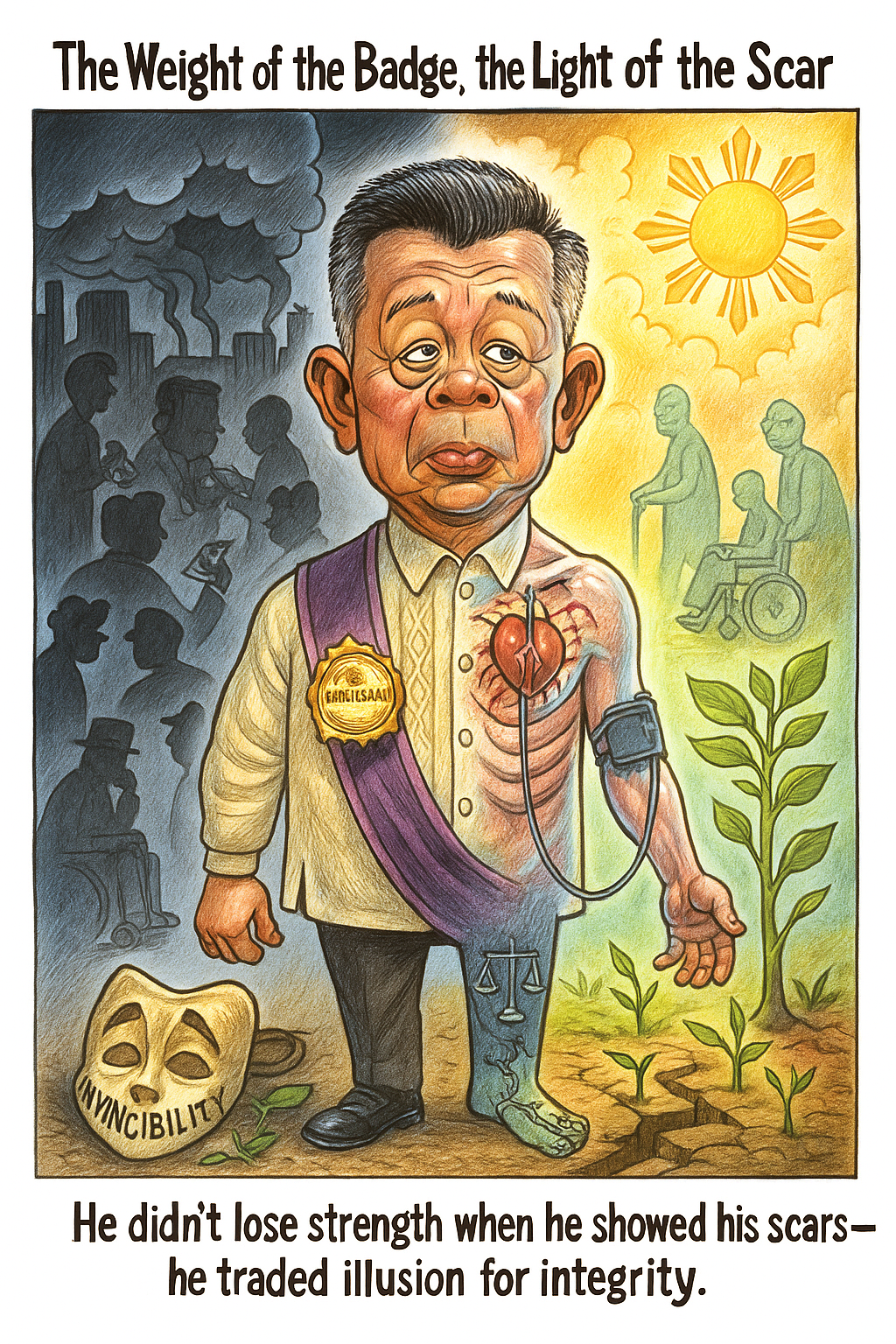
His battle with illness is more than a personal story — it’s a test of whether vulnerability can give birth to moral strength in Philippine public life.
By Louis ‘Barok‘ C. Biraogo — October 28, 2015
WHEN Ombudsman Jesus Crispin Remulla revealed that he had battled leukemia following a quintuple bypass, the disclosure struck the nation with a quiet jolt. Here was one of the country’s most powerful legal figures, suddenly rendered human — not as a bureaucrat or a political tactician, but as a man who had come face to face with mortality.
It was more than a confession. It was a statement of philosophy.
In a culture where political leaders conceal their weaknesses to project invincibility, Remulla’s admission was an act of defiance. Philippine public life rewards toughness and punishes transparency. Yet here he was, saying aloud what many in government dare not whisper: that illness can be an ally, that fragility can clarify what strength cannot.
Motives Behind the Disclosure
To understand why Remulla chose this moment to go public, one must look beyond sentiment. Political timing and moral purpose often intersect.
At a personal level, his revelation could be cathartic — an acknowledgment of survival after two brushes with death, first through heart failure, then cancer. But there may also be a political subtext. As Ombudsman, he oversees the machinery of accountability in a government notorious for opacity and impunity. By revealing his own vulnerability, he may be asserting moral authority — a reminder that integrity, like life itself, is finite and must be guarded against decay.
There is also a strategic calculation. By disclosing his illness now — after recovery, not during crisis — Remulla insulates himself from whispers and speculation. It preempts rumors that might have cast his health as weakness. Instead, it transforms frailty into moral capital: a story of survival that frames him as resilient, grounded, and more attuned to human imperfection.

The Double-Edged Sword of Disclosure
Still, transparency carries risk.
The advantages are clear: humanization, empathy, and renewed moral legitimacy. The disadvantages are subtler but real. Public knowledge of illness can erode confidence among allies and subordinates who equate vigor with authority. In the ruthless arena of Philippine politics, compassion can be mistaken for decline.
Yet if Remulla’s disclosure shifts the tone of leadership — from bravado to authenticity — then the risk may be worth it. It signals that governance need not be performed through masks of strength, but through the courage of truth.
Illness and Greatness: A Long Human Story
Remulla’s revelation joins a lineage of leaders who found greatness not in their power, but in their endurance.
Franklin D. Roosevelt, paralyzed by polio, reimagined democracy from a wheelchair.
Winston Churchill, haunted by depression, summoned resolve amid despair.
John F. Kennedy, enduring chronic pain, embodied vitality through sheer will.
Stephen Hawking, locked in paralysis, expanded the frontiers of the cosmos with the force of his mind.
And then there was Deng Xiaoping, who nearly died not once but twice — first in the violent purges of Mao’s Cultural Revolution, and later when his home was attacked during a political upheaval that left him with severe bone fractures. Stripped of power, isolated, and physically broken, Deng returned from near oblivion to rebuild China. From his suffering emerged a new kind of leadership: pragmatic, humble, stripped of dogma. “It doesn’t matter whether the cat is black or white,” he said, “as long as it catches mice.”
His strength was not the arrogance of the unscathed, but the clarity of one who had suffered. Deng’s body bore scars, but his spirit had been refined by adversity. He understood that endurance is not about denying weakness — it’s about transforming it into wisdom.
So too might Remulla’s ordeal become the crucible of reform. The test now is whether he can translate survival into institutional transformation — whether personal redemption can become a metaphor for national integrity.
The Road Ahead
The Ombudsman’s office is a lonely post. Its mission — to expose corruption and uphold ethical government — often pits it against both allies and enemies. It demands moral stamina as much as legal acumen.
Remulla’s battle with illness may have stripped him of physical vigor, but it could also have endowed him with something rarer: moral gravitas. If he uses his experience not to solicit sympathy but to deepen reform, he could redefine public service as an act of conscience rather than convenience.
But if his disclosure remains merely autobiographical — a story of survival without corresponding institutional courage — it risks fading into sentimentality. The challenge, then, is not simply to recover, but to renew: to prove that the nation’s fight against corruption can be as tenacious as one man’s fight for life.
The Courage to Be Mortal
Deng Xiaoping’s broken bones. Roosevelt’s wheelchair. Hawking’s voice machine. These men proved that mortality need not diminish greatness — it can purify it.
If Ombudsman Remulla can turn his scars into a source of resolve, if he can govern not in spite of his vulnerability but because of it, then perhaps his revelation will stand not as a confession of frailty, but as a declaration of faith — in the idea that those who have confronted their own limits are the ones best equipped to confront the limits of power.
And if he succeeds — if he channels the empathy of the wounded into the justice of the courageous — he could mark a quiet turning point in Philippine leadership. A nation so often governed by the arrogant and the unaccountable might, for once, be led by someone who understands that the truest kind of strength is not the absence of weakness, but the wisdom born of surviving it.
- ₱75 Million Heist: Cops Gone Full Bandit

- ₱6.7-Trillion Temptation: The Great Pork Zombie Revival and the “Collegial” Vote-Buying Circus

- ₱1.9 Billion for 382 Units and a Rooftop Pool: Poverty Solved, Next Problem Please

- ₱1.35 Trillion for Education: Bigger Budget, Same Old Thieves’ Banquet
- ₱1 Billion Congressional Seat? Sorry, Sold Out Na Raw — Si Bello Raw Ang Hindi Bumili

- “We Will Take Care of It”: Bersamin’s P52-Billion Love Letter to Corruption
- “Skewed Narrative”? More Like Skewered Taxpayers!

- “Scared to Sign Vouchers” Is Now Official GDP Policy – Welcome to the Philippines’ Permanent Paralysis Economy
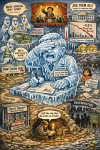
- “Robbed by Restitution?” Curlee Discaya’s Tears Over Returning What He Never Earned
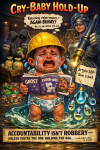
- “No Pressure” Luistro? The House Pork Bazaar Exposed
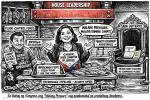
- “My Brother the President Is a Junkie”: A Marcos Family Reunion Special

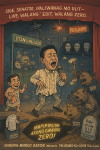
- “Mapipilitan Akong Gawing Zero”: The Day Senator Rodante Marcoleta Confessed to Perjury on National Television and Thought We’d Clap for the Creativity

 KWEBA ni BAROK
Leave a comment