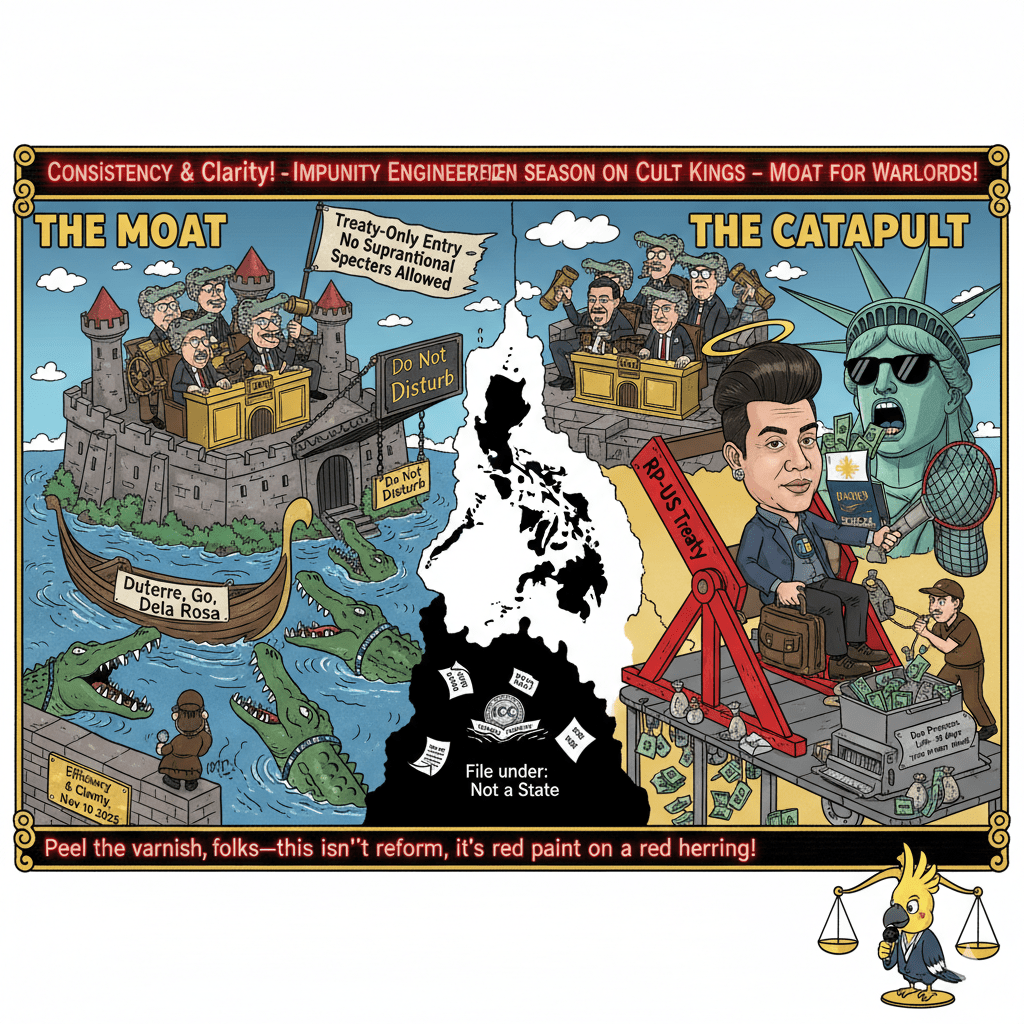
For Go & Dela Rosa: The Court Built a Moat. For Quiboloy: The Court Built a Catapult — Straight to America
By Louis “Barok” C. Biraogo — October 30, 2025
1. The “Perfectly Timed” Panic Button: Coincidence or ICC-Proof Bunker?
MGA ka-kweba ng legal coliseum, gather ’round. The Supreme Court has just dropped a glittering new rulebook on extradition proceedings, effective November 10, 2025 – a date that might as well be etched in the calendars of every jet-setting politico with a warrant warming in some foreign drawer. It’s billed as a “significant step toward making the legal process of turning over fugitives… consistent, clear, and efficient.” How noble. How timely. But let’s not kid ourselves: in the theater of Philippine justice, timing is everything, and this smells less like procedural housekeeping and more like a smoke signal from the palace guard.
Is this new rule a genuine step toward a more orderly international legal order, or is it a meticulously crafted “get out of jail free” card for the Philippine political elite, designed to shield them from international accountability while appearing to cooperate? Buckle up, dear readers. We’re about to dissect this beast with the precision of a scalpel and the glee of a gladiator.
Why now? The Court’s own statement chirps about “consistency and guidance” in extradition cases, but let’s connect the dots. Presidential Decree No. 1069 (PD 1069), our creaky Extradition Law from the Marcos martial days, has limped along for decades without this sudden polish. No, this reeks of pre-emptive architecture – a legal fortress erected just as the International Criminal Court (ICC)’s siege engines creak into position. It’s not a procedural update; it’s a moat dug deeper than the Pasig, complete with alligators named “treaty only” and “double criminality.” The world sees cooperation; the elite sees a panic room.
2. The “State-Only” Trapdoor: ICC? Never Heard of It.
Ah, the jewel in this crown of convenience: these rules apply exclusively to state-to-state requests under existing treaties. Double criminality? Check – extradition only if the crime’s a felony in both the Philippines and the requesting state, per the new rules and PD 1069, Section 2. Minimum six months left on a sentence? Fine print for the convicted. But here’s the surgical strike: the ICC is not a state. It’s a supranational specter, governed by Rome Statute Article 89, which demands “surrender” via national procedures – not our treaty-tied tango.
Contrast that with Philippine law: PD 1069, Section 1 limits extradition to “foreign states” with treaties, leaving a yawning void for non-state actors like the ICC. Republic Act No. 9851 (RA 9851), our nod to international humanitarian law, flirts with complementarity but stops short of mandating ICC handoffs. The result? A legal black hole where ICC warrants for crimes against humanity (Rome Statute, Article 7) – think extrajudicial killings racking up thousands – simply evaporate upon Philippine soil. No petition from the Department of Justice (DOJ), no extradition court jurisdiction, no nothing. It’s unenforceable, folks. A safe haven etched in marble.
The consequence? Impunity on steroids. Duterte & Co. can thumb their noses at The Hague from the comfort of Malacañang’s shadow, while the Court pretends it’s all about “efficiency.” This isn’t order; it’s a smokescreen, billowing thick enough to choke justice itself.

3. The Quiboloy Gambit: Throw the Cult King to the Wolves, Save the Warlords
Enter Apollo Quiboloy, the self-proclaimed “Appointed Son of God” with a U.S. extradition request hotter than his flock’s tithes. Wanted for sex trafficking and fraud under our 1976 RP-US Extradition Treaty? Oh, the new rules will hum like a well-oiled machine:
- DOJ petition to the Regional Trial Court (RTC)
- 30-day judgment on documents alone (witnesses optional)
- Discretionary bail only if he swears he’s no flight risk – good luck, Apollo
- Appeals to the Court of Appeals (CA)? 90 days tops, then final and executory
Swift. Surgical. Efficient.
Now contrast: For Duterte, Go, or Dela Rosa, an ICC warrant? Crickets. No treaty, no framework – just a polite “not our circus” from the Department of Foreign Affairs (DFA). Is this coincidence, or calculus? Quiboloy’s no political heavyweight; he’s a non-entity ally, a cult king without a caucus. Toss him to the wolves, and voilà – the Philippines looks like a cooperative global citizen, ticking the “we extradite bad guys” box for the U.S. while slamming the vault on ICC interlopers. A sacrificial lamb on the altar of appearances? You bet.
4. Due Process on a Conveyor Belt: Efficiency or State-Sanctioned Steamroller?
Let’s zoom in on the “efficiencies” that make these rules sparkle like fool’s gold. “Efficiency” FeatureReality Check Judgments on documents only No mandatory witnesses – because who needs confrontation? 30-day decision clock Echoes Rule 126, Rules of Court but turbocharged Bail? A unicorn for the convicted Purganan’s high bar lives on
Sarcasm alert: How efficient! Justice on an assembly line, where due process gets the lean manufacturing treatment. Remember Secretary of Justice v. Lantion (G.R. No. 139465, 2000)? The Court once bent over backward for pre-arrest rights, only to reverse itself later. Here, it’s Lantion-lite: open court unless “national security” whispers shut the doors, tilting the scales to the state faster than a tipsy judge at a bar conference.
These shortcuts don’t streamline; they strangle. The extraditee gets a hearing, sure – but one where the house always wins, courtesy of PD 1069’s treaty deference and the Constitution’s own extradition carve-out (Article III, Section 2). It’s due process in a straitjacket, mocking the very precedents it cites. Efficiency at what cost? The soul of justice, apparently.
5. The Grand Finale: Who’s Really Getting the “Get Out of Jail Free” Card?
So, to the burning question: Genuine reform, or elite escape hatch? Spoiler: It’s the latter, wrapped in the former’s gift paper. The unspoken agenda? A jurisdictional sleight of hand, fortifying the archipelago against non-state nemeses like the ICC while flaunting “cooperation” via treaty toys. RA 9851‘s humanitarian pretensions? Window dressing. The Rome Statute’s Article 86 cooperation mandate? Ancient history post-withdrawal.
This is impunity engineered by the eminent domain of the elite – a moat for the mighty, a trapdoor for the rest.
Barok’s Final Orders:
- To the Public: Peel back the procedural varnish. This isn’t reform; it’s a red herring. Demand transparency – audit every DOJ petition like it’s your IRA.
- To the ICC: Wake up. Extradition’s a dead end here. Pivot to assertive flanks – universal jurisdiction in ally states, asset freezes, or UN spotlights.
- To the Political Allies: Enjoy the provisional palace. Your safety’s as solid as a Duterte promise – fine at home, fatal abroad. One wrong vacation to an ICC-friendly shore, and poof: Purganan‘s flight-risk presumption becomes your reality.
The curtain falls, but the suspense lingers. November 10, 2025, looms like a guillotine’s shadow. Who’ll be the first “test case” – Quiboloy’s coiffed head, or a stunned silence when The Hague tests the walls? The world watches, popcorn in hand. Will the facade hold, or crack under the weight of its own hypocrisy?
Barok out.
Key Citations
- Supreme Court of the Philippines. “Rules on Extradition Proceedings.” Supreme Court of the Philippines, 2025.
- Republic of the Philippines. Presidential Decree No. 1069: The Philippine Extradition Law. elibrary.judiciary.gov.ph, 2 May 1977. Accessed 30 Oct. 2025.
- International Criminal Court. Rome Statute of the International Criminal Court. United Nations, 17 July 1998.
- Republic of the Philippines. Republic Act No. 9851: Philippine Act on Crimes Against International Humanitarian Law, Genocide, and Other Crimes Against Humanity. Official Gazette of the Republic of the Philippines, 11 Dec. 2009.
- Government of the United States of America v. Purganan, G.R. No. 148571, Supreme Court of the Philippines, 24 Sept. 2002.
- Secretary of Justice v. Lantion, G.R. No. 139465, Supreme Court of the Philippines, 17 Oct. 2000.
- “Extradition Treaty between the Government of the Republic of the Philippines and the Government of the United States of America.” 13 Nov. 1994. Supreme Court E-Library.
- Federal Bureau of Investigation. “Apollo Carreon Quiboloy.” FBI Most Wanted, Federal Bureau of Investigation, 2025.
- “Preacher Wanted by FBI on Sex Crime Charges Evades Philippine Police as Followers Resist in Dayslong Standoff.” CNN, 27 Aug. 2024.

- ₱75 Million Heist: Cops Gone Full Bandit

- ₱6.7-Trillion Temptation: The Great Pork Zombie Revival and the “Collegial” Vote-Buying Circus

- ₱1.9 Billion for 382 Units and a Rooftop Pool: Poverty Solved, Next Problem Please

- ₱1.35 Trillion for Education: Bigger Budget, Same Old Thieves’ Banquet

- ₱1 Billion Congressional Seat? Sorry, Sold Out Na Raw — Si Bello Raw Ang Hindi Bumili

- “We Will Take Care of It”: Bersamin’s P52-Billion Love Letter to Corruption

- “Skewed Narrative”? More Like Skewered Taxpayers!

- “Scared to Sign Vouchers” Is Now Official GDP Policy – Welcome to the Philippines’ Permanent Paralysis Economy

- “Robbed by Restitution?” Curlee Discaya’s Tears Over Returning What He Never Earned

- “No Pressure” Luistro? The House Pork Bazaar Exposed
- “My Brother the President Is a Junkie”: A Marcos Family Reunion Special

- “Mapipilitan Akong Gawing Zero”: The Day Senator Rodante Marcoleta Confessed to Perjury on National Television and Thought We’d Clap for the Creativity




 KWEBA ni BAROK
Leave a comment