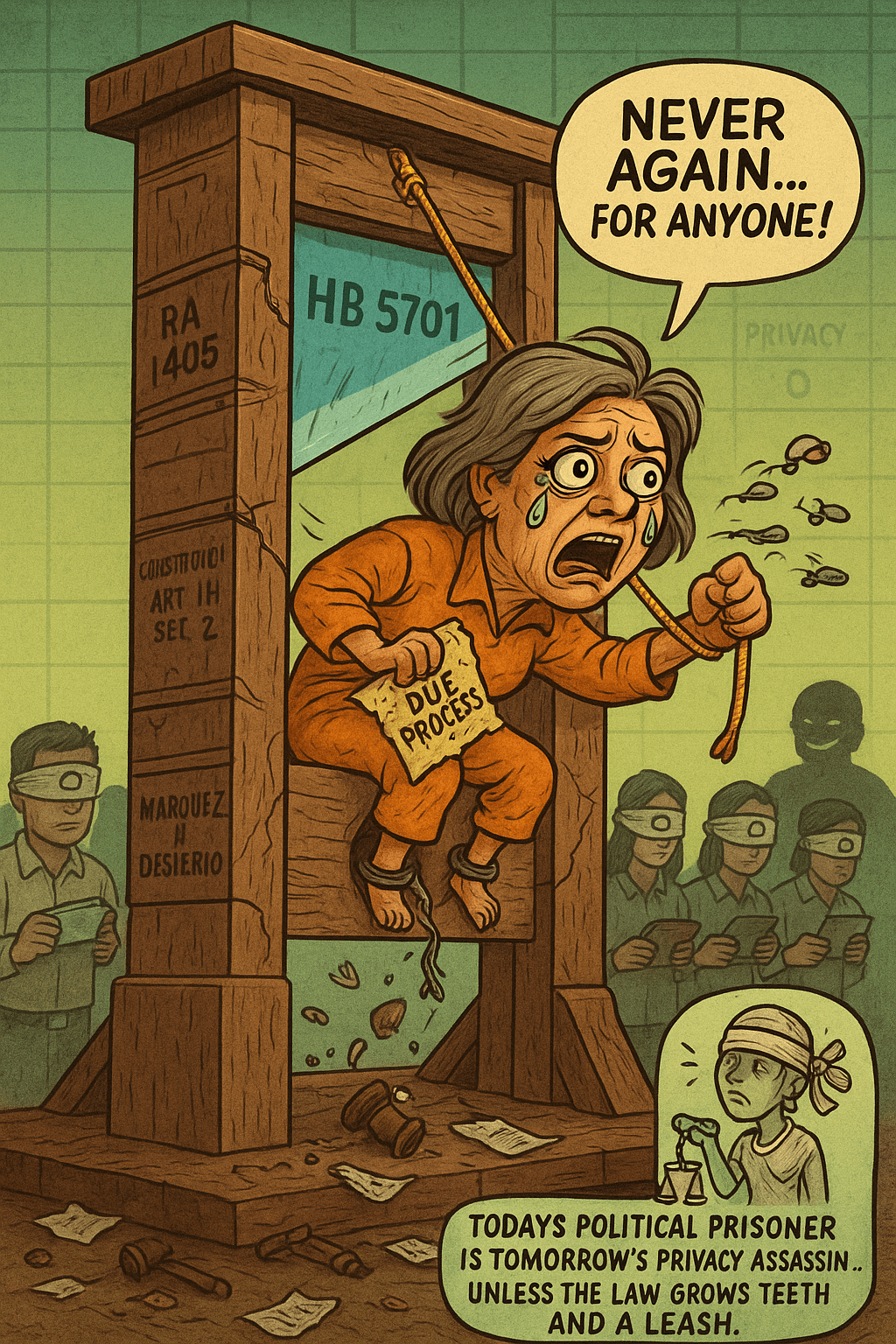
HB 5701: Where Due Process Goes to Die… Quietly
By Louis “Barok” C. Biraogo — November 1, 2025
From Political Prisoner to Privacy Assassin?
Leila de Lima—jailed for five years on charges many call a Duterte-era frame-up—is back in Congress as Mamamayang Liberal Party-list Representative. Her weapon? House Bill No. 5701 (HB 5701).
Her rallying cry: “Empower the Office of the Ombudsman (OMB) to crush corruption!”
My red flag: Empower—or hand a master key to every Filipino’s financial life?
New Ombudsman Jesus Crispin “Boying” Remulla has been in office one week, already torching Samuel Martires’ Statement of Assets, Liabilities, and Net Worth (SALN) blackout. The flood-control scandal has triggered a sharp market sell-off, with billions wiped out in days. Billions more vanish yearly into graft, per official estimates. And now—perfectly timed—De Lima drops a bill letting the OMB rifle through bank records without a court order, without a pending case, without a warrant.
Just a subpoena, and poof—your financial soul is laid bare.
This isn’t anti-corruption.
This is a surveillance state wearing an anti-graft halo.
THE LEGAL HEART: The Supreme Court’s “NO TRESPASSING” Sign That HB 5701 Wants to Bulldoze
Cue the drama, kweba style.
2001. Ombudsman Aniano Desierto, chasing graft tied to former Customs fixer Guillermo Parayno, demands bank records. No case filed. No court order. Just a subpoena duces tecum.
The bank fires back: “Republic Act No. 1405 (RA 1405) says no.”
Desierto: “I’m the Ombudsman. I’m above that.”
Enter the Supreme Court in Marquez v. Desierto (G.R. No. 135882, 27 June 2001)—and it slams the emergency brake:
“The Ombudsman cannot compel production of bank records unless a case is already pending in court.”
Why? Because:
- RA 1405 (Bank Secrecy Law) is absolute—deposits are confidential except in narrow, judicially supervised cases (impeachment, bribery with court order, litigation).
- Article III, Section 2 of the 1987 Constitution—no unreasonable searches without a warrant issued by a judge upon probable cause.
- Separation of powers—the judiciary, not an executive agency, guards the gate to private financial data.
The Court didn’t just rule. It drew a constitutional moat:
“The right to privacy is not sacrificed on the altar of administrative convenience.”
HB 5701?
It’s not amending the law.
It’s trying to drain the moat.
THE FORBIDDEN FRUIT: Why the Bill’s Defenders Are Half-Right (and Fully Dangerous)
Let’s give the devil its due—with steel-toed boots.
De Lima and her allies aren’t wrong about the rot:
- Corruption is a vampire. It drains trillions. The flood-control scandal? Just the latest bloodbath.
- Bank secrecy is its cloak. RA 1405, meant to shield depositors from nosy officials, has become a safe house for plunderers.
- Marquez handcuffed the OMB. No case = no access = corrupt officials move money, destroy evidence, laugh all the way to Dubai.
- Republic Act No. 6770 (RA 6770) already says the OMB can “examine and have access to bank accounts.” Why let a 2001 ruling neuter a 1989 law?
- Anti-Money Laundering Council (AMLC) does it. The AMLC gets bank records without court orders in covered transactions. Why not the OMB for graft?
And let’s not forget: De Lima has scars. She was targeted by state power. She knows what abuse looks like. Her bill, she says, is about never again letting the corrupt hide.
Fair. Compelling.
But here’s the cyanide in the champagne.
THE POISONED CHALICE: Why This Bill Is a Constitutional Suicide Pact
Let’s dismantle this brick by brick—with a sledgehammer of logic.
1. It Violates the Right to Privacy—Full Stop.
Article III, Section 2, 1987 Constitution:
“The privacy of communication and correspondence shall be inviolable except upon lawful order of the court…”
Bank records aren’t just numbers. They’re your medical payments, your political donations, your affair in Boracay, your life.
The Supreme Court in Ople v. Torres (1998) called privacy a “fundamental right”—not to be pierced by administrative whim.
HB 5701?
It hands that piercing tool to one office—the OMB—with zero judicial filter.
That’s not empowerment.
That’s executive overreach in a robe.
2. It Bypasses Judicial Oversight—A Separation of Powers Nightmare
Marquez wasn’t being petty. It was protecting the architecture of democracy.
- The judiciary is the neutral referee.
- The OMB is a prosecutor—powerful, yes, but not a judge.
Letting an investigator be judge, jury, and bank-vault opener?
That’s how you get fishing expeditions, political hit jobs, and midnight subpoenas.
Remember NBI raids without warrants? Remember DOJ fishing for SALNs?
This is that—on steroids.
3. It Invites Abuse—And History Is Watching
De Lima says: “Trust the Ombudsman.”
I say: Trust is earned, not legislated.
- The OMB is appointed by the President.
- It has been used before to harass critics (hello, Trillanes bank probe).
- Under Martires, it hid SALNs. Under Desierto, it overreached.
Now you want to give that same office a blank check to your finances?
This isn’t anti-corruption.
This is anti-due process.
4. It Conflicts with RA 1405 and the Data Privacy Act
RA 1405 says: No inquiry without court order—except in 4 cases.
HB 5701 adds a 5th: “Because the Ombudsman said so.”
That’s not an exception.
That’s statutory repeal by ambush.
And the Data Privacy Act (RA 10173) (2012)? It requires lawful purpose, proportionality, and transparency.
HB 5701 offers none of that.
THE BITTER IRONY: The Persecuted Becomes the Persecutor
Let’s talk about the elephant in the room.
Leila de Lima was jailed for five years on charges widely seen as fabricated by the Duterte regime. Her bank accounts? Frozen. Her reputation? Dragged. Her freedom? Stolen.
She knows what it’s like to be targeted by state power.
So why is she now handing that same power—unchecked, unreviewed, unrestrained—to the next Ombudsman?
This isn’t hypocrisy.
This is tragedy.
A survivor of weaponized justice is now crafting the ultimate weapon.
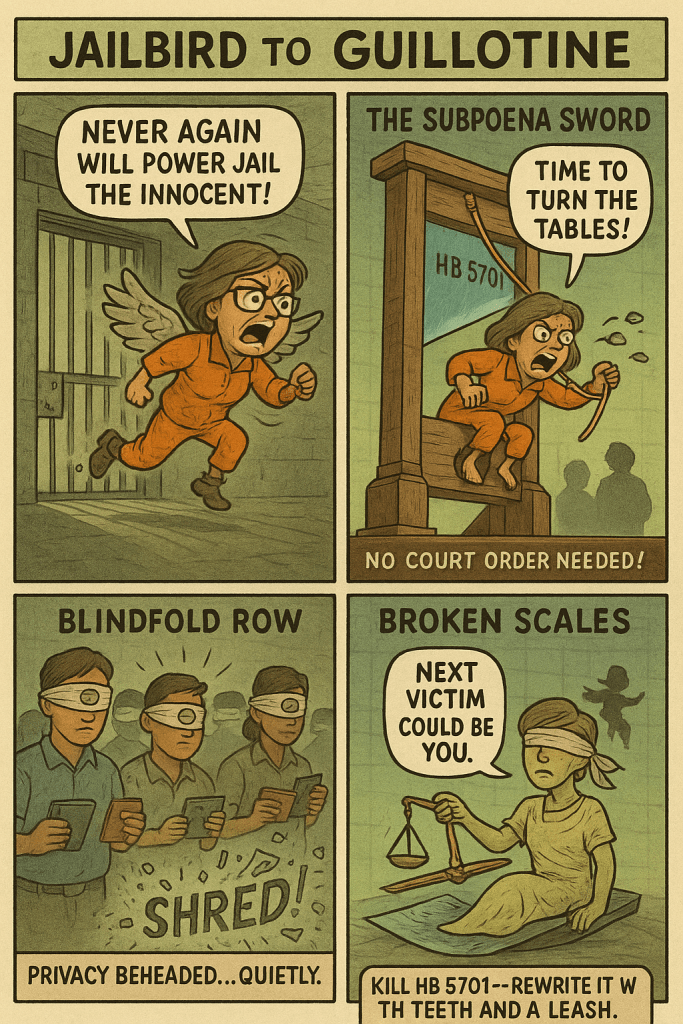
THE PATH FORWARD: Guardrails, Not a Blank Check
I’m not saying the OMB should be toothless.
I’m saying: Give it teeth—but put a muzzle of due process on it.
HB 5701, as filed, is constitutionally doomed and operationally dangerous.
| REQUIRED GUARDRAIL | WHY IT MATTERS |
|---|---|
| 1. Probable Cause Standard | Not “reasonable suspicion.” Probable cause, certified in writing by the Ombudsman himself, not a deputy. |
| 2. Ex-Post Judicial Review | Mandatory Sandiganbayan review within 10 days of access. Account holder gets notice. Can challenge. |
| 3. Strict Minimization | Only records directly tied to the alleged graft. No data dumps. No retention beyond the case. |
| 4. Ironclad Confidentiality | Leak a single transaction? Criminal liability + perpetual disqualification. |
| 5. Severe Penalties for Abuse | Misuse = imprisonment (6–12 years) + ₱5M fine + disbarment. |
Add a sunset clause and inter-agency protocol with AMLC.
Then—and only then—do you have a powerful Ombudsman, not a rogue one.
THE FINAL WORD: We Don’t Need a Super-Prosecutor. We Need a Constitutional One.
Corruption is a cancer.
But HB 5701 is chemotherapy that kills the patient.
We don’t fix plunder by plundering privacy.
We don’t fight abuse with bigger abuse.
Leila de Lima wants to be the people’s guardian?
Then guard the Constitution first.
Because the day the Ombudsman can open your bank account on a hunch…
That’s the day the rule of law closes its account—permanently.
Barok’s Verdict:
KILL HB 5701. Rewrite it with teeth and a leash.
Or watch the cure become the disease.
Louis “Barok” C. Biraogo is a fierce defender of due process—even when it protects the guilty. Because if we lose it for one, we lose it for all.
Key Citations
- Marquez v. Desierto, G.R. No. 135882, Supreme Court of the Philippines, 27 June 2001.
- Ople v. Torres, G.R. No. 127685, Supreme Court of the Philippines, 23 July 1998.
- The Constitution of the Republic of the Philippines (1987). Official Gazette of the Republic of the Philippines. Accessed 1 Nov. 2025.
- Philippines. “Republic Act No. 1405: An Act Prohibiting Disclosure of or Inquiry Into, Deposits with Any Banking Institution and Providing Penalty Therefor.” eLibrary of the Supreme Court of the Philippines, 9 Sept. 1955. Accessed 1 Nov. 2025.
- Republic Act No. 6770, An Act Providing for the Functional and Structural Organization of the Office of the Ombudsman, and for Other Purposes, Congress of the Philippines, 1989.
- Republic Act No. 9160: Anti-Money Laundering Act of 2001. Congress of the Philippines, 29 Sept. 2001. Accessed 1 Nov. 2025.
- Republic Act No. 10173, Data Privacy Act of 2012, Congress of the Philippines, 2012.
- Subingsubing, Krixia. “Bill Grants Ombudsman Access to Bank Accounts sans Court Order.” Philippine Daily Inquirer, 30 Oct. 2025.
- Human Rights Watch. “Philippines Slammed for Senator’s Politically Motivated Prosecution.” Human Rights Watch, 21 Apr. 2017. Accessed 1 Nov. 2025.
- Navarro, Aika Rey. “CJ Sereno Impeachment: What You Need to Know about the SALN Issue.” Rappler, 10 Jan. 2018. Accessed 1 Nov. 2025.
- Romero, Alexis. “Prosecution: Warrantless Arrest of Teacher Defective, Confession in Media ‘Cured’ It.” The Philippine Star, 15 May 2020. Accessed 1 Nov. 2025.
- Cepeda, Mara. “Trillanes to Duterte: Sign Bank Secrecy Waiver, Let AMLC Probe My Accounts.” Philippine Daily Inquirer, 18 Sept. 2017. Accessed 1 Nov. 2025.

- “Forthwith” to Farce: How the Senate is Killing Impeachment—And Why Enrile’s Right (Even If You Can’t Trust Him)

- “HINDI AKO NAG-RESIGN!”

- “I’m calling you from my new Globe SIM. Send load!”

- “Mahiya Naman Kayo!” Marcos’ Anti-Corruption Vow Faces a Flood of Doubt

- “Meow, I’m calling you from my new Globe SIM!”

- “No Special Jail for Crooks!” Boying Remulla Slams VIP Perks for Flood Scammers

- “PLUNDER IS OVERRATED”? TRY AGAIN — IT’S A CALCULATED KILL SHOT

- “Several Lifetimes,” Said Fajardo — Translation: “I’m Not Spending Even One More Day on This Circus”

- “Shimenet”: The Term That Broke the Internet and the Budget

- “We Did Not Yield”: Marcos’s Stand and the Soul of Filipino Sovereignty

- “We Gather Light to Scatter”: A Tribute to Edgardo Bautista Espiritu

- $150M for Kaufman to Spin a Sinking Narrative


 KWEBA ni BAROK
Leave a comment