
Disbarment Threat: The Boomerang That Hit Home
By Louis ‘Barok‘ C. Biraogo — November 10, 2025
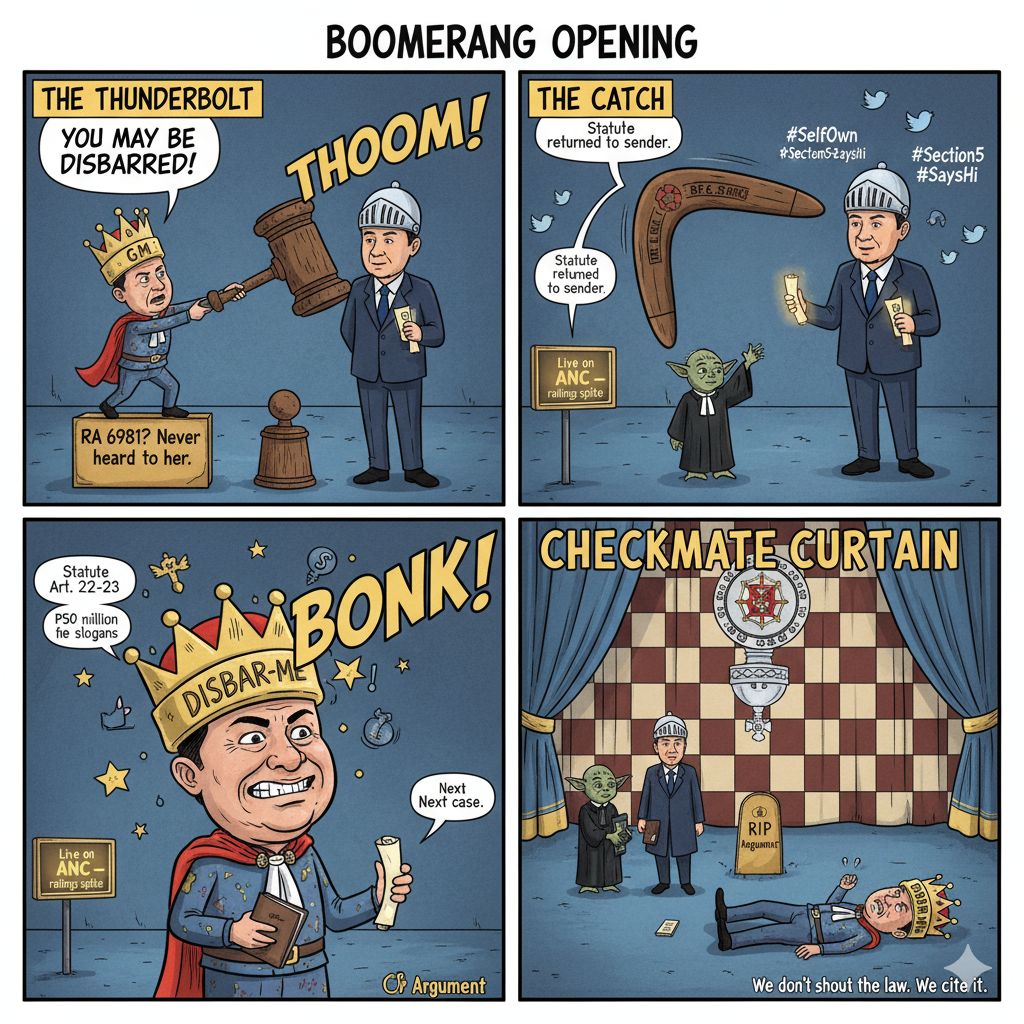
UYYY, the Senate Blue Ribbon Committee—Philippine politics’ favorite stage for grand opera, where flood-control billions morph into kickback confessions, and senators strut like gladiators in tailored barongs. Last week, Senator Rodante Marcoleta thought he’d deliver the coup de grâce: a live, televised threat to disbar Department of Justice (DOJ) Secretary Crispin “Boying” Remulla for daring to demand that state witnesses return the loot before hiding under the Witness Protection Program (WPP)‘s cozy blanket.
“You do not change the provision of law, Mr. Secretary. You may be disbarred.“
Cue the dramatic music. Marcoleta, eyes blazing, chest puffed—peak prosecutorial theater. The gallery gasped. Twitter exploded. The senator had just played what he thought was his queen sacrifice.
But in law, as in chess, the board doesn’t care about your monologue.
And the board just flipped.
Enter Integrated Bar of the Philippines (IBP) President Alan Panolong—not with a shout, not with a soundbite, but with a quiet, surgical citation of statute, doctrine, and procedure that left Marcoleta’s argument bleeding on the floor. What followed wasn’t just a defense of Remulla. It was a public autopsy of legislative arrogance.
Let’s dissect the corpse in three clean cuts.
Pillar 1: The Statute He Demanded… But Never Read
Republic Act (RA) 6981, Section 5 – The Clause That Ate His Argument
Marcoleta thundered:
“Show me the law that says restitution comes before protection!”
Panolong, with the calm of a man reading bedtime law to a toddler, pointed to Section 5 of RA 6981:
“…the witness shall comply with his legal obligations and civil judgments against him.”
Translation for the legally literate: The moment a witness admits to pocketing P50 million in kickbacks, that money is no longer “income.” It’s a debt. A legal obligation. And the WPP’s Memorandum of Agreement (MOA)—the contract every witness signs—isn’t a loyalty oath. It’s a binding enforcement mechanism.
Remulla wasn’t inventing law.
He was reading the fine print Marcoleta skipped.
This wasn’t “opinion.” This was statutory duty. Marcoleta demanded the law—then ignored it when it was handed to him on a silver citation.
Check.
Pillar 2: The Doctrine He Forgot Existed
Civil Code Articles 22 & 23 – The Unjust Enrichment Hammer
Here’s where Marcoleta’s legal education publicly collapsed.
Any first-year law student knows:
“No one shall be unjustly enriched at the expense of another.”
— Article 22, Civil Code
A witness who testifies, “Yes, I took P100 million in bribes,” has just confessed to unjust enrichment. The obligation to return it isn’t a “future civil judgment.” It’s immediate, self-executing, and doctrinally airtight—as affirmed in Republic v. Sandiganbayan (G.R. No. 152154, 2002).
Panolong didn’t just cite it—he weaponized it.
Marcoleta’s response? Crickets.
Because you can’t filibuster a bedrock principle of Philippine law with “pero hindi naman nakalagay eh.”
This wasn’t Remulla’s “moral opinion.”
This was 200 years of civil law tradition slapping a senator across the face with a leather-bound Civil Code.
Check.
Pillar 3: The Process He Pretended Wasn’t There
The MOA – Where “Sinceridad” Meets Contract Law
Marcoleta sneered:
“That’s just your opinion, Mr. Secretary.”
No, Senator.
That’s administrative discretion under RA 6981 Section 4, operationalized through the MOA—a contract that requires demonstrated sincerity.
And what’s the ultimate proof of sincerity?
Not tears. Not promises. Not a PowerPoint of death threats.
Returning the money you stole.
The DOJ doesn’t admit witnesses into protection like a VIP club with a wink and a nod. It’s a contractual process. Remulla wasn’t gatekeeping—he was enforcing the terms.
Marcoleta treated the WPP like a binary switch: testify → protected.
Reality: It’s a contract with conditions. And conditions aren’t “opinions.” They’re law.
Checkmate.
The Boomerang: When the Threat Becomes the Punchline
Let’s talk about the disbarment threat—that glorious moment of self-sabotage.
Under Rule 139-B of the Rules of Court, disbarment isn’t a senator’s toy. It’s a judicial process initiated by complaint, investigated by the IBP, and decided by the Supreme Court. Marcoleta didn’t just overstep—he cosplayed as a judge in a committee hearing.
Worse: Article VI, Section 11 of the 1987 Constitution gives him parliamentary immunity from lawsuits, not from professional ridicule or Senate censure. The chamber can still slap him with internal discipline (Osmeña v. Pendatun, G.R. No. L-17144, 1960).
And under the Code of Professional Responsibility and Accountability (CPRA), Canon II, Rule 8.01:
“A lawyer shall not, in his professional capacity, use language which is abusive, offensive, or otherwise improper.”
Threatening a co-lawyer with disbarment on national TV?
That’s not oversight. That’s a CPRA violation in 4K.
Marcoleta wanted to question Remulla’s competence.
He ended up auditioning for his own disciplinary hearing.
The Final Board: Substance 1, Spectacle 0
| Marcoleta | Panolong & Remulla |
|---|---|
| Loud threats | Quiet citations |
| Selective reading | Statutory fidelity |
| Procedural cosplay | Doctrinal mastery |
| Self-own | Checkmate |
Panolong didn’t raise his voice. He didn’t need to.
The law spoke for him.
Prescription from the Kweba: How to Avoid Dying by Statute
- For Marcoleta:
- Public retraction. Now.
- Civil Law 1 refresher (focus: unjust enrichment).
- Bonus: A humility seminar. Non-credit.
- For the Senate:
- Censure Marcoleta for unparliamentary conduct.
- Ban disbarment threats as committee props. This isn’t Perry Mason.
- For the DOJ:
- Issue formal guidelines on MOA restitution protocols.
- Make “sinceridad” measurable, not rhetorical.
- For the IBP:
- Publish a plain-language primer on WPP + unjust enrichment.
- Title it: “How Not to Get Owned by RA 6981”.
Epilogue: A Cautionary Tale Carved in Statute
In the arena of law, soundbites don’t survive cross-examination.
Marcoleta lived by the threat.
He died by Section 5.
And somewhere, in the quiet halls of the IBP, Alan Panolong closed his statute book, adjusted his glasses, and whispered:
“Next.”
“We don’t just report the law. We autopsy the nonsense.”
Louis “Barok” C. Biraogo Kweba ni Barok Blog
Key Citations
- Congress of the Philippines. Republic Act No. 6981, The Witness Protection, Security and Benefit Act of 1991. Official Gazette of the Republic of the Philippines, 15 Jan. 1992.
- Constitution of the Republic of the Philippines, art. VI, sec. 11. 1987.
- Supreme Court of the Philippines. Code of Professional Responsibility and Accountability (CPRA), A.M. No. 22-09-01-SC. 2023.
- Republic of the Philippines, petitioner, vs. Honorable Sandiganbayan (Special First Division), Ferdinand E. Marcos, represented by his estate/heirs, and Imelda Romualdez Marcos, respondents. G.R. No. 152154, Supreme Court of the Philippines, 453 Phil. 1059, 18 Sept. 2002, Supreme Court E-Library.
- Republic vs. Sandiganbayan (G.R. No. 152154, 2002)
- Supreme Court of the Philippines. Osmeña v. Pendatun, G.R. No. L-17144, 28 Oct. 1960.
- Supreme Court of the Philippines. Rule 139-B, Rules of Court (Disbarment and Discipline of Attorneys). LawPhil Project.
- Philippines. Republic Act No. 386: Civil Code of the Philippines. Official Gazette, 18 June 1949. Accessed 9 Nov. 2025.
- Biraogo, Louis ‘Barok‘ C. . Witness Protection’s Ethical Earthquake: Remulla’s Moral Might vs. Marcoleta’s Legal Lip Service.“ Kweba ni Barok, 23. Sept. 2025.
- ₱75 Million Heist: Cops Gone Full Bandit

- ₱6.7-Trillion Temptation: The Great Pork Zombie Revival and the “Collegial” Vote-Buying Circus

- ₱1.9 Billion for 382 Units and a Rooftop Pool: Poverty Solved, Next Problem Please

- ₱1.35 Trillion for Education: Bigger Budget, Same Old Thieves’ Banquet

- ₱1 Billion Congressional Seat? Sorry, Sold Out Na Raw — Si Bello Raw Ang Hindi Bumili

- “We Will Take Care of It”: Bersamin’s P52-Billion Love Letter to Corruption
- “Skewed Narrative”? More Like Skewered Taxpayers!

- “Scared to Sign Vouchers” Is Now Official GDP Policy – Welcome to the Philippines’ Permanent Paralysis Economy
- “Robbed by Restitution?” Curlee Discaya’s Tears Over Returning What He Never Earned
- “My Brother the President Is a Junkie”: A Marcos Family Reunion Special

- “Mapipilitan Akong Gawing Zero”: The Day Senator Rodante Marcoleta Confessed to Perjury on National Television and Thought We’d Clap for the Creativity
- “Just Following Orders” Is Dead: How the Hague Just Turned Tokhang’s Finest Into International Fugitives

 KWEBA ni BAROK
Leave a comment