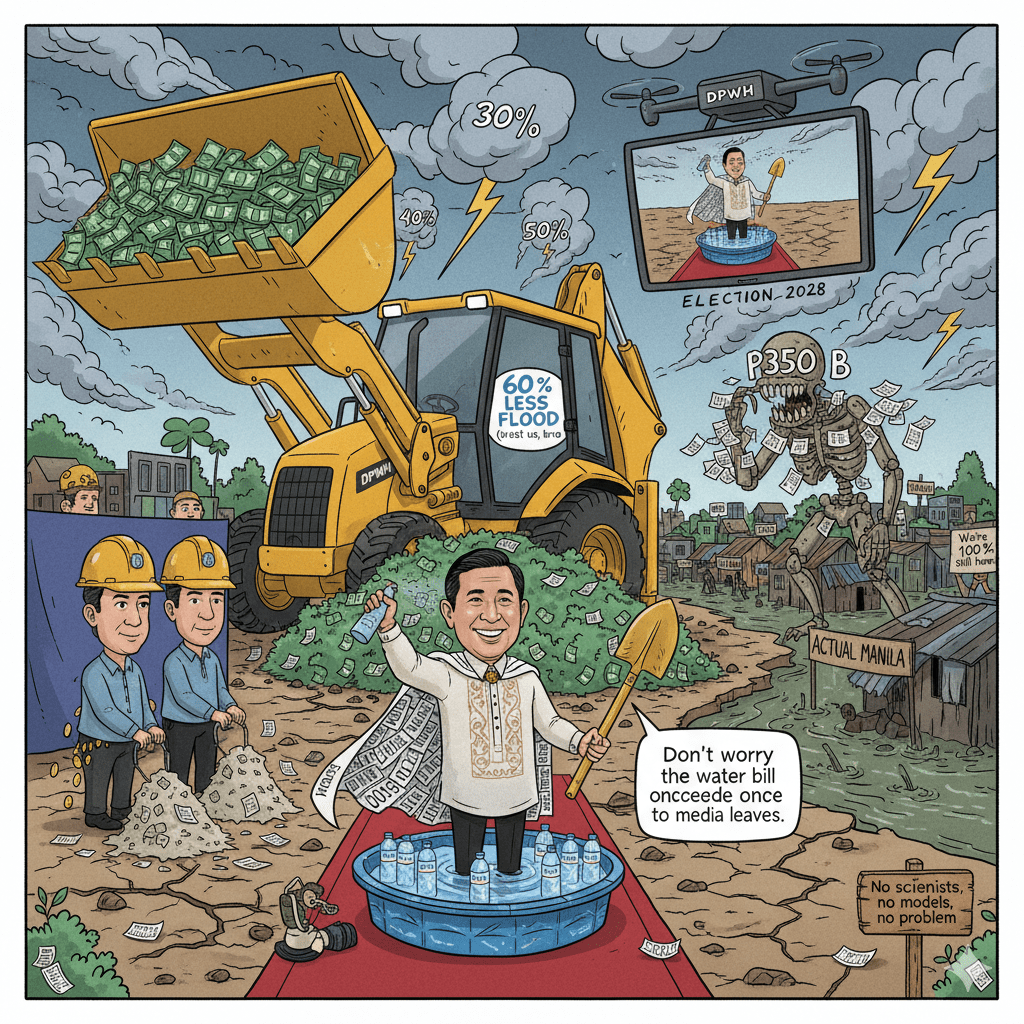
60% less flooding. 0% less kickbacks.
By Louis ‘Barok‘ C. Biraogo — November 13, 2025
Superhero Launch, Villain Still on Payroll: The Absurdity Begins
Behold: President Ferdinand Marcos Jr., sleeves hiked like a man auditioning for “Floodfighter: The Movie”, standing in three inches of staged water at Balihatar Creek—while DPWH (Department of Public Works and Highways) drones nod like bobbleheads and a banner screams “Oplan Kontra Baha” in Comic Sans glory.
As if typhoon victims weren’t still burying their dead.
Meanwhile, just weeks earlier, twin typhoons Tino (international name: Kalmaegi) and Uwan (international name: Fung-wong) turned Metro Manila into a shallow lake of despair—cars floating like toys, families wading through waist-deep filth, and the stench of garbage and broken promises rising higher than the water itself.
And now, another grandly named “Oplan,” launched with the fanfare of a superhero movie, promising to vanquish a villain that his own administration has arguably been feeding for years with ghost projects, kickbacks, and a flood control budget that vanished faster than the water recedes.
Welcome to Oplan Kontra Baha—the latest installment in the long-running Philippine saga: “How to Look Busy While the Country Drowns.”
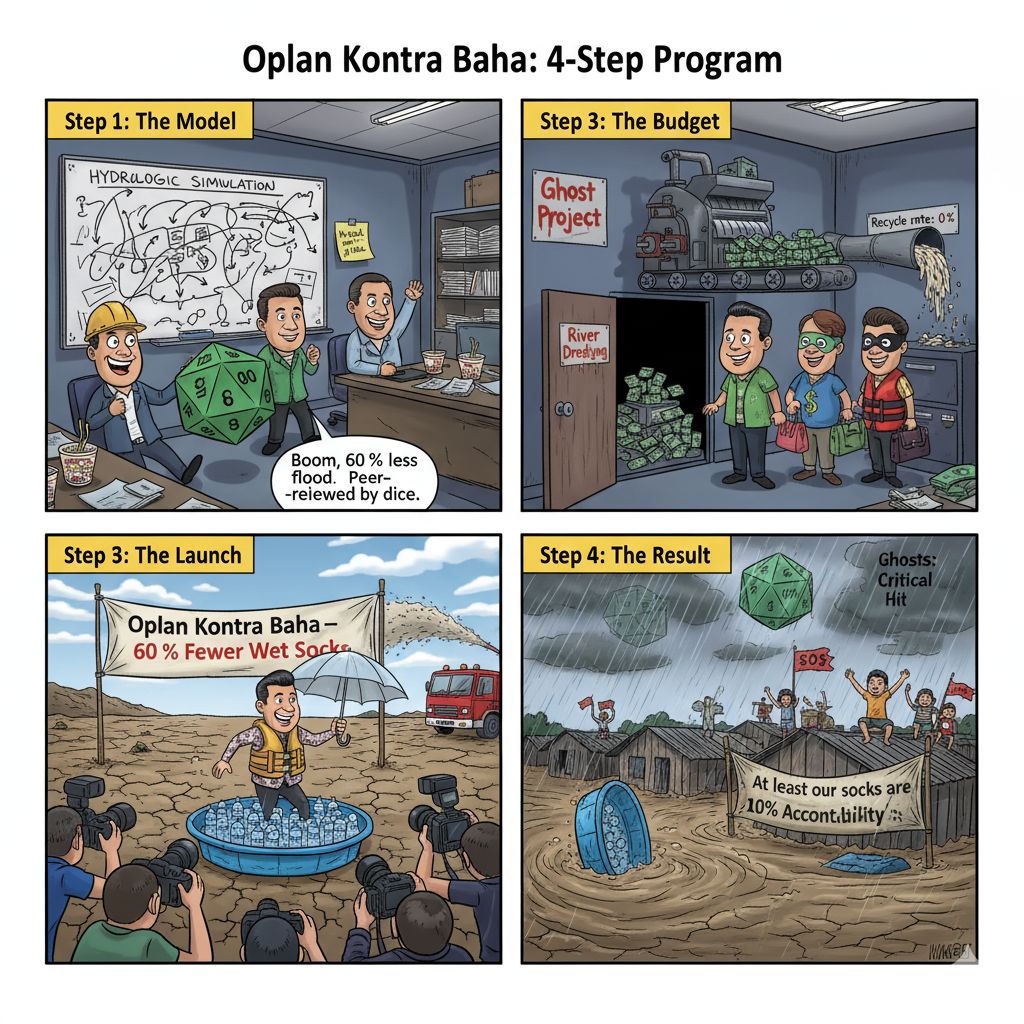
60% Reduction? More Like 60% Hot Air: The Magic Number Exposed
Let’s start with the star of the show: the 60% reduction in flooding.
Marcos says “our scientists” crunched the numbers. Our scientists. Not named. Not cited. Not peer-reviewed. Just… there. Like a magic bean that grows into a flood-free Manila overnight.
So what exactly is this 60%?
- 60% fewer puddles?
- 60% fewer wet socks?
- 60% fewer Instagram stories of people kayaking to work?
No. It’s supposedly a 60% reduction in flooding if we restore 142.4 kilometers of rivers, creeks, and esteros, plus 333.15 kilometers of drainage systems, to “full carrying capacity.”
Ah, yes. The classic “if everything works perfectly” clause.
For the claim: Sure, unclogging drains can help. Trash, silt, and illegal shanties choke the system. Clear the targeted waterways, and maybe—maybe—you’ll see less standing water after a light rain. Pumping stations that actually pump? Revolutionary.
Against the claim: Where do we even begin?
- No model. No baseline. No transparency.
The public has seen zero evidence of the “hydrologic simulations” behind this number. Is it depth? Duration? Area? Affected population? Economic loss? Or just the number of times Marcos says “60%” before the next typhoon hits? - You can’t drain a city while the watershed burns.
Deforestation in Rizal. Concrete sprawl in Quezon City. Sea level rise. Climate change. Upstream mining. Downstream tides. This plan treats symptoms while ignoring the cancer. - Re-clogging is inevitable.
Without solid waste management reform, behavioral change, or enforcement, those clean drains will be trash rivers again by next monsoon. - Ghost projects walk among us.
Remember the 60 ghost flood control projects under investigation? The P350 billion black hole in DPWH budgets? The rock-netting scams? The overpriced dikes that collapse like wet cardboard? This “60%” isn’t science. It’s misdirection—a magician pulling a rabbit out of a hat while the audience’s wallet disappears.
Damage Control in Designer Boots: The Real Motive Behind the Mud
Let’s not pretend this is about saving lives.
The benign version: The President wants to reassure a traumatized public. He wants to show leadership. He wants to do something.
The reality: This is political theater at its most cynical.
- Damage control: Senate hearings are roasting DPWH officials over ghost projects. Mayors like Vico Sotto and Benjamin Magalong are testifying. Contractors are singing. The administration needs a shiny new object to wave in front of the cameras.
- Deflection: “Look over here! We’re cleaning creeks!” While over there, billions in flood control funds vanished into thin air.
- Image laundering: The man who signed the “dirtiest budgets in history” now wants to be seen as the reformer. The architect of the corrupt system is suddenly its greatest critic.
He expresses anger at the corruption—the same corruption he enabled. Spare me.
This isn’t leadership. This is a firebreak. A PR stunt to contain the political wildfire before it reaches Malacañang.
Why Now? Because the Dead Don’t Vote: The Timing of a Panic Launch
Why now? Why this week?
The administration’s excuse: “We had to wait for the typhoons to see the damage.” “We needed granular data.” “Planning takes time.”
The truth:
- Flooding in Metro Manila isn’t new. It’s not a surprise. It’s not a revelation.
- We’ve had master plans since the 1970s.
- We’ve had budgets—hundreds of billions.
- We’ve had warnings from the Philippine Atmospheric, Geophysical and Astronomical Services Administration (PAGASA), from mayors, from activists, from drowning citizens.
But action? Only when the dead bodies float, the Senate hearings get too loud, and the midterm elections loom.
This isn’t responsiveness. This is crisis exploitation.
Was the Data “Not Granular Enough” When Kickbacks Were Counted?
Was the data not “granular” enough when:
- P51 billion was inserted into one congressional district’s flood control budget?
- Ghost dikes were being “built” in the middle of nowhere?
- Contractors were stealing sand and selling it back to the government?
- Informal settlers were being blamed while the real obstructions—corruption and inaction—remained untouched?
The delay wasn’t bureaucracy.
It wasn’t “planning.”
It wasn’t “jurisdictional complexity.”
It was priority.
It was profit.
It was political survival.
Flood control wasn’t a crisis—until it became a liability.
False Hope = Future Disaster: The True Cost of the Charade
If this plan partially works:
- A false sense of security.
- Future administrations will underinvest in real solutions.
- The next super typhoon will be “unexpected.”
If it fails—and it will, without systemic reform:
- More deaths.
- More economic loss.
- More eroded trust.
- And the same politicians will return with Oplan Kontra Baha 2: The Reckoning.
The true cost isn’t measured in cubic meters of silt.
It’s measured in displaced families, drowned dreams, and a democracy drowning in its own corruption.
Potemkin Dikes, Ghost Budgets, Zero Accountability: The Final Verdict
Oplan Kontra Baha is not a flood control program.
It is a Potemkin village—a fake facade of progress built on a foundation of lies, ghost projects, and stolen futures.
Ferdinand Marcos Jr. is not the savior of Manila’s waterways.
He is the central figure in the flood control fiasco—the man who approved the budgets, ignored the warnings, and now dares to lecture us about “maintenance.”
This is not leadership.
This is survival.
Four Demands (Because “Oplan” Won’t Save Us)
- Publish the damn model. Let the public, the academe, and independent engineers see the math behind the 60%. No more “trust me, bro” science.
- Audit the old projects first. Before one more peso is spent on “Oplan” anything, exhume the ghosts. Where did the P350 billion go? Who signed the vouchers? Who got the kickbacks?
- Take the money out of the hands of the corrupt. Empower independent bodies—not DPWH, not the President’s men—to monitor every cent. No more “Maintenance and Other Operating Expenses” (MOOE) slush funds.
- Look in the mirror, Mr. President. The greatest obstruction to Manila’s waterways isn’t silt or trash.
It’s the clogged arteries of a corrupt political system—and you’re holding the scalpel.
Barok’s Final Word:
We don’t need another “Oplan.”
We need accountability.
We need justice.
We need a government that prevents floods before people die—not one that launches photo-ops after the water recedes.
Until then, Oplan Kontra Baha is just another drop in the flood of hypocrisy.
Stay dry. Stay angry.
— Barok
Key Citations
- Valente, Catherine S.. “Marcos: Oplan Kontra Baha Program to Reduce Flooding in Metro Manila, Nearby Areas by 60%.” The Manila Times, 12 Nov. 2025.
- Bajo, Anna Felicia. “COA Finds P309M Worth of ‘Ghost’ Flood Control Projects in Bulacan.” GMA News Online, 24 Oct. 2025. Accessed 12 Nov. 2025.
- “Marcoleta: 60 Suspected ‘Ghost’ Flood Control Projects Under Scrutiny.” INQUIRER.net, 6 Sept. 2025. Accessed 12 Nov. 2025.
- Aquino, Albert P., et al. “Ecological Solid Waste Management Act: Environmental Protection Through Proper Solid Waste Practice.” Food and Fertilizer Technology Center, 8 Dec. 2013. Accessed 12 Nov. 2025.
- “Senate Probe on Flood Control Bares Ghost Projects, Favoritism.” Philippine News Agency, 19 Aug. 2025. Accessed 12 Nov. 2025.
- “Pasig Mayor Vico Sotto Attends House Flood Control Probe.” The Manila Times, 8 Sept. 2025. Accessed 12 Nov. 2025.
- benjieoct2. “Lahat Sila Corrupt! Magalong Bares ‘Big 3’ Behind DPWH Anomalies.” Politiko, 1 Oct. 2025. Accessed 12 Nov. 2025.
- “Bigger Problems in 2025 Budget.” INQUIRER.net, 27 Jan. 2025. Accessed 12 Nov. 2025.
- “COA Finds P309M Worth of ‘Ghost’ Flood Control Projects in Bulacan.” GMA News Online, 24 Oct. 2025. Accessed 12 Nov. 2025.
- Gavilan, Jodesz. “Flood Control in PH: Analyses, Explainers.” Rappler, 20 Aug. 2025. Accessed 12 Nov. 2025.
- “Contractor Behind ‘Useless’ Benguet Project Is Marcos Political Ally.” INQUIRER.net, 25 Aug. 2025. Accessed 12 Nov. 2025.
- Republic of the Philippines. Republic Act No. 9003: An Act Providing for an Ecological Solid Waste Management Program, Creating the Necessary Institutional Mechanism, and Appropriating Funds Therefor. Official Gazette, 26 Jan. 2001. Accessed 12 Nov. 2025.
- Greater Wellington Regional Council. Flood Hazard Modelling Standard. 6 May 2021.




 KWEBA ni BAROK
Leave a comment