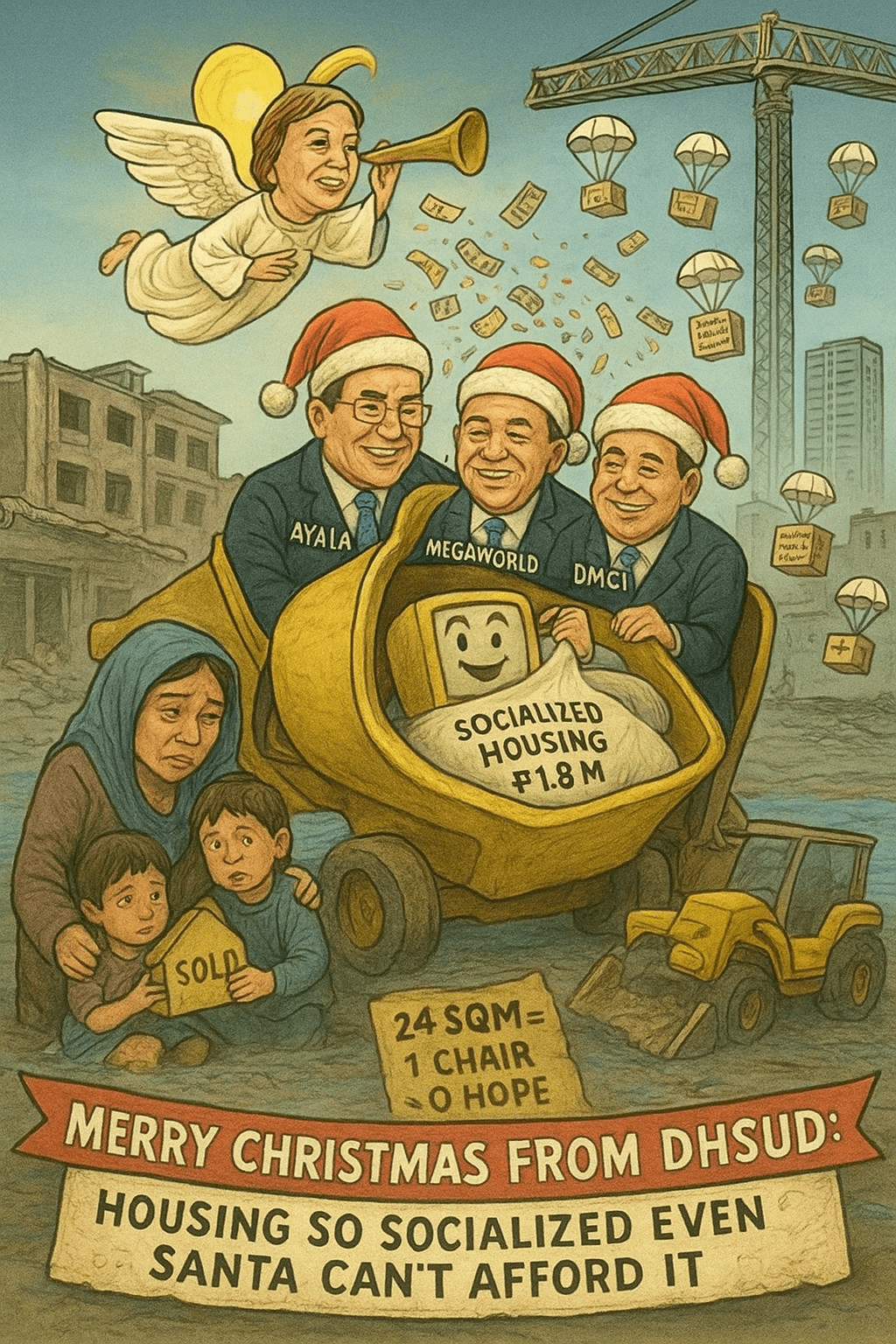
Santa Came Early—for Ayala Land, Megaworld, and Every Developer on the Nice List
By Louis “Barok” C. Biraogo — December 4, 2025
A FEW days back, in a press release cleaner than a DPWH contractor’s conscience, the DHSUD and the newly invented DepDev proudly announced they have raised the price ceiling for what they still have the gall to call “socialized housing.”
- House-and-lot package: ₱950,000.
- Condominium unit: ₱1.8 million.
And because dignity apparently comes in square meters, the minimum floor area is now 24 sqm instead of 22. Two extra square meters—luxury! You can finally fit a monobloc chair.
Bravo. Slow clap. For the developers.
Because let’s call this what it is: not a housing program for the poor, but a taxpayer-funded stimulus package for the real-estate cartel dressed up as pro-poor policy.

1. The Bait-and-Switch Everyone Saw Coming
The government crows about “higher-quality, more spacious units.” Translation: we made the price so high only the lower-middle class can reach it, then slapped the word “socialized” on it so we can still claim we’re helping the poor.
Take a minimum-wage earner in Metro Manila—₱610 a day if the stars align and the employer feels generous. That’s roughly ₱13,000–₱15,000 a month. Pag-IBIG’s own affordability calculator says a ₱950,000 loan at 6.5% over 30 years costs around ₱6,000–₱7,000 monthly. A ₱1.8 million condo? ₱12,000–₱14,000.
In other words, the new “socialized” housing is perfectly affordable… if your household income is at least ₱45,000–₱60,000 a month. Congratulations, informal settlers, street vendors, and slum families: the government just built you a house you will never live in.
And the “consultations with private developers” Secretary Aliling keeps bragging about? In a stunning coincidence, the developers asked for higher ceilings and—miracle of miracles—they got exactly what they wanted. One might call this genius, if one were a developer.
2. The Developer Windfall, Served Hot
Every time the government raises the socialized-housing ceiling (and it’s the third or fourth time in six years), the script is identical:
- Developers whine that old ceilings don’t cover costs anymore.
- Government “consults,” then obediently raises the ceiling.
- Developers pocket fatter margins.
- The poor are told to wait for the next adjustment.
This is not a housing program. This is a subsidy laundering scheme: public policy captures public money and funnels it straight into private profit, then calls it “public-private partnership.”
The only thing trickling down here is contempt.
3. The ₱1.8 Million Condo: Socialized Gentrification in High-Rise Form
Ah, yes—the crown jewel: the ₱1.8 million condominium unit now officially “socialized.”
Picture this: a family from the estero in Tondo, relocated to a 24-sqm box in Bulacan or Cavite, two to three hours away from where they used to earn ₱300 a day selling cigarettes.
They get a shiny new unit with a flush toilet.
They lose their livelihood, their kids’ school, their neighbors, their entire survival network.
But the city gets to brag it “cleared” another informal settlement, and the developer gets to book ₱1.8 million per door.
Progress!
This is not housing the poor. This is warehousing them—out of sight, out of vote-rich urban centers, and out of the conscience of the elite.
4. The Ghost in the Machine: Where Did the Money Go?
While DHSUD pretends ₱1.8 million is “socialized,” the country is drowning—literally—because hundreds of billions allocated for flood control have vanished into thin air.
₱170 billion, ₱300 billion, ₱560 billion—pick your favorite estimate from the Senate hearings. Ghost pumps, imaginary dikes, detention ponds that exist only in PowerPoint.
With just ten percent of the money stolen from flood-control budgets, the government could have:
- Bought land banks inside cities and given the poor real in-city upgrading.
- Funded direct cash grants so informal settlers could actually afford these “socialized” units.
- Built a hundred thousand truly affordable homes instead of zero.
But no. We chose fake flood control and fake socialized housing.
The poor get flooded twice: once by water, once by policy.
5. Stop Begging. Start Demanding.
This is not the time for polite suggestions. This is the time to shout from the rooftops:
- Scrap developer-centric policymaking. No more “consultations” that are actually negotiations on how fat the profit margin should be.
- Launch a genuinely pro-poor housing program built on massive direct subsidies, aggressive land banking, and in-city community upgrading—not relocation to nowhere.
- Publish every 4PH contract, every beneficiary list, every cost breakdown. Radical transparency or nothing.
- Reallocate every peso currently rotting in corruption-riddled infrastructure budgets into housing grants that actually reach the poorest 30%.
- End the farce of calling ₱1.8 million condos “socialized.” Reserve that label for homes the poor can actually own without selling their souls to Pag-IBIG for thirty years.
Until then, the 4PH program is not Pambansang Pabahay para sa Pilipino.
It is PAMBANSANG PABAHAY PARA SA PROFIT.
And the real punchline?
Somewhere tonight, a mother in Baseco or Parola will tuck her children under a piece of tarpaulin while the government celebrates “higher-quality units” that will never be hers.
That, Secretary Aliling, is not dignity.
That is disgrace.
–Barok
still angry, still writing from the cave
Source:
- “Forthwith” to Farce: How the Senate is Killing Impeachment—And Why Enrile’s Right (Even If You Can’t Trust Him)

- “HINDI AKO NAG-RESIGN!”

- “I’m calling you from my new Globe SIM. Send load!”

- “Mahiya Naman Kayo!” Marcos’ Anti-Corruption Vow Faces a Flood of Doubt

- “Meow, I’m calling you from my new Globe SIM!”

- “No Special Jail for Crooks!” Boying Remulla Slams VIP Perks for Flood Scammers

- “PLUNDER IS OVERRATED”? TRY AGAIN — IT’S A CALCULATED KILL SHOT

- “Several Lifetimes,” Said Fajardo — Translation: “I’m Not Spending Even One More Day on This Circus”

- “Shimenet”: The Term That Broke the Internet and the Budget

- “We Did Not Yield”: Marcos’s Stand and the Soul of Filipino Sovereignty

- “We Gather Light to Scatter”: A Tribute to Edgardo Bautista Espiritu

- $150M for Kaufman to Spin a Sinking Narrative






 KWEBA ni BAROK
Leave a comment