
By Louis ‘Barok‘ C. Biraogo — December 10, 2025
“I have no agenda.”
When Ombudsman Jesus Crispin Remulla said those words on ANC last week, he was not issuing a challenge or throwing down a gauntlet. He was, in his own quiet way, asking to be taken at face value, perhaps for the first time in a very long political life. At 64, after leukemia, heart surgery, and decades in the furnace of Cavite and national politics, he sounded almost tired. “I’ll be 71 when this term ends,” he reminded Karen Davila. “This is the culmination of a good legal career.”
In a country that rarely believes its officials when they speak of endings, the statement landed like a small, improbable prayer.
I. The Stage & The Statement
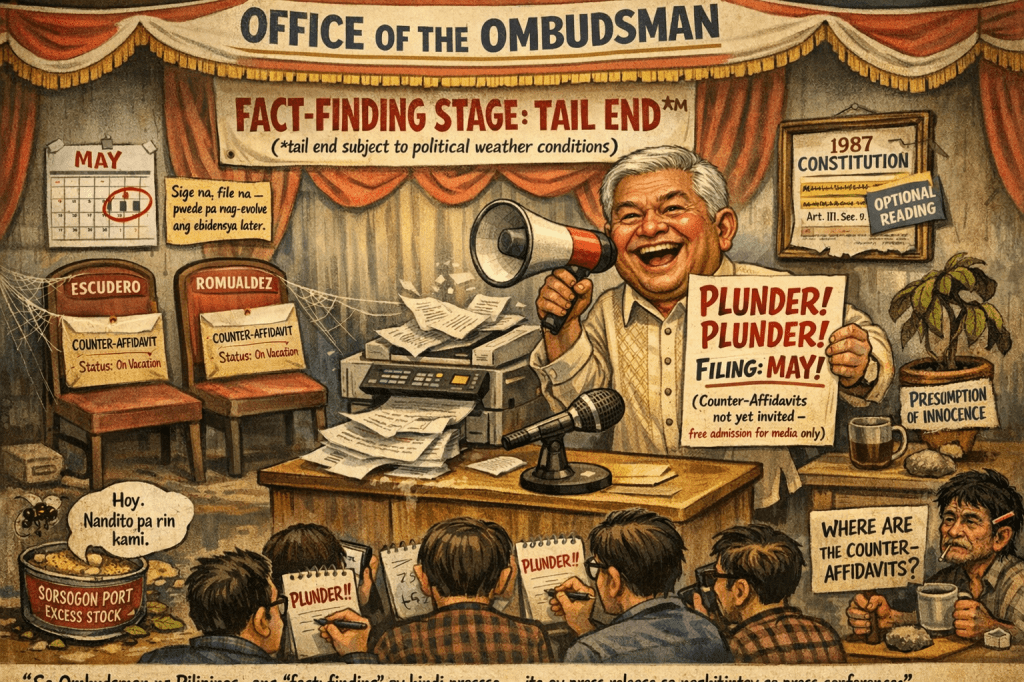
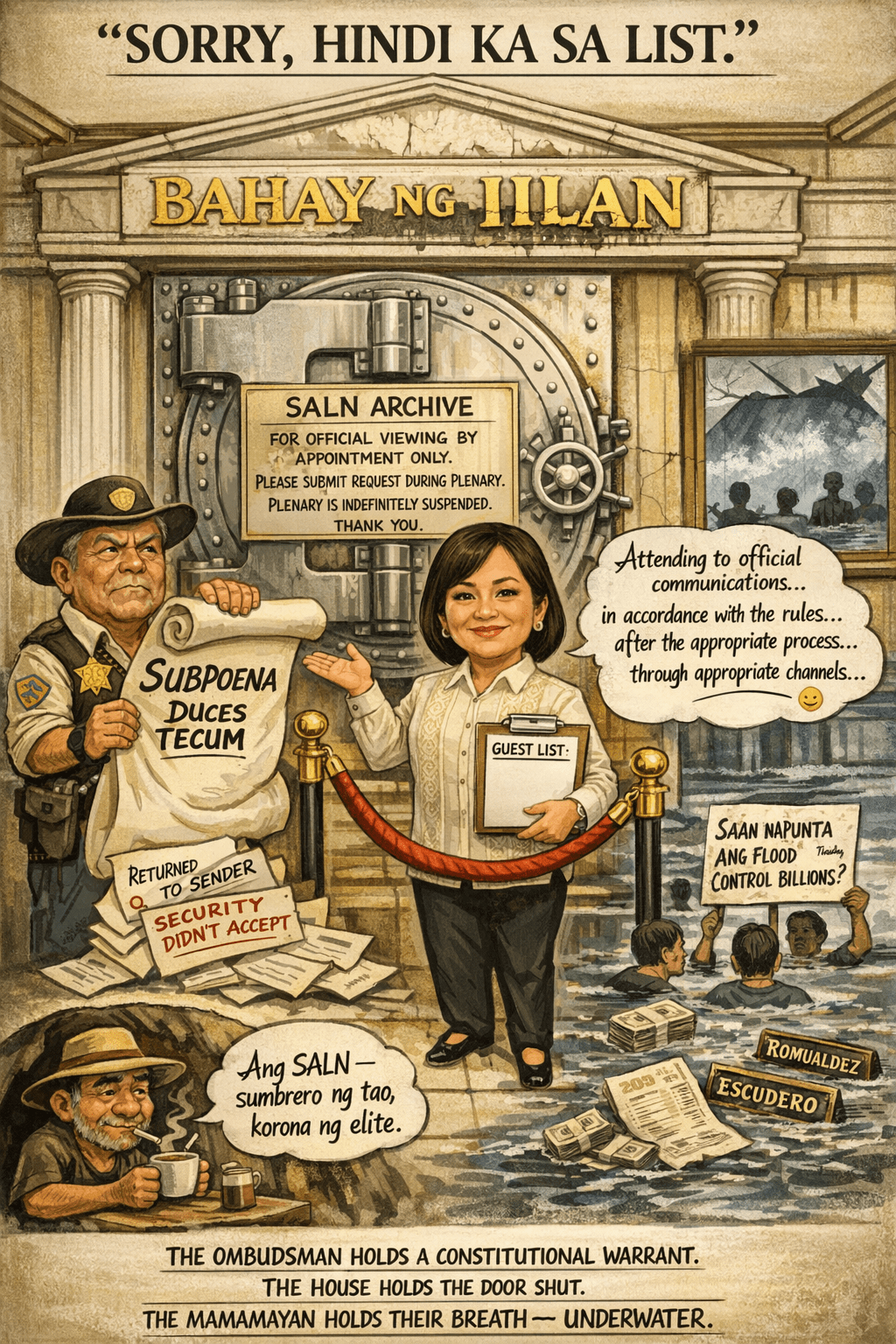
Two months into the job, Remulla has done something no Ombudsman has managed in years: he has moved with visible speed. Graft and malversation cases have already been filed against contractor Sarah Discaya (P96.5 million ghost project in Davao Occidental) and former Ako Bicol Rep. Elizaldy Co (P289.5 million nonexistent dike in Oriental Mindoro). Eight investigative teams are at work on the flood-control anomalies; more will be stood up in 2026. High-profile names—Senator Francis Escudero, former Senator Nancy Binay, possibly others—are openly mentioned as subjects of case build-ups.
This is not business as usual. The broader scandal involves thousands of projects and losses that credible estimates place in the tens—if not hundreds—of billions. Every typhoon season, the human cost becomes visible again: submerged barangays, drowned children, families clinging to roofs. If even a fraction of the money had reached the ground, some of those lives might have been spared.
Against that backdrop, Remulla’s promise of “no agenda” is either naïve or courageous. Perhaps both.
II. The Case For Taking Him at His Word
- There is, first, the sheer pace. Cases are being filed, teams are being formed, dormant investigations (Pharmally among them) are being revived. He has promised to make officials’ SALNs public again and to push for faster Sandiganbayan procedures. These are not the moves of a man marking time.
- Second, the personal context. Remulla has spoken openly about his health battles—leukemia in remission, a heart bypass, the sense that this appointment is a kind of second life. At 64, with no realistic path back to elective office, the usual political calculus does not apply in the same way. Legacy, for once, might actually weigh more than the next campaign.
- Third, the targets. Naming sitting senators and former senators is not the path of least resistance. If the goal were simply to please Malacañang, there are quieter, safer ways to demonstrate loyalty.
III. The Case For Caution
None of this erases the legitimate questions.
He is, after all, a Remulla—part of a Cavite dynasty with deep historical ties to the Marcoses. His brother sits at DILG. His appointment came from the Palace. In a political culture where family and fraternity still explain more than ideology ever will, optics matter. The reorganization that asked nearly 200 Martires-era deputies for courtesy resignations has been read by some as a purge rather than a fresh start. And yes, the old “bend the law” remark—made in a different context—still echoes uncomfortably.
These are not trivial concerns. Institutions are only as independent as they appear to be, and appearance is half the battle in Manila.
IV. The Shadow Play: What We Know, What We Don’t
Rumors swirl, as they always do: quiet fund returns, imminent arrest warrants, strategic distractions from the ICC probe. Some may prove true; many will not. What we can say with certainty is that the flood-control scandal is large enough to touch every major political family and coalition at least once. The real test will be uniformity—whether the evidence flows in every direction it needs to flow, or whether it mysteriously stops at certain doorsteps.
V. The Reckoning Ahead
If Remulla’s cases are built solidly and pursued evenly, the Philippines might finally see a handful of once-untouchable figures held to account. The Sandiganbayan dockets will groan, but the precedent could be worth it. More importantly, a fraction of the stolen billions might actually be recovered and redirected to real flood mitigation—projects that save lives instead of enriching contractors.
If the probes falter on procedure, or if they begin to look selective, the damage will be severe: another cycle of public cynicism, another generation convinced that justice is just another word for political weather.
VI. A Modest Hope
So perhaps the kindest—and most useful—posture toward Jesus Crispin Remulla right now is watchful hope.
- Hope that the man who says he has nothing left to prove actually means it.
- Hope that speed does not become haste, and that transparency becomes his reflex rather than his exception.
- Hope that when the history books write the final chapter of his long career, they will record not just the audacity of a political survivor, but the rare courage of someone who chose, in the evening of his life, to let the evidence speak louder than the old alliances.
To Ombudsman Remulla:
- Publish the full inventory of projects under review.
- Release the field validation reports as soon as classification rules allow.
- Let the country see that the net is cast wide and even.
To the press and to civil society: Keep asking the hard questions, but also acknowledge when real work is being done.
To the rest of us: Reserve final judgment until the cases have survived the courts and the evidence has been tested in daylight.
Because if this tired, battle-scarred lawyer from Cavite truly manages to deliver accountability on a scandal this large—without fear or favor—he will have earned the one thing Philippine politics almost never gives its elders: the benefit of the doubt.
The floodwaters are still rising. Whether Boying Remulla’s last act becomes a genuine turning point or simply another stormy chapter depends, more than we usually admit, on whether we are willing to let an old man surprise us.
Source:
- ₱75 Million Heist: Cops Gone Full Bandit

- ₱6.7-Trillion Temptation: The Great Pork Zombie Revival and the “Collegial” Vote-Buying Circus

- ₱1.9 Billion for 382 Units and a Rooftop Pool: Poverty Solved, Next Problem Please

- ₱1.35 Trillion for Education: Bigger Budget, Same Old Thieves’ Banquet

- ₱1 Billion Congressional Seat? Sorry, Sold Out Na Raw — Si Bello Raw Ang Hindi Bumili

- “We Will Take Care of It”: Bersamin’s P52-Billion Love Letter to Corruption

- “Skewed Narrative”? More Like Skewered Taxpayers!

- “Scared to Sign Vouchers” Is Now Official GDP Policy – Welcome to the Philippines’ Permanent Paralysis Economy

- “Robbed by Restitution?” Curlee Discaya’s Tears Over Returning What He Never Earned

- “No Pressure” Luistro? The House Pork Bazaar Exposed
- “My Brother the President Is a Junkie”: A Marcos Family Reunion Special

- “Mapipilitan Akong Gawing Zero”: The Day Senator Rodante Marcoleta Confessed to Perjury on National Television and Thought We’d Clap for the Creativity




 KWEBA ni BAROK
Leave a comment