
Black Box Bait: How Confidential Funds Turned Public Money into the Ultimate Deep-Sea Mystery
By Louis ‘Barok’ C Biraogo — December 15, 2025
MGA ka-kweba, at the Kweba ni Barok, the ₱612.5-million question is not merely about the possible guilt of Vice President Sara Duterte—it is about a system that allows “confidential funds” to exist in a pitch-black box devoid of light. This scandal is merely a symptom of a chronic disease: the deliberate engineering of budgetary opacity and the systematic dismantling of accountability safeguards.
On December 12, 2025, a group of civil society leaders—including former Finance Undersecretary Cielo Magno and 2025 Ramon Magsaysay awardee Fr. Flaviano Villanueva—filed plunder and other criminal complaints against Duterte and 15 others at the Office of the Ombudsman (Inquirer, 12 Dec. 2025). The allegation: systematic misuse and concealment of confidential funds from the Office of the Vice President (OVP) and Department of Education (DepEd).
Duterte called it “another fishing expedition”—a diversion from the flood control scandals (Inquirer, 14 Dec. 2025}. But beneath the political theater, the real drama is the legal battle that will reveal whether the law is for everyone, or only for those who slip through the holes of opacity.

The Charge Sheet: A Grueling Legal Triathlon
The prosecution must win in three disciplines—plunder, graft, and constitutional violations—while the defense needs only one misstep to dismiss the entire case.
First, plunder under Republic Act No. 7080 (Plunder Law, as amended). The threshold is ₱50 million (not ₱75M as in the old version), and it requires proof of “amassing of ill-gotten wealth” through a “combination or series” of criminal acts resulting in personal enrichment. This is a major hurdle: misuse or unwarranted benefit (covered by Republic Act No. 3019 (Anti-Graft and Corrupt Practices Act) graft) is not enough—evidence is needed that the money ended up in the accused’s pocket. The recent October 2025 Supreme Court ruling in Estrada v. Sandiganbayan clarified that graft and plunder are distinct crimes; graft is not absorbed by plunder, and can be pursued separately even if acquitted of plunder.
Second, the constitutional guillotine from Araullo v. Aquino (G.R. No. 209287, 2014). The ₱125 million transfer from the Office of the President to the OVP—which had no specific appropriation for confidential funds in the 2022 General Appropriations Act (GAA)—may violate Article VI, Section 25(5) of the 1987 Constitution prohibiting cross-border transfers of savings except for augmentation within the same branch. If proven to be an unconstitutional realignment, this is a culpable violation of the Constitution—a standalone charge that does not require the plunder threshold.
Third, the ethical baseline under Republic Act No. 6713 (Code of Conduct and Ethical Standards for Public Officials and Employees). This is the moral covenant of public service: commitment to public interest, professionalism, and simple living. The allegations of fabricated receipts and irregular disbursements are a direct betrayal of this—not just criminal, but a violation of the most fundamental principle that “public office is a public trust.”
The War of Narratives: Weaponized Legalese in Action
Duterte’s “fishing expedition” is not just a soundbite—it is a technical defensive strategy aimed at framing the complaint as lacking probable cause ab initio, which can be used in a motion to dismiss. It is projection at its finest: confidential funds themselves allow “fishing” in the dark sea of secrecy.
On the other side, the pivot to flood control is classic jiu-jitsu: moral equivalence to activate tribal loyalties. Duterte claims the complaint is a diversion from the “robbery to our nation’s coffers” in flood control—where Ombudsman Remulla is aggressive, with impending charges against senators and asset freezes. The Supreme Court has designated special courts for these cases, showing judicial priority. Both narratives are active fronts—but the opacity of confidential funds enables this kind of stalemate.
The Palace denial that “complainants are critics, not allies” is plausible theater: who benefits from this ambiguity? The complainants—who are critics of both clans—provide a veneer of independence, but the timing raises questions.
The Shadow Play: Rumors as Doomsday Devices
Rumors are not gossip—they are strategic assets in psychological warfare.
- The impeachment “Plan B”: After the one-year bar from the dismissed impeachment, an Ombudsman probable cause finding would provide a “respectable” basis for new articles on betrayal of public trust.
- The “offer” to resign: This is a leverage play—resignation could moot impeachment, but not criminal suits (the VP has no immunity). It probes the price of a political exit.
- Mutually assured destruction in flood control: The possibility of counter-exposés (with big names on the administration side) becomes a doomsday device that weakens aggressive prosecution on both sides.
The Forking Paths: Branching Scenarios in a System of Opacity
- Path 1: Ombudsman dismissal. It could be seen as a victory for due process (if personal enrichment evidence is weak), or proof of selective justice—like the Jinggoy Estrada plunder acquittal that still allowed a graft trial.
- Path 2: Filing in the Sandiganbayan. Automatic preventive suspension—a political earthquake that could martyr Duterte, or provide catharsis for the public.
- Path 3: Negotiated exit. Plea to a lesser charge, or resignation for “peace”—but who has leverage in a system where both sides have skeletons?
The ultimate consequence: The resolution will dictate whether the “public trust” doctrine is still alive, or whether faith in accountability is irreparably shattered.
The Biraogo Verdict: Recommendations from the Kweba
- Ombudsman Remulla: Demand the receipts—not just liquidation reports, but the full chain of custody for every peso. Invoke the presumption of malversation if the trail is “confidentially” missing.
- Media: Stop the press release war. What is needed is forensic journalism: map the arguments, track the milestones in the Ombudsman, and explain the Araullo doctrine to the public.
- Public: Demand transparency, not vibes. The question is not “Do you like Sara?” but “Can you trace the ₱612.5M?” Turn off the political theater; turn on docket watching.
- And to the system: Abolish confidential funds as a line item. If legitimate security needs exist, fund them through auditable, mission-specific appropriations. Opacity is the womb of plunder—this scandal is the inevitable offspring of a system that prefers secrecy over accountability.
At Kweba ni Barok, the black box must be opened. If not, the next scandal will only be bigger—and the public will pay a higher price.
— Barok
Key Citations
- Argosino, Faith. “Plunder, Other Charges Filed vs Vice President Sara Duterte, 15 Others.” Philippine Daily Inquirer, 12 Dec. 2025.
- Reyes, Dempsey. “Sara Duterte: Plunder Raps Another ‘Fishing Expedition’.” Inquirer.net, 14 Dec. 2025.
- Philippines. The Constitution of the Republic of the Philippines. 1987. Official Gazette.
- Republic Act No. 7080: An Act Defining and Penalizing the Crime of Plunder (as amended). Congress of the Philippines, 12 July 1991,Official Gazette.
- Republic Act No. 3019: Anti-Graft and Corrupt Practices Act. Congress of the Philippines, 17 Aug. 1960, LawPhil.
- Republic Act No. 6713: An Act Establishing a Code of Conduct and Ethical Standards for Public Officials and Employees. Congress of the Philippines, 20 Feb. 1989, Official Gazette.
- Araullo v. Aquino III, G.R. No. 209287, Supreme Court of the Philippines, 1 July 2014, LawPhil.
- Supreme Court of the Philippines. “Press Briefer: October 29, 2025.” Supreme Court of the Philippines, 29 Oct. 2025.
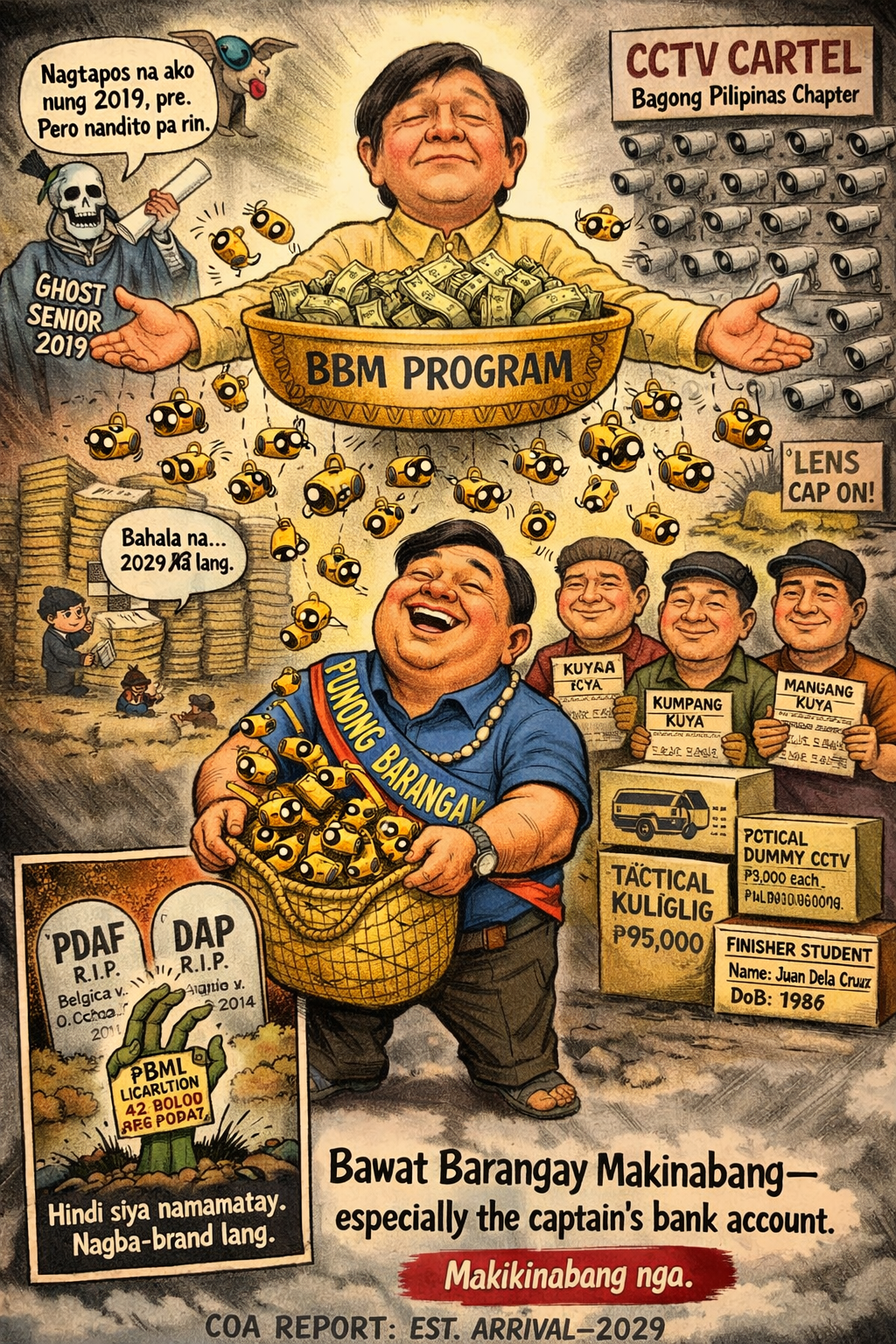
- ₱8B BBM Pork: CCTV for Every Captain’s Kumpare?
- ₱75 Million Heist: Cops Gone Full Bandit

- ₱6.7-Trillion Temptation: The Great Pork Zombie Revival and the “Collegial” Vote-Buying Circus

- ₱1.9 Billion for 382 Units and a Rooftop Pool: Poverty Solved, Next Problem Please

- ₱1.35 Trillion for Education: Bigger Budget, Same Old Thieves’ Banquet

- ₱1 Billion Congressional Seat? Sorry, Sold Out Na Raw — Si Bello Raw Ang Hindi Bumili

- “We Will Take Care of It”: Bersamin’s P52-Billion Love Letter to Corruption

- “Skewed Narrative”? More Like Skewered Taxpayers!

- “Scared to Sign Vouchers” Is Now Official GDP Policy – Welcome to the Philippines’ Permanent Paralysis Economy
- “Robbed by Restitution?” Curlee Discaya’s Tears Over Returning What He Never Earned

- “No Pressure” Luistro? The House Pork Bazaar Exposed
- “My Brother the President Is a Junkie”: A Marcos Family Reunion Special


 KWEBA ni BAROK
Leave a comment