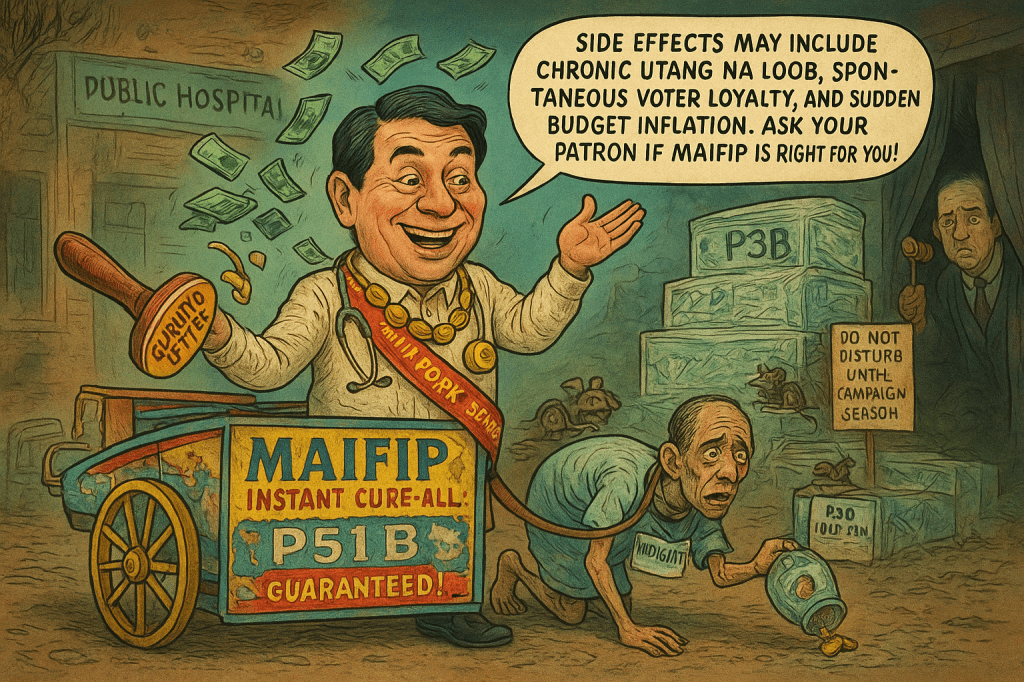
From PDAF to MAIFIP: Same Old Pork, Now Wearing a Stethoscope
By Louis ‘Barok‘ C. Biraogo — December 16, 2025
MGA ka-kweba, imagine this: A desperately ill Filipino, too poor to pay hospital bills, queues not at a clinic but at a politician’s office, hat in hand, begging for a “guarantee letter” – that magical chit promising the government will foot the bill. Meanwhile, lawmakers in Manila pat themselves on the back for ballooning a program’s budget to P51 billion for 2026, even as auditors reveal P3.013 billion from the same program sat idle in 2024, rotting away due to delays, incompetence, and unliquidated funds. This is the absurd tragedy of the Medical Assistance to Indigent and Financially Incapacitated Patients Program (MAIFIP) – a supposed lifeline for the sick poor that has become a monument to patronage, inefficiency, and outright hypocrisy.

Patronage and the Debt of Gratitude
On one hand, MAIFIP wears the noble mask of charity: financial aid for medicines, tests, surgeries, and care to ease the crushing out-of-pocket burdens on indigent patients. Yet in reality, it operates through a system where politicians issue those guarantee letters, turning healthcare – a basic human right – into a political favor. The poor are forced to cultivate utang na loob, that insidious debt of gratitude, trading their dignity for survival. As Cardinal Pablo Virgilio David so rightly decried, this transforms illness into a tool of patronage: “Health care is no longer delivered as a right flowing from need and citizenship, but as a favor mediated by political power.” It’s a feudal ritual dressed in modern bureaucracy, where the sick must prostrate themselves before their congressional patrons rather than access aid through impartial institutions.
Billions Unspent: The COA’s Damning Report
And now, the bicameral conference committee – in a move reeking of election-year generosity – has jacked up MAIFIP’s 2026 budget to P51 billion (or P51.6 billion in some reconciliations), far exceeding the Senate’s cautious P29 billion and even the executive’s modest proposal. Why pour more money into a leaking bucket? The Commission on Audit’s damning 2024 report provides the answer: gross implementation failures left billions unspent (Philstar, 15 Dec. 2025).
In Western Visayas, over 80% of funds idled because transfers arrived too late. Mimaropa left 38% unused; Eastern Visayas nearly half. Delays in reimbursements – often breaching the 60-day guideline – have driven private hospitals to boycott guarantee letters altogether, leaving patients in limbo. Staffing shortages, incomplete documentation, inconsistent guidelines: these aren’t minor hiccups; they’re systemic rot. As COA warned, such deficiencies “cast doubt on the attainment of the objectives” of a program meant to deliver accessible aid. Yet lawmakers’ response? Throw more money at the problem. Are we funding healthcare for the poor, or stockpiling a slush fund for the next campaign cycle?
Pork Barrel 2.0: Echoes of the PDAF Scam
This isn’t innovation; it’s déjà vu. MAIFIP’s guarantee-letter mechanics echo the infamous Priority Development Assistance Fund (PDAF) scam – the “pork barrel” system the Supreme Court struck down as unconstitutional in 2013 for enabling precisely this kind of post-enactment legislative meddling. Remember Janet Lim-Napoles and her ghost projects? Politicians funneled funds through fake NGOs for kickbacks, eroding public trust and democracy itself. MAIFIP is Pork Barrel 2.0, now cloaked in a white doctor’s coat: discretionary funds ripe for abuse, where politicians claim credit for “saving lives” while potentially skimming overpricing, diverting to favored hospitals, or simply parking money for political leverage. Rumors of last-minute “bond paper inserts” in the bicam report only fuel suspicions of backroom deals. Have we learned nothing from the ghosts of scandals past?
Subverting Universal Health Care (UHC)
Worse, MAIFIP doesn’t just waste money; it actively sabotages genuine reform. The Universal Health Care (UHC) Law mandates a rights-based, institutional system through PhilHealth – automatic coverage, zero-balance billing, no political gatekeepers. Yet colossal sums are diverted to this parallel, politicized channel, starving PhilHealth (which got zero subsidy in some years) and delaying true universal access. Critics like Dr. Tony Leachon call it a “structural redirection” to discretionary pots, breeding corruption and violating legal earmarks. Cardinal David labels it a “violation of human dignity.” Even Senator Panfilo Lacson refuses to sign the bicam report without fixes, insisting all health funds subsume under UHC. This isn’t aid; it’s subversion.
The Farce Demands Consequences
Motivations range from the naively charitable – filling UHC gaps for 1.1 million patients – to the blatantly political: visible credit-claiming to secure voter loyalty in poor districts. But the nefarious potential looms largest: a complex financial stream perfect for kickbacks, overbilling, or election war chests. Proponents claim funds won’t pass through politicians, but without ironclad safeguards, that’s hollow assurance.
Enough. This farce demands consequences, not complacency:
- President Marcos must veto the irresponsible P51-billion hike and redirect funds to strengthen PhilHealth.
- The Senate Blue Ribbon Committee should launch an immediate investigation into implementation failures and patronage risks.
- The Supreme Court should review MAIFIP’s constitutionality against the UHC Law and post-PDAF precedents.
- Congress must abolish the guarantee-letter system outright, integrating all medical assistance into PhilHealth with transparent, automated guidelines and real-time tracking.
- If graft emerges – from delayed reimbursements masking diversions to overpriced claims – pursue criminal prosecution without mercy.
A Stark Choice
In the end, the MAIFIP scandal forces a stark choice on Philippine governance: Is healthcare a fundamental right of citizenship, delivered through sturdy, impartial institutions? Or a privilege doled out by political patrons, perpetuating feudal dependencies and eroding the poor’s dignity? We’ve mourned the human cost – lives lost to delays, families bankrupted while billions idle – and mocked the stupidity of wasting taxpayer money on a broken machine. Now, we must demand better. The powerful must be shamed into action, or we’ll remain a nation where the sick beg for scraps while politicians feast. The time for moral urgency is now.
Thank you for reading, my countrymen. If you still have a conscience, now’s the time to use it.
- – Barok, fearless against those who fear the truth.
Source:
- Flores, Dominique Nicole. “While Bicam Boosts MAIFIP Funding, COA Flags P3 Billion Left Unspent.” Philstar.com, 15 Dec. 2025.

- “Forthwith” to Farce: How the Senate is Killing Impeachment—And Why Enrile’s Right (Even If You Can’t Trust Him)
- “HINDI AKO NAG-RESIGN!”

- “I’m calling you from my new Globe SIM. Send load!”

- “Mahiya Naman Kayo!” Marcos’ Anti-Corruption Vow Faces a Flood of Doubt

- “Meow, I’m calling you from my new Globe SIM!”

- “No Special Jail for Crooks!” Boying Remulla Slams VIP Perks for Flood Scammers
- “PLUNDER IS OVERRATED”? TRY AGAIN — IT’S A CALCULATED KILL SHOT

- “Several Lifetimes,” Said Fajardo — Translation: “I’m Not Spending Even One More Day on This Circus”

- “Shimenet”: The Term That Broke the Internet and the Budget

- “We Did Not Yield”: Marcos’s Stand and the Soul of Filipino Sovereignty

- “We Gather Light to Scatter”: A Tribute to Edgardo Bautista Espiritu

- $150M for Kaufman to Spin a Sinking Narrative

 KWEBA ni BAROK
Leave a comment