
Why Pass a Law When You Can Just Keep Talking About Amending the Constitution?
By Louis ‘Barok‘ C. Biraogo — December 18, 2025
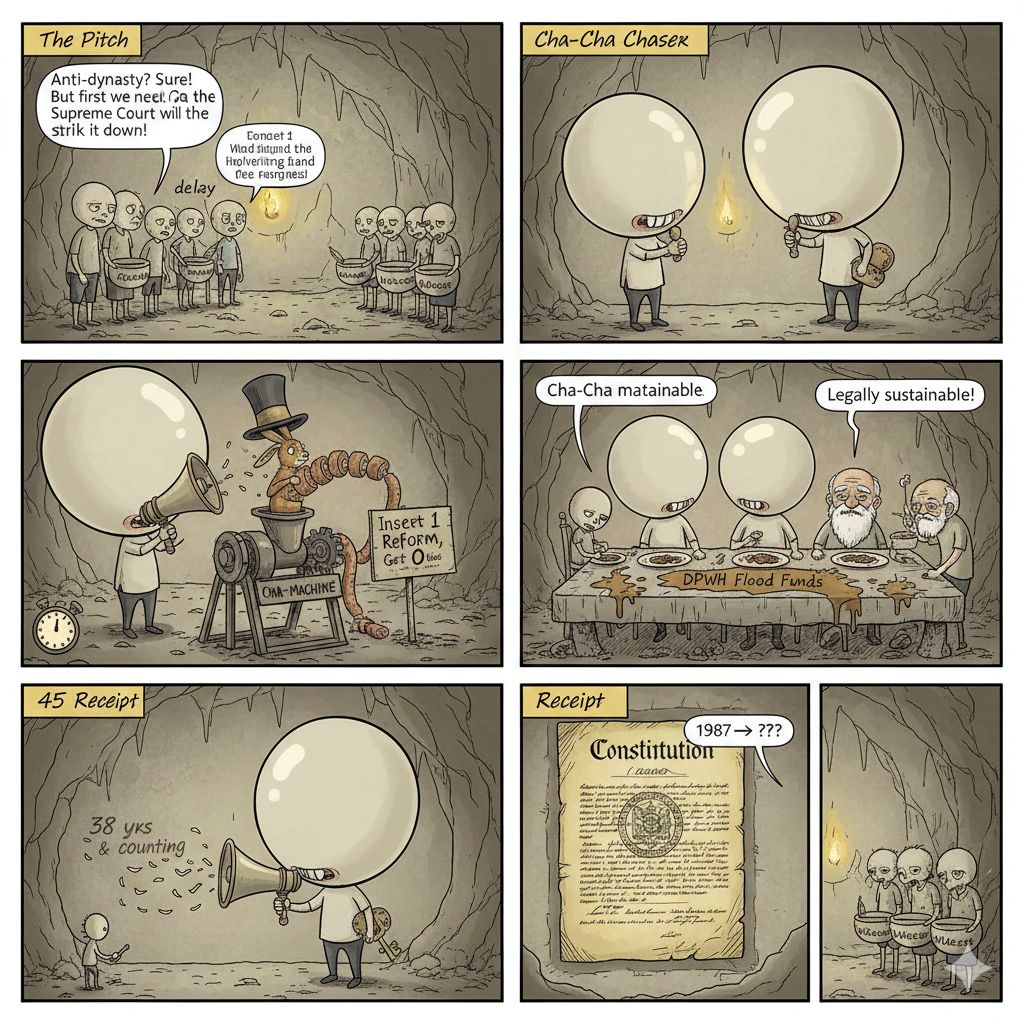
MGA ka-kweba, fellow martyrs in Philippine politics that feels like an endless telenovela with no happy ending: Welcome back to the Kweba ni Barok. Today, let’s talk about Ako Bicol Party-list Representative Alfredo “Alfred” Garbin Jr., vice chair of the House committee on constitutional amendments, who suddenly turned into a constitutional scholar in a radio interview and a Facebook post this December 2025. His thesis? That for an anti-political dynasty law to be truly “binding,” we first need Charter Change (ChaCha). Otherwise, he claims, it would be unconstitutional and likely struck down by the Supreme Court. The goal is noble, he says, but it has to be “legally sustainable.”
Good Lord. It’s like a thief saying stealing for the poor is noble, but we need to amend the Constitution first to make theft legal. This is performative legalism at its finest—a masterclass in intellectual dishonesty wrapped in fake caution, all designed to kick the can down the road while political dynasties continue to feast on the republic.
Legal Evisceration: Garbin’s Precedents Don’t Hold Water
First, let’s examine his star witnesses: Albano vs. Comelec (G.R. No. 257610, 2023) and Social Justice Society vs. Dangerous Drugs Board (2008). In Albano, the Supreme Court (SC) struck down a statutory ban on party-list nominees who had lost in previous elections—because it added a qualification not found in the Constitution. In SJS, mandatory drug testing for candidates was invalidated as an extra-constitutional requirement.
Yes, Garbin is correct that Congress cannot add qualifications beyond those listed in Articles VI and VII (age, citizenship, residency, etc.). But here’s the fatal flaw in his logic: Article II, Section 26 of the 1987 Constitution explicitly states:
“The State shall guarantee equal access to opportunities for public service, and prohibit political dynasties as may be defined by law.”
“As may be defined by law.” That means the Constitution itself has delegated to Congress the power and duty to define and prohibit dynasties. This is not an additional qualification invented out of thin air; it is the direct implementation of a constitutional mandate. Without an enabling law, that provision is useless—a dead letter written just to look good on paper, while we’ve been waiting for 38 years.
Contrast this with Pimentel-related discussions and pending petitions (e.g., consolidated cases before the SC in 2025 involving 1Sambayan and Kapatiran Party): The SC has repeatedly noted that without an enabling law, there is no enforceable prohibition—implying Congress must act through ordinary legislation, not ChaCha. In Belgica vs. Ochoa (2013), the Court upheld pork barrel reforms because they fulfilled anti-corruption mandates; the analogy here to anti-dynasty as anti-power concentration is clear.
And Republic Act No. 6713 (Code of Conduct and Ethical Standards for Public Officials and Employees)? It mandates ethical standards and prohibits conflicts of interest—a perfect foundation for an anti-dynasty law that is not arbitrary. A well-drafted bill (narrow definition, e.g., up to second-degree kinship, with a rational basis test for equal protection) can survive scrutiny precisely because it is mandated, not invented.
Garbin’s argument? It’s like saying we need to amend the Constitution first before we can enforce the Bill of Rights. Absurd. This is not legal caution; this is legal evasion.
Motivational Forensics: What’s the Real Endgame?
Garbin, vice chair of the ChaCha committee, suddenly deeply concerned about “sustainability.” Coincidence? His party-list, Ako Bicol, was knee-deep in 2025 flood control scandals—billions in anomalous Department of Public Works and Highways (DPWH) projects linked to resigned colleague Zaldy Co (now a fugitive, passport canceled, hiding abroad). Garbin defended the party, claiming it remains “untainted,” even as investigations exposed patronage and insertions.
And now, anti-dynasty is supposedly the Trojan horse for ChaCha? We all know the playbook: Push “political reforms” to sneak in economic amendments (foreign ownership) or worse, term extensions. Garbin himself authored resolutions for territorial and economic ChaCha. His stance conveniently delays any real curb on dynasties—including party-list “dynasties” like the Cos in Ako Bicol.
Cynical? Absolutely. But when a lawmaker from a scandal-tainted group lectures us on “genuine, enforceable change” while blocking the one reform that could disrupt entrenched power, what else are we supposed to conclude? Self-preservation disguised as jurisprudence.
Consequence Analysis: Kicking the Can, Preserving the Feast
If Garbin wins: ChaCha becomes a politicized circus—years of debates, plebiscite costs, and inevitable failure amid public distrust. Meanwhile, dynasties thrive: 70–80% of seats held by clans, patronage unchecked, corruption entrenched. Equal access? A cruel joke.
If he loses: 38+ years of inaction continues, SC petitions pile up (still pending in 2025), public cynicism deepens. Democracy pays the price—new blood blocked, merit sidelined, oligarchy solidified.
This position doesn’t protect the Constitution; it protects the status quo.
Enough with the Excuses: Congress, Just Do Your Job
Garbin, with all due respect (none, actually): Your “legal sustainability” is just another excuse for perpetual inaction. Congress has had since 1987 to draft a precise, narrow anti-dynasty law—define dynasty tightly (second-degree kinship, simultaneous or successive terms), frame it as implementing a mandate rather than a disqualification, and tie it to ethical standards under RA 6713.
Stop hiding behind misapplied precedents. Stop using ChaCha as a shield. Pass the damn law—or admit you’re part of the problem.
Fellow citizens: Demand it now. Petitions to the SC, rallies, votes—whatever it takes. Because if we don’t, we’ll remain prisoners forever in this cave of dynasties.
See you when Congress finally remembers it works for us, not the clans.
—Barok
Key Citations
- “1987 Constitution of the Republic of the Philippines.” Official Gazette of the Republic of the Philippines.
- Albano v. Commission on Elections, G.R. No. 257610, 24 Jan. 2023, Supreme Court of the Philippines, LawPhil.
- Belgica v. Ochoa, G.R. No. 208566, 19 Nov. 2013, Supreme Court of the Philippines, LawPhil.
- Republic Act No. 6713, An Act Establishing a Code of Conduct and Ethical Standards for Public Officials and Employees, 20 Feb. 1989, Official Gazette of the Republic of the Philippines.
- Social Justice Society v. Dangerous Drugs Board, G.R. No. 157870, 3 Nov. 2008, Supreme Court of the Philippines, LawPhil.
- “Batas PHL.” “AKO BICOL SOLON: ANTI-POLITICAL DYNASTY LAW REQUIRES CHARTER CHANGE.” Facebook, 16 Dec. 2025. Accessed 17 Dec. 2025.

- “Forthwith” to Farce: How the Senate is Killing Impeachment—And Why Enrile’s Right (Even If You Can’t Trust Him)

- “HINDI AKO NAG-RESIGN!”

- “I’m calling you from my new Globe SIM. Send load!”

- “Mahiya Naman Kayo!” Marcos’ Anti-Corruption Vow Faces a Flood of Doubt

- “Meow, I’m calling you from my new Globe SIM!”

- “No Special Jail for Crooks!” Boying Remulla Slams VIP Perks for Flood Scammers

- “PLUNDER IS OVERRATED”? TRY AGAIN — IT’S A CALCULATED KILL SHOT

- “Several Lifetimes,” Said Fajardo — Translation: “I’m Not Spending Even One More Day on This Circus”

- “Shimenet”: The Term That Broke the Internet and the Budget

- “We Did Not Yield”: Marcos’s Stand and the Soul of Filipino Sovereignty

- “We Gather Light to Scatter”: A Tribute to Edgardo Bautista Espiritu

- $150M for Kaufman to Spin a Sinking Narrative


 KWEBA ni BAROK
Leave a comment