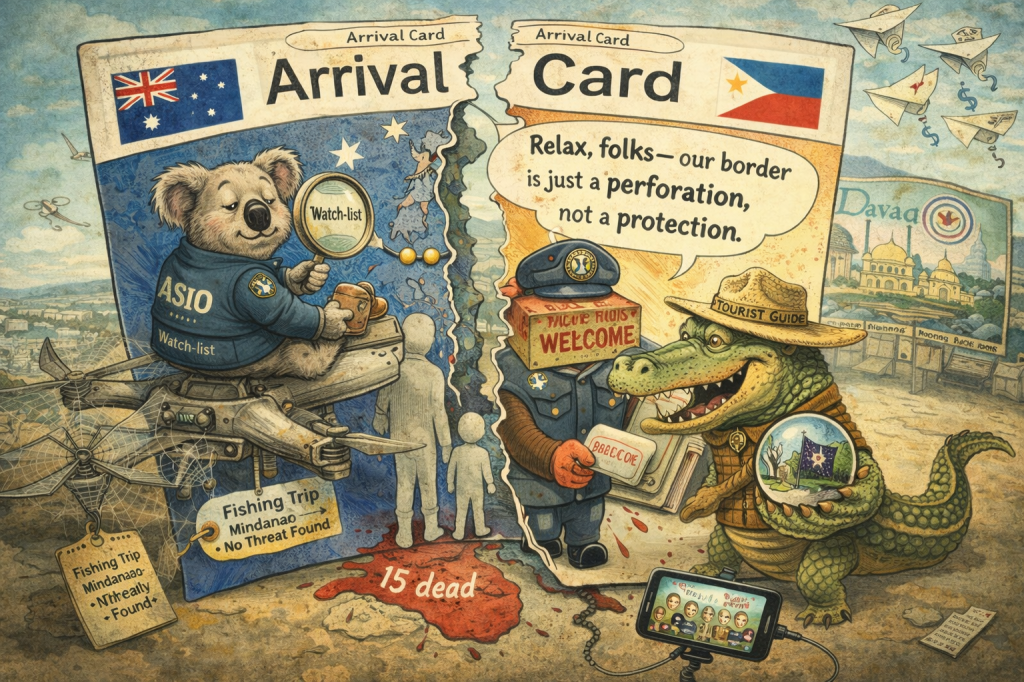
Self-Radicalized? Or Mindanao-Recharged?
By Louis ‘Barok‘ C. Biraogo — December 17, 2025
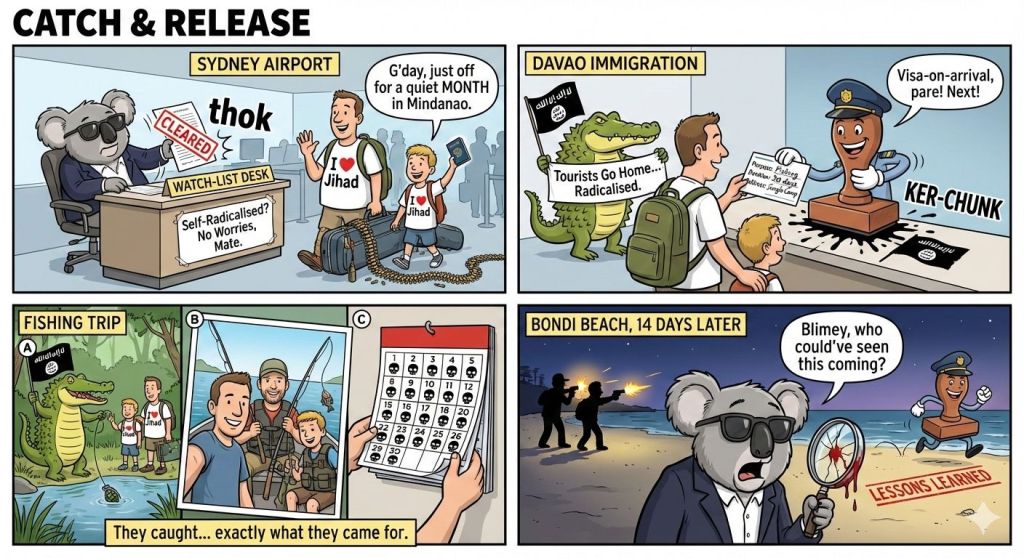
MGA ka-kweba, visualize this: a father and son, one already whispered about in the hushed corridors of Australian intelligence, pack their bags in Sydney and jet off to the Philippines for a leisurely month-long holiday. They scribble “Davao” on their arrival card—Davao, that bustling gateway to Mindanao, a region still smoldering from decades of insurgency and ISIS franchises. They fish, perhaps. They relax. They depart on November 28, 2025, stamping out through Manila, back to ordinary life Down Under.
Two weeks later, on December 14, they open fire on a Hanukkah celebration at Bondi Beach. Fifteen dead, including a child and a rabbi. ISIS flags fluttering in their car like party decorations. The father dies in a hail of police bullets; the son survives to face the consequences. And the world asks, in stunned disbelief: How in God’s name did this happen?
Let us not rush to the massacre. Let us linger, instead, on the breathtaking complacency that made it possible.
A Month in Mindanao
Sajid Akram, 50, and Naveed Akram, 24, arrived on November 1. Philippine immigration records—confirmed by the Bureau of Immigration itself—show them entering without incident. Some reports say they presented as Indian nationals, others as Pakistani-origin Australians. Whichever passport they waved, no one blinked. No alert pinged. No secondary screening. Just another pair of tourists bound for Davao, that charming destination famous for durian, Duterte, and—oh yes—pockets of the country still hosting splinter cells of the Islamic State.
They stayed nearly four weeks. Long enough to rent a house, make friends, learn a few routes through the jungle, perhaps handle a weapon or two in some secluded camp. Long enough, certainly, for any competent intelligence service to notice something amiss—if anyone had been looking.
But no one was. Not here. Not, apparently, in Australia either, where Naveed had been on ASIO’s radar since 2019 yet was judged “no immediate threat.” Self-radicalized, the authorities now murmur, as if two men need no help to turn into murderers. Self-radicalized—yet somehow requiring a month-long sojourn in one of Southeast Asia’s most notorious conflict zones to complete the transformation. How convenient that explanation is. How utterly absurd.
This was not a lightning bolt from a clear sky. This was a slow-moving catastrophe enabled by an ecosystem of failure so vast, so routine, it has become invisible.
The Ecosystem of Failure
Start with the border. The Bureau of Immigration, that proud institution whose officers are renowned for their meticulous attention to… overtime pay and passport stamps. Did anyone ask why two men from Sydney were heading to Davao for a month? Did the word “Mindanao” trigger even a flicker of curiosity? Or was the arrival card just another piece of paper to be rubber-stamped and filed under “tourism revenue”? The Philippines offers visa-on-arrival to dozens of nationalities. Porous borders are not a bug here; they are the business model.
Then there is the intelligence charade. Australian authorities knew about the son. They watched, they assessed, they… let him travel. To a region crawling with ISIS remnants. For a “fishing trip,” the family was told. How quaint. Perhaps they caught some grouper between bomb-making classes. Perhaps they networked with old fighters who know how to turn household chemicals into something far deadlier. Or perhaps they simply marinated in the arrogance that comes from knowing the world’s security apparatus is too sluggish, too siloed, too terrified of “profiling” to act.
And Manila? Silent. No shared watchlists flashing red. No quiet tip-off from Canberra. No follow-up when two foreigners lingered in a sensitive area. Just the usual tropical torpor.
The Spreading Poison
The consequences are already spreading like blood in water.
- First, the social poison. Every Muslim Filipino, every Bangsamoro community, every migrant from South Asia will feel the heat of suspicion now. Mosques will be watched. Innocent men named Akram will be side-eyed on the street. Far-right vultures—here, in Australia, across the web—are already feasting, twisting identities, screaming about “Indian terrorists” or “Pakistani plots” depending on which geopolitical axe they wish to grind. State-sponsored trolls, some say from Islamabad, are gleefully pushing the “Indian passport” angle to stoke old enmities. The victims at Bondi are barely buried, yet the scapegoating has begun.
- Diplomatically, the whispers between Canberra and Manila will grow sharp. Australia will demand answers, records, cooperation—and will receive them slowly, defensively, wrapped in bureaucratic excuses. Trust will erode. Travel advisories will darken. Investors will pause.
- And tourism? Poor Philippines, forever fighting to shed its reputation for danger, now gifted headlines branding Mindanao a “terrorist training resort.” Come for the beaches, stay for the paramilitary refresher course! Who needs marketing when you have this kind of free publicity?
Worst of all is the circus of misinformation already in full swing. Conspiracy peddlers, sensationalist hacks, anonymous accounts—they are inventing camp names, facilitators, secret meetings. Every unverified rumor becomes gospel for someone eager to hate.
We cannot let this stand.
The Verdict and the Remedy
The verdict is unavoidable, and it is damning.
We need—immediately—an open, joint investigation, supervised by neutral international observers. No more closed-door whitewashes where agencies pat each other on the back and declare “lessons learned.” Release the immigration records, the CCTV stills, the passenger manifests. Let the public see exactly how these two men glided through.
We need a gutting of the broken systems. Real-time intelligence fusion with allies. Biometric gates that actually work. An end to the naive visa-on-arrival fantasy for nationals from high-risk regions. And while we’re at it, perhaps Australian authorities could explain why a man on their watchlist was allowed to vacation in a war zone.
Most urgently, leaders must speak—clearly, loudly—to protect the innocent. Condemn the bigotry before it festers. Reach out to Muslim and Jewish communities with something stronger than platitudes. Show moral courage, not just crisis management.
Because in the end, this is what haunts me: We spend billions on walls, watchlists, drones, and data centers. We boast of global counterterrorism networks that can track a suspicious tweet across continents. Yet two future murderers— one already known to security services—can spend nearly a month in our backyard, preparing for a massacre, and no one lifts a finger.
What, precisely, are we paying for?
The blood of fifteen innocents cries out from Australian sand, ignored by those paid to protect. The cave answers with contempt and demand.
—Barok
- ₱75 Million Heist: Cops Gone Full Bandit

- ₱6.7-Trillion Temptation: The Great Pork Zombie Revival and the “Collegial” Vote-Buying Circus

- ₱1.9 Billion for 382 Units and a Rooftop Pool: Poverty Solved, Next Problem Please

- ₱1.35 Trillion for Education: Bigger Budget, Same Old Thieves’ Banquet

- ₱1 Billion Congressional Seat? Sorry, Sold Out Na Raw — Si Bello Raw Ang Hindi Bumili

- “We Will Take Care of It”: Bersamin’s P52-Billion Love Letter to Corruption

- “Skewed Narrative”? More Like Skewered Taxpayers!

- “Scared to Sign Vouchers” Is Now Official GDP Policy – Welcome to the Philippines’ Permanent Paralysis Economy
- “Robbed by Restitution?” Curlee Discaya’s Tears Over Returning What He Never Earned

- “No Pressure” Luistro? The House Pork Bazaar Exposed
- “My Brother the President Is a Junkie”: A Marcos Family Reunion Special

- “Mapipilitan Akong Gawing Zero”: The Day Senator Rodante Marcoleta Confessed to Perjury on National Television and Thought We’d Clap for the Creativity


 KWEBA ni BAROK
Leave a comment