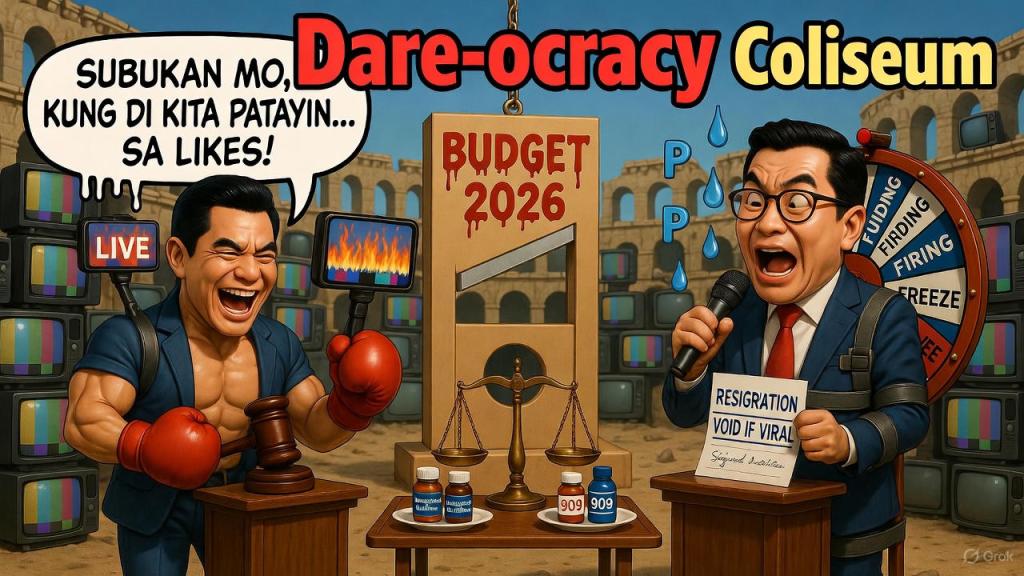
Grandstanding vs. Due Process: Why Viral Outrage Isn’t a Legal Hammer
By Louis ‘Barok‘ C. Biraogo — December 18, 2025
MGA ka-kweba, behold the Philippine political arena—where budget hearings double as gladiatorial spectacles, and public health regulation is reduced to a macho challenge: “Prove it, and I’ll fire the guy” (Inquirer, 16 Dec. 2025). Welcome to the latest episode of As the Senate Turns, starring Senator Raffy Tulfo as the indignant crusader and Health Secretary Teodoro Herbosa as the cornered bureaucrat who, in a moment of budgetary desperation, uttered words he might now regret.
This Farce in One Paragraph: Dares, Takedowns, and Demands for Heads
Let’s recap this farce, shall we? Tulfo, ever the showman, hammers the Food and Drug Administration (FDA) for failing to purge online platforms of unregistered, potentially hazardous products. Fair point—public health advisories without enforcement are about as useful as a screen door on a submarine. But then it devolves into theater: Tulfo challenges FDA Director-General Paolo Teston to resign if the products linger. They do. Tulfo confronts Herbosa. Herbosa, facing the Senate’s budgetary guillotine, allegedly accepts the “challenge”: If Tulfo’s team can get the listings yanked, he’ll personally boot Teston.
Lo and behold, Tulfo’s staff sends letters, and—miracle of miracles—700 listings vanish in seven days (later claimed as 909). Tulfo crows victory in a privilege speech, branding the FDA “inutil, tamad, corrupt,” and demands Herbosa “make true your word.” Cue the dramatic music.
This isn’t governance; it’s a dare on national television. Absurd doesn’t begin to cover it. In a sane system, regulatory failures are probed through formal investigations, not settled like a bar bet. Tulfo’s media-honed ultimatum mocks the sober demands of administrative due process, turning executive accountability into a viral soundbite contest. And Herbosa’s purported acceptance? A tragic capitulation to legislative bullying during budget season—understandable, perhaps, in the shark tank of Senate hearings, but utterly destructive to institutional integrity.

Slaughtering the Arguments: Both Sides Get Skewered (But One Bleeds More)
Now, let’s dissect the arguments, because both sides have points worth eviscerating.
For Tulfo: Yes, public health is urgent. Unregistered products peddled online endanger lives, and the FDA’s advisories often lack bite. Oversight is a senator’s job—Article VI, Section 21 of the 1987 Constitution empowers inquiries in aid of legislation. Tulfo’s “results” (those takedowns) highlight enforcement gaps, and his accusations of corruption invoke Republic Act No. 3019 (Anti-Graft and Corrupt Practices Act)‘s prohibitions on graft.
Against Tulfo: This is overreach wrapped in sanctimony. A senator demanding an executive appointee’s head based on a public dare violates separation of powers and tramples due process (Article III, Section 1, 1987 Constitution). Labeling officials “useless, lazy, corrupt” without hard evidence flirts with defamation (Revised Penal Code, Article 353) and breaches Republic Act No. 6713 (Code of Conduct and Ethical Standards for Public Officials and Employees)‘s courtesy norms. It’s sensationalism for the cameras, undermining collaborative governance.
For Herbosa: He supervises the FDA (Republic Act No. 9711 (Food and Drug Administration Act of 2009), Sec. 4), and emphasizing performance aligns with RA 6713‘s efficiency mandate. Regulatory enforcement is complex—inspections, notices, coordination with platforms take time. His “promise” could be seen as tactical deflection during scrutiny, per precedents allowing disciplinary initiation for inefficiency (e.g., Emilio A. Gonzales III v. Office of the President, G.R. No. 196231, 2012).
Against Herbosa: Promising removal on a political wager risks undermining civil service protections. The FDA chief is presidentially appointed (RA 9711, Sec. 7(c)); summary dismissal via secretarial fiat could violate RA 3019, Sec. 3(e) (undue injury via partiality). It’s capitulation that erodes rule-of-law governance.
Peeling Back the Motives: Spectacle vs. Survival in a Political Trap
Motivations? Tulfo’s brand is built on “pro-people” outrage—media roots, political capital from tough stances, amplified visibility. Genuine concern for consumers? Possibly secondary to the spectacle that boosts his image. Herbosa, a career health official, navigates bureaucratic survival amid Senate pressure—his misstep a flawed bid to secure Department of Health (DOH) funding and deflect criticism in an impossible trap.
Lawful Exits from This Mess: Due Process Over Decapitation
Legally tenable paths forward? Plenty, if anyone cared for law over headlines.
Tulfo could file a formal complaint with the Civil Service Commission (CSC) or Ombudsman if evidence of corruption exists. Or sponsor reforms strengthening online enforcement under RA 9711.
Herbosa should commission an internal probe, issue orders clarifying protocols, or strengthen inter-agency ties—while rejecting promise-based removal.
Resolutions prioritizing due process: A formal administrative case under CSC’s 2017 Rules on Administrative Cases in the Civil Service (RACCS)—Rule 3 mandates investigation and hearing before dismissal for neglect. Or legislative reforms enhancing FDA powers, not scapegoating one head.
Law Drops the Hammer: Why This Promise-Based Purge is Flat-Out Illegal
And here’s where law eviscerates this nonsense, not mere opinion.
Summary removal via a public promise is illegal: RACCS requires formal charges, notice, and opportunity to defend—no shortcuts for grave offenses like neglect (Sec. 50). Supreme Court doctrine reinforces security of tenure—no removal except for cause after due process (Gonzales v. OP, supra; principles echo constitutional guarantees).
Corruption probes belong under RA 6713 (ethical standards) and RA 3019 (graft)—via Ombudsman investigation, not Senate soundbites.
FDA’s mandate (RA 9711) involves intricate post-market surveillance; “failure” demands proof of gross neglect, not political dissatisfaction or a senator’s quicker letters.
In the end, this scandal exposes systemic rot—but the cure isn’t more spectacle. Herbosa, imperfect as he is (that promise was a blunder born of pressure), is trapped in a distorted system where Tulfo’s grandstanding holds institutions hostage.
Enough. End governance by dare and viral challenge. All actors—retreat from the media stage. File proper complaints, initiate lawful probes, pursue unglamorous reforms. The honorable path is the rigorous application of law: due process, evidence-based accountability, structural fixes. Anything less is just bad theater poisoning the republic.
Until next time, from the cave—stay skeptical.
—Barok
Key Citations
- Republic Act No. 9711. “Food and Drug Administration (FDA) Act of 2009.” Official Gazette of the Republic of the Philippines, 18 Aug. 2009.
- Republic Act No. 6713. “Code of Conduct and Ethical Standards for Public Officials and Employees.” Official Gazette of the Republic of the Philippines, 20 Feb. 1989.
- Republic Act No. 3019. “Anti-Graft and Corrupt Practices Act.” Official Gazette of the Republic of the Philippines, 17 Aug. 1960.
- Civil Service Commission. “2017 Rules on Administrative Cases in the Civil Service (RACCS).” 2017.
- Emilio A. Gonzales III v. Office of the President. G.R. No. 196231, Supreme Court of the Philippines, 4 Sept. 2012.3
- “The 1987 Constitution of the Republic of the Philippines.” Official Gazette of the Republic of the Philippines.
- Philippines. Act No. 3815: The Revised Penal Code. 8 Dec. 1930. Official Gazette.
- “Title 13 – Crimes Against Honor, Book Two, Revised Penal Code.” Legal Resource PH, 10 Oct. 2023.
- Das, Sherwin. “Tulfo Calls Out Herbosa over Promise to Remove FDA Chief.” Philippine Daily Inquirer, 16 Dec. 2025.

- “Forthwith” to Farce: How the Senate is Killing Impeachment—And Why Enrile’s Right (Even If You Can’t Trust Him)
- “HINDI AKO NAG-RESIGN!”

- “I’m calling you from my new Globe SIM. Send load!”

- “Mahiya Naman Kayo!” Marcos’ Anti-Corruption Vow Faces a Flood of Doubt

- “Meow, I’m calling you from my new Globe SIM!”

- “No Special Jail for Crooks!” Boying Remulla Slams VIP Perks for Flood Scammers

- “PLUNDER IS OVERRATED”? TRY AGAIN — IT’S A CALCULATED KILL SHOT

- “Several Lifetimes,” Said Fajardo — Translation: “I’m Not Spending Even One More Day on This Circus”

- “Shimenet”: The Term That Broke the Internet and the Budget

- “We Did Not Yield”: Marcos’s Stand and the Soul of Filipino Sovereignty

- “We Gather Light to Scatter”: A Tribute to Edgardo Bautista Espiritu

- $150M for Kaufman to Spin a Sinking Narrative


 KWEBA ni BAROK
Leave a comment