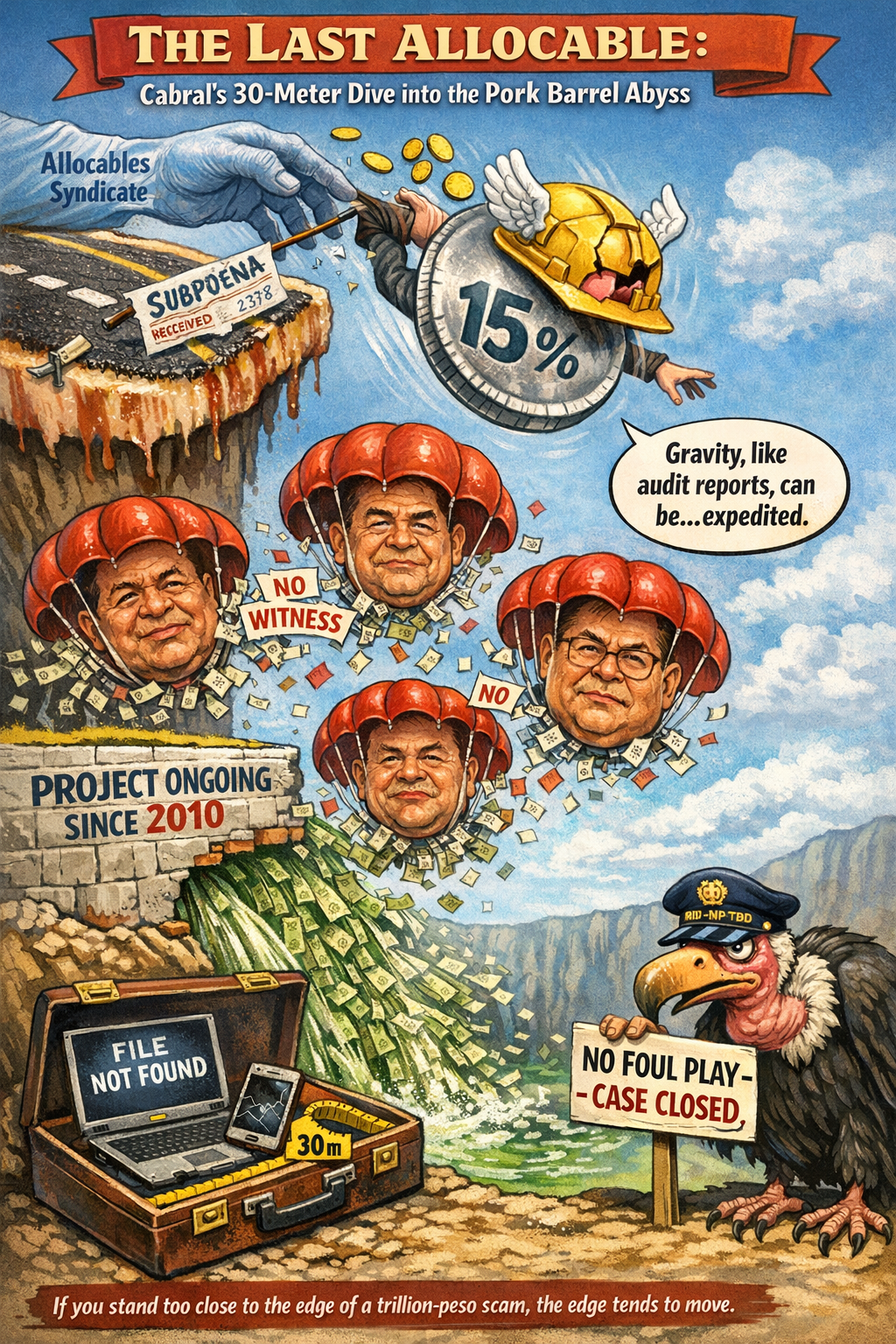
When Budget Insertions Meet Terminal Velocity
By Louis ‘Barok‘ C. Biraogo — December 19, 2025
AH, the perfect retirement plan for a pioneering DPWH undersecretary: after decades of building flood walls that never quite held, Maria Catalina Cabral decides to test gravity personally. She has her driver drop her solo on Kennon Road—home to sheer drops of 20–30 meters into the charming Bued River below—as if the most powerful woman in Philippine infrastructure needed one last adrenaline rush right before spilling trillion-peso secrets. Who needs witness protection when you have scenic cliffs?
Hours later, she’s found unconscious at the bottom of the ravine. Declared dead just after midnight. No witnesses. No suicide note. No signs of struggle, say the police. Just an “alleged fall.”
And all this unfolds days after she skips a subpoenaed hearing into a P1-trillion flood control plunder spanning 15 years. How exquisitely… convenient.
Maria Catalina Cabral, 63, licensed civil engineer with doctorates in Business Management and Public Administration, was no ordinary bureaucrat. She was the architect of budget planning, the gatekeeper of public-private partnerships. Until former Undersecretary Roberto Bernardo pointed the finger: Cabral, he swore, ran a sophisticated kickback machine alongside ex-DPWH secretaries Mark Villar and Manuel Bonoan. Fifteen percent cuts on billions in annual flood control allocations. “Allocables”—those shadowy congressional insertions—turned into personal ATMs.
She resigned in September 2025 as the storm broke. Senate Blue Ribbon hearings loomed. The Independent Commission for Infrastructure (ICI) subpoenaed her. She missed the December 15 session. Her office computer mysteriously vanished months earlier—reportedly packed with documents she was preparing to surrender.
Then, on December 18, 2025:
- 3:00 p.m. – Driver Ricardio “Cardo” Hernandez drops her at Camp 5, Kennon Road. She asks to be left alone.
- 5:00 p.m. – Driver returns. She’s gone.
- 7:00 p.m. – He reports her missing after checking her Baguio hotel.
- 8:00 p.m. – Police find her body 20–30 meters below the highway, near the riverbank.
- 12:03 a.m., December 19 – Doctor declares her dead.
Almost immediately, the Ombudsman orders authorities to seize and preserve her cellphone and gadgets. If this is just a tragic slip, why the panic to lock down her digital life?
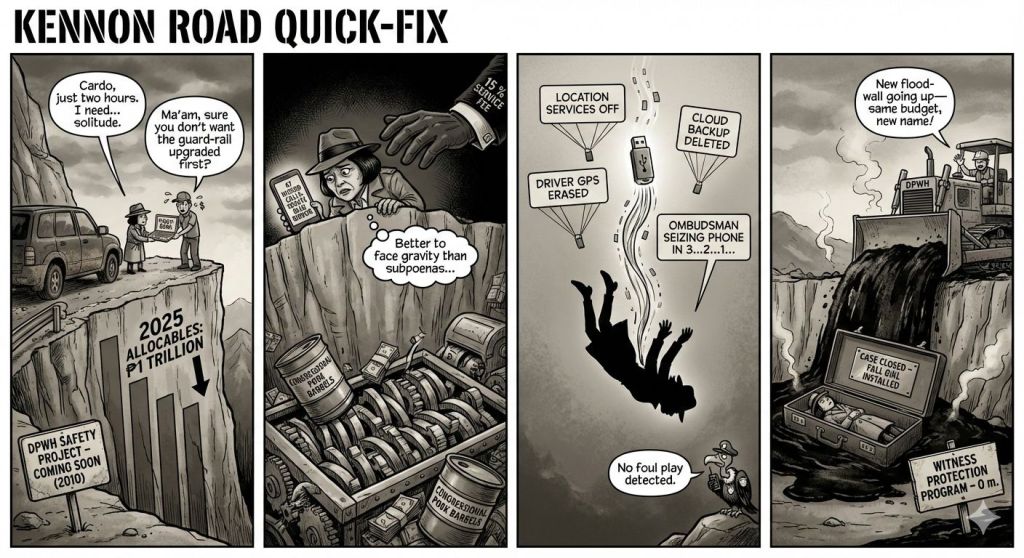
The Official Story vs. The Mountain of Doubt
The police line is almost insultingly tidy: alleged fall, no foul play established, investigation ongoing.
But place it beside the facts and it collapses like a ghost dike in a typhoon.
- She was centrally implicated in a scheme that allegedly siphoned trillions.
- Her testimony could have buried powerful men.
- Her computer disappeared.
- She skipped a critical hearing.
- And now she’s silenced forever—by a “fall” on a road notorious for danger, yet chosen for solitude.
The timing isn’t just convenient. It’s theatrical.
The Spectrum of Possibilities
Let us examine each scenario with ruthless clarity.
1. The Officially Endorsed: Pure Accident
Kennon Road kills carelessly. Slippery edges, poor visibility, sheer drops. She strolls, slips, falls.
But Cabral was reportedly afraid of heights. A veteran engineer who understood terrain risks better than most. Why linger near a cliff edge, alone, under crushing stress?
2. The Convenient: Suicide
Scandal, humiliation, looming plunder charges—enough to break anyone. No note needed; despair is often silent.
Yet this was a trailblazer, president of the Philippine Institute of Civil Engineers, a resilient fighter. Suicide feels like a script written to close the case quickly.
3. The Likely: Foul Play
A staged “cleanup.” Pushed, drugged, or coerced over the edge to prevent her from talking.
Motive? Overwhelming. She knew the allocables map, the kickback percentages, the ghost projects in Bulacan and beyond. Powerful contractors, lawmakers, ex-secretaries—all had skin in the game. The driver’s two-hour absence leaves a gaping window. No CCTV cited. No witnesses to her “walk.” The rushed gadget seizure screams fear of deleted evidence.
4. The Dark Horse: Medical Event
Heart attack or stroke causes dizziness; she collapses over the edge. Plausible at 63 under extreme pressure—but only an autopsy can confirm.
What a Real Investigation Would Look Like
This isn’t rocket science. It’s basic due diligence the public deserves.
- Forensic rigor: Independent autopsy (not just provincial). Full toxicology. Injury pattern analysis—free fall or pre-fall trauma? Drone mapping of the ravine for trajectory, footprints, drag marks.
- Digital deep dive: Forensic extraction of her seized phone and gadgets. Call logs, messages, GPS pings, deleted files. Who contacted her last? Threats? Confessions?
- Human scrutiny: Polygraph the driver. Verify his GPS and phone data. Canvas motorists, residents, nearby establishments for sightings.
- Financial chase: Trace the money trail she allegedly helped build—bank records, unexplained wealth of implicated parties.
- Find the missing computer. Now.
The Rotten Core: The Scandal Beneath the Death
Never let a tragic death eclipse the original crime.
This was systemic plunder on a staggering scale.
“Allocables” turned budget insertions into kickback vehicles.
Overpriced walls. Substandard revetments. Ghost projects that exist only on paper while real floods kill real people.
P1 trillion vanished across Duterte and Marcos eras. Protected by political dynasties and silent auditors. Names like Villar, Bonoan, Romualdez hover over the wreckage.
Cabral wasn’t the queenpin. She was the mechanic who kept the machine running. And now she’s the one who paid the ultimate price.
The Stakes—and the Demand
If this is whitewashed as an “alleged fall,” the consequences are catastrophic:
- Public trust, already battered, collapses entirely.
- Flood controls remain unbuilt; the next typhoon claims more lives.
- Whistleblowers learn silence is safer than truth.
- Impunity wins again.
This death is not just a personal tragedy. It is a test of whether Philippine institutions still function—or have finally surrendered to the corrupt.
We demand:
- A transparent, multi-agency investigation—NBI, Ombudsman, ICI—insulated from political interference.
- Independent international-standard forensics.
- Public release of autopsy, toxicology, and digital findings.
- Prosecution that climbs to the very top—no more sacrificial fall women.
Because if we accept this story without relentless scrutiny, we’re all standing too close to the edge.
— Barok
Source:
- ₱75 Million Heist: Cops Gone Full Bandit

- ₱6.7-Trillion Temptation: The Great Pork Zombie Revival and the “Collegial” Vote-Buying Circus

- ₱1.9 Billion for 382 Units and a Rooftop Pool: Poverty Solved, Next Problem Please

- ₱1.35 Trillion for Education: Bigger Budget, Same Old Thieves’ Banquet

- ₱1 Billion Congressional Seat? Sorry, Sold Out Na Raw — Si Bello Raw Ang Hindi Bumili

- “We Will Take Care of It”: Bersamin’s P52-Billion Love Letter to Corruption

- “Skewed Narrative”? More Like Skewered Taxpayers!

- “Scared to Sign Vouchers” Is Now Official GDP Policy – Welcome to the Philippines’ Permanent Paralysis Economy

- “Robbed by Restitution?” Curlee Discaya’s Tears Over Returning What He Never Earned

- “My Brother the President Is a Junkie”: A Marcos Family Reunion Special

- “Mapipilitan Akong Gawing Zero”: The Day Senator Rodante Marcoleta Confessed to Perjury on National Television and Thought We’d Clap for the Creativity

- “Just Following Orders” Is Dead: How the Hague Just Turned Tokhang’s Finest Into International Fugitives



 KWEBA ni BAROK
Leave a comment