From Imperial Diktat to Deferential Delay: LTFRB and GSM Grovel Before Cebu’s Procedural Priestess
By Louis ‘Barok‘ C. Biraogo — December 20, 2025
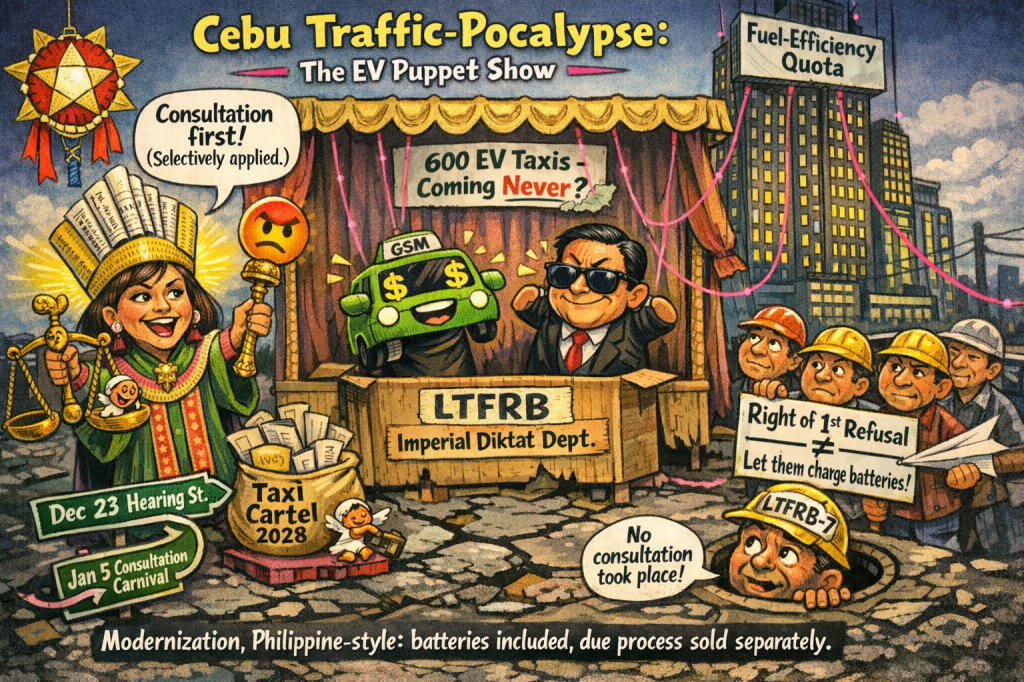
MGA ka-kweba, gather ’round for another episode of Philippine regulatory comedy, this time starring the Land Transportation Franchising and Regulatory Board (LTFRB) as the Lords of Franchise Folly, waving their Memorandum Circular 050 like a magic wand to conjure 600 electric vehicle (EV) taxis out of thin air in congested Metro Cebu. And entering stage left: Cebu Governor Pamela Baricuatro, clutching her pearls over “due process” while the streets choke on yet more vehicles. This isn’t modernization—it’s bureaucratic bungling wrapped in green ribbon, with a side of political theater that would make even the most jaded Manila insider yawn.

The Dueling Follies: A Tale of Two Sanctimonies
Here we have a classic clash: one side preaching environmental salvation from the comfort of air-conditioned Manila offices, the other suddenly discovering the sacred gospel of consultation and fairness. Neither emerges smelling like roses—or like clean EV exhaust, for that matter.
Baricuatro’s “Procedural Piety”: Oh, how touching—the Governor’s sudden epiphany about due process and stakeholder consultation! One day she’s posting fiery Facebook missives decrying the lack of dialogue with local operators; the next, she’s positioning herself as the fierce defender of Cebu’s taxi drivers. But let’s ask the uncomfortable question: Is this genuine governance, or just savvy political grandstanding to shore up support from existing transport groups, who just might form a handy political base in the provinces? The Local Government Code (RA 7160, Sections 2(c) and 27, for the uninitiated) does mandate consultation with local government units (LGUs) on national projects affecting local jurisdictions—fair point. But has Her Honor ever insisted on the same rigorous stakeholder huddles for, say, provincial infrastructure boondoggles or tourism pushes that snarl traffic just as badly? Selective piety, anyone?
The LTFRB’s “Green Edict”: And then there’s the Board, issuing MC 050 on November 18, 2025, like imperial fiat from on high: 600 shiny new EV slots for Metro Cebu, exclusively for one lucky applicant, Green & Smart Mobility (GSM). This “greenwashed diktat” drops from Manila with all the grace of a Grab surge during rush hour—zero prior consultation, as LTFRB-7 Director Montealto sheepishly admitted. “No consultation took place,” he says, blaming the central office. Classic passing of the buck! This top-down arrogance directly flouts administrative due process, as laid down in the immortal Ang Tibay v. CIR (G.R. No. L-46496)—you know, those pesky requirements like notice, hearing, and substantial evidence? And under the Public Service Act (CA 146), a Certificate of Public Convenience (CPC) demands proof of actual public need, not just alignment with some national “fuel efficiency” sermon. Cleaner air is lovely, but is there data showing Cebu needs more taxis, electric or otherwise?
Motivational Theater: The Puppet Show Behind the Curtain
Let’s pull back the curtain on the motives, shall we? Because nothing in Philippine governance is ever purely about “public convenience.”
Baricuatro: Guardian of Cebuano Livelihoods or Chieftain of the Taxi Cartel? → Our Governor waxes eloquent about protecting drivers from displacement, but one wonders if her outrage scales neatly with potential political “contributions” from grateful transport associations. Wink wink. We’re not saying anything violates RA 3019 (Anti-Graft and Corrupt Practices Act) or RA 6713 (Code of Conduct and Ethical Standards for Public Officials and Employees)—perish the thought!—but ethical tightropes get slippery when livelihoods (and votes) are at stake. Transparency in those stakeholder meetings would be refreshing, no?
The LTFRB & GSM: A Touch of Green Cronyism? → On the other side, handing 600 slots to a single operator (GSM, reportedly Vietnam-backed and app-based) smells like lobbying gold medalists getting their reward. In the LTFRB’s zeal to hit EV quotas under RA 11697 (Electric Vehicle Industry Development Act or EVIDA), are they birthing a de facto monopoly in Cebu’s taxi space? That could flirt dangerously with the spirit—if not the letter—of the Philippine Competition Act (RA 10667). Fair competition? Or just preferential treatment for the “smart” and “green” newcomer?
Legal Arson: Burning Down the Board’s Flimsy Justifications
Now, the main event: let’s torch the LTFRB’s house of cards with some actual law.
The “Provisional Authority” Sham — This PA is nothing but a regulatory shortcut, a “beta test” unleashed on Cebu’s live roads with real people’s jobs as crash dummies. Provisional authority is meant to be temporary and exceptional, pending full CPC scrutiny—not a loophole to bypass proof of public necessity.
The “EVIDA” Smokescreen — Yes, RA 11697 pushes EVs for cleaner transport—bravo! But it doesn’t grant the LTFRB a free pass to ignore core duties under CA 146. Promoting batteries doesn’t absolve proving “public convenience and necessity.” Cleaner traffic is still traffic, folks. Where’s the mandatory Traffic Impact Assessment? The Social Impact Study on displaced drivers? Crickets, apparently.
The “Prior Operator Rule” & Displacement — Jurisprudence like Batangas Transportation Co. v. Orlanes protects existing operators who’ve invested blood, sweat, and franchise fees. The LTFRB’s tone-deaf retort? “Just buy EVs yourselves!” Marie Antoinette would approve: “Let them charge batteries!” Existing operators aren’t Luddites—they’re asking for fairness, like right-of-first-refusal on those new slots.
The Farce of the “Public Hearing” (Dec. 23)
Ah, the tentatively scheduled December 23 hearing—a classic Philippine “post-justification” carnival! By then, the PA was already leaked, opposition mobilized, and—spoiler—the whole thing got suspended anyway after Baricuatro’s pushback led to a deferral and a new consultative meeting set for January 5, 2026. (GSM even agreed to pause launch “in deference” to the Governor.) Predictable as monsoon floods: the hearing would have been a box-ticking ritual, opposition voices noted for the record, and approval rubber-stamped. Fait accompli, anyone?
Call to Arms (Wrapped in a Snark)
Enough despair—here’s what these clowns should do, delivered with the affection of a disappointed tito after too much tuba:
For the LTFRB: Dear Lords of Folly, try—for once—reading your own damn rules. Comply with notice, publication, and genuine hearings before issuing PAs. Base decisions on data, not diktats from Manila.
For Baricuatro: If you’re truly serious about due process, stop at Facebook righteousness and file that Petition for Certiorari (Rule 65) already. Your office has lawyers—use them to haul the LTFRB for grave abuse of discretion.
The Grand Compromise: Let’s craft a real “Cebu EV Transition Plan”: data-driven (actual traffic studies!), phased rollout tied to charging infrastructure, right-of-first-refusal for existing operators to go electric, and mandatory LGU consultation under RA 7160. True modernization needs brains, legality, and stakeholder buy-in—not just batteries and bureaucratic arrogance.
Until then, fellow sufferers, buckle up: Cebu’s roads will stay congested, but at least the farce keeps us entertained.
—Barok
Kweba ni Barok, December 19, 2025
Key Citations
- Erram, Morexette Marie B. “Baricuatro Opposes EV Taxi Rollout.” SunStar Cebu, 17 Dec. 2025, http://www.sunstar.com.ph/cebu/baricuatro-opposes-ev-taxi-rollout.
- Ang Tibay v. Court of Industrial Relations, G.R. No. L-46496, 27 Feb. 1940, LawPhil.
- Batangas Transportation Co. v. Orlanes, G.R. No. 28865, 19 Dec. 1928, Lawphil.
- Republic Act No. 7160, Local Government Code of 1991, 10 Oct. 1991, Official Gazette of the Republic of the Philippines.
- Philippines. Commonwealth Act No. 146: An Act to Reorganize the Public Service Commission, Prescribe its Powers and Duties, Define and Regulate Public Services, Provide and Fix the Rates and Quota of Expenses to be Paid by the Same, and for Other Purposes. 7 Nov. 1936. Supreme Court E-Library.
- Republic Act No. 11697, Electric Vehicle Industry Development Act (EVIDA), 15 Apr. 2022, LawPhil.
- Republic Act No. 3019, Anti-Graft and Corrupt Practices Act, 17 Aug. 1960, Official Gazette of the Republic of the Philippines.
- Republic Act No. 6713, Code of Conduct and Ethical Standards for Public Officials and Employees, 20 Feb. 1989, Official Gazette of the Republic of the Philippines.
- Republic Act No. 10667, Philippine Competition Act, 21 July 2015, Official Gazette of the Republic of the Philippines.

- “Forthwith” to Farce: How the Senate is Killing Impeachment—And Why Enrile’s Right (Even If You Can’t Trust Him)
- “HINDI AKO NAG-RESIGN!”

- “I’m calling you from my new Globe SIM. Send load!”

- “Mahiya Naman Kayo!” Marcos’ Anti-Corruption Vow Faces a Flood of Doubt

- “Meow, I’m calling you from my new Globe SIM!”

- “No Special Jail for Crooks!” Boying Remulla Slams VIP Perks for Flood Scammers

- “PLUNDER IS OVERRATED”? TRY AGAIN — IT’S A CALCULATED KILL SHOT

- “Several Lifetimes,” Said Fajardo — Translation: “I’m Not Spending Even One More Day on This Circus”

- “Shimenet”: The Term That Broke the Internet and the Budget

- “We Did Not Yield”: Marcos’s Stand and the Soul of Filipino Sovereignty

- “We Gather Light to Scatter”: A Tribute to Edgardo Bautista Espiritu

- $150M for Kaufman to Spin a Sinking Narrative


 KWEBA ni BAROK
Leave a comment