
Immutable Receipts for Mutable Morals: How One Senator Plans to Eternalize the Grift
By Louis ‘Barok‘ C. Biraogo — December 20, 2025
IN THE wake of the Department of Public Works and Highways (DPWH)’ multibillion-peso flood control fiasco—complete with “ghost” projects that exist only on paper and kickbacks “voluntarily” returned like overdue library books—the Philippine Senate has gifted us the Citizen Access and Disclosure of Expenditures for National Accountability (CADENA) Act. Passed unanimously on December 15, 2025, with nary a dissenting voice, this blockchain-powered transparency crusade arrives certified urgent by President Marcos Jr. himself, ostensibly to cauterize the bleeding trust in government. But let’s be clear: CADENA isn’t bold legislation born of principled foresight. It’s a frantic political bandage slapped on a festering wound exposed by scandal, a performative ritual in a Congress that moves at glacial speed unless public outrage lights a fire under its collective posterior. Sen. Bam Aquino, the bill’s chief architect from the opposition benches, even admitted as much: without the ongoing DPWH investigations, this measure would have gathered dust like so many reform bills before it.
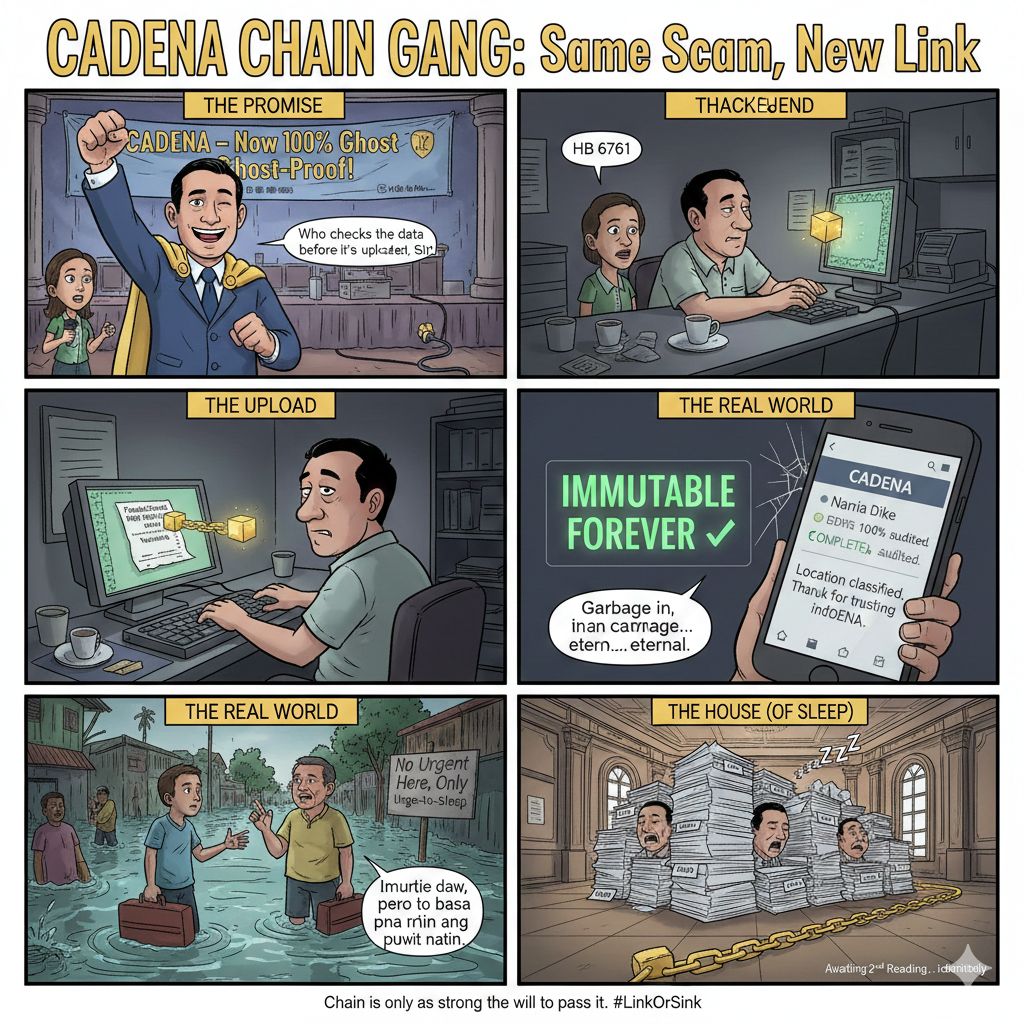
The Blockchain Balm: Panacea or Placebo?
Proponents hail blockchain as the silver bullet for Philippine corruption: immutable, traceable, tamper-proof. Upload contracts, procurement records, bills of materials, and disbursements to a national digital platform, and voilà—every peso becomes auditable in real time, empowering citizens, journalists, and the Commission on Audit (COA) to spot anomalies before the ink dries. In theory, it’s a masterstroke, operationalizing the constitutional right to information and shifting oversight from reactive FOI requests to proactive public scrutiny. The Philippines could even claim global bragging rights as a pioneer in blockchain budgeting.
But spare me the techno-utopianism. Blockchain’s vaunted immutability is only as good as the data fed into it—garbage in, garbage out, eternally enshrined on the ledger. Fraudulent receipts, inflated bids, or phantom deliverables uploaded by complicit officials become “permanent” lies, cloaked in a false aura of integrity. This is classic tech-washing: slathering shiny blockchain over rotten governance without addressing pre-upload verification. Who validates the data before it hits the chain? The same agencies mired in scandal? Without mandatory independent audits or third-party certification protocols, CADENA risks becoming a placebo, soothing public anger while corruption metastasizes off-chain.
Implementation is the real chasm. Manila’s tech-savvy bureaus might manage, but marginalized local government units (LGUs)—plagued by spotty internet, outdated hardware, and untrained staff—face digital exclusion. Costs for infrastructure, training, and cybersecurity could balloon into yet another procurement boondoggle. And let’s not ignore the whispers of vendor lock-in: if the platform isn’t mandated as open-source, proprietary tech firms could feast on contracts, birthing a new strain of “tech-corruption” where kickbacks hide in software licenses and maintenance fees.
Motivations: Crisis, Calculus, and Kabuki Theater
CADENA’s lightning passage through the Senate—17-0, no abstentions— reeks of political theater. Why the unanimous love-in? The DPWH scandal, with its ghost dikes and surrendered millions, has the public baying for blood. President Marcos Jr.’s urgent certification smells of reputational damage control, positioning his administration as reformist amid probes into his flagship infrastructure program. For the opposition bloc—Aquino, De Lima, and their allies—it’s a calculated jab: weaponizing transparency to highlight dynastic excesses in pork-laden districts.
Yet the House drags its feet, with counterpart bills (like HB 6761) languishing in committee despite the same priority tag. This contrasting velocity exposes Congress’s routine inertia: reforms sprint only when scandal spotlights incompetence. Genuine motivation? Doubtful. This is kabuki—choreographed outrage yielding symbolic wins, while systemic enablers (dynasties, weak enforcement) remain untouched. Rumors swirl of maneuvering to dilute provisions or favor certain tech vendors, turning anti-corruption into another insider game.
The Legal Labyrinth: Shining Light, Drawing Lines
CADENA wisely anchors itself in bedrock jurisprudence. It operationalizes the self-executing right to information affirmed in Valmonte v. Belmonte and Legaspi v. Civil Service Commission, extending Chavez v. PEA‘s mandate for transparency in government contracts. Constitutionally, it breathes life into Article II, Section 27 (policy against corruption), Article III, Section 7 (access to public information), and Article XI, Section 1 (public office as public trust).
Substantively, it layers digital immutability atop R.A. 9184‘s (Government Procurement Reform Act) procurement reforms, deterring post-bid tampering, and bolsters R.A. 3019‘s (Anti-Graft and Corrupt Practices Act) anti-graft penalties with non-compliance sanctions. It aligns with R.A. 6713‘s (Code of Conduct and Ethical Standards for Public Officials and Employees) disclosure ethics. But pitfalls loom: potential clashes with R.A. 10173‘s (Data Privacy Act of 2012) demand careful redaction of personal data, lest sensitive contractor info or national security items spill unchecked. Without explicit harmonization, CADENA could invite constitutional challenges or selective compliance.
The Corruption Endgame: Will the Tape Hold?
Philippine bureaucracy’s corruption isn’t mere greed—it’s a pathological culture of impunity, where billions vanish into ghost projects while officials treat ill-gotten gains as interest-free loans, “returning” them only when cornered. The DPWH scandal exemplifies this farce: suspended personnel, frozen assets, voluntary surrenders—all theater absent ironclad prosecutions. CADENA aims to disrupt by exposing the “last mile”—off-chain cash kickbacks or unqualified contractors renting licenses—but a ledger can’t reform human venality. Without cultural overhaul, it merely illuminates the rot, leaving extraction points intact.
Advantages abound in theory: continuous auditing, reduced discretion, civic empowerment. But disadvantages glare: data overload without AI tools, cybersecurity vulnerabilities, chilling effects on legitimate procurement. Unintended consequences? Performative uploads of dirty data, eroding trust further if glitches expose the emperor’s new code.
Verdict: A Sword Without an Arm?
CADENA’s ambitions are laudable—boldly precedent-setting, genuinely empowering real-time civic audits, and enshrining transparency as non-negotiable. It extols the finest constitutional virtues: accountability as trust, information as power. In a nation weary of scandals, it’s a theoretical triumph.
Yet its flaws are fatal without fixes: no robust pre-upload verification invites misleading permanence; implementation gaps risk symbolic transparency; absent parallel reforms, it’s a sword sans wielder. Enforcement agencies need independence, courts judicial fortitude unswayed by politics, bureaucracy a culture pried from patronage.
For the House version and IRR: mandate open-source platforms to thwart vendor capture; embed independent verification protocols (COA-led or third-party); allocate dedicated funds for LGU capacity-building; fortify cybersecurity and privacy safeguards with automated redaction. Pair it with stronger whistleblower protections and automated anomaly-detection AI.
Citizens, don’t settle for blockchain illusions—demand the full arsenal: prosecute the DPWH rogues without mercy, dismantle dynasties, fortify institutions. Government, prove this isn’t kabuki: enact CADENA unflinchingly, then wield it to jail the corrupt. The chain is only as strong as the will to forge it unbreakable. What say you, Philippines—shall we link arms, or let the links rust?
Key Citations
- Mangaluz, Jean. “Senate Passes CADENA Act to Put Budget, Gov’t Records on Blockchain.” Philstar.com, 16 Dec. 2025.
- “1987 Constitution of the Republic of the Philippines.” Official Gazette of the Republic of the Philippines. Accessed 18 Dec. 2025.
- “Chavez v. Public Estates Authority, G.R. No. 133250.” The Lawphil Project. Supreme Court of the Philippines, 9 July 2002.
- “Republic Act No. 3019 (Anti-Graft and Corrupt Practices Act).” Official Gazette of the Republic of the Philippines, 17 Aug. 1960.
- “Republic Act No. 6713 (Code of Conduct and Ethical Standards for Public Officials and Employees).” Official Gazette of the Republic of the Philippines, 20 Feb. 1989.
- “Republic Act No. 9184 (Government Procurement Reform Act).” Official Gazette of the Republic of the Philippines, 10 Jan. 2003.
- “Republic Act No. 10173 (Data Privacy Act of 2012).” Official Gazette of the Republic of the Philippines, 15 Aug. 2012.
- “Valmonte v. Belmonte, G.R. No. 74930.” The Lawphil Project. Supreme Court of the Philippines, 13 Feb. 1989.

- ₱75 Million Heist: Cops Gone Full Bandit

- ₱6.7-Trillion Temptation: The Great Pork Zombie Revival and the “Collegial” Vote-Buying Circus

- ₱1.9 Billion for 382 Units and a Rooftop Pool: Poverty Solved, Next Problem Please

- ₱1.35 Trillion for Education: Bigger Budget, Same Old Thieves’ Banquet

- ₱1 Billion Congressional Seat? Sorry, Sold Out Na Raw — Si Bello Raw Ang Hindi Bumili

- “We Will Take Care of It”: Bersamin’s P52-Billion Love Letter to Corruption

- “Skewed Narrative”? More Like Skewered Taxpayers!

- “Scared to Sign Vouchers” Is Now Official GDP Policy – Welcome to the Philippines’ Permanent Paralysis Economy

- “Robbed by Restitution?” Curlee Discaya’s Tears Over Returning What He Never Earned

- “No Pressure” Luistro? The House Pork Bazaar Exposed
- “My Brother the President Is a Junkie”: A Marcos Family Reunion Special

- “Mapipilitan Akong Gawing Zero”: The Day Senator Rodante Marcoleta Confessed to Perjury on National Television and Thought We’d Clap for the Creativity




 KWEBA ni BAROK
Leave a comment