
The Curious Case of the Drug Kingpin Who Almost Boarded a One-Way Flight Home
By Louis ‘Barok‘ C. Biraogo — December 22, 2025
CHINA says: “Send him back, please—he’s our kidnapper.”
The Philippines says: “Sure thing, flight leaves Tuesday.”
Then, at the eleventh hour, the Bureau of Immigration (BI) whispers: “Actually… we hear he’s cooking shabu in Rizal. Mind if we keep him?”
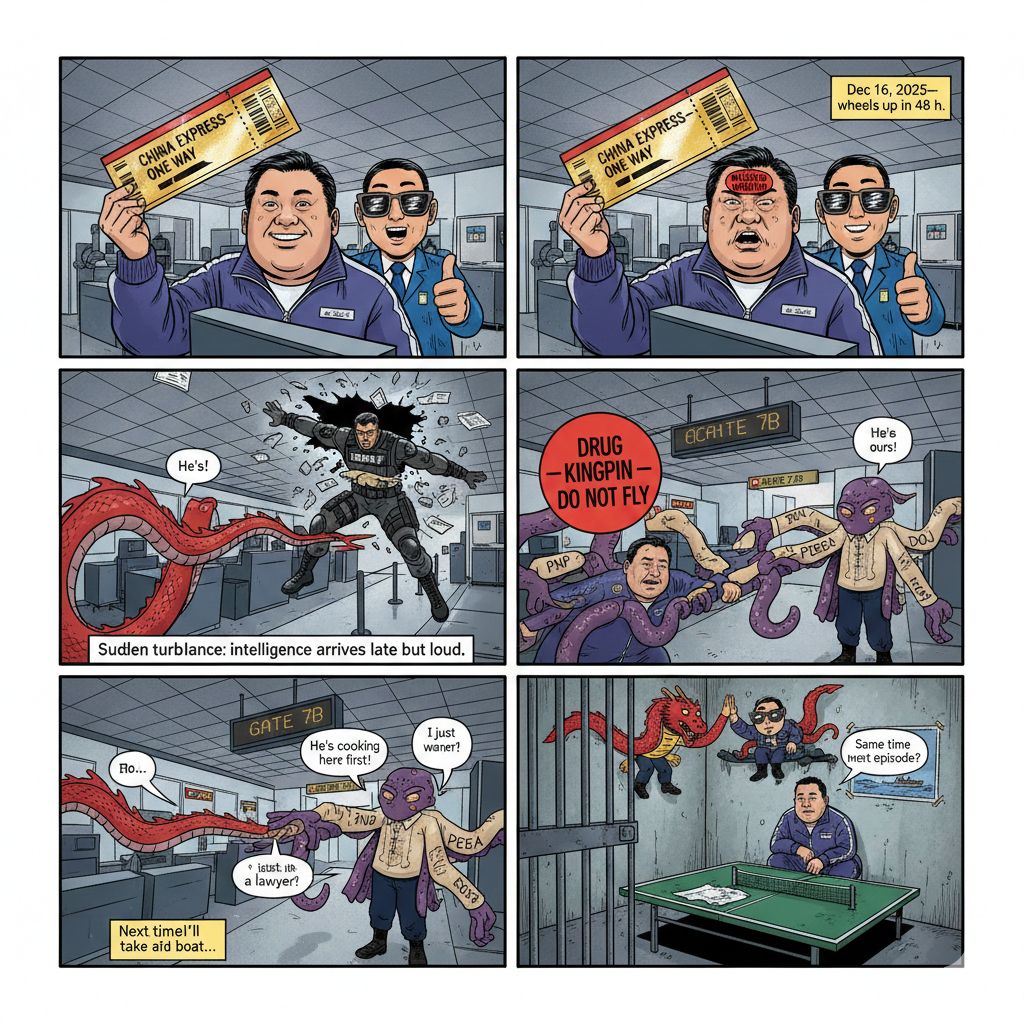
Thus begins the latest episode of Passport Ping-Pong. On December 14, 2025, BI agents scooped up Shi Chunfang, 40, from a Taytay residential hideout. Complete rap sheet: Chinese kidnapping warrant (2024), canceled passport, BI blacklist (January 2025), watchlist (July 2025), and certified “undesirable” under the Philippine Immigration Act of 1940 (Commonwealth Act No. 613). Deportation was practically in the bag—until Philippine pride decided to grow a spine at the very last second.
The Narrative Fog Machine
Reports swirled that Shi had been politely released by the BI only to be dramatically re-arrested by the Philippine National Police (PNP)’s Criminal Investigation and Detection Group (CIDG)—a classic Philippine law-enforcement trope of “who gets the headline?” Commissioner Joel Anthony Viado wasted no time slamming these as “inaccurate,” insisting Shi never left BI custody. He even hinted at “ill-motivated individuals” trying to “muddle the incident,” noting that the fugitive had apparently become an “influential community leader” in Rizal while allegedly running a shabu laboratory on the side.
One cannot help but admire the timing. The Chinese Embassy pushes for expedited repatriation, deportation is scheduled for December 16, and—poof!—intelligence suddenly materializes revealing Shi as a shabu (methamphetamine) “kingpin.” Is this vigilant sovereignty, or a convenient script flip to counter perceptions of the BI as a mere conveyor belt for foreign requests?
The Jurisdictional Hot Potato
Here lies the delicious legal irony: Commonwealth Act No. 613 allows summary deportation of undesirable aliens with cheerful efficiency—especially when the home country is eager to reclaim them for their own offenses. Yet when “government intelligence” links the same alien to manufacturing illegal drugs on Philippine soil, the scales tip toward Republic Act No. 9165 (Comprehensive Dangerous Drugs Act of 2002) and the territorial principle in Article 2 of the Revised Penal Code (Republic Act No. 3815).
Supreme Court precedents offer a narrow path. In Board of Commissioners v. Dela Rosa (G.R. Nos. 95122-23, 1991), the Court affirmed broad deportation powers but warned against using them to evade criminal accountability when local charges loom. Canceling the flight to pursue investigation may thus be defensible diligence—provided the intelligence holds up.
Meanwhile, Domingo v. Scheer (G.R. No. 154745, 2004) reminds even the most undesirable foreigners of their constitutional due process rights. Keeping Shi in an administrative facility while “coordinating” with the Department of Justice (DOJ), Department of the Interior and Local Government (DILG), and PNP risks sliding into indefinite detention if charges aren’t filed promptly.
Systemic red flags abound: Why did the drug-lab revelation surface only on the eve of departure? Does the BI have independent capacity to corroborate such intelligence, or is it forever playing telephone with the Philippine Drug Enforcement Agency (PDEA) and PNP?
The Bigger Game: Transnational Vulnerabilities and Diplomatic Tightrope
This is no isolated comedy of errors. It exposes enduring cracks in monitoring foreign nationals who overstay, reinvent themselves as “community leaders,” and allegedly embed criminal operations. Past waves of migration tied to offshore gaming have only widened those cracks. Deferring automatically to embassy requests risks turning the Philippines into a safe exit ramp for transnational offenders; overriding them without solid evidence invites diplomatic frost and accusations of overreach.
What the case truly demands is structural clarity: legislated protocols spelling out when local prosecution under RA 9165 trumps administrative deportation, and when bilateral comity prevails.
The Path Forward: From Ad-Hoc Drama to Institutional Backbone
The final act in this Passport Ping-Pong will define the BI’s trajectory—whether it remains reactive or evolves into assertive guardian of territorial justice. Success should be measured not by press statements but by outcome: either airtight criminal charges filed, or a forthright explanation if deportation resumes.
Measured recommendations for breaking the cycle:
- Convene an inter-agency task force to draft a binding “Protocol for High-Value Foreign Fugitives,” requiring joint BI-DOJ-DILG-PNP-PDEA evaluation immediately upon arrest—eliminating conflicting narratives and credit-grabbing.
- Strengthen BI’s investigative linkages with PDEA and PNP, including forensic access to verify intelligence independently before public disclosure or detention extension.
- Mandate swift transition from administrative to criminal custody when local offenses are alleged, shielding against habeas corpus challenges.
In the end, the real winner should not be any single agency’s reputation, but a system robust enough to handle the next Shi Chunfang without resorting to last-minute plot twists.
Key Citations
- Patinio, Ferdinand. “BI Arrests Chinese Fugitive Found to Be Drug Kingpin.” Philippine News Agency, 19 Dec. 2025.
- “BI Arrests Chinese Fugitive Found to Be Drug Kingpin.” Bureau of Immigration Philippines, 19 Dec. 2025.
- Commonwealth Act No. 613: The Philippine Immigration Act of 1940. Official Gazette of the Republic of the Philippines, 26 Aug. 1940.
- Republic Act No. 9165: Comprehensive Dangerous Drugs Act of 2002. Official Gazette of the Republic of the Philippines, 7 June 2002.
- Republic Act No. 3815: The Revised Penal Code of the Philippines. Official Gazette of the Republic of the Philippines, 8 Dec. 1930.
- Board of Commissioners v. Dela Rosa, G.R. Nos. 95122-23, Supreme Court of the Philippines, 31 May 1991, LawPhil.
- Domingo v. Scheer, G.R. No. 154745, Supreme Court of the Philippines, 29 Jan. 2004, LawPhil.

- “Forthwith” to Farce: How the Senate is Killing Impeachment—And Why Enrile’s Right (Even If You Can’t Trust Him)

- “HINDI AKO NAG-RESIGN!”

- “I’m calling you from my new Globe SIM. Send load!”

- “Mahiya Naman Kayo!” Marcos’ Anti-Corruption Vow Faces a Flood of Doubt

- “Meow, I’m calling you from my new Globe SIM!”

- “No Special Jail for Crooks!” Boying Remulla Slams VIP Perks for Flood Scammers

- “PLUNDER IS OVERRATED”? TRY AGAIN — IT’S A CALCULATED KILL SHOT

- “Several Lifetimes,” Said Fajardo — Translation: “I’m Not Spending Even One More Day on This Circus”

- “Shimenet”: The Term That Broke the Internet and the Budget

- “We Did Not Yield”: Marcos’s Stand and the Soul of Filipino Sovereignty

- “We Gather Light to Scatter”: A Tribute to Edgardo Bautista Espiritu

- $150M for Kaufman to Spin a Sinking Narrative







 KWEBA ni BAROK
Leave a comment