
Guarantee Letters: The New Prescription for Utang na Loob
By Louis ‘Barok‘ C. Biraogo — December 24, 2925
HETO, Senate Bill No. 1593 (text of the bill as reported), the so-called Universal Healthcare Medical Assistance Program Act. What a noble-sounding title for what is, at its core, the Priority Development Assistance Fund (PDAF) zombie rising from the grave, now draped in a white lab coat and stethoscope for plausible deniability. Critics have aptly dubbed the Medical Assistance to Indigent and Financially Incapacitated Patients (MAIFIP) program “health pork,” and for good reason: it requires indigent patients to grovel for “guarantee letters” from lawmakers just to access funds. Imagine being on your deathbed, not only fighting illness but also navigating the treacherous waters of political patronage—begging your local congressman for a scrap of healthcare like it’s a favor owed for votes past or future.
But here’s where the grand deception kicks in, and it’s a doozy. The news reports scream that guarantee letters are still required, turning medical aid into a politician’s photo-op prop. Yet, somewhere in the shadowy backrooms of the Senate, a key proponent claims the “final” version of the bill forbids these letters entirely, supposedly to “prevent political patronage.” Which is it, dear senators? Is this bill a depoliticized lifeline for the poor, or a slush fund disguised as charity? The contradiction is glaring, deliberate, and reeks of obfuscation. Lawmakers are playing a shell game: wave the “no patronage” flag in public statements to placate critics, while the actual text (as reported) keeps the guarantee letters intact. It’s classic Philippine legislative sleight-of-hand—promise reform, deliver the same old trapo feast.
This structure mirrors the unconstitutional Priority Development Assistance Fund (PDAF) struck down in the landmark Belgica v. Ochoa (G.R. No. 208566, November 19, 2013) ruling. Remember PDAF? Discretionary funds allocated to legislators, who then exercised post-enactment control over project identification and fund release—breeding corruption on an industrial scale. SB 1593 does the same dance: a massive annual appropriation (P51.6 billion for 2026 alone, bloated from the executive’s modest proposal), funneled through a mechanism that lets politicians gatekeep access. Even if administered by the Department of Health (DOH) on paper, the guarantee letter (or its informal equivalent) ensures lawmakers retain influence. It’s PDAF 2.0, only now the “projects” are human lives, and the kickbacks come in votes, loyalty, and campaign fodder.
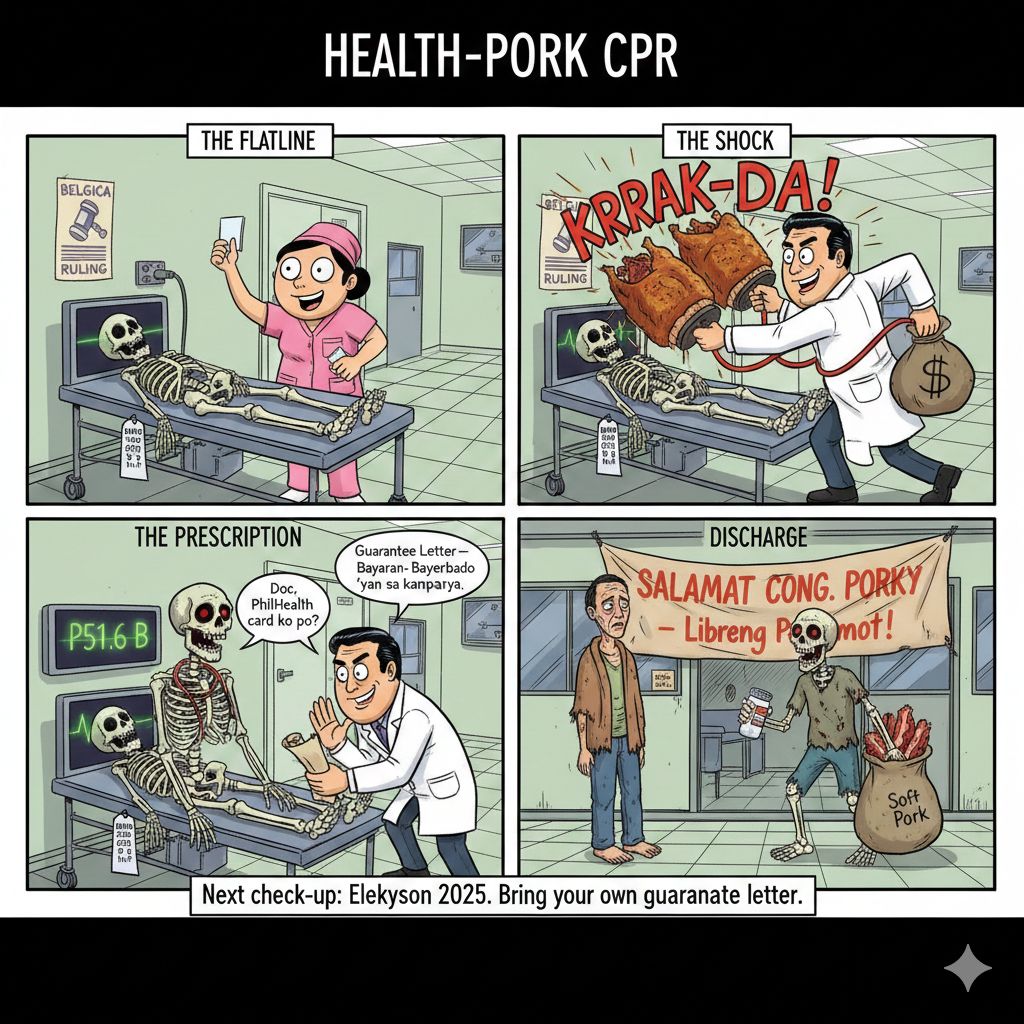
Constitutional and Legal Crossfire
Let’s fire the legal broadsides, shall we? First, separation of powers. The Constitution is crystal clear: Congress appropriates, the Executive implements. Belgica eviscerated PDAF precisely because it allowed legislators post-enactment meddling—identifying beneficiaries, steering funds—which encroaches on executive turf. Any whiff of guarantee letters in SB 1593 repeats this sin. Politicians issuing or influencing these letters? That’s textbook post-enactment control, unconstitutional on its face.
Then there’s the sabotage of the Universal Health Care (UHC) Act (Republic Act No. 11223). This law, enacted in 2019, enshrines a rights-based, integrated system: automatic coverage for all Filipinos, financial risk protection through Philippine Health Insurance Corporation (PhilHealth), equity in access, and a push toward zero out-of-pocket payments via pooled resources and standardized benefits. The goals are noble—protect the vulnerable from catastrophic health costs, promote health consciousness, and build an efficient, single-payer-like framework centered on PhilHealth.
SB 1593? It fragments this beautifully. Instead of bolstering PhilHealth, it creates a parallel, politician-mediated “assistance” program for gaps PhilHealth allegedly can’t fill. But why create a separate pantry when the UHC mandates strengthening the main kitchen? This duplication weakens pooling, invites inefficiency, and turns a universal right into discretionary charity.
Enter the Supreme Court’s fresh ammunition from December 2025: the unanimous ruling (Supreme Court Press Briefer, December 5, 2025) voiding the diversion of P60 billion in PhilHealth reserves to the national treasury. The Court slammed a 2024 budget provision as an illegal “rider”—non-germane, sabotaging the UHC Act’s intent to keep PhilHealth funds dedicated to universal coverage, benefits expansion, and protecting indigents, seniors, and persons with disabilities (PWDs). Diverting funds undermined financial protection and equity, the very principles of RA 11223.
SB 1593 is cut from the same cloth. By siphoning billions into a separate program vulnerable to political whims, it similarly undermines UHC integration and PhilHealth’s role. And dare we speculate? The bill itself could be challenged as a “rider” tacked onto the UHC framework, distorting its rights-based core with patronage elements. The Court just condemned riders that raid health funds—how is this different?
The Patronage Machine: How It Would (Really) Work
Even if proponents swear up and down that guarantee letters are banned in the “final” version (a claim reeking of post-hoc spin), let’s get real. Patronage doesn’t need formal letters to thrive. In practice, desperate patients will flock to congressional offices—the “frontline centers” proponents boast about—begging for intervention. Lawmakers’ staff will “facilitate” applications, hospitals will prioritize “recommended” cases, and politicians will claim credit via press releases and tarpaulins: “Thanks to Cong. So-and-So, Patient X is saved!”
This is how favoritism manifests: the well-connected (or those in the right district, or who voted correctly) get fast-tracked; others languish. Public distrust is already palpable—imagine comments on senators’ social media posts lamenting how aid goes to loyal voters while opponents get nada. It’s utang na loob on steroids.
And the corruption risks? Déjà vu of the Janet Lim-Napoles PDAF scam, which defrauded the government of a staggering ₱10 billion through fake NGOs, ghost projects, and massive kickbacks (40-60% rebates to lawmakers). Here, the modus could evolve: connivance with hospital admins for inflated bills, “ghost patients,” or diverted funds split between political offices and complicit providers. Dr. Tony Leachon’s allegations of kickback schemes ring true—why invite the same systemic rot into healthcare, where lives hang in the balance?
The Superior, Rights-Based Alternative
Kill this bill. Full stop. Reject SB 1593 outright and redirect that bloated P51.6 billion straight to PhilHealth. The December 2025 Supreme Court ruling isn’t just a slap—it’s a mandate: return the raided ₱60 billion (plus the barred ₱29.9 billion) and fortify the institutional insurance system. No more excuses for parallel slush funds.
The true path aligns with RA 11223: fully implement zero balance billing, expand benefits, lower contributions for the poor, and ensure equitable, needs-based access through objective criteria. Any supplementary assistance must be administered solely by DOH or PhilHealth—certified by social workers, audited rigorously by Commission on Audit (COA), with transparent, automated processes. No politician in the loop. Period.
This isn’t radical; it’s faithful to the UHC’s principles of equity, integration, and rights over favors.
Call to Action & Recommendations
Civil society, medical associations (those 72 groups screaming for abolition), and watchdogs: gear up for a Supreme Court petition. Cite Belgica for separation of powers violations, the fresh December 2025 PhilHealth ruling for undermining UHC via riders and diversions, and equal protection breaches when aid hinges on political connections.
Mr. President: wield that line-item veto like a scalpel. Excise any trace of legislative discretion over these funds.
Commission on Audit: don’t wait for enactment—design preemptive, ironclad audit frameworks to expose any whiff of Napoles-style scams.
And to the senators peddling this monstrosity: spare us the hypocrisy. Filipinos deserve a robust, apolitical health system—a true universal right, not a pork barrel in scrubs.
The only acceptable path forward is clear: bury this “health pork” bill six feet under and redirect every peso toward the equitable, institutional UHC Filipinos are entitled to by law, conscience, and hard-earned taxes. Anything less is malpractice.
- —Barok, who knows the real cure for the nation’s sickness isn’t a guarantee letter—it’s political will and actual accountability
Key Citations
- Belgica v. Executive Secretary Ochoa. Supreme Court of the Philippines, G.R. No. 208566, 19 Nov. 2013.
- “Press Briefer December 05, 2025.” Supreme Court of the Philippines, 5 Dec. 2025.
- Republic Act No. 11223: An Act Instituting Universal Health Care for All Filipinos, Prescribing Reforms in the Health Care System, and Appropriating Funds Therefor. Official Gazette of the Republic of the Philippines, 20 Feb. 2019.
- Varcas, Michael. “Senate Panels Want ‘Health Pork’ Institutionalized.” Philstar.com, 23 Dec. 2025.
- “Forthwith” to Farce: How the Senate is Killing Impeachment—And Why Enrile’s Right (Even If You Can’t Trust Him)

- “HINDI AKO NAG-RESIGN!”

- “I’m calling you from my new Globe SIM. Send load!”

- “Mahiya Naman Kayo!” Marcos’ Anti-Corruption Vow Faces a Flood of Doubt

- “Meow, I’m calling you from my new Globe SIM!”

- “No Special Jail for Crooks!” Boying Remulla Slams VIP Perks for Flood Scammers

- “PLUNDER IS OVERRATED”? TRY AGAIN — IT’S A CALCULATED KILL SHOT

- “Several Lifetimes,” Said Fajardo — Translation: “I’m Not Spending Even One More Day on This Circus”

- “Shimenet”: The Term That Broke the Internet and the Budget

- “We Did Not Yield”: Marcos’s Stand and the Soul of Filipino Sovereignty

- “We Gather Light to Scatter”: A Tribute to Edgardo Bautista Espiritu

- $150M for Kaufman to Spin a Sinking Narrative

 KWEBA ni BAROK
Leave a comment