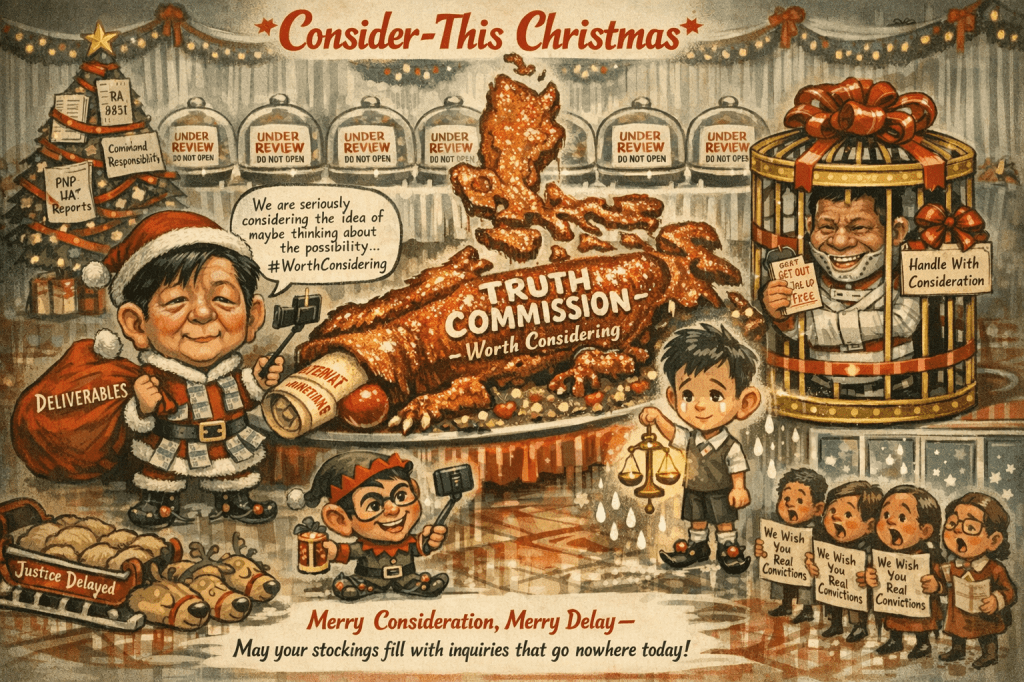
Kian Gets Convictions, Architects Get Considerations: The Palace’s Holiday Gift to Impunity
By Louis ‘Barok‘ C. Biraogo — December 25, 2025
HMMNN…, Christmas Eve in Malacañang. While the rest of the country is carving lechon and singing carols, Presidential Communications Secretary Dave Gomez drops a little stocking stuffer for the grieving families of the drug war dead: the idea of a Truth Commission for the Duterte-era killings is, drumroll please, “worth considering.”
Not committing to. Not pushing for. Not even pretending to rush. Just… considering. You know, like how one “considers” fixing the roof when it’s already collapsed on the family inside.
And the timing? Exquisite. The Supreme Court has just affirmed the murder convictions of the three cops who executed 17-year-old Kian delos Santos in 2017—proof that our courts can, when pushed hard enough, convict the triggermen. Meanwhile, the alleged architect of the entire slaughterhouse policy, Rodrigo Duterte, sits in a cell in The Hague, cooling his heels while the International Criminal Court (ICC) ponders crimes against humanity.
So naturally, the Palace response is to float the idea of a talk-shop. Brilliant. Nothing says “we’re serious about justice” like bureaucratic languor wrapped in the passive voice.
Let us dissect this pantomime with the precision it deserves.
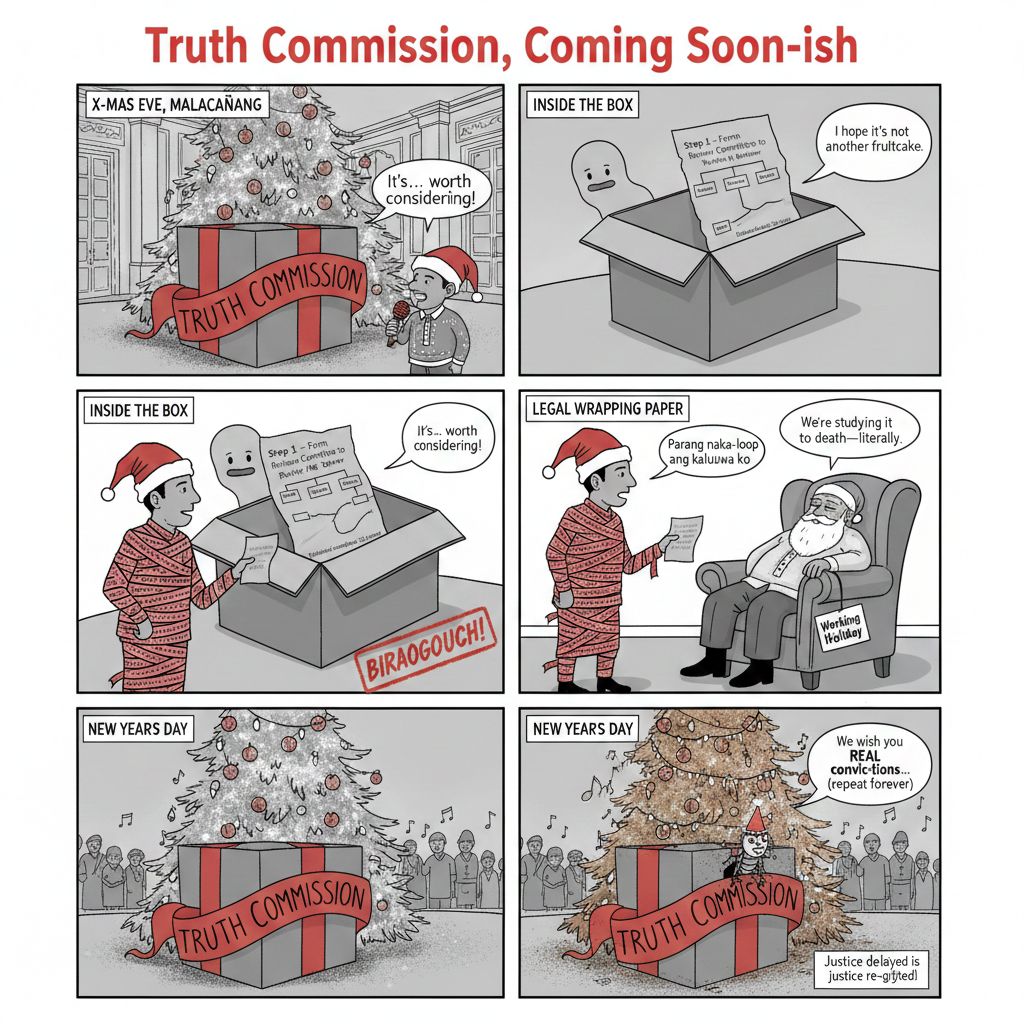
The Language of Eternal Delay
Secretary Gomez: “We still need to review the Supreme Court decision. [But] this development underscores the need to consider the proposal…”
Translate that from Palace-speak: “We’re going to study this to death, then bury it in committee, then blame Congress, then blame the budget, then blame the holidays.”
“Worth considering” is the verbal equivalent of a shrug emoji sent to thousands of widows and orphans. Contrast that milquetoast murmur with the reality it purports to address: an industrial-scale killing machine that left anywhere from 6,000 (official) to 30,000 (human rights groups) bodies in its wake, most of them poor, many of them “nanlaban” only in police fairy tales.
A Ghost From 2010 Walks Into Malacañang…
Remember Biraogo v. The Philippine Truth Commission of 2010? Of course you don’t—Malacañang is clearly hoping the entire country has amnesia. The Supreme Court struck down Noynoy Aquino’s Executive Order No. 1 because it created a truth body that singled out the Arroyo administration alone. Violation of the Equal Protection Clause, the Court ruled. You cannot constitutionally design a fact-finding panel to hunt only one political clan while giving every other administration a free pass.
So here we are again: a proposed commission laser-focused on the Duterte drug war. Same fatal flaw, different dynasty. Unless the Palace suddenly decides to investigate extrajudicial killings (EJKs) under Estrada, Arroyo, Aquino, and yes, even the current administration’s own “continuity” operations, this thing is dead on arrival at the Supreme Court steps. The Dutertes’ lawyers are already sharpening their petitions, licking their chops at the irony of using a pro-Aquino precedent to shield a Duterte.
But perhaps that’s the point. Float an unconstitutional feint, let it get enjoined, then throw up hands: “We tried, but the Court stopped us.” Classic.
Truth Commission or Soft-Landing Commission?
Let us be clear about what a truth commission actually does: it talks. It listens. It compiles heartbreaking testimonies. It issues a thick report that gathers dust on some congressional shelf. It does not indict. It does not imprison. It does not deliver justice—it delivers catharsis for the state, not for the victims.
We already have laws that can deliver actual justice:
- Republic Act No. 9851 (Philippine Act on Crimes Against International Humanitarian Law and Genocide), the Philippine Act on Crimes Against International Humanitarian Law, gives our courts full jurisdiction to prosecute crimes against humanity right here, no Hague required.
- The doctrine of command responsibility, affirmed in Rodriguez v. Macapagal-Arroyo, holds superiors liable when they knew or should have known about atrocities committed by subordinates and did nothing.
- The 1987 Constitution, Article III, Section 1—the right to life—was violated on a scale that should shame any nation claiming to be civilized.
- Republic Act No. 6713 (Code of Conduct and Ethical Standards for Public Officials and Employees), the Code of Conduct for public officials, demands they uphold human dignity, not cheerlead its destruction.
We do not need another commission. We need prosecutors with spines.
Instead, the Palace dangles this ghost of precedent past as either:
- a distraction from its own governance failures,
- a fig leaf for the ICC to invoke complementarity (“See? We’re investigating ourselves!”), or
- a cynical chess move to kneecap the Duterte dynasty ahead of 2028 without ever having to prove anything in a real courtroom.
The Cast Performs Their Predictable Roles
The Marcos administration plays the reluctant reformer—concerned, oh so concerned, but paralyzed by “process.” Spare me. This is realpolitik at its most transparent: the UniTeam corpse is still warm, and here comes the knife, wrapped in human-rights rhetoric.
The Duterte camp will scream “political persecution” and “selective justice”—and on the narrow point of equal protection, they’ll have the Biraogo precedent on their side. Delicious irony.
Leila de Lima and the opposition have the moral high ground, no question. After years in detention on trumped-up charges, she has every right to demand the dismantling of the Davao model. But let us not pretend this cause lacks political utility: every hearing, every headline, keeps the Dutertes bleeding into the BSKE elections and beyond.
And the victims’ families? They watch this theater from the cheap seats, wondering if anyone up on stage actually gives a damn about their dead.
What We Should Demand Instead
If the Palace is serious—and stop laughing, I’m trying to finish this sentence—then skip the unconstitutional Executive Order (EO) stunt. Go to Congress. Pass a properly drafted law creating a commission that investigates EJKs across all administrations, gives it subpoena power, witness protection, and a direct pipeline for its findings to the Office of the Ombudsman and Department of Justice (DOJ). Make the report actionable, not merely archival.
Better yet, skip the commission entirely. Use the tools already rusting in the shed:
- Direct the DOJ to file cases under Republic Act No. 9851.
- Order full disclosure of every “nanlaban” police report.
- Reform the Philippine National Police (PNP) Internal Affairs Service so it stops whitewashing its own.
- Prosecute up the chain using command responsibility—because the fish rots from the head.
True sovereignty is not chest-thumping defiance of the ICC. It is the demonstrated capacity to police your own monsters.
A Christmas Carol for the Powerful
On this Christmas Day, while the Palace “considers,” remember Kian delos Santos—dragged from his home, forced to hold a gun, shot in the head, then branded a drug dealer to justify the slaughter. Remember the thousands whose names we do not even know.
This proposed Truth Commission is not a step toward justice. It is a feint, a delay, a dilution. It is the sound of powerful men negotiating how much accountability they can avoid while still looking concerned on camera.
Justice delayed is justice denied. Justice diluted is justice betrayed. And justice performed as political theater is the cruelest denial of all.
The victims deserve better than consideration. They deserve convictions.
Writing so the victims’ names outlive the lies told about them,
–Barok
Key Citations
- “Biraogo v. Philippine Truth Commission, G.R. No. 192935.” Supreme Court of the Philippines, 7 Dec. 2010, LawPhil.
- Panti, Llanesca T. “Palace: Truth Commission for Duterte-Era Drug War Probe Worth Considering.” GMA News Online, 24 Dec. 2025.
- Philippines, Supreme Court. “SC Affirms Murder Conviction of Police Officers in Kian Delos Santos Case.” Supreme Court of the Philippines, 22 Dec. 2025.
- Republic Act No. 6713: Code of Conduct and Ethical Standards for Public Officials and Employees. Congress of the Philippines, 20 Aug. 1987.
- Republic Act No. 9851: Philippine Act on Crimes Against International Humanitarian Law, Genocide, and Other Crimes Against Humanity. Congress of the Philippines, 11 Dec. 2009.
- Rodriguez v. Macapagal-Arroyo. G.R. No. 191805, Supreme Court of the Philippines, 16 Apr. 2013. LawPhil.
- The 1987 Constitution of the Republic of the Philippines. Congress of the Philippines, 2 Feb. 1987, Article III, Section 1.
- ₱8B BBM Pork: CCTV for Every Captain’s Kumpare?
- ₱75 Million Heist: Cops Gone Full Bandit

- ₱6.7-Trillion Temptation: The Great Pork Zombie Revival and the “Collegial” Vote-Buying Circus

- ₱1.9 Billion for 382 Units and a Rooftop Pool: Poverty Solved, Next Problem Please

- ₱1.35 Trillion for Education: Bigger Budget, Same Old Thieves’ Banquet
- ₱1 Billion Congressional Seat? Sorry, Sold Out Na Raw — Si Bello Raw Ang Hindi Bumili

- “We Will Take Care of It”: Bersamin’s P52-Billion Love Letter to Corruption
- “Skewed Narrative”? More Like Skewered Taxpayers!

- “Scared to Sign Vouchers” Is Now Official GDP Policy – Welcome to the Philippines’ Permanent Paralysis Economy
- “Robbed by Restitution?” Curlee Discaya’s Tears Over Returning What He Never Earned
- “No Pressure” Luistro? The House Pork Bazaar Exposed
- “My Brother the President Is a Junkie”: A Marcos Family Reunion Special


 KWEBA ni BAROK
Leave a comment