Zero Rent for Ghosts, Sky-High Rates for Humans: A Lesson in Prioritizing the Non-Existent
By Louis ‘Barok‘ C. Biraogo — December 26, 2025
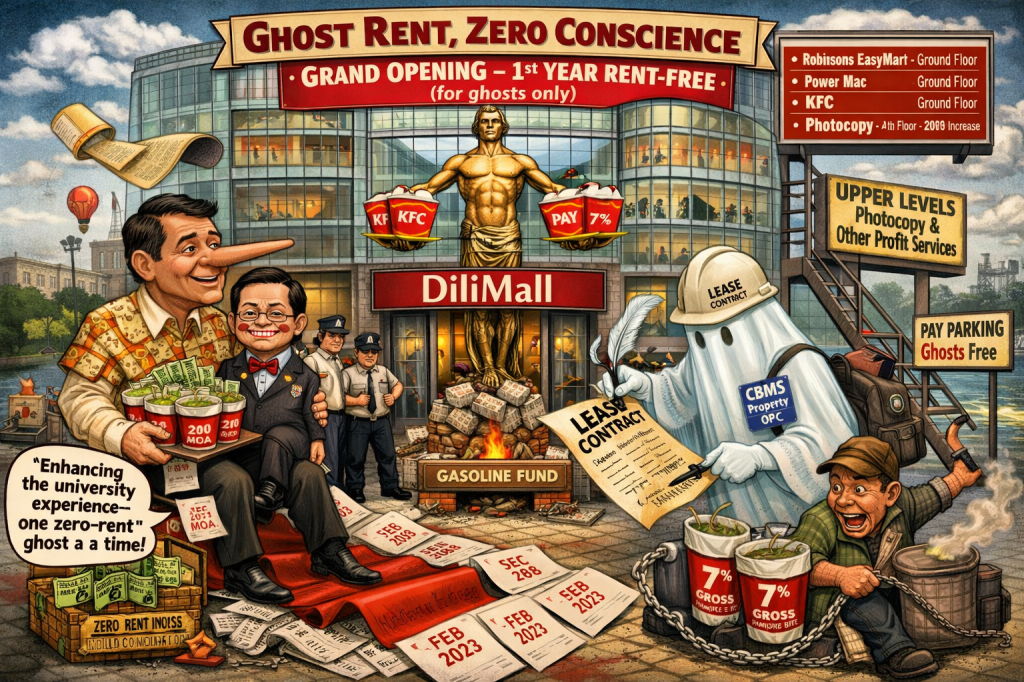
HAYY, the mighty University of the Philippines, proud fortress of fearless inquiry and champion of the masses, now moonlighting as a prime real estate playground for ghost entities and chain-store invaders. But behold the latest syllabus from the Jimenez administration: “Privatization 101: How to Hand Prime Public Property to Shadowy Insiders While Kicking Legacy Vendors to the Curb.” Starring President Angelo Jimenez, his predecessor Danilo Concepcion, and a chorus of enablers like Vice President Daniel Peckley and former Vice Chancellor Raquel Florendo, with cameo appearances by “ghost entities” like CBMS Property Company OPC—registered with the SEC a full month after inking the deal—and the ever-opaque JoseBizCo. The displaced vendors from the old Shopping Center? Mere extras, evicted from their tennis court limbo in April 2024, now facing exorbitant rents plus a 7% gross sales skim if they’re lucky enough to squeeze into the shiny new DiliMall.
And the pièce de résistance? A full year of zero rent for these private darlings, letting them monetize public land while UP gets zilch. Jimenez’s response? A pious press release about “enhancing the university experience” and “careful consideration for those affected.” How touching. One wonders if that “careful consideration” included checking if their business partner actually existed legally before signing away the farm.
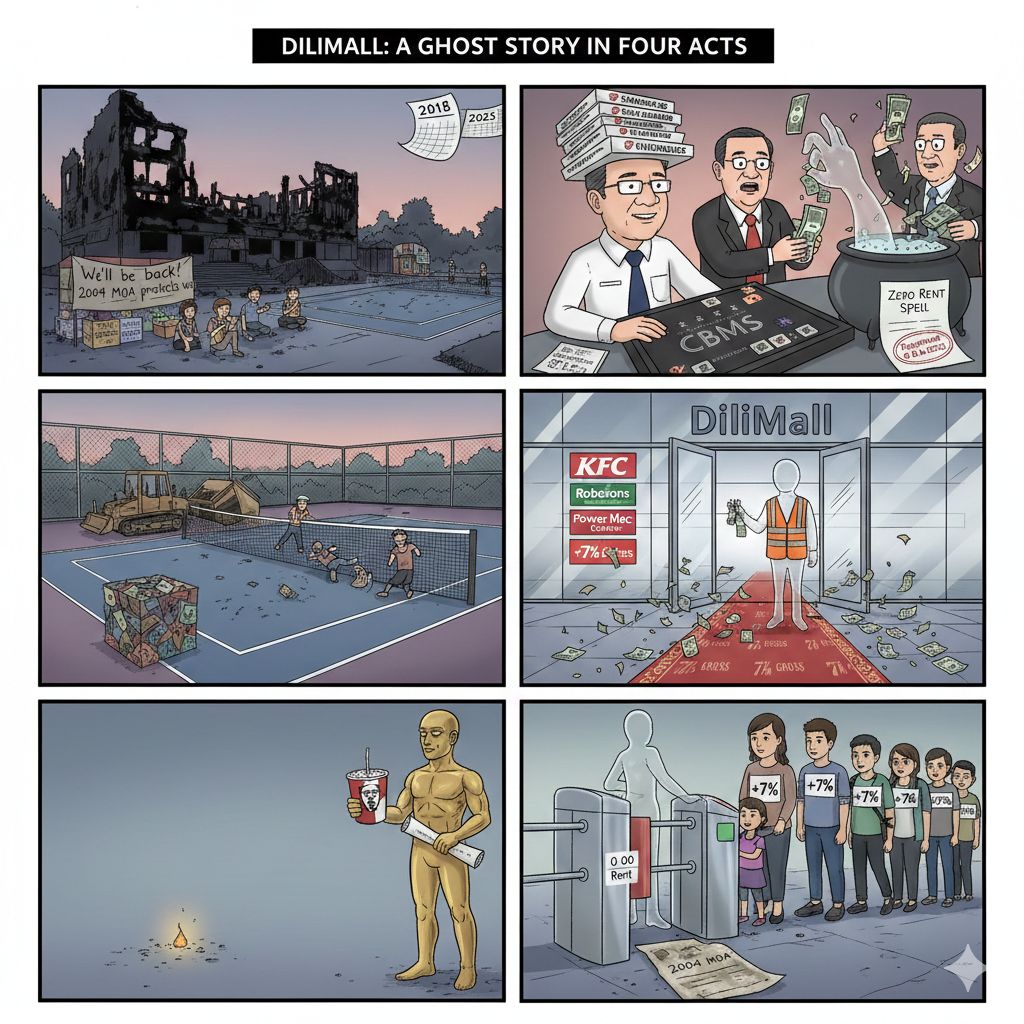
Let’s unpack this thriller, shall we? It starts with a bang—the 2018 fire that gutted the beloved UP Shopping Center, home to affordable eats, photocopies, and sari-sari stores that kept generations of students alive on a budget. Vendors relocated temporarily to the tennis courts, clinging to a 2004 Memorandum of Agreement (MOA) promising them priority rights, first refusal, and discounted rents in any rebuild. Fast-forward to 2023: Instead of honoring that binding pact, the administration inks a Master Lease Agreement (MLA) on January 6 with CBMS—a entity that, per SEC records, wasn’t even registered until February. A “ghost entity,” as the complainants aptly call it, handed absolute control over leasing. Vendors? Priced out with jacked-up rates and that 7% gross sales vampire bite. The result: Big chains like Robinsons Easymart, Power Mac, Shakey’s, and KFC hog the ground floor, while essential student services (photocopying, anyone?) get banished to the upper levels. Suspense builds as protests erupt, but the ribbon-cutting goes on anyway.
Administrative Autopsy: Exposing the Rot in UP’s ‘Betrayal of the Iskolar’ Diploma Program
For the complainants—the UP Not for Sale Network of vendors, students, workers, and residents—this is open-and-shut graft. The officials flagrantly ignored the 2004 MOA, a perfected contract with the “full force of law,” evicting vendors without alternatives and subjecting survivors to rates that scream profiteering. Then there’s the zero-rent bonanza: A full year of exclusive profiteering on public land, no remittance to UP. Grossly disadvantageous? That’s putting it mildly—it’s a giveaway that violates Republic Act No. 3019 (Anti-Graft and Corrupt Practices Act) Section 3(g) outright, entering into contracts “manifestly and grossly disadvantageous to the government.”
And the crowning folly: Partnering with a ghost. CBMS Property Company OPC didn’t exist when the MLA was signed. No due diligence? That’s gross inexcusable negligence under RA 3019 Section 3(e), causing undue injury to vendors and the community while handing unwarranted benefits to insiders. Add Republic Act No. 6713 (Code of Conduct and Ethical Standards for Public Officials and Employees) violations—grave misconduct, gross neglect—for good measure. The disregard for the MOA isn’t just breach of contract; it’s breach of faith with the very people who make UP tick.
Steel-Manning the Defense… Then Torch It
Oh, but the respondents will trot out their shields. “It’s just modernization!” they’ll cry—post-fire reconstruction demands professional developers for a fire-compliant facility. The zero-rent period? A mere incentive for CBMS to shoulder massive build-out costs UP couldn’t afford. No personal pocket-lining, so no bad faith—just sound business judgment, deference to policy decisions, and alignment with the university’s revenue needs amid budget woes.
Cute. But let’s dismantle this house of cards. The Business Judgment Rule? A flimsy umbrella when you forget to verify if your “partner” is a legal phantom. Reliance on subordinates doesn’t fly when red flags wave—like signing with an unregistered entity (hello, Arias v. Sandiganbayan: no shield if negligence is glaring). And “grossly disadvantageous” under RA 3019 doesn’t require bribery or pocketed cash—just the contract’s blatant imbalance, which this zero-rent, full-control setup screams. As for the University of the Philippines Charter (Republic Act No. 9500)? Leasing isn’t banned per se, but long-term deals demand BOR discussion, comprehensive plans, public bidding under Republic Act No. 9184 (Government Procurement Reform Act), and mission alignment. Complainants allege no proper BOR approval for the framework—another procedural gut punch.
The Charter Charade: Lease or Camouflaged Alienation?
Speaking of the Charter—Section 23 bans outright sale of UP land (with narrow exceptions). Respondents will smirk: “It’s just a lease, bro—not alienation!” But is it? This setup hands private entities de facto control, exclusive monetization for a year, and pricing power that displaces public-serving vendors for profit-chasing chains. Smells like prohibited alienation in disguise, à la Chavez v. Public Estates Authority: You can’t camouflage giveaways of public assets as “leases” to skirt safeguards. The spirit of Section 23—protecting public dominion—clashes violently with this commercialized reality. If it walks like privatization and quacks like profiteering, it’s no mere lease.
Ombudsman’s Playbook: Prima Facie Fireworks, But Criminal Hurdles
The complaint’s strengths? Explosive optics and low prima facie bar at the Ombudsman. Documentary gold: MLAs, SEC records proving the ghost timeline, vendor testimonies, zero-rent terms. Easy to flag undue injury and disadvantageous deals. Preventive suspension? Likely, to stop tampering. Pitfalls: Proving criminal bad faith or manifest partiality is tough—respondents can hide behind “collective decision” and “no personal gain.” Expect motions to dismiss, appeals to presumption of regularity.
Resolution Roulette: Place Your Bets
- Whitewash (Most Likely Short-Term): Ombudsman dismisses criminal charges for lack of intent; administrative slap (reprimand) if procedural lapses admitted.
- Sacrificial Lamb: Mid-level officials suspended; Jimenez skates on “policy deference.”
- Nullification Bombshell: Courts void the ghost contract (Civil Code: void ab initio if party nonexistent); vendors reinstated under 2004 MOA.
- Messy Compromise: Renegotiated terms—socialized wing for legacy vendors, partial rent refunds—to save face but infuriate all.
I’d wager on administrative accountability sticking (high risk for due diligence fails) while criminal fades—unless the ghost unravels more. Complainants win optics and pressure; respondents escape jail but bleed trust.
The Ripple Effect: Privatizing the Soul of Public Education
This isn’t isolated rot. It’s a blueprint for state universities nationwide: Hand public assets to “developers,” displace communities, mall-ify campuses. Impacts? Skyrocketing costs erode access for poor students; trust in UP as “public” evaporates; the university’s democratic soul—consultation, affordability—gets commodified. If UP falls to this neoliberal fever, what hope for other SUCs?
A Call to Arms: Enough is Enough
This isn’t a “policy error,” President Jimenez—it’s a potential betrayal of public trust, a graft-scented surrender of sacred ground. To the Ombudsman: Investigate fiercely, suspend preventively, prosecute where evidence demands. To the Magnificent Board of Regents: Account for your opacity—did you truly vet this framework? Lay the contracts bare under FOI sunlight. Reinstate vendors per the 2004 MOA. Nullify the ghost deals.
UP community: Rise. This is our university—not a private fiefdom. Demand transparency, justice, accountability. Iskolar ng Bayan, para kanino? Not for ghost entities and zero-rent insiders. For the people. Always.
In the name of justice and the oppressed vendors
- —Barok of the Cave here, reminding you: the world turns, but graft always comes back around.
Key Citations
Primary Legal Sources
- Republic Act No. 3019, Anti-Graft and Corrupt Practices Act, Congress of the Philippines, 17 Aug. 1960, Official Gazette.
- Republic Act No. 6713, An Act Establishing a Code of Conduct and Ethical Standards for Public Officials and Employees, Congress of the Philippines, 20 Feb. 1989, Official Gazette.
- Republic Act No. 9500, An Act to Strengthen the University of the Philippines as the National University (University of the Philippines Charter of 2008), Congress of the Philippines, 29 Apr. 2008, LawPhil.
- Republic Act No. 9184, An Act Providing for the Modernization, Standardization and Regulation of the Procurement Activities of the Government and for Other Purposes (Government Procurement Reform Act), Congress of the Philippines, 10 Jan. 2003, Official Gazette.
- Arias v. Sandiganbayan, G.R. No. 81563, Supreme Court of the Philippines, 19 Dec. 1989, LawPhil.
- Chavez v. Public Estates Authority, G.R. No. 133250, Supreme Court of the Philippines, 9 July 2002, LawPhil.
Primary News Article

 KWEBA ni BAROK
Leave a comment