Whispers in the Lounge: When “Briefing” Really Means “Bribe Me Quietly”
By Louis ‘Barok‘ C. Biraogo — December 28, 2025
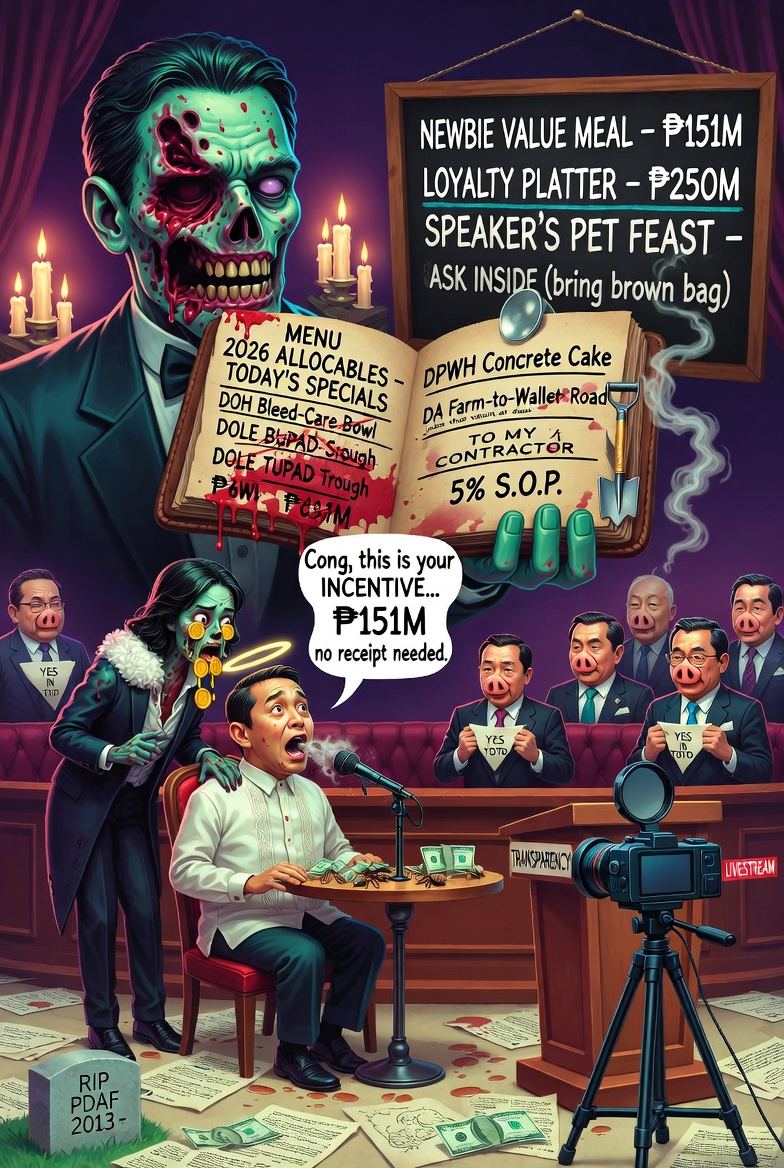
MGA ka-kweba, it’s your friendly neighborhood cave dweller here in the depths of Kweba ni Barok, shining a flashlight on the slimy underbelly of Batasang Pambansa. Today, we’re dissecting the latest stench wafting from the House of Representatives: the “budget incentive” scandal where a mysterious “Attorney Jolina” from Rep. Mikaela Suansing’s office allegedly slid Batangas Rep. Leandro Leviste a ₱151 million “goodie bag” of projects—like it’s a secret Santa gift for obedient lawmakers.
This isn’t some rogue staffer gone wild. No, this is the blatant resurrection of the pork barrel system, rebranded as “allocables” and “incentives,” slithering through the halls of Congress like a zombie that just won’t stay dead. The Supreme Court buried Priority Development Assistance Fund (PDAF) in 2013 with Belgica v. Ochoa, declaring it unconstitutional for violating separation of powers and public accountability. But here we are, over a decade later, with the same rotten corpse painted over and paraded as “reform.”
Let’s break down this farce, shall we?

The Clandestine Lounge Deal: Not a Briefing, a Bribe Pitch
Picture this: September 30, just weeks before the House rubber-stamps the 2026 budget. “Attorney Jolina” hits up Leviste on Viber—”Good morning po, VC Leandro Leviste, this is Attorney Jolina from the office of chair Mika Suansing, may I call po?” She insists there’s a “topic na ayaw niyang isulat”—something she doesn’t want in writing. Red flag much?
They meet not in an office, not in a committee room, but in the cozy lounge at Batasang Pambansa. There, she flashes a document: ₱151 million sliced into tasty portions—₱21M for Department of Health (DOH) medical assistance, ₱25M for Department of Labor and Employment (DOLE)‘s TUPAD, ₱25M for Department of Social Welfare and Development (DSWD)‘s AICS, ₱30M for Department of Agriculture (DA) farm-to-market roads, another ₱25M for “others,” and ₱25M for Department of Public Works and Highways (DPWH) hard projects.
And her exact words? “Cong, this is your incentive.”
Incentive for what, exactly? For playing nice as vice chair of the appropriations committee? For voting yes on the budget “in toto,” no questions asked? This wasn’t a transparent briefing on district needs. This was a transactional offer, whispered in a lounge to avoid paper trails, because sunlight is kryptonite to corruption.
The Tiered Loyalty Menu: Because Some Pigs Are More Equal Than Others
Oh, but it gets richer. Leviste spots another entry on the document—₱250 million for some other lucky congressman, with the same breakdown. Why the disparity? Leviste got ₱151M as a vice chair “incentive,” but others snag bigger hauls—some reportedly even more, depending on seniority or loyalty.
Welcome to the Batasang Bribe Menu: Entry-level for newbies, premium packages for the speaker’s pets, and VIP mega-bundles for the inner circle. Are votes now priced like a fast-food value meal? Extra compliance gets you extra DPWH millions? This tiered system screams patronage—reward the loyal, starve the skeptics. It’s not about national priorities; it’s about buying a smooth budget passage, ensuring no pesky amendments or debates derail the train.
And timing? Right before the October vote. Coincidence? Please. This is leverage: Approve the budget wholesale, or watch your district’s “assistance” vanish.
Legal Gutting: The Unconstitutional Ghost of PDAF
Let’s get serious—and legal. The Supreme Court in Belgica v. Ochoa (2013) eviscerated the Priority Development Assistance Fund for allowing post-enactment legislator control over lump sums, breaching separation of powers and accountability. Lawmakers can’t play executive by identifying projects after the budget’s passed.
Yet here we are: These “incentives” and “allocables” are lump-sum slush funds doled out discreetly, often in “soft pork” like MAIP and AICS—programs critics call perfect for patronage because implementation is opaque. This violates Republic Act No. 3019 (Anti-Graft and Corrupt Practices Act), prohibiting unwarranted benefits or preferential treatment tied to official acts. Offering projects as “incentives” for budget votes? That’s textbook quid pro quo.
Don’t forget Republic Act No. 6713 (Code of Conduct and Ethical Standards for Public Officials and Employees): Transparency, integrity, public interest over personal. Secret lounge menus? Hardly.
This isn’t reform; it’s PDAF’s ghost, haunting the budget process under new names like “allocables.”
Motivations: Compliance Buying and the Cabral Shadow
For Suansing’s camp, chair of the powerful appropriations committee: This ensures the budget sails through without drama. Buy off potential troublemakers early—especially vice chairs like Leviste—with district goodies. Smooth passage means leadership looks strong, allies stay happy.
For Leviste: He’s dropping “Cabral files”—documents from the late DPWH exec exposing questionable allocations—and now this expose. Reformist hero exposing the machine? Or savvy positioning, building a clean-image brand amid the flood control scandals? Either way, his refusal and public outing force the question: If it’s all above board, why the secrecy?
The Reform Theater: Livestreams and Sub-Committees as Smokescreen
Suansing’s crew boasts about “reforms”—Budget Amendments Review Sub-committee, livestreamed bicams. Cute. But behind the cameras, the old game rages: Secret menus, tiered incentives, billions in allocables funneled to favored districts. It’s theater—look transparent while the backroom deals continue. The public sees the show; insiders get the pork.
This scandal exposes the lie: No real change, just better PR.
Enough. Time for Real Action.
Mga kababayan, we can’t let this zombie pork feast on our taxes anymore. Demand now:
- Full Transparency: Immediate public disclosure of EVERY “allocable” and “incentive” for ALL legislators—per district, per program, with computations. Publish the full menu before ratification!
- Accountability: House Ethics Committee and Ombudsman—investigate “Attorney Jolina,” who sent her, and who authorized this system. No whitewash.
- Systemic Overhaul: Abolish all lump-sum, legislator-specific incentives. Return to a budget driven by objective national criteria, not loyalty tiers. Enforce Belgica fully—no more ghosts.
Congress works for us, not the other way around. Share this, rage about it, flood their inboxes. Let’s drag this corruption into the light and burn it for good.
Hanggang sa susunod na kwebanata,
–Barok
Key Citations
- Belgica v. Executive Secretary Paquito N. Ochoa, Jr., G.R. No. 208566, Supreme Court of the Philippines, 19 Nov. 2013, LawPhil.
- Republic Act No. 3019, Anti-Graft and Corrupt Practices Act, Congress of the Philippines, 17 Aug. 1960, LawPhil.
- Republic Act No. 6713, Code of Conduct and Ethical Standards for Public Officials and Employees, Congress of the Philippines, 20 Feb. 1989, LawPhil.
- Rosal, Macon Ramos-Araneta. “Leviste: Suansing Staff Allegedly Offered Budget Items as ‘Incentives.’” Philippine Daily Inquirer, 26 Dec. 2025.
- “Forthwith” to Farce: How the Senate is Killing Impeachment—And Why Enrile’s Right (Even If You Can’t Trust Him)
- “HINDI AKO NAG-RESIGN!”

- “I’m calling you from my new Globe SIM. Send load!”

- “Mahiya Naman Kayo!” Marcos’ Anti-Corruption Vow Faces a Flood of Doubt

- “Meow, I’m calling you from my new Globe SIM!”

- “No Special Jail for Crooks!” Boying Remulla Slams VIP Perks for Flood Scammers
- “PLUNDER IS OVERRATED”? TRY AGAIN — IT’S A CALCULATED KILL SHOT

- “Several Lifetimes,” Said Fajardo — Translation: “I’m Not Spending Even One More Day on This Circus”
- “Shimenet”: The Term That Broke the Internet and the Budget
- “We Did Not Yield”: Marcos’s Stand and the Soul of Filipino Sovereignty

- “We Gather Light to Scatter”: A Tribute to Edgardo Bautista Espiritu

- $150M for Kaufman to Spin a Sinking Narrative

 KWEBA ni BAROK
Leave a comment