Perimortem, Postmortem, or Just Post-Competence? A Ravine-Side Mystery
By Louis “Barok” C. Biraogo — December 29, 2025
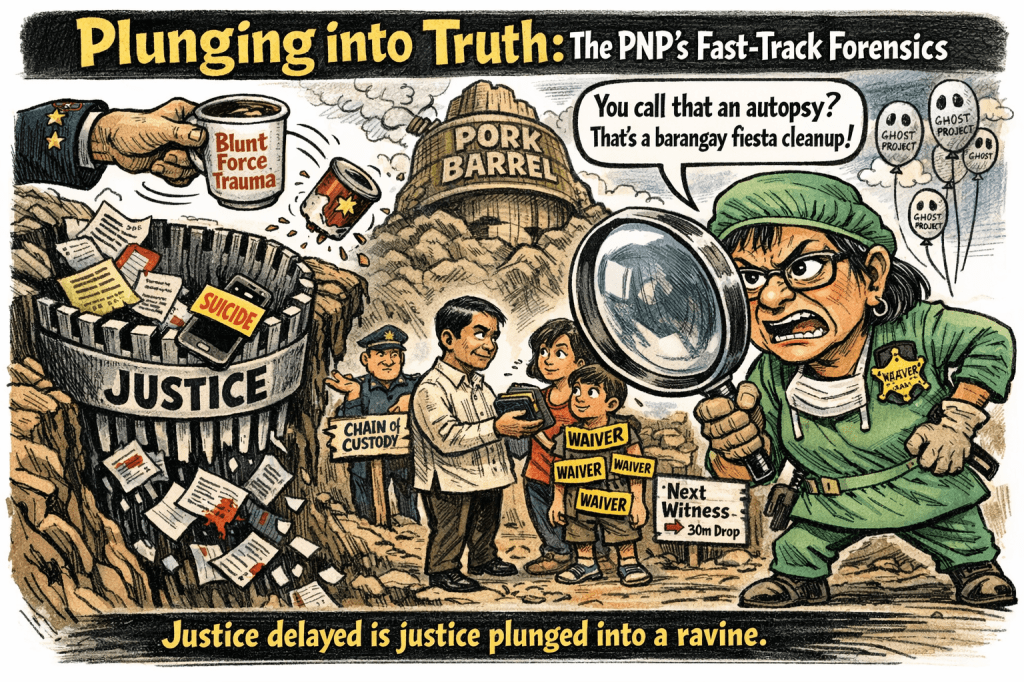
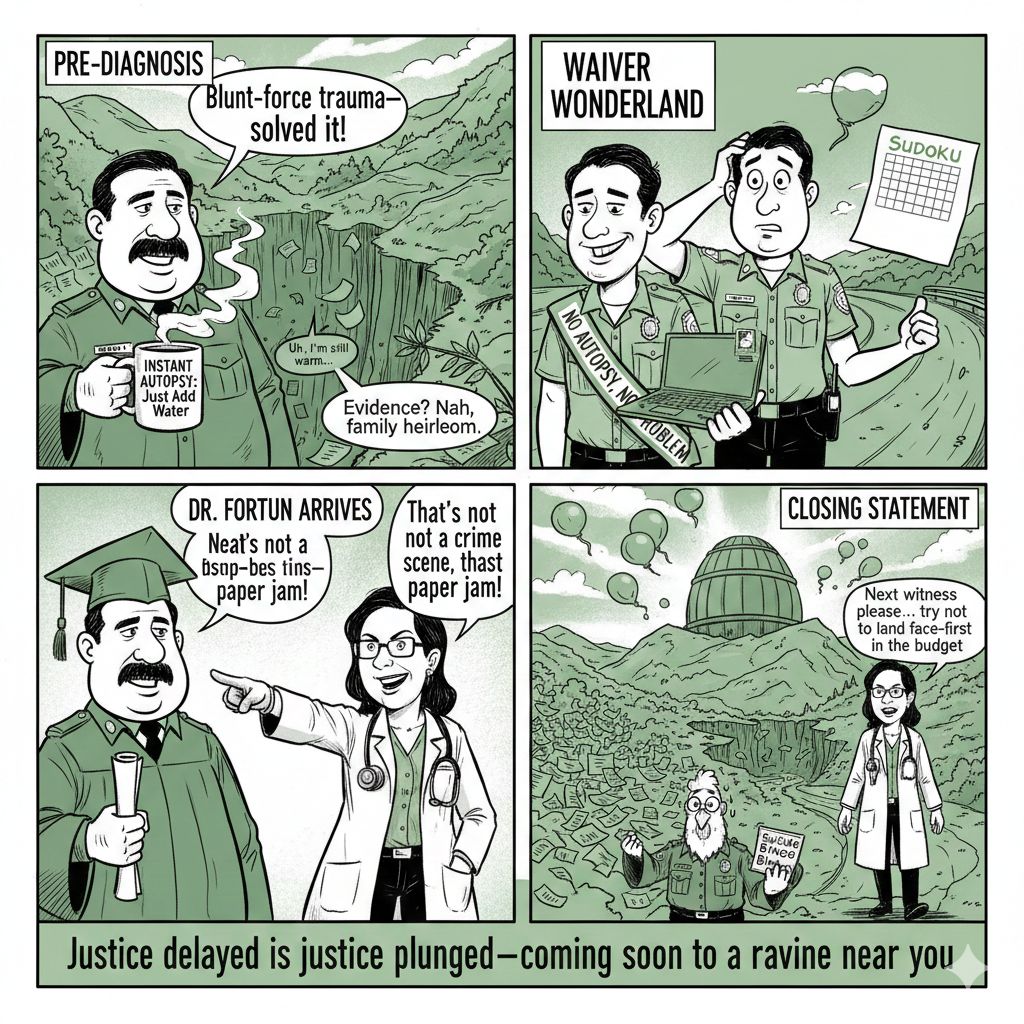
ONLY in the Philippines—where unnatural deaths of key corruption witnesses are handled with all the forensic rigor of a barangay fiesta cleanup crew. Former Department of Public Works and Highways (DPWH) Undersecretary Maria Catalina Cabral, a central figure in the swirling scandal over billions in allegedly anomalous flood control projects, plunges into a ravine along Kennon Road on December 18, 2025. By December 20, Department of the Interior and Local Government (DILG) Secretary Jonvic Remulla is already declaring “blunt force trauma consistent with the fall” as if he’s solved the case over coffee. And by Christmas week, the Philippine National Police (PNP) and DILG are confidently proclaiming suicide, no foul play detected.
Enter Dr. Raquel Fortun, one of the country’s only two recognized forensic pathologists, who proceeds to eviscerate this rush to judgment with surgical precision. Her critique exposes a comedy of errors so profound it borders on tragedy—one that not only undermines confidence in Cabral’s death investigation but threatens to torpedo the broader anti-corruption probe into the so-called Cabral Files.
Forensic Deconstruction: Dr. Fortun’s Damning Inventory of Lapses
Let’s start with the basics that even a rookie Scene of the Crime Operations (SOCO) team should know, yet somehow eluded the authorities here.
First, premature pronouncements. Remulla’s December 20 declaration of blunt force trauma came before a full autopsy. As Fortun dryly notes: “They’re saying … blunt force trauma—of course, she fell down. But that doesn’t answer everything.” Blunt trauma is what happens when a body meets rocks from 30 meters up. It tells us nothing about whether Cabral was alive when she fell (perimortem injuries, with vital reactions like bleeding) or already dead and dumped (postmortem injuries, no hemorrhage). Distinguishing the two is Forensic Pathology 101, yet authorities skipped class.
Second, the optional autopsy farce. Fortun insists autopsy “should be mandatory” in suspicious deaths, and “the family really cannot say no.” But in our benighted Republic, it’s optional because—why not?—the family signed a waiver. “Why is there even a waiver?” she asks, with the weary sarcasm of someone who’s fought this battle for decades. Even without a mandatory law, Presidential Decree No. 856 (Code on Sanitation of the Philippines)—the creaky 50-year-old decree—authorizes autopsies in mysterious or criminal cases. But standards? Competence? Forget it—Fortun questions whether those handling it “really know how to do an autopsy.”
Third, toxicology neglect. No tests to check if Cabral was under the influence—alcohol, drugs, or something administered to incapacitate her. Fortun explains: Rule out substances first, then weigh evidence for accident versus suicide versus homicide. Authorities later claimed she tested positive for antidepressants, but the initial omission speaks volumes about half-measures.
Fourth, chain of custody catastrophe. Cabral’s driver, Ricardo Hernandez—a person of interest—was allowed to hand her phone and belongings directly to the family immediately after body recovery. Police did nothing. This “blunder” (Remulla’s own word) led to the relief of the local police chief, but the damage was done. Fortun: “You have to separate property versus evidence… especially the phone, because you are deconstructing what could have happened to her.” The driver even gave unchecked media statements. In a case tied to potential digital evidence of graft, this is investigative malpractice.
Counter-arguments from authorities? They lean on family rights, cultural sensitivity, and “initial findings” showing no struggle, no skin under nails, no bullets. Fair enough in a straightforward case—but this death was anything but. The timing, the corruption probe, the driver’s unchallenged account—all scream for caution, not deference to waivers or haste.
Fortun’s arguments carry overwhelming scientific and procedural weight. Her counterpoints expose a system that prioritizes speed and optics over truth.
Mapping the Scandal’s Ecosystem: From Ravine to “Cabral Files”
Cabral wasn’t just any official; she was knee-deep in the DPWH flood control anomalies—alleged overpricing, ghost projects, and budget insertions worth billions. Reports speak of a “Leviste List” or Cabral Files, purportedly detailing proponents (lawmakers, executives, private individuals) behind dubious allocations, including one “ES” tied to P8.3 billion.
Her phone and devices were potential goldmines for the Office of the Ombudsman probe. Yet by letting them slip into family hands first, police created a broken chain of custody that could render any recovered data inadmissible in court. Supreme Court precedents demand unbroken links; any tampering window dooms prosecution.
Rumors flourish in this vacuum: witness silencing, evidence tampering, even faked death theories (echoing past cases where officials vanished to evade liability). Some speculate the driver was coerced or complicit. Plausibility? High, given the botched handling and timing—just as probes heated up. Origins? Public distrust bred by the very lapses Fortun flagged. When authorities treat a scene like a family heirloom handover, conspiracy theories aren’t paranoia—they’re logical fallout.
The forensic failures don’t just cloud Cabral’s death; they poison the graft investigation. Compromised digital evidence weakens cases under Republic Act No. 3019 (Anti-Graft and Corrupt Practices Act) and Republic Act No. 7080 (An Act Defining and Penalizing the Crime of Plunder), where documentary proof is king.
Pathways and Consequences: Where Law Meets Incompetence
Prosecution Pathways:
- Suicide Confirmed: Death doesn’t extinguish liability. The Office of the Ombudsman can pursue civil forfeiture of ill-gotten assets from Cabral’s estate under provisions of RA 3019 and RA 7080.
- Homicide Suspected: Revised Penal Code articles (e.g., murder/homicide) kick in if perimortem discrepancies or scene evidence (drag marks, push points) emerge. Conspiracy charges possible if third-party involvement proven.
- Obstruction: Mishandling officials face administrative/criminal liability; family or others concealing evidence risk obstruction charges.
Government Handling Critique:
The PNP and DILG’s performance is a masterclass in self-sabotage—relieving one chief is theater when systemic rot (no mandatory standards, outdated PD 856) persists. Remulla’s early declarations and deference to waivers reek of damage control.
Recommendations for Salvage:
- Immediate full toxicology, digital forensics on recovered devices, and scene reconstruction (Fortun’s offer to autopsy at the University of the Philippines should have been taken).
- Enact a Death Investigation Act mandating autopsies in unnatural/suspicious deaths, eliminating waivers in high-profile cases.
- Establish the long-proposed National Forensic Institute for standardized, independent expertise.
- Strengthen PNP protocols on evidence custody and media control for persons of interest.
Scenario Impacts:
| Scenario | Outcome on Death Probe | Impact on Corruption Probe | Broader Consequences |
|---|---|---|---|
| Suicide Confirmed | Closure with antidepressants, notes | Continues via alternative evidence; chilling effect on witnesses | Eroded trust; slowed anti-graft momentum |
| Homicide Uncovered | Criminal charges; political explosion | Bolstered if silencing proven | Crisis of confidence; potential impeachments |
| Evidence Compromised | Inconclusive; rumors perpetual | Cases weakened/admissibility challenges | Public cynicism; impunity reinforced |
Any resolution favoring incompetence erodes public trust, shields grafters, and destabilizes anti-corruption efforts.
A Call for Justice: No More Ravines, No More Waivers
This case is a microcosm of Philippine justice: competent voices like Fortun ignored, procedural shortcuts taken, powerful interests potentially protected. We cannot let Cabral’s death—suicide or otherwise—bury the truth about billions looted from flood control funds meant to save lives.
Demand transparency: Release full forensic reports.
Demand accountability: Probe the probers.
Demand reform: Mandatory autopsies, independent forensics—now.
Because if we don’t, the next witness might find the ravine even more inviting. Justice for Cabral isn’t charity; it’s the bare minimum for a nation drowning in its own corruption.
Barok out.
Justice delayed is justice plunged into a ravine.
Key Citations
- Cabral, Maria Catalina. “Forensic Expert Lists Lapses in Catalina Cabral Case.” Philippine Daily Inquirer, 25 Dec. 2025, https://newsinfo.inquirer.net/2158936/forensic-expert-lists-lapses-in-cabral-case. Accessed 29 Dec. 2025.
- Republic Act No. 3019. Anti-Graft and Corrupt Practices Act. Official Gazette of the Republic of the Philippines, 17 Aug. 1960, https://www.officialgazette.gov.ph/1960/08/17/republic-act-no-3019/.
- Republic Act No. 7080. An Act Defining and Penalizing the Crime of Plunder. Official Gazette of the Republic of the Philippines, 12 July 1991, https://www.officialgazette.gov.ph/1991/07/12/republic-act-no-7080/.
- Presidential Decree No. 856. Code on Sanitation of the Philippines. Supreme Court E-Library, 23 Dec. 1975, https://elibrary.judiciary.gov.ph/thebookshelf/showdocs/26/15313.
- Act No. 3815. The Revised Penal Code. Official Gazette of the Republic of the Philippines, 8 Dec. 1930, https://www.officialgazette.gov.ph/1930/12/08/act-no-3815-s-1930/.
- “Forthwith” to Farce: How the Senate is Killing Impeachment—And Why Enrile’s Right (Even If You Can’t Trust Him)
- “HINDI AKO NAG-RESIGN!”

- “I’m calling you from my new Globe SIM. Send load!”

- “Mahiya Naman Kayo!” Marcos’ Anti-Corruption Vow Faces a Flood of Doubt

- “Meow, I’m calling you from my new Globe SIM!”

- “No Special Jail for Crooks!” Boying Remulla Slams VIP Perks for Flood Scammers
- “PLUNDER IS OVERRATED”? TRY AGAIN — IT’S A CALCULATED KILL SHOT

- “Several Lifetimes,” Said Fajardo — Translation: “I’m Not Spending Even One More Day on This Circus”

- “Shimenet”: The Term That Broke the Internet and the Budget

- “We Did Not Yield”: Marcos’s Stand and the Soul of Filipino Sovereignty

- “We Gather Light to Scatter”: A Tribute to Edgardo Bautista Espiritu

- $150M for Kaufman to Spin a Sinking Narrative


 KWEBA ni BAROK
Leave a comment