
The Magical Guarantee Letter: Your VIP Pass to Taxpayer-Funded Mercy
By Louis ‘Barok‘ C. Biraogo — December 31, 2025
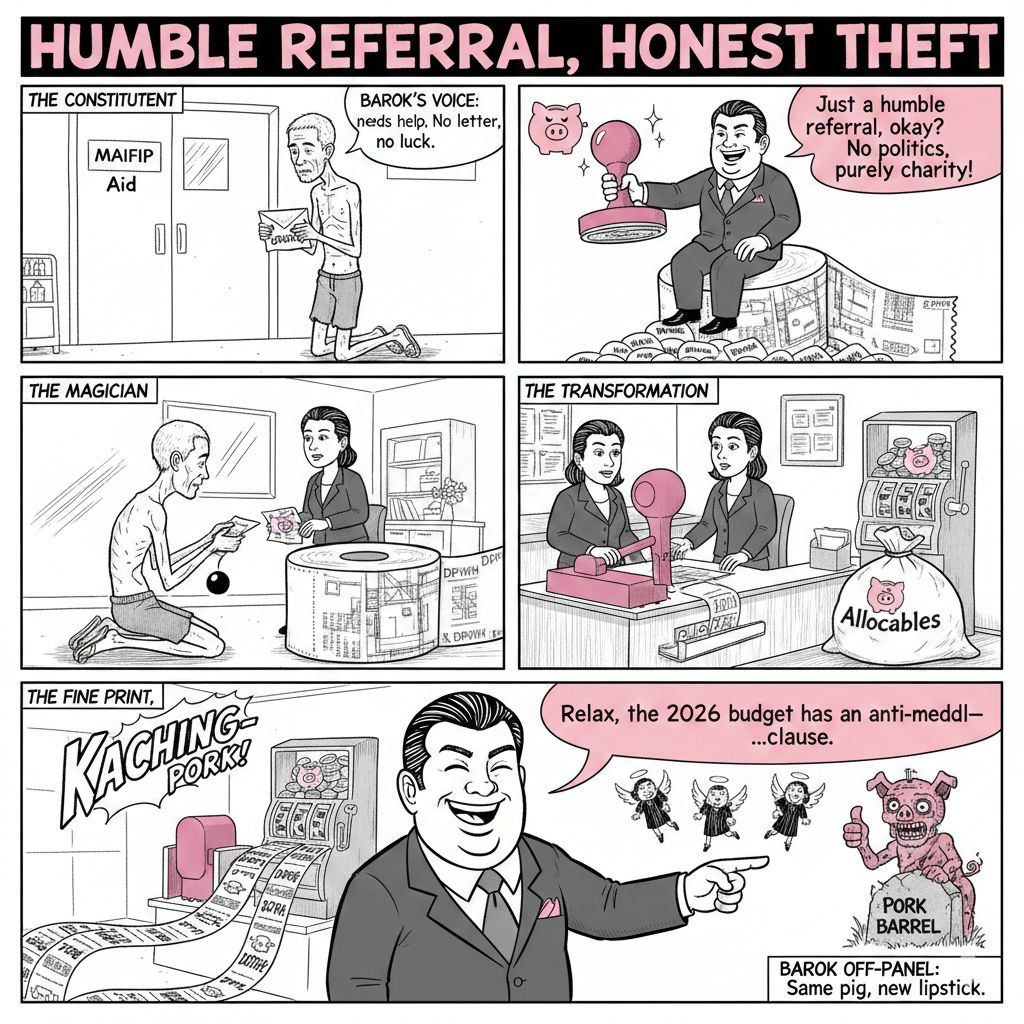
NAKS, the timeless art of Philippine political theater. Just when you think the Supreme Court buried the pork barrel system in 2013 with its landmark ruling in Belgica v. Ochoa, along comes Deputy Speaker Ronaldo Puno, waving his “guarantee letters” like a magician pulling rabbits from a hat. These aren’t political interventions, he insists with a straight face—they’re just “humble referral letters,” assurances that a poor constituent is truly deserving of government aid. And those mysterious Department of Public Works and Highways (DPWH) “allocables”? Mere oversight tools, nothing to see here. All this while the 2026 national budget quietly slips in a clause banning political meddling in aid distribution. How convenient. Welcome to Epal Governance 101, where public funds become personal favors, and lawmakers play Voucher-in-Chief.
Puno’s defense is a masterclass in deflection. Lawmakers, he says, are glorified bureaucratic pen pals: “We don’t pay for anything—we just refer and recommend.” The guarantee letter? Not his money on the line, just a polite note vouching that the patient or crisis victim is “qualified.” Masama ba ‘yun? (Is that wrong?) he asks innocently. And those DPWH allocables—pre-set pots of money for lawmaker-recommended projects? Perfectly normal consultation, he claims, because district engineers need congressional input to “verify” local needs. The money stays with DPWH, they have the “final say” (GMA News Online, 29 Dec. 2025). Nothing irregular, folks—just move along. It’s like calling a backdoor kickback scheme a “consultancy fee.” These letters aren’t harmless hall passes; they’re magic tickets to faster aid, turning objective public assistance into a politician’s discretionary gift. Why else would hospitals and agencies prioritize them if not for the implied clout?
But let’s eviscerate this narrative with actual law, because satire writes itself when the facts are this damning.
Pillar 1: The Constitutional and Supreme Court Smackdown
Remember Belgica v. Ochoa (2013)? The Supreme Court didn’t just strike down the Priority Development Assistance Fund (PDAF)—it outlawed the entire Congressional Pork Barrel System for allowing legislators post-enactment intervention in budget execution. Congress appropriates; the Executive implements. Any lawmaker meddling in project identification, fund release, or beneficiary selection post-General Appropriations Act (GAA) enactment? Unconstitutional violation of separation of powers.
Puno’s “referrals” and DPWH “allocables” are PDAF in disguise. Steering specific beneficiaries to Medical Assistance to Indigent and Financially Incapacitated Patients (MAIFIP) funds or recommending projects for those pre-allocated pots? That’s textbook post-enactment authority—the very evil Belgica banned. How is vouching for “qualified” patients not selecting beneficiaries? How is collating lawmaker recommendations for DPWH budgets not identifying projects? It’s resurrection of the dead pork, zombie-style.
Layer on the 1987 Philippine Constitution: Article II, Section 27 demands honesty and integrity in public service, with measures against graft. Article XIII prioritizes social justice and equitable access to services. Turning healthcare or crisis aid into political favors—where constituents beg lawmakers for letters—violates human dignity and equal protection. Public aid should be a right, not a patron’s bounty.
Pillar 2: The Anti-Graft Lawfare
Enter Republic Act No. 3019 (Anti-Graft and Corrupt Practices Act). Section 3(e): It’s unlawful for public officials to cause undue injury or give “unwarranted benefits, advantage, or preference” through manifest partiality, bad faith, or negligence.
Guarantee letters scream partiality. Why does a politician’s vouch accelerate processing or unlock funds when agencies have objective guidelines? It creates preferential queues: allies and loyal districts first, opposition or unaffiliated last. Rumors persist of aid weaponized—flooded into administration strongholds, withheld from critics.
And those “allocables”? A deniable kickback pipeline, eroding DPWH’s technical mandate. Enter the “Cabral Files”—documents from the late Undersecretary Maria Catalina Cabral’s office, allegedly detailing billions in pre-partitioned infrastructure for lawmakers and even Cabinet officials (including a mysterious “ES” with P8.3 billion). Puno dismisses them as routine consultation, but critics see a shadow system ripe for commissions. Perfect ecosystem: lawmakers recommend, contractors bid favorably, everyone wins—except taxpayers.
Pillar 3: The Policy Hypocrisy
The Universal Health Care Act (Republic Act No. 11223) promises automatic, institutionalized coverage via Philippine Health Insurance Corporation (PhilHealth)—no political middlemen needed. Yet MAIFIP, bloated despite the ban, relies on these letters, undermining universal health care and turning healthcare into a “beggar’s right.”
If Department of Social Welfare and Development (DSWD), Department of Health (DOH), and DPWH have clear eligibility rules, why the congressional “vouch”? Efficiency? Please. It’s control—monetizing misery for votes. Critics like health experts and Church leaders call it patronage pure: aid tied to epal credits, not need.
This isn’t isolated. It’s systemic: the Cabral Files scandal, allegations of P2 million “Christmas bonuses” per congressman to secure budget votes (denied, of course), selective aid distribution punishing opposition districts. Symptoms of the same disease—a machinery monetizing public funds for power.
Enough mockery. Time for razor-sharp reforms:
- Enforce the 2026 budget’s anti-political involvement clause absolutely—no exceptions, with automatic sanctions for violators, including administrative and criminal liability.
- Demand the Office of the Ombudsman (under Republic Act No. 6770, the Ombudsman Act of 1989) and Department of Justice (DOJ) subpoena and forensic-examine all Cabral Files immediately. Expose the allocables pipeline, prosecute manipulators, recover ill-gotten gains.
- Amend the Universal Health Care Law: Phase out MAIFIP entirely, absorb funds into depoliticized PhilHealth with automatic enrollment and zero political referrals.
- Broader: Ban all post-enactment lawmaker interventions, align strictly with Belgica, and mandate transparent, dashboard-tracked aid distribution.
The Rule of Law isn’t optional—it’s the antidote to this legalized corruption. If we let “humble referrals” slide, we’re complicit in perpetuating a system where public service means private gain. Time to bury the pork—for good.
Yours in perpetual vigilance against legalized thievery,
–Barok
Key Citations
- Panti, Llanesca T. “Guarantee Letters Vouch for Those in Need, Not Political Intervention — Rep. Puno.” GMA News Online, 29 Dec. 2025.
- “Belgica v. Executive Secretary Paquito N. Ochoa, Jr., et al.” Supreme Court of the Philippines, G.R. No. 208566, 19 Nov. 2013, LawPhil Project.
- The 1987 Constitution of the Republic of the Philippines. Official Gazette of the Republic of the Philippines.
- Republic Act No. 3019: Anti-Graft and Corrupt Practices Act. Official Gazette of the Republic of the Philippines, 17 Aug. 1960.
- Republic Act No. 6770: An Act Providing for the Functional and Structural Organization of the Office of the Ombudsman, and for Other Purposes. The LawPhil Project, 17 Nov. 1989.
- Republic Act No. 11223: An Act Instituting Universal Health Care for All Filipinos, Prescribing Reforms in the Health Care System, and Appropriating Funds Therefor. Official Gazette of the Republic of the Philippines, 20 Feb. 2019.
- Philippines. Batasang Pambansa. Batas Pambansa Blg. 881: Omnibus Election Code of the Philippines. 3 Dec. 1985. Official Gazette of the Republic of the Philippines.
- 2004 Rules on Notarial Practice (A.M. No. 02-8-13-SC). Supreme Court of the Philippines, 6 July 2004.

 KWEBA ni BAROK
Leave a comment