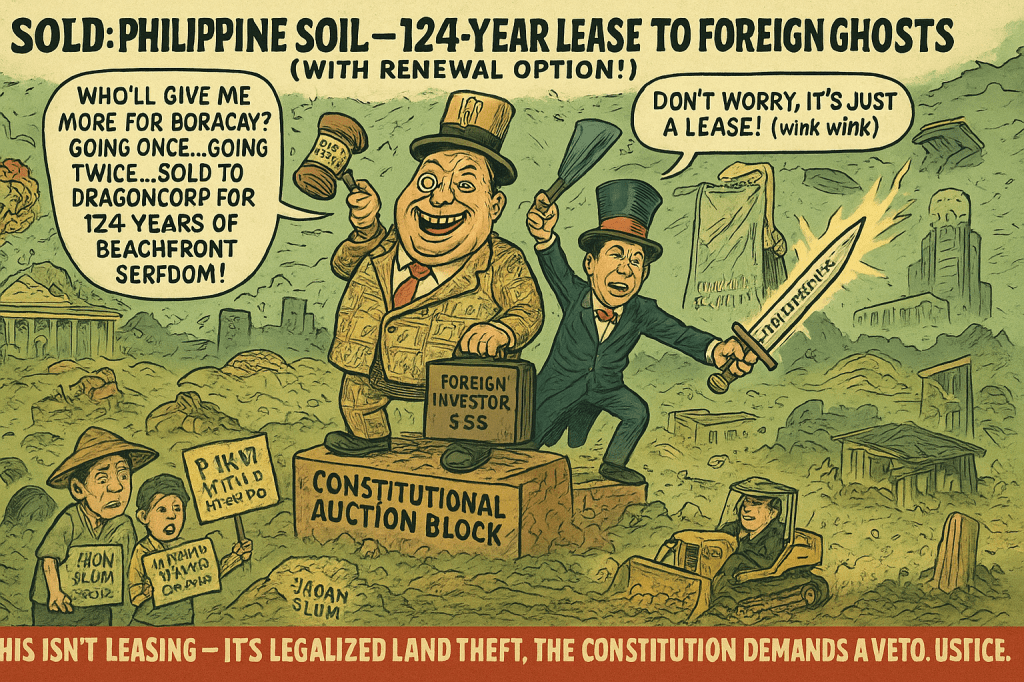
124 Years of Foreign Control Proves Congress Cares More About Cash Than Country
By Louis ‘Barok‘ C. Biraogo — January 3, 2026
A Nation Betrayed by Its Own Laws
On September 3, 2025, President Marcos Jr. signed Republic Act No. 12252 (Amended Investors’ Lease Act), a law that doesn’t just tweak its predecessor—it spits in the face of the 1987 Constitution. By granting foreigners a 99-year land lease, with a potential 25-year cherry on top, this legislative sleaze hands our national patrimony to foreign investors on a silver platter. It’s not progress; it’s a constitutional crisis dressed up as an economic win. The Supreme Court, armed with ironclad precedent, has a duty to shred this farce before our land becomes a foreign fiefdom.
The Great Land Swindle: 124 Years of Foreign Control
Let’s call Republic Act No. 12252 (Amended Investors’ Lease Act) what it is: a con. Its predecessor, Republic Act No. 7652 (Investors’ Lease Act of 1993), allowed foreigners to lease private land for 50 years, renewable for 25 more—75 years total. That was already a constitutional tightrope, tiptoeing around Article XII, Section 7 of the 1987 Constitution, which bans alien land ownership outright. But RA 12252 goes full rogue, extending leases to 99 years, with a one-time 25-year renewal—a staggering 124 years. This isn’t a lease; it’s de facto ownership, a middle finger to the Constitution’s prohibition on foreigners holding our soil.
A 124-year term outlives two Filipino generations. It’s not a temporary arrangement—it’s perpetual control, a mockery of the constitutional mandate that reserves land for Filipino citizens and 60% Filipino-owned corporations. Proponents will whine that it’s “just a lease,” but when the term spans a century-plus, that’s a distinction without a difference. This is a legislative shell game, and our national patrimony is the prize.
The Luminary’s Battle Cry: A Constitutional Titan Calls Out Congress
Our legal luminary, arguably one of the country’s sharpest constitutional minds, nails it: RA 12252 is a “blatant attempt to circumvent” the Constitution’s ban on alien land ownership. This isn’t just any voice—our luminary, a constitutional titan, has fought shoulder-to-shoulder with me in countless Supreme Court battles, wielding our legal might to shield the Constitution from assaults. From challenging dubious laws to exposing governmental overreach, this titan has seen it all, and our verdict on RA 12252 carries the weight of battle-tested expertise. The Supreme Court will obliterate RA 12252, not out of spite but because it’s tasked with slapping down Congress’s constitutional overreach. The luminary’s quip about the Court wanting to “get even” sounds like tabloid fodder, but this isn’t about revenge—it’s about upholding Article VIII, Section 1 to ensure lawmakers don’t pawn our land for foreign cash.
Precedents That Pack a Punch: Krivenko, Gamboa, and the Ban Hammer
The Supreme Court has a legal arsenal to obliterate RA 12252, and it starts with Krivenko v. Register of Deeds (1947). This isn’t just precedent; it’s the holy grail of land sovereignty. The Court ruled that aliens can’t own land, not even through arrangements granting “permanent or indefinite possession.” A 124-year lease? That’s indefinite possession with a capital “I.” Krivenko doesn’t just whisper; it screams that RA 12252 is unconstitutional.
Next up, Gamboa v. Teves (2011) shows the Court’s no-nonsense approach to economic provisions. The justices struck down corporate layering that diluted Filipino control in public utilities, embracing “strict legalism” under Article XII. If the Court saw through equity shenanigans, it won’t blink at temporal ones. A 124-year lease is just ownership stretched over time, and Gamboa’s logic demands its demise.
The final nail? The doctrine of indirect violation: “What cannot be done directly cannot be done indirectly.” This maxim, wielded in Lao Ichong v. Hernandez (1957) and Alvarez v. PICOP Resources (2011), is a constitutional sledgehammer. RA 12252’s century-long lease is a textbook dodge, handing foreigners what the Constitution explicitly denies. The Court doesn’t just have the tools to kill this law; it has a duty to swing.
The Poor Get Screwed: A New Feudal Nightmare
RA 12252 isn’t just a legal travesty; it’s a betrayal of the Filipino poor. Republic Act No. 6657 (Comprehensive Agrarian Reform Law of 1988) promised land to farmers, a hard-fought win for the rural destitute. But what’s the point if those farmers, scraping by on ₱12,000 a month (PSA, 2023), are pressured to lease their ancestral lands to foreign corporations for 124 years? These aren’t savvy dealmakers; they’re desperate folks who’ll sign predatory contracts, turning their birthright into corporate fiefdoms. The result? A new feudal order where Filipinos are serfs on their own soil.
Urban poor fare no better. Informal settlers—20% of Manila’s population—face eviction as foreign-funded resorts and condos gobble up land. The Court in Maceda v. Vasquez (1993) shielded settlers from arbitrary displacement, but RA 12252 greenlights legal land grabs. And what about national security? Leases near Subic or Clark could fall to Chinese state-backed firms, especially amid West Philippine Sea tensions. Food security? Forget it—17 million Filipinos are food-poor (PSA, 2023), and handing prime farmland to foreigners for a century risks starvation for profit. This law doesn’t just mock the Constitution; it mocks the “common good” it’s supposed to protect (Article XII, Section 10).
Battle Plan: Torch This Law Before It Burns Us
RA 12252 isn’t a policy; it’s a constitutional crime. Here’s how to stop it:
- Storm the Supreme Court: Any citizen—farmers, indigenous groups, urban poor—must file a Rule 65 certiorari petition now. David v. Macapagal-Arroyo (2006) proves the Court will hear cases tied to national interest. Don’t wait for the first 99-year lease to scar our land.
- Congress, Repeal or Veto This Trash: Lawmakers, grow a backbone and repeal RA 12252. If not, President Marcos Jr. must veto its implementation pending judicial review. His “national security” clause is a paper tiger—use it or admit you’re complicit.
- Expose the Corporate Puppets: Who rammed this through? Which lawmakers got fat checks from real estate tycoons or foreign chambers? Demand transparency under Republic Act No. 6713 (Code of Conduct and Ethical Standards for Public Officials and Employees). Name the culprits, trace the cash, and let the people judge.
RA 12252 is a sellout, a shameless dodge of our Constitution’s heart. The Supreme Court must act as its guardian, not Congress’s lackey. This law isn’t progress—it’s a betrayal of every Filipino who calls this land home. Strike it down, justices, or watch our patrimony vanish for a century. The clock’s ticking.
Key Citations
- News Report on RA 12252: Philippine News Agency, September 5, 2025. Details the signing and provisions of Republic Act No. 12252 (Amended Investors’ Lease Act).
- 1987 Philippine Constitution: Official Gazette. Article XII, Section 7 bans alien land ownership; Section 10 promotes equitable wealth distribution.
- Republic Act No. 7652 (Investors’ Lease Act of 1993): Official Gazette, June 4, 1993. Permits 50+25-year leases for foreign investors.
- Republic Act No. 6657 (Comprehensive Agrarian Reform Law of 1988): Official Gazette, June 10, 1988. Outlines land redistribution for farmers.
- Republic Act No. 6713 (Code of Conduct and Ethical Standards for Public Officials and Employees): Official Gazette, February 20, 1989. Mandates transparency and ethical governance.
- Krivenko v. Register of Deeds (1947): LawPhil, G.R. No. L-630. Prohibits alien land ownership, including indefinite possession.
- Gamboa v. Teves (2011): LawPhil, G.R. No. 176579. Enforces strict legalism in economic provisions.
- Lao Ichong v. Hernandez (1957): LawPhil, G.R. No. L-7995. Establishes the doctrine of indirect violation.
- Alvarez v. PICOP Resources (2011): LawPhil, G.R. No. 162243. Reinforces prohibition on indirect constitutional evasion.
- Lambino v. Comelec (2006): LawPhil, G.R. No. 174153. Demonstrates judicial check on legislative overreach.
- David v. Macapagal-Arroyo (2006): LawPhil, G.R. No. 171396. Affirms locus standi for citizens in national interest cases.
- Maceda v. Vasquez (1993): LawPhil, G.R. No. 102781. Protects informal settlers from arbitrary eviction.
- Philippine Statistics Authority (PSA) 2023 Poverty Data: PSA, 2023. Reports 18% poverty rate and 17 million food-poor Filipinos.
- West Philippine Sea Tensions: Reuters, December 10, 2023. Highlights geopolitical risks of foreign land control.




 KWEBA ni BAROK
Leave a comment