
From Guaranteed Pay to Ghost Funding: How Lawmakers Made Civil Servants the Collateral Damage of Pork 2.0
By Louis ‘Barok‘ C. Biraogo — January 4, 2026
LADIES and gentlemen of the jury—otherwise known as the long-suffering Filipino taxpayers—gather ’round while I expose the latest parlor trick pulled off in the smoke-filled backrooms of the Bicameral Conference Committee (Bicam). In a move smoother than a pickpocket in Quiapo, our esteemed solons decided to vanish P43.24 billion meant for the salaries, upgrades, retirement benefits, and terminal leave of government employees… only to make it reappear, like a bad magic act, under the heading “For Payment of Personnel Services Requirements” in the Unprogrammed Appropriations (UA).
Poof! Gone from the guaranteed, programmed budget. Abracadabra! Now it’s a “standby” fund that only materializes if the government somehow stumbles into excess revenue. As Rep. Antonio Tinio so aptly put it, this is a “brutal betrayal” of civil servants. I call it fiscal sleight-of-hand worthy of a carnival hustler—except the marks here are teachers, soldiers, cops, and retirees who actually keep this country running.
And who orchestrated this illusion? None other than the House contingent led by Rep. Mikaela Suansing, chairperson of the Appropriations Committee, who insists the whole thing is just prudent “fiscal flexibility.” Flexibility? Madam, the only thing flexible here is your spine when it comes to defending the indefensible.
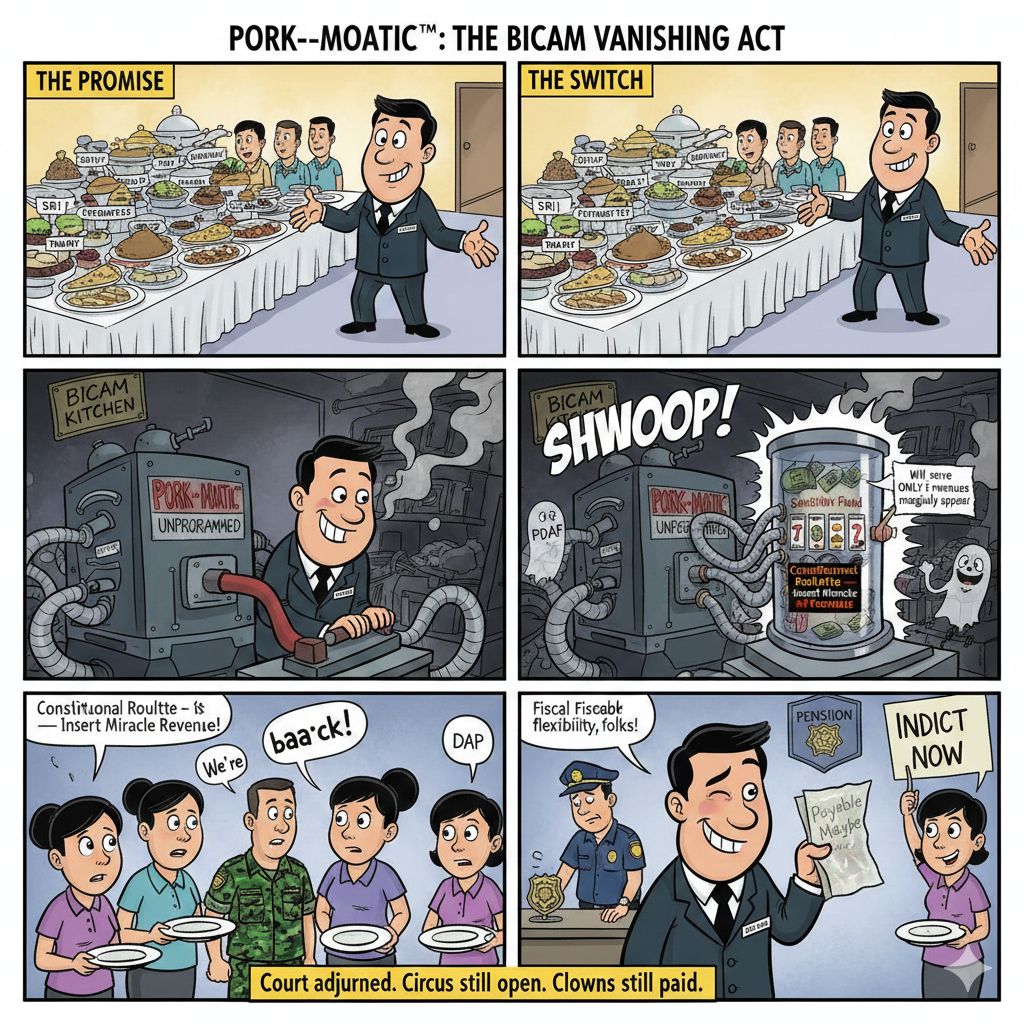
Constitutional Roulette: Betting Against Article VI
Let us consult the highest law of the land, the 1987 Philippine Constitution, Article VI, shall we? Section 24: All appropriation bills shall originate exclusively in the House. Section 25: No provision unrelated to an appropriation, and Congress may not increase the President’s proposed budget. Section 29: No money shall be paid out of the Treasury except in pursuance of an appropriation made by law.
Now tell me, dear lawmakers: how does moving guaranteed personnel emoluments—protected under the civil service provisions of the Constitution—into a contingent, discretionary slush fund square with the specificity doctrine? How does it not violate the Power of the Purse when you create a new P43.24 billion line item that existed in neither the House nor Senate versions, only to birth it in the secrecy of the bicam?
This isn’t budgeting. This is constitutional roulette, spinning the wheel and hoping the ball doesn’t land on “Supreme Court strikes down entire General Appropriations Act (GAA).”
The Ghost of PDAF Past: How Unprogrammed Funds Became the New Pork
Remember Belgica v. Ochoa (G.R. No. 208566, 2013)? The Supreme Court eviscerated the Priority Development Assistance Fund (PDAF) for being a lump-sum, post-enactment discretionary playground that allowed legislators to play Santa with public money. Then came Araullo v. Aquino (G.R. No. 209287, 2014), which buried the Disbursement Acceleration Program (DAP) for the same mortal sin: moving funds around without clear legislative intent.
And yet here we are, watching Congress resurrect the undead in the form of Unprogrammed Appropriations—P243 billion worth of “standby” funds that the executive can release at its pleasure once revenue magically appears. The P43.24 billion personnel item is just the latest zombie limb grafted onto this monster. It’s PDAF with better PR: same opacity, same risk of abuse, same potential for flood control “projects” that exist only on paper while contractors laugh all the way to the bank.
Tinio vs. Suansing: The Prophet vs. The Bookkeeper in a Theater of the Absurd
On one side stands Rep. Antonio Tinio, the Cassandra of the minority, warning that this maneuver turns guaranteed salaries into a Vegas bet. He points to the 2025 Service Recognition Incentive (SRI) fiasco—where government employees got prorated bonuses because funds were “insufficient”—as dress rehearsal. His argument is simple, moral, and devastating: you do not gamble with the livelihoods of people who serve the public.
On the other side, Rep. Mikaela Suansing, guardian of the ledger, assures us the budget is “people-centered” and unprogrammed funds are merely prudent contingencies. Standby funds for salaries? Madam, the only contingency here is whether teachers will get paid on time or have to wait for some miraculous revenue windfall. And while we’re at it, perhaps you could explain the rumors swirling around “incentives,” “allocables,” and those mysterious “Cabral files” that allegedly document insertions? Or shall we just take your word that everything was above board while the Local Government Support Fund ballooned by tens of billions?
Pathways to Prison: A Prosecutor’s Shopping List
Let’s talk consequences, because someone must.
- Republic Act No. 3019 (Anti-Graft and Corrupt Practices Act): Causing undue injury to government employees by rendering their benefits uncertain while potentially freeing up funds for political patronage? Check.
- Administrative misconduct under the Code of Conduct and Ethical Standards for Public Officials and Employees (Republic Act No. 6713): Lack of transparency, possible conflict of interest, failure to be responsive to public need? Double check.
- Plunder (Republic Act No. 7080): If this P43 billion shuffle is linked to the ongoing flood control ghost projects and overpriced contracts, we’re no longer talking ethics complaints—we’re talking orange jumpsuits.
The Office of the Ombudsman, empowered under Republic Act No. 6770 (The Ombudsman Act of 1989), should open an investigation tomorrow. The Commission on Audit (COA) should dissect every insertion. The House Ethics Committee should haul in Suansing and company to explain the incentives and the midnight line items. And if the “Cabral files” are real, release them to the public—now.
The Human Cost: Not Numbers, But Lives on the Line
This is not an accounting exercise. These are teachers who won’t get salary upgrades. Soldiers and cops whose retirement benefits hang on revenue projections. Veterans wondering if their pensions will arrive. We already saw the preview in 2025 when the SRI was sliced because funds were “constrained.” Do it again, Congress, and watch morale in the civil service collapse faster than a flood control dike built by your favorite contractor.
The President’s Choice: Sign, Veto, or Become an Accomplice
President Marcos has until January 5. The options are clear, as upheld in Philconsa v. Enriquez (G.R. No. 113105, 1994):
- Sign the bill as is and own this betrayal.
- Exercise the line-item veto and strike the entire unprogrammed appropriations or at least this treacherous P43.24 billion item.
- Let it lapse into reenactment and force Congress back to the table.
Anything less than a veto makes the Palace complicit in turning the national budget into a discretionary piggy bank.
Verdict: Indictments, Injunctions, and Overhaul—Now
This is not policy disagreement. This is institutional betrayal dressed up as fiscal prudence.
I call for:
- Immediate investigation by the Ombudsman, COA, and House Ethics Committee into the bicam insertions, incentives, and the entire unprogrammed fund mechanism.
- Full transparency: Release every page of the bicam deliberations, the so-called Cabral files, and all documentation of insertions.
- Supreme Court intervention: Let petitioners—lawmakers, unions, civil society—challenge the constitutionality of this P43.24 billion shift and the unprogrammed appropriations framework itself. The ghosts of PDAF and DAP demand it.
- Structural reform: Abolish or radically restrict unprogrammed funds. Require line-item specificity for every peso. Ban contingent appropriations for mandatory personnel benefits. Pass a real Budget Reform Act that closes this loophole forever.
The law is supposed to protect the people, not enable the powerful to pick their pockets in the dark.
The courtroom of public opinion is now in session.
Let the indictments begin.
Court adjourned. The circus tents stay up, and the clowns keep their salaries.
Your resident cave-dweller,
—Barok
Key Citations
- “’Uncertain pay’: P43B for gov’t salaries, benefits moved to unprogrammed funds in 2026.” Philstar.com, 2 Jan. 2026.
- Philippines. The 1987 Constitution of the Republic of the Philippines, Article VI. Official Gazette of the Republic of the Philippines.
- Republic Act No. 3019 (Anti-Graft and Corrupt Practices Act). Official Gazette of the Republic of the Philippines, 17 Aug. 1960.
- Republic Act No. 6713 (Code of Conduct and Ethical Standards for Public Officials and Employees). Official Gazette of the Republic of the Philippines, 20 Feb. 1989.
- Republic Act No. 6770 (The Ombudsman Act of 1989). Official Gazette of the Republic of the Philippines, 17 Nov. 1989.
- Republic Act No. 7080 (An Act Defining and Penalizing the Crime of Plunder). Official Gazette of the Republic of the Philippines, 12 July 1991.
- Belgica v. Ochoa, G.R. No. 208566, Supreme Court of the Philippines, 19 Nov. 2013, LawPhil Project.
- Araullo v. Aquino, G.R. No. 209287, Supreme Court of the Philippines, 1 July 2014.
- Philippine Constitution Association v. Enriquez, G.R. No. 113105, Supreme Court of the Philippines, 19 Aug. 1994, LawPhil Project.

- “Forthwith” to Farce: How the Senate is Killing Impeachment—And Why Enrile’s Right (Even If You Can’t Trust Him)
- “HINDI AKO NAG-RESIGN!”

- “I’m calling you from my new Globe SIM. Send load!”

- “Mahiya Naman Kayo!” Marcos’ Anti-Corruption Vow Faces a Flood of Doubt

- “Meow, I’m calling you from my new Globe SIM!”

- “No Special Jail for Crooks!” Boying Remulla Slams VIP Perks for Flood Scammers

- “PLUNDER IS OVERRATED”? TRY AGAIN — IT’S A CALCULATED KILL SHOT

- “Several Lifetimes,” Said Fajardo — Translation: “I’m Not Spending Even One More Day on This Circus”

- “Shimenet”: The Term That Broke the Internet and the Budget

- “We Did Not Yield”: Marcos’s Stand and the Soul of Filipino Sovereignty

- “We Gather Light to Scatter”: A Tribute to Edgardo Bautista Espiritu

- $150M for Kaufman to Spin a Sinking Narrative




 KWEBA ni BAROK
Leave a comment