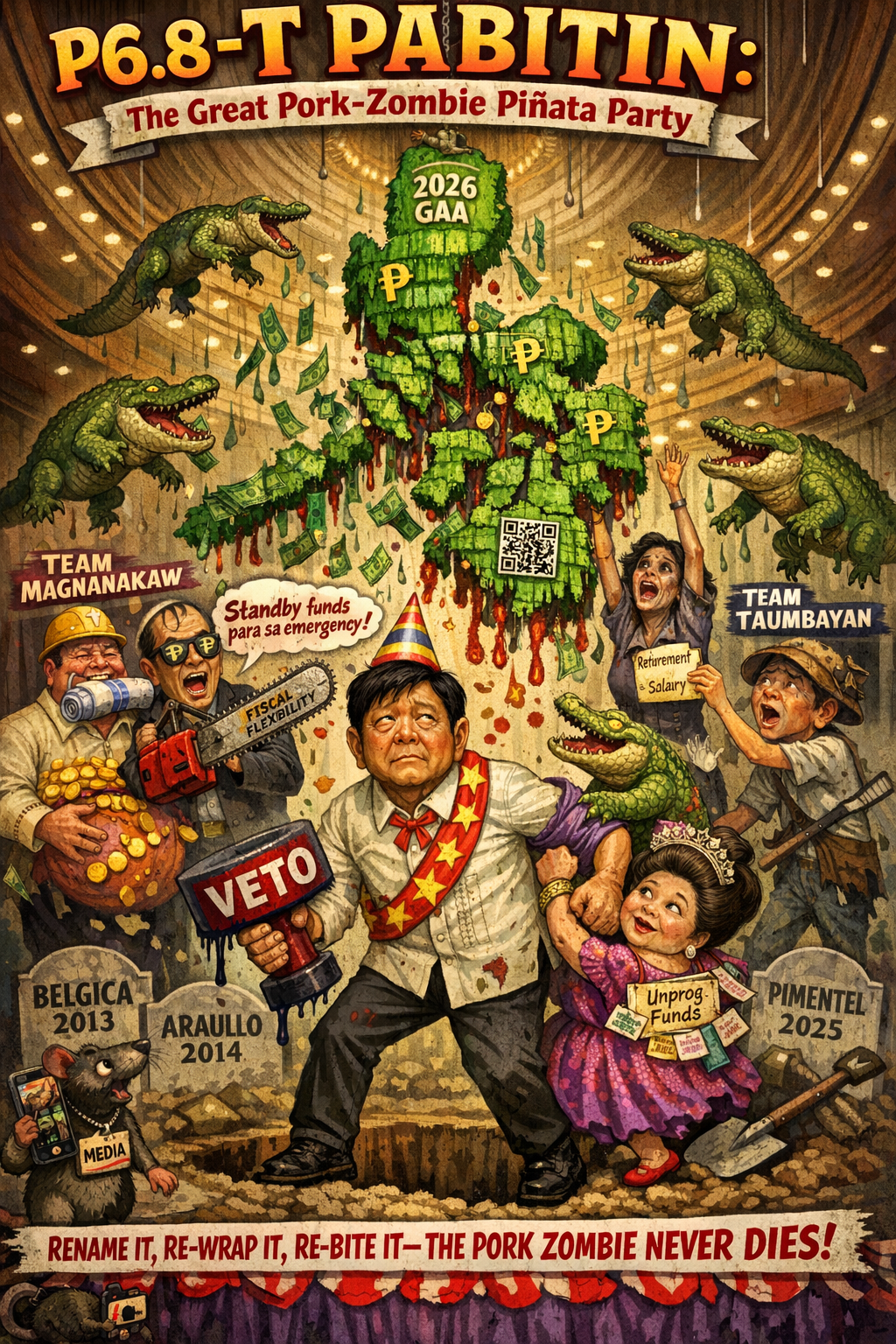
The Unprogrammed Zombie Rises Again: PDAF and DAP’s Bastard Child Refuses to Die
By Louis ‘Barok‘ C. Biraogo — January 5, 2026
MGA ka-kweba, grab a seat and pour yourself a drink—beer or coffee, depending on the hour you’re reading this—because it’s that time of year again: the annual national ritual known as the passage of the General Appropriations Act (GAA). Every year, like a mass celebrated by hypocrites, Congress and Malacañang gather to carve up the P6.793 trillion budget for 2026. But make no mistake—this isn’t about public service. This is the Season of the Pork, the season when the people’s money becomes a pabitin mercilessly bashed by politicians until it rains envelopes, contracts, and kickbacks.
And now, one man is threatening to be the fly that stings a very corrupt horse: House Senior Deputy Minority Leader Rep. Edgar Erice—a title so long it could double as a tape measure for the depth of corruption in the Lower House. He says that if President Ferdinand Marcos Jr. does not veto the unprogrammed appropriations (UA) in the budget, he will bring the matter to the Supreme Court (GMA News Online, 4 Jan. 2026). Bravo, Congressman! A gladiator in the arena of crocodiles. But wait—is he truly a gladiator, or just an extra in the opposition’s political drama?
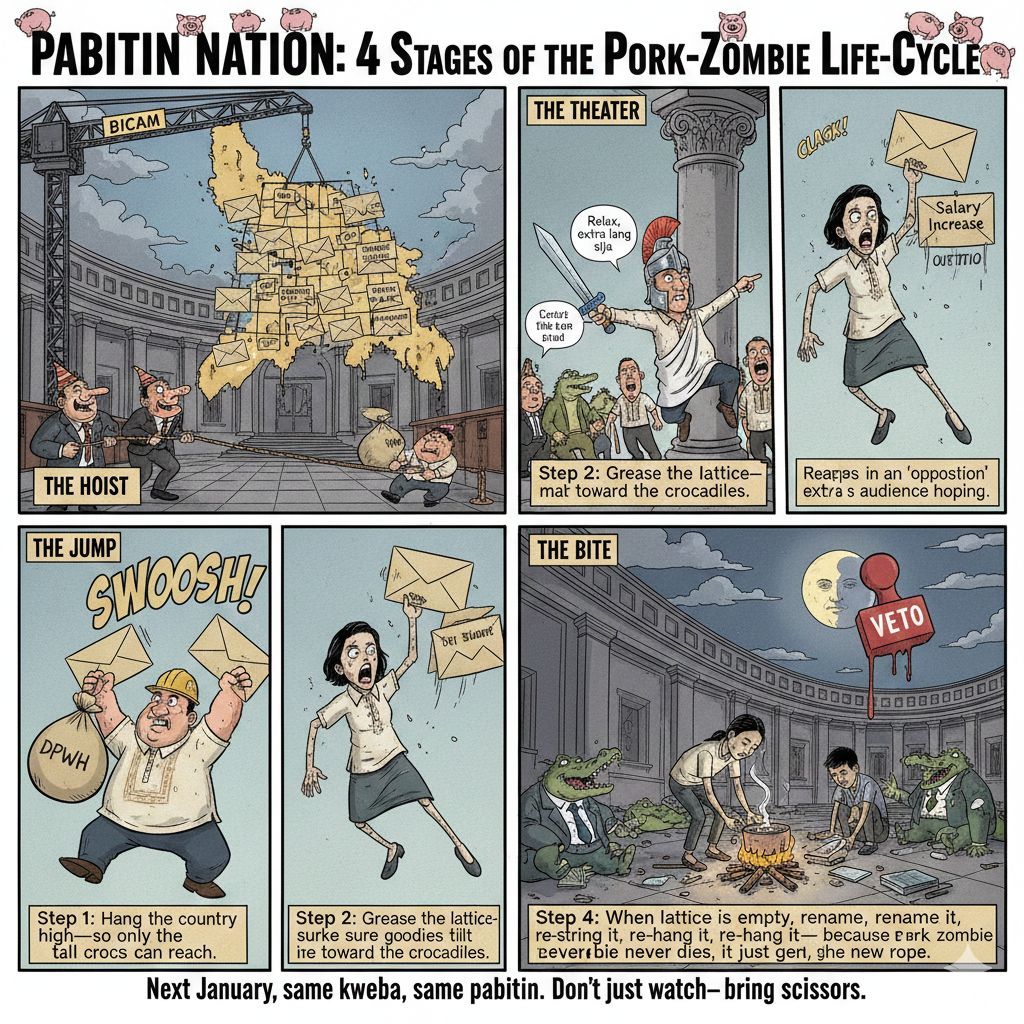
The “Unprogrammed” Lie: The Pork Zombie That Refuses to Die
Unprogrammed Appropriations. What a beautiful name, right? It’s like a serial killer’s euphemism for “it was an accident.” In reality, this is the latest moniker for institutionalized discretionary pork—the zombie formerly known as the Priority Development Assistance Fund (PDAF), then the Disbursement Acceleration Program (DAP), and now UA. How many times must we rename this monster before we finally drive a stake through its heart?
In the 2026 budget, there is P243 billion in UA—P243 billion in “standby” funds that can only be released if there is excess revenue, new loans, or special laws. Standby? It’s as if the government is saying: “We don’t know where the money will come from, but we’re damn sure going to spend it.” And the most infuriating part? They transferred P43 billion intended for teachers’ retirement benefits and salary increases into the unprogrammed fund. Mandatory benefits for teachers—the people educating our children under leaking roofs—have been made conditional. But infrastructure for favored contractors? Guaranteed. Flood control projects riddled with anomalies? Top priority. The Department of Public Works and Highways (DPWH) right-of-way scams? Always fully funded.
And don’t get me started on the historical feeding frenzy: from P100 billion in 2022, ballooning to P731 billion in 2024, and still P243 billion now even if it’s supposedly “reformed.” This isn’t an accounting trend. This is an orgy of graft.
The Legal Theater: No Actor Escapes Criticism
Erice? He’s constitutionally correct. He cites Associate Justice Ramon Paul Hernando, who declared UA “repugnant to the Constitution.” He’s also right that in 2025, in Aquilino Pimentel III v. Executive Secretary, the Supreme Court struck down P449.5 billion in UA from the 2024 budget. But Congressman, why are you only waking up now? You’re a minority leader, yes, but your timing smells like political posturing—a perfect soundbite for the next election cycle. Is this principle or performance?
The defenders of UA? Pure comedy. “Fiscal flexibility,” they say. I call it flexibility for corruption. “For emergencies,” they claim. If it’s for emergencies, why are teachers’ salaries being treated as one? And Senator Sherwin Gatchalian proudly boasts that they removed SAGIP—one slush fund—to preserve a much larger UA. Is this what passes for “reform”? It’s like removing one deck chair from the Titanic while ordering more with unprogrammed funds.
President Marcos Jr.? His legacy hangs in the balance. He has line-item veto power under Article VI, Section 27(2) of the 1987 Constitution. He could veto all UA and become a hero of fiscal sanity. Or he could sign everything and inherit the corrupt status quo. Are you a reformer, Mr. President, or merely the caretaker of the old system?
And Congress? The bicameral conference committee—the den of compromise where transparency goes to die. They inflated UA beyond even the Senate’s proposal. A direct violation of Article VI, Section 25(1), which prohibits Congress from increasing the President’s budget proposal. Yet they still do it in the dark.
Manifesto: This Is Not a Conclusion—This Is War
Here then are my demands, my fellow citizens:
- Immediate veto of all unconstitutional UA. This is the bare minimum the President must do to avoid being labeled an enabler.
- True Zero-Based Budgeting. Every peso must be justified from scratch—not based on last year’s graft-ridden baseline.
- Enact an Anti-Unprogrammed Appropriations Act. All spending must go into the programmed fund. Create a separate, limited, and fully auditable contingency fund for genuine national emergencies—not for emergency kickbacks.
- Honor the spirit of Belgica v. Ochoa (2013) that killed PDAF, Araullo v. Aquino (2014) that struck down DAP, and the fresh Pimentel ruling of 2025. UA are their illegitimate offspring—bastard children designed to evade the Court’s justice.
This is not just about accounting. This is about the oligarchic capture of the national treasury. This is the continued selling-out of the future of our teachers, our children, and the poor—for the contracts of a few powerful families. As long as UA exist, legalized looting continues. As long as there’s a pabitin, the crocodiles will feast.
And if Marcos signs it, Erice, take it to the Supreme Court. And if you lose there, take it to the streets. Because the people are tired of promises of “reform” while the stealing goes on.
Straight from Kweba,
- –Barok, not done yet—the pork is still sizzling, and I’ve got plenty of salt left.
Key Citations
Primary Legal Sources
- 1987 Constitution of the Republic of the Philippines. Official Gazette of the Republic of the Philippines, 1987.
- Republic Act No. 3019 (Anti-Graft and Corrupt Practices Act). Official Gazette of the Republic of the Philippines, 17 Aug. 1960.
- Republic Act No. 6713 (Code of Conduct and Ethical Standards for Public Officials and Employees). Official Gazette of the Republic of the Philippines, 20 Feb. 1989.
- Philippines, Supreme Court. Aquilino Pimentel III, et al. vs. House of Representatives, et al. G.R. Nos. 274778, 275405, and 276233, 3 Dec. 2025. Supreme Court of the Philippines.
- Hernando, Ramon Paul L. Separate Concurring and Dissenting Opinion. Aquilino Pimentel III, et al. v. House of Representatives, et al. G.R. Nos. 274778, 275405, and 276233, 3 Dec. 2025. Supreme Court of the Philippines.
- Belgica v. Ochoa, G.R. No. 208566, Supreme Court of the Philippines, 19 Nov. 2013, LawPhil Project.
- Araullo v. Aquino, G.R. No. 209287, Supreme Court of the Philippines, 1 July 2014, LawPhil Project.
Primary News Article

- “Forthwith” to Farce: How the Senate is Killing Impeachment—And Why Enrile’s Right (Even If You Can’t Trust Him)
- “HINDI AKO NAG-RESIGN!”

- “I’m calling you from my new Globe SIM. Send load!”

- “Mahiya Naman Kayo!” Marcos’ Anti-Corruption Vow Faces a Flood of Doubt

- “Meow, I’m calling you from my new Globe SIM!”

- “No Special Jail for Crooks!” Boying Remulla Slams VIP Perks for Flood Scammers

- “PLUNDER IS OVERRATED”? TRY AGAIN — IT’S A CALCULATED KILL SHOT

- “Several Lifetimes,” Said Fajardo — Translation: “I’m Not Spending Even One More Day on This Circus”

- “Shimenet”: The Term That Broke the Internet and the Budget
- “We Did Not Yield”: Marcos’s Stand and the Soul of Filipino Sovereignty

- “We Gather Light to Scatter”: A Tribute to Edgardo Bautista Espiritu

- $150M for Kaufman to Spin a Sinking Narrative


 KWEBA ni BAROK
Leave a comment